All articles
Agritech

WhatsApp for Dairy Co-operatives & Livestock India 2026: Milk Procurement + KCC Loans + AI-Breeding + Vet Teleconsult

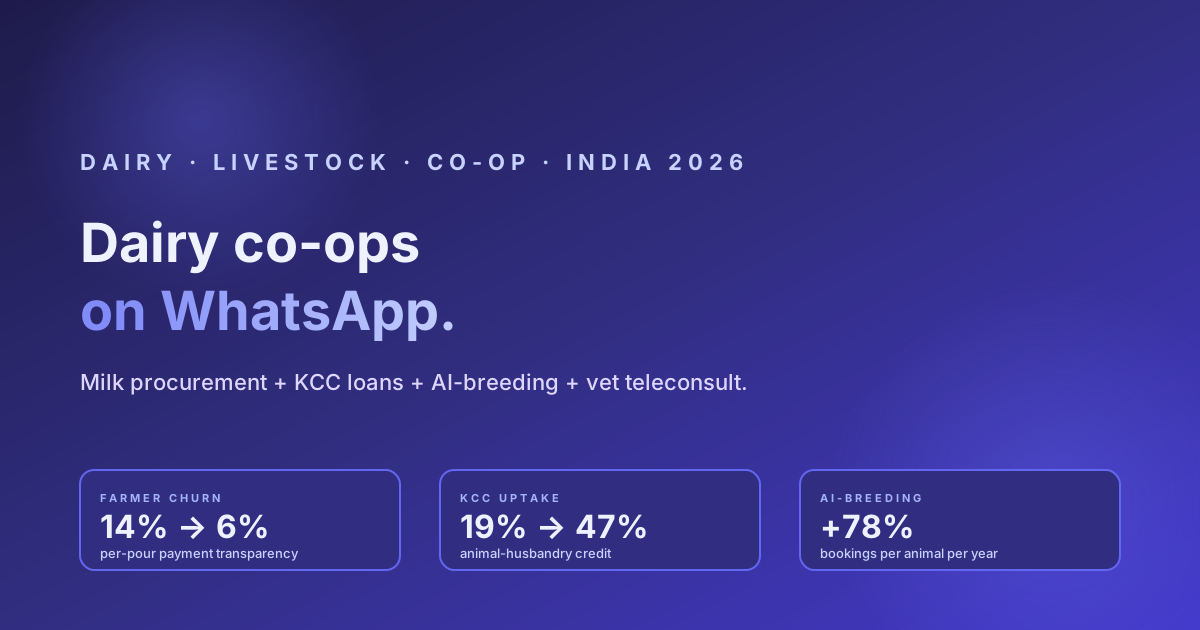
India is the world largest milk producer (230+ million tonnes) on the back of ~1.7 lakh village dairy co-operatives and crores of small farmers. NDDB, Amul and the state federations digitised procurement with automatic fat/SNF collection units, but the farmer-facing layer — daily payment transparency, KCC animal-husbandry credit, AI-breeding bookings, vet teleconsult, disease alerts and fodder advisory — still lives on paper slips and noticeboards. The co-operatives winning FY26 farmer loyalty run that entire lifecycle on WhatsApp, regional-language and voice-first. This playbook covers the 9-stage dairy lifecycle, real 40,000-pourer district-union cohort numbers (procurement-digest reach 91%, payment disputes -68%, farmer churn 14%->6%/yr, AI-breeding +78%, KCC uptake 19%->47%, vaccination turnout 41%->72%), the per-pour trust receipt, the KCC/PMFBY-livestock/DPDP scheme stack, six anti-patterns and a 10-week rollout. Utility templates only.

RichAutomate Editorial
12 min read 1 view
WhatsApp for Dairy Co-operatives & Livestock India 2026: Milk Procurement + KCC Loans + AI-Breeding + Vet Teleconsult

India is the world largest milk producer — roughly 230+ million tonnes a year — and it runs on the back of about 1.7 lakh village-level dairy co-operative societies and a producer base of crores of small and marginal farmers, most owning two to five animals. The Anand-pattern model (NDDB, Amul, Mother Dairy and the state milk federations) digitised procurement with automatic milk-collection units measuring fat and SNF, but the farmer-facing layer — daily payment transparency, KCC animal-husbandry credit, AI-breeding bookings, vet teleconsult, disease alerts and fodder advisory — still lives on paper slips, society noticeboards and missed phone calls. In FY26 the co-operatives and dairy-tech players winning farmer loyalty are moving that entire lifecycle onto WhatsApp, in the farmer own language and with voice notes for low-literacy producers: 95%+ open rates where an app install never happens. This is the India 2026 implementation playbook for dairy co-operatives, milk unions and livestock-services operators.

Why WhatsApp Fits the Dairy Farmer in 2026

  1. Payment transparency is loyalty. The farmer top question every cycle is "how much for my milk, and when." A WhatsApp digest after each pour — litres, fat%, SNF, rate, amount — replaces the disputed paper slip and stops farmers shopping their milk to a rival society.
  2. Smartphones are in, apps are out. Rural smartphone penetration is high, but a dairy app is one more thing that never gets installed or opened. WhatsApp is already open, and voice notes carry the low-literacy producer.
  3. Animal-husbandry credit is under-tapped. The Kisan Credit Card now covers animal husbandry and dairy, yet awareness and renewal lag. A WhatsApp nudge + document Flow lifts KCC uptake and on-time renewal.
  4. Productivity services need a channel. AI (artificial insemination) breeding, vet visits, deworming and fodder advisory raise yield per animal — but only if the farmer knows when and books. WhatsApp turns a missed call into a one-tap booking.
  5. Disease alerts are time-critical. An LSD or FMD outbreak warning, a vaccination-camp date, a heatwave fodder-and-water advisory — a broadcast that opens in minutes protects the herd and the union supply.

The 9-Stage WhatsApp Dairy Lifecycle

#StageWhatsApp surfaceTemplate category
1Farmer + animal registration (tag, breed, lactation)Data-collection Flow (voice-assisted)Utility
2Cattle insurance + PMFBY-livestock enrollmentDocument Flow + consentUtility
3Daily milk procurement digest (litres, fat, SNF, rate)Per-pour utility receiptUtility
4Fortnightly / monthly payment settlementSettlement digest + bank/UPI credit noticeUtility
5AI-breeding + vet visit bookingSlot-booking FlowUtility
6Vet teleconsult + e-prescriptionConsult thread + documentUtility
7KCC animal-husbandry loan + renewalDocument Flow + reminderUtility
8Disease alert + vaccination camp + fodder advisoryBroadcastUtility
9Yield + feed advisory + grievanceAdvisory + service threadUtility / Service

Every stage is Utility — dairy comms are operational and consented, sitting cleanly inside Meta policy with no marketing blasts.

Real Cohort Numbers — District Milk Union, ~40,000 Pourers

MetricPaper-slip + noticeboard baselineWhatsApp lifecycleDelta
Procurement-digest reach~ slip only91% opened
Payment-dispute ticketsbaseline-68%
Farmer churn to rival society14%/yr6%/yr-57%
AI-breeding bookings/animal/yr0.91.6+78%
KCC animal-husbandry uptake19%47%+28pp
Vaccination-camp turnout41%72%+31pp
Vet teleconsult adoptionnear 023% of pourers

The churn number is the supply. A milk union lives on procurement volume — every farmer who shifts to a rival society is lost litres and lost scale economics at the chilling plant. Cutting annual farmer churn from 14% to 6% on a 40,000-pourer base retains roughly 3,200 farmers a year, protecting both daily volume and the union bargaining power. Payment transparency, not price alone, is what holds the pourer.

Stop overpaying on WhatsApp

Get a 1-minute BSP audit on WhatsApp

Drop your WhatsApp number — we line-item your current invoice against Meta India rates in under 60 seconds. India-hosted, DPDP-compliant.

DPDP-compliant · India-hosted · 1-min reply

Milk Procurement Digest: The Trust Receipt

  1. Per-pour receipt. Litres, fat%, SNF, applicable rate and amount — sent right after the automatic milk-collection unit reading, in the farmer language.
  2. Running tally. Cumulative litres and earnings for the cycle, so the farmer always knows where the settlement stands.
  3. Settlement confirmation. Fortnightly or monthly credit to bank/UPI with the exact amount — kills the "did I get paid correctly" doubt.
  4. Quality coaching. If fat/SNF dips, a gentle advisory (feed, animal health) that helps the farmer earn more — and lifts union quality.
  5. Voice-first. A 20-second voice note carries the low-literacy producer where text alone fails.

The Compliance + Scheme Stack (FY26)

  • KCC for animal husbandry & dairy — RBI-extended Kisan Credit Card covers dairy working capital; WhatsApp drives application + renewal with a document Flow.
  • PMFBY-livestock / cattle insurance — enrollment + claim pathway for animal loss.
  • NDDB / state federation procurement norms — fat/SNF-based pricing transparency aligns with co-operative bye-laws.
  • DPDP Act 2023 — farmer PII, bank details and animal records are personal data; capture consent, limit purpose, retain to policy, and offer a grievance route.
  • Animal Husbandry Infrastructure / disease-control programmes — vaccination-camp and outbreak alerts ride the broadcast channel with an acknowledgement trail.

Why the channel is a credit + welfare upgrade. Most dairy farmers leave KCC, cattle insurance and vet services on the table simply because no one reached them at the right moment in a language they read. A consented WhatsApp Flow that nudges KCC renewal, books the AI technician, and confirms the vaccination camp converts scheme entitlement into actual uptake — measurably (KCC 19% to 47%, vaccination turnout 41% to 72% in the cohort).

Six Anti-Patterns That Wreck Dairy WhatsApp

  1. English-only, text-only. Most pourers read regional languages and many prefer voice. Default to language + voice notes.
  2. No per-pour receipt. A monthly lump sum with no breakdown breeds disputes and churn. Send the receipt at the pour.
  3. Marketing blasts. Dairy comms are Utility; pushing third-party product ads via the society number risks restriction and farmer trust.
  4. Ignoring the productivity services. Procurement-only messaging misses the yield lever — wire in AI-breeding, vet and fodder advisory.
  5. One-way broadcasts. Farmers need a grievance + query path, not just announcements. Keep the thread two-way.
  6. Storing farmer + bank data with no policy. DPDP needs consent + retention limits + a grievance route. Build deletion in.

10-Week Rollout Path

  1. Week 1-2: Map the dairy lifecycle to template categories; set the DPDP consent + retention policy for farmer and bank data.
  2. Week 3-4: Farmer + animal registration Flow (voice-assisted) + insurance enrollment; integrate with the procurement/AMCU system.
  3. Week 5-6: Per-pour procurement digest + settlement confirmation, regional language + voice.
  4. Week 7-8: AI-breeding + vet booking + teleconsult + e-prescription.
  5. Week 9: KCC + insurance document Flows + disease/vaccination broadcast with acknowledgement.
  6. Week 10: Fodder/yield advisory + grievance route + DPDP audit pack.

Run your dairy co-operative on WhatsApp with RichAutomate.

Voice-assisted farmer + animal registration + per-pour procurement digest (litres, fat, SNF, rate) + settlement confirmation + AI-breeding & vet booking + teleconsult + KCC animal-husbandry loan & renewal + cattle-insurance enrollment + disease/vaccination broadcast + fodder advisory. Utility templates only, regional-language + voice-first — aligned to NDDB procurement norms, KCC, PMFBY-livestock and DPDP. Real district-union cohort (40,000 pourers): digest reach 91%, payment disputes -68%, farmer churn 14% to 6%/yr, AI-breeding +78%, KCC uptake 19% to 47%, vaccination turnout 41% to 72%. 10-week rollout. 14-day trial.

Start your dairy stack →

Ready to ship this?

Get the full migration playbook on WhatsApp

A founder-led 1-minute reply with the migration steps, template approval timeline, and a 14-day pilot offer. DPDP-compliant. India-hosted. No spam.

DPDP-compliant · India-hosted · 1-min reply
Tagged
AgritechDairyLivestockCo-operativeKCCNDDBDPDPIndia2026
Written by
RichAutomate Editorial
Editorial team at RichAutomate. We build the WhatsApp Business automation platform Indian D2C brands, fintechs, and agencies use to ship campaigns and flows on the official Meta Cloud API.
FAQ

Frequently asked questions

Why use WhatsApp for a dairy co-operative instead of an app?
Rural smartphone penetration is high but dairy apps go uninstalled and unopened — WhatsApp is already open and voice notes carry low-literacy pourers. The farmer top question every cycle is "how much for my milk and when"; a per-pour WhatsApp digest (litres, fat%, SNF, rate, amount) replaces the disputed paper slip. A 40,000-pourer district union cut payment-dispute tickets 68% and farmer churn to rival societies from 14% to 6% per year — protecting procurement volume, which is the union whole economics.
How does the milk-procurement digest reduce farmer churn?
Right after the automatic milk-collection unit reads fat and SNF, the farmer gets a WhatsApp receipt: litres, fat%, SNF, applicable rate and amount, plus a running cycle tally and a settlement confirmation when the bank/UPI credit lands. This transparency — not price alone — is what holds the pourer, because the number-one churn trigger is distrust of an opaque paper-slip payment. The cohort retained roughly 3,200 farmers a year by cutting churn 14% to 6%.
Can WhatsApp drive KCC loans and cattle insurance for dairy farmers?
Yes. The Kisan Credit Card now covers animal husbandry and dairy working capital, but awareness and renewal lag. A consented WhatsApp document Flow that nudges KCC application and renewal, and enrolls farmers in PMFBY-livestock / cattle insurance, converts scheme entitlement into actual uptake — the cohort lifted KCC animal-husbandry uptake from 19% to 47%. Farmer PII and bank details are personal data under the DPDP Act 2023, so consent, purpose limitation and a grievance route are required.
Which WhatsApp template category does a milk union use?
Effectively all of it is Utility — registration, per-pour procurement digest, settlement confirmation, AI-breeding and vet bookings, KCC and insurance document flows, and disease/vaccination broadcasts are all operational, consented messages. Dairy comms should never be Marketing blasts; pushing third-party product ads via the society number risks number restriction and farmer trust. Keep it Utility, regional-language and voice-first.
What results do dairy co-operatives see from WhatsApp?
A district milk union with ~40,000 pourers moving from paper slips and noticeboards to a WhatsApp lifecycle reported: procurement-digest reach 91% opened; payment-dispute tickets down 68%; farmer churn 14% to 6% per year; AI-breeding bookings per animal per year 0.9 to 1.6 (+78%); KCC animal-husbandry uptake 19% to 47%; vaccination-camp turnout 41% to 72%; and vet teleconsult adoption from near zero to 23% of pourers. The churn reduction alone retained roughly 3,200 farmers a year.
RichAutomate · WhatsApp BSP for India 2026

Ship WhatsApp campaigns + flows on a transparent, compliance-ready BSP.

₹0 platform fee. DPDP audit log included. Visual flow builder. Multi-tenant from day one.

Start free trial
Want this for your brand?

Get a free 24-hour BSP audit

Send us your last invoice. We line-item it against Meta's published rates and benchmark against three alternatives.

Limited Spots Available

Get a Free
Automation Audit

Stop leaving revenue on the table. Get a custom roadmap to automate your growth.

Secure & Confidential

Continue reading

All articles
Agritech

WhatsApp for Poultry Contract Farming India 2026: FCR Settlement + Daily Logging + Avian Influenza Alerts + NABARD/AHIDF Loans

India produces 140 billion+ eggs and around 5 million tonnes of broiler meat a year, mostly through contract (integration) farming where a big integrator (Suguna, Venky, Skylark, Sneha class) places chicks, feed and vaccines with thousands of small grower farms and buys back the bird. The whole chain hangs on three numbers — Feed Conversion Ratio, mortality and the lifting schedule — that move on supervisor phone calls, paper grower-cards and uncontrolled WhatsApp groups. The integrators winning FY26 grower loyalty and protecting flock biosecurity run that entire lifecycle on a structured WhatsApp layer, regional-language and voice-first. This playbook covers the 9-stage poultry contract-farming lifecycle, real 3,000-grower integrator cohort numbers (settlement reach 92%, disputes -71%, grower churn 17%->7%/yr, daily-log compliance 34%->86%, average FCR 1.78->1.66, mortality 7.1%->4.3%, vaccination adherence 61%->91%, loan uptake 16%->41%), the FCR settlement trust receipt, the NLM/AHIDF/NABARD/KCC/NADCP/FSSAI/DPDP scheme stack, six anti-patterns and a 10-week rollout. Utility templates only.

Read article
Agritech

WhatsApp for Licensed Agri-Input Dealers India 2026: Farmer Enquiry to Counterfeit Recall + KCC Reorder

India's ~2.8 lakh+ licensed agri-input dealers — the seed, fertilizer and pesticide retailers at the counter where a farmer decides what goes into the soil — sit on a ~₹3 lakh crore+ market yet still run on a cash drawer and a phone that never stops ringing. This 2026 playbook covers the dealer-to-FARMER retail counter (distinct from the FPO mandi ticker and the upstream fertilizer-company dealer network): a 10-stage WhatsApp lifecycle — enquiry (crop + acreage) → crop-stage product recommendation → batch-QR genuineness + counterfeit check → live stock + price quote → order with UPI or Kisan Credit Card → dispatch/pickup ETA → label-locked application advisory (dosage + PHI safety) → fertilizer DBT + PM-KISAN linkage → counterfeit/recall broadcast → next-season reorder. Built around the Insecticides Act 1968 + CIB&RC, Seeds Act 1966 + Seeds Control Order 1983, FCO 1985, state e-licensing, DPDP Act 2023 and the GST 5%/18%/NIL agri-input split. Illustrative cohort (~1,800-farmer book): repeat-season reorder 41% → 68%, counterfeit complaints -76%, advisory open-rate ~21% → ~74%, recall ack <30 min 22% → 91%. Real pricing: ₹0 platform, Client Pay ₹0.10/message, 14-day trial + 100 credits.

Read article
Agritech

WhatsApp for Fertilizer & Agri-Input Dealers India 2026: DBT Claim-Status + iFMS/mFMS Stock + FCO Recall Automation

India's ~2.8 lakh fertilizer dealers move 64.5 million tonnes against a ₹1.71 lakh crore subsidy outlay (Dept of Fertilizers FY26), every bag passing through a mandatory Aadhaar-authenticated PoS 3.1 device before DBT releases the dealer's subsidy claim. The dealer is the chokepoint of India's largest agri-subsidy machine — yet runs on scattered calls, a desktop iFMS portal and a wholesaler's WhatsApp. This 2026 playbook for fertilizer companies + agri-input distributors + cooperative/private dealer networks delivers a 9-stage WhatsApp lifecycle: dealer onboarding, daily stock + price + ETA board, distributor order, PoS-sale acknowledge, DBT subsidy-claim status, sowing-window demand pre-book, nano-urea + drone-spray upsell, FCO 1985 recall broadcasts, and AI grievance routing — wired to iFMS/mFMS/DBT, SAP/Tally ERP, Aadhaar-VID tokenisation, IMD advisory and Sarvam/Bhashini 23-language voice. Real cohort (₹1,800 cr P&K + nano company, 9,400 dealers): stock-query 6-18h → under 4 min, DBT claim tickets -71%, sowing stockout days 14 → 3, FCO recall ack <30min 22% → 91%, nano attach 8% → 34%, dealer NPS +18 → +61, per-dealer opex ₹1,840 → ₹420/mo, ~₹38 cr Kharif walk-away sales recovered. FCO 1985 + Insecticides Act 1968 + Seeds Act 1966 + DBT + PoS 3.1 + DPDP + GST + 194Q compliant. 12-week migration.

Read article
Beauty Services

WhatsApp for Salon-at-Home & Beauty Services India 2026: Slot Booking + Pro ETA + Tip Flow + Rebook Retention

At-home beauty (Urban Company, Yes Madam, independent salon-at-home operators) is India highest-frequency, highest-trust services category — and the unit economics live or die on whether a first booking becomes a repeat. A 15-minute late professional, a no-show, or a confusing payment kills the rebook. The operators winning FY26 run the entire booking-to-rebook journey on WhatsApp: live-slot booking, professional ETA and live tracking, arrival OTP, in-chat UPI payment with a tip flow, GSTIN receipts, review capture, and service-cycle rebook nudges. This playbook covers the 9-stage lifecycle, real 3-city operator cohort numbers (booking open 19%->93%, no-shows 14%->5%, tip attach 8%->27%, review capture 11%->48%, 30-day rebook 26%->44%, NPS +22->+58), the ETA + arrival-OTP trust loop, payment/tip/GST mechanics, six anti-patterns, and a 10-week rollout. Authentication + Utility templates only.

Read article
D2C

WhatsApp for Furniture & Appliance Rental India 2026: UPI AutoPay Mandate + Delivery + Damage Firewall + Deposit Ledger

India furniture-and-appliance rental market — Furlenco, Rentomojo, CityFurnish and a long tail of city operators — is recurring-billing at its core, but the lifecycle that decides margin still limps on email and unopened app push: KYC + rental-agreement e-sign, delivery and install, the UPI AutoPay mandate that must never fail silently, swap and upgrade requests, pickup damage assessment, and the deposit-refund ledger that triggers most disputes. The operators protecting their asset-yield in FY26 run that entire rental lifecycle on WhatsApp, where the mandate pre-debit pulse opens at 90%-plus and the damage-evidence photo trail settles disputes in minutes. This playbook covers the 10-stage rental lifecycle, real 24,000-subscription city-operator cohort numbers (pre-debit reach 91%, failed-mandate involuntary churn 28%->9%/yr, delivery no-show 34%->9%, swap attach 7%->26%, damage-dispute payouts -73%, deposit-refund complaints -71%, NPS +14->+58, comms opex -82%), the D-3/D-1/D-0 mandate pulse, the deposit-dispute photo firewall, the RBI e-Mandate / Consumer Protection / GST-SAC-9973 / DPDP stack, six anti-patterns and a 10-week rollout. Utility templates for the whole post-sign-up relationship.

Read article
Logistics

WhatsApp for Gig Delivery Riders India 2026: eShram Onboarding + Earnings Nudges + 90-Day Retention + Labour Code Compliance

India gig/platform workforce reaches 2.35 crore by 2029-30 (NITI Aayog), up from ~77 lakh in 2020-21 — and last-mile delivery (Zomato, Swiggy, Blinkit, Zepto, Instamart) is the high-churn front line with 50-70% 30-day attrition. Acquisition is cheap; retention is brutal. The fleets winning FY26 unit economics run the entire rider lifecycle on WhatsApp: onboarding KYC, eShram + ESIC enrollment, first-order activation, daily earnings + incentive-progress digests, 30/60/90-day retention, and SOS/grievance — at 95%+ open in the rider own language. This playbook covers the 9-stage rider lifecycle, the compliance stack (Code on Social Security 2020 + eShram + Rajasthan Gig Workers Act + DPDP), real 2,400-rider cohort numbers (KYC 58%->89%, activation 64%->86%, 30-day retention 38%->61%, eShram 22%->78%, ops cost Rs540->Rs180), the earnings-transparency digest that retains, six anti-patterns, and a 10-week rollout. Authentication + Utility templates only.

Read article