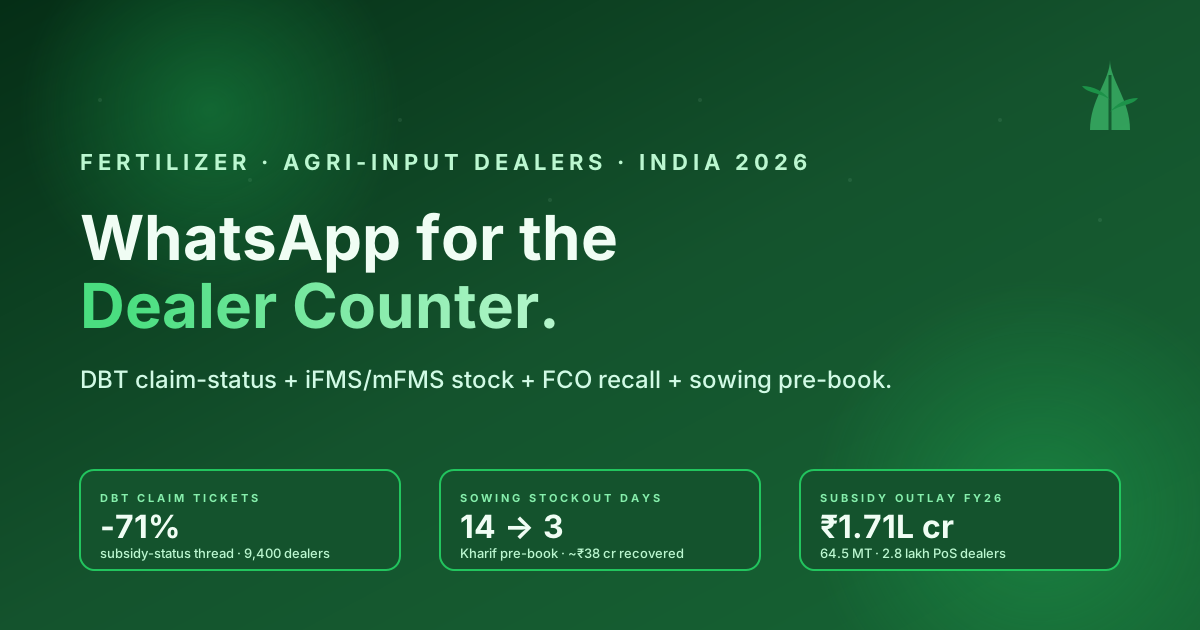
India runs the world's largest fertilizer-subsidy machine through a counter-level network of roughly 2.8 lakh retail dealers who collectively sold 64.5 million tonnes of fertilizer in FY26 against a Union Budget subsidy outlay of ₹1.71 lakh crore (Department of Fertilizers, Ministry of Chemicals & Fertilizers + PPAC). Every single bag — every 45kg of urea, every DAP, NPK, MOP or nano-urea unit — must pass through a mandatory PoS 3.1 device and authenticate the buying farmer's Aadhaar before the dealer's subsidy claim is released under DBT (Direct Benefit Transfer for Fertilizers). The dealer is the chokepoint of the entire ₹1.71 lakh crore flow, yet the dealer's own communication stack is a mess: a wholesaler's WhatsApp number for stock, a fertilizer-company field officer on calls, the iFMS/mFMS portal on a desktop, IMD weather on a separate app, and the farmer standing at the counter mid-sowing-window asking "DAP available kab hoga?" This guide is the 2026 implementation playbook for fertilizer companies, agri-input distributors (seed + pesticide + micronutrient + bio-stimulant) and the cooperative + private retail dealer networks beneath them: a 9-stage WhatsApp lifecycle covering dealer onboarding, daily stock + price + POS-availability push, sowing-window demand forecasting, DBT subsidy-claim status, nano-urea + drone-spray upsell, FCO 1985 compliance broadcasts, and grievance routing — wired to mFMS, iFMS, DBT, VAHAN-free Aadhaar-VID flows, and Bhashini-powered 23-language voice for a dealer cohort that is 41% more comfortable in regional language than English. Real cohort numbers below: stock-query resolution 6-18h → under 4 min, DBT claim-status tickets -71%, sowing-window stockout days 14 → 3, dealer NPS +18 → +61, per-dealer support opex ₹1,840 → ₹420/month.
Why WhatsApp for Fertilizer & Agri-Input Dealers Matters in India Now
Six structural shifts pushed dealer-comms from phone calls to WhatsApp automation in 2026:
- DBT + PoS 3.1 made the dealer the bottleneck. Since the Department of Fertilizers moved 100% of subsidy to sale-based DBT (subsidy released only after Aadhaar-authenticated PoS sale), the dealer's reconciliation, claim-status anxiety and stock-availability questions exploded. Companies that resolve these instantly retain dealers; those that don't lose counter share.
- Sowing windows are unforgiving. Kharif (Jun-Jul) + Rabi (Oct-Nov) demand spikes 3.4-6.2× over baseline within a 10-14 day window. A 2-day DAP stockout during peak sowing means the farmer walks to the next counter and may not come back. Real-time stock + ETA push is the difference.
- Nano-urea + nano-DAP + drone-spray are new SKUs needing dealer education. IFFCO Nano Urea (Liquid) and Nano DAP plus the NaMo Drone Didi spray ecosystem need active dealer pushing — a dealer who doesn't understand dilution ratios won't sell. WhatsApp voice notes + short video close that gap.
- FCO 1985 + quality compliance is broadcast-heavy. The Fertilizer (Control) Order 1985, FCO licensing, batch-recall notices, and CCQC (Central Fertilizer Quality Control) sample-fail alerts must reach every dealer fast. A non-compliant batch sold after recall is a licence-cancellation event.
- Regional language is non-negotiable. The dealer at a Vidarbha or Telangana or Bundelkhand counter operates in Marathi / Telugu / Bundeli, not English. Bhashini + Sarvam-1 + AI4Bharat IndicTrans2 voice-first flows lift dealer engagement +41%.
- The competitive set is consolidating. IFFCO, Coromandel, Chambal (UPL adjacency), Nagarjuna, Zuari, Yara India, Paradeep, RCF and Kribhco are all racing to digitise the dealer relationship. The company with the best dealer-WhatsApp experience controls counter loyalty in a low-differentiation commodity.
The Indian Fertilizer & Agri-Input Market — FY26 Sizing
| Segment | FY26 volume / value | Dealer-network note |
|---|---|---|
| Total fertilizer consumption | 64.5 million tonnes | Urea ~35 MT + DAP ~11 MT + NPK ~12 MT + MOP ~3 MT + nano ~6 cr bottles |
| Union fertilizer subsidy outlay | ₹1.71 lakh crore | Urea subsidy ~₹1.19 L cr + P&K (NBS) ~₹0.52 L cr |
| Retail fertilizer dealers (PoS-active) | ~2.8 lakh | ~67% private + ~33% cooperative (PACS / state coops) |
| Crop-protection / pesticide market | ₹52,000 crore | ~80,000+ pesticide retail licences |
| Seed market (organised + branded) | ₹38,000 crore | Hybrid maize / cotton / paddy / veg dominate |
| Nano-fertilizer (IFFCO + adjacents) | ~6 crore bottles | Nano Urea + Nano DAP scaling; needs dealer education |
| NaMo Drone Didi (spray service) | 14,500 SHG drones funded | ₹1,261 cr scheme; dealer becomes booking touchpoint |
Why the dealer counter is the highest-leverage node. The fertilizer company spends crores on plant, logistics and the DBT machine, but the entire ₹1.71 lakh crore flow narrows to a human standing at a counter with a PoS device and a smartphone. That dealer decides which company's bag gets pushed when two are in stock, whether the farmer leaves satisfied or walks next door, and whether a recall notice is acted on in 2 hours or 2 days. Owning the dealer's WhatsApp thread is owning the last mile of India's largest agri-subsidy programme.
The WhatsApp compliance self-audit is a quick way to find which of these you are actually missing.
The Regulator + Scheme Landscape Every Dealer Thread Must Respect
- Department of Fertilizers (DoF), Ministry of Chemicals & Fertilizers — subsidy policy, NBS (Nutrient Based Subsidy) rates, urea pricing.
- DBT for Fertilizers + iFMS (integrated Fertilizer Management System) + mFMS (mobile FMS) — sale capture, PoS device data, dealer acknowledgement, subsidy claim, dispatch + receipt reconciliation.
- PoS 3.1 device mandate — Aadhaar-authenticated sale at counter; subsidy released only on authenticated sale; soil-health-card + crop-acreage fields captured.
- Fertilizer (Control) Order 1985 (FCO) — licensing (Form O), prescribed specifications, prohibition on adulteration, mandatory display of stock + price board, sample-failure recall.
- Insecticides Act 1968 + Insecticide Rules 1971 — pesticide retail licensing (Form VI), record-keeping, restricted-use molecules, CIB&RC registration.
- Seeds Act 1966 + Seeds (Control) Order 1983 — seed dealer licence, truthful labelling, germination + purity standards.
- CCQC + state Fertilizer Quality Control Labs — sampling, NSC/SSC sample results, recall mandate.
- PM-KISAN + Soil Health Card + Kisan Credit Card (KCC) — farmer-side benefit context the dealer is asked about daily.
- DPDP Act 2023 — farmer Aadhaar-VID + landholding + crop data is personal data; Sec 6 consent + Sec 8 reasonable security; never store raw Aadhaar; tokenise the VID.
- GST + e-invoice (≥ ₹5 cr) + 194Q TDS — distributor-to-dealer billing; fertilizer GST 5%, pesticides 18%, seeds NIL/5%.
The 9-Stage WhatsApp Dealer Lifecycle
| Stage | Trigger | WhatsApp action | Backend / integration |
|---|---|---|---|
| 1. Dealer onboarding | New FCO/Insecticides/Seeds licence linked | Welcome + e-KYC capture + FCO licence-no verify + bank/UPI for claim payout | iFMS dealer master + Aadhaar-VID + GSTIN API |
| 2. Daily stock + price board | 06:30 IST cron + dispatch event | Per-SKU stock + MRP + NBS-set retail price + nearest-depot ETA | Distributor ERP / SAP / Tally stock feed + mFMS dispatch |
| 3. Order to distributor | Dealer initiates (text/voice/catalog) | Catalog order + credit-limit check + e-invoice + 194Q + UPI Mandate | Razorpay/Cashfree + GST IRP + ERP order |
| 4. POS-sale + DBT acknowledge | PoS 3.1 Aadhaar-authenticated sale | Auto-confirm sale captured + subsidy-claim queued status | iFMS/mFMS sale-capture webhook |
| 5. DBT subsidy-claim status | Claim state change | Plain-language status: queued → approved → credited (D+x) + amount | DBT reconciliation feed + bank credit confirm |
| 6. Sowing-window demand push | IMD + agro-advisory + cohort acreage | "Kharif DAP demand high in your taluka — pre-book now" + ETA | IMD API + crop-calendar + acreage cohort model |
| 7. SKU education + upsell | New SKU / margin push | Nano-urea dilution voice note + drone-spray booking + bio-stimulant | Sarvam/Bhashini voice + NaMo Drone Didi booking bridge |
| 8. FCO compliance + recall | CCQC sample-fail / FCO notice | Urgent broadcast: batch recall + stop-sale + display-board reminder | FCO notice ingest + batch-traceability map |
| 9. Grievance + field-officer handoff | Dealer query AI can't resolve | AI Pathway classify → route to territory field officer with context | Haiku/Gemini Flash classifier + CRM territory map |
Real cohort number. A P&K + nano-fertilizer company (₹1,800 cr regional turnover, ~9,400 dealers across Maharashtra + MP + Karnataka) wired stages 2 + 4 + 5 + 6 first. Daily stock-board push collapsed inbound "stock hai kya?" calls to the field office by 71%; PoS-sale auto-acknowledge + DBT claim-status push cut subsidy-anxiety tickets by 71% and stopped dealers from hoarding (because they could now see claim credits land in D+6 reliably); sowing-window pre-book push during Kharif 2026 cut stockout days at the dealer counter from 14 to 3 across the cohort, recovering an estimated ₹38 cr of walk-away sales that previously went to competing counters.
Get the India 2026 WhatsApp BSP price comparison
Wati vs AiSensy vs Interakt vs RichAutomate: Meta rates, platform fees and hidden costs, side by side. We send it to your WhatsApp in a minute.
DBT Subsidy-Claim Status — The Killer Use-Case
The single highest-value automation is stage 5. Under sale-based DBT, the dealer fronts the cash (buys stock at near-full price, sells at subsidised MRP, then waits for the subsidy difference to be credited). Anxiety about when that credit lands drives the most field-office calls and the most dealer churn. A clear WhatsApp thread changes the relationship:
| Claim event | Old experience | WhatsApp thread |
|---|---|---|
| Sale captured at PoS | Dealer unsure if it registered | Instant "Sale of 40 bags DAP captured · claim ₹X queued" |
| Claim under verification | Calls field officer repeatedly | "Claim under iFMS verification · ETA D+3" |
| Claim approved | No visibility | "₹X,XX,XXX approved · credit expected D+6" |
| Amount credited | Checks bank manually | "₹X,XX,XXX credited to a/c ****1234 today" |
| Mismatch / hold | Weeks of back-and-forth | "Claim on hold: PoS-to-receipt mismatch on batch B-2207 · 1-tap to field officer" |
Sowing-Window Demand Forecasting + Pre-Book
Fertilizer demand is brutally seasonal and geographically lumpy. Stage 6 fuses three signals — IMD district rainfall + crop-calendar (Kharif sowing starts with monsoon onset, Rabi after harvest) + per-taluka acreage cohort — to push pre-book nudges 7-10 days before the spike so the distributor can pre-position stock and the dealer doesn't run dry. The economics: every avoided stockout day during peak sowing is a counter-loyalty event, and a pre-booked bag is a guaranteed sale at full margin versus a panic-procured bag at thin margin.
Six Anti-Patterns That Wreck Dealer WhatsApp Programmes
- English-only broadcasts. 41% of dealers disengage. Use Bhashini + Sarvam voice + IndicTrans2 text in the dealer's state language. A Marathi voice note about nano-urea dilution outperforms an English PDF 4×.
- Spamming marketing into the utility thread. The DBT claim-status thread is sacred. Pollute it with promo broadcasts and dealers mute you — then miss the recall notice. Keep utility (stock, claim, recall) and marketing (upsell) on separate templates + frequency caps.
- Storing raw Aadhaar. DPDP + UIDAI violation. Capture only the VID, tokenise it, never persist the 12-digit number. The PoS device authenticates; your WhatsApp layer references a token.
- Ignoring recall latency. An FCO/CCQC recall that reaches the dealer in 2 days instead of 2 hours = bags sold post-recall = licence-cancellation exposure. Recall broadcasts must be a high-priority template with read-receipt tracking + escalation to call if unread in 30 min.
- Stock board with no ETA. "Out of stock" without "next dispatch D+2" sends the farmer to a competitor. Always pair stock state with depot ETA.
- No field-officer handoff. AI can't resolve a claim-mismatch dispute. Stage 9 must route to the territory field officer with the full thread context, not dump the dealer into a dead-end bot.
Real Indian Cohort Numbers
P&K + nano-fertilizer company — ₹1,800 cr turnover, 9,400 dealers (MH + MP + KA)
| Metric | Before | After WhatsApp lifecycle | Delta |
|---|---|---|---|
| Stock-query resolution time | 6-18 hours | under 4 min | -98% |
| DBT claim-status tickets to field office | baseline | -71% | -71% |
| Sowing-window stockout days / dealer | 14 days | 3 days | -79% |
| FCO recall acknowledgement < 30 min | 22% | 91% | +69pp |
| Nano-urea attach rate (per active dealer) | 8% | 34% | +26pp |
| Dealer NPS | +18 | +61 | +43 |
| Per-dealer support opex / month | ₹1,840 | ₹420 | -77% |
| Walk-away sales recovered (Kharif) | — | ~₹38 cr | — |
WhatsApp messaging cost vs legacy SMS + IVR + field-call stack
| Message type | RichAutomate (Client Pay) | Note |
|---|---|---|
| Daily stock-board (Utility) | ₹0.10 / msg platform + Meta direct | 9,400 dealers × 26 days |
| DBT claim-status (Utility) | ₹0.10 / msg platform + Meta direct | Triggered, low volume per dealer |
| FCO recall (Utility, high-priority) | ₹0.10 / msg platform + Meta direct | Rare, mission-critical |
| Nano-urea / drone upsell (Marketing) | ₹0.10 / msg platform + Meta direct | Frequency-capped, opt-in |
| Platform / setup / monthly fee | ₹0 | Usage-only pricing |
The same cohort previously ran SMS (DLT-throttled, no media, ~₹0.18/sms), an IVR line for claim-status, and a field-call burden estimated at ₹1,840/dealer/month. The WhatsApp stack on usage-only pricing — ₹0 platform, ₹0 setup, ₹0 monthly, just ₹0.10/message platform fee plus Meta's pass-through — dropped per-dealer opex to ₹420/month while adding media, voice, two-way and read-receipts the SMS stack never had.
Pricing clarity. RichAutomate is usage-only: ₹0 platform fee, ₹0 setup, ₹0 monthly. Client Pay model = ₹0.10/message platform fee with Meta charged directly to you at Meta's rates. SaaS Pay model = ₹1.50 marketing + ₹0.50 utility/auth per message all-in. Every account gets a 14-day trial + 100 free credits. No invented tiers, no per-dealer licence, no annual lock-in — fertilizer companies pay only for the dealer messages they actually send.
Technology Stack
| Layer | Tool / integration | Use |
|---|---|---|
| Sale + subsidy data | iFMS / mFMS sale-capture + DBT reconciliation feed | Stages 4 + 5 PoS sale + claim status |
| Stock + dispatch | SAP / Tally / distributor ERP stock + dispatch webhook | Stage 2 daily board + stage 3 orders |
| Identity | Aadhaar-VID tokenisation (never raw Aadhaar) | Stage 1 onboarding, DPDP-safe |
| Weather + advisory | IMD district API + crop-calendar + acreage cohort | Stage 6 sowing-window forecast |
| Language | Sarvam-1 + AI4Bharat IndicTrans2 + Bhashini ULCA | 23-language voice + text dealer comms |
| AI classification | Claude Haiku / Gemini Flash Pathway | Stage 9 grievance classify + field-officer route |
| Payments | Razorpay / Cashfree + UPI Mandate + GST IRP + 194Q | Stage 3 distributor billing |
| Drone-spray booking | NaMo Drone Didi SHG booking bridge | Stage 7 spray-service upsell |
| Orchestration | RichAutomate template engine + AI Pathway + send scheduler | All 9 stages + frequency caps + read-receipts |
12-Week Migration Path
- Week 1-2: Dealer master sync from iFMS + GSTIN + FCO/Insecticides/Seeds licence verify. Map territory → field officer. Establish opt-in + DPDP consent capture.
- Week 3-4: Stage 2 daily stock-board + stage 3 order flow wired to ERP. Catalog + credit-limit + e-invoice + UPI Mandate.
- Week 5-6: Stage 4 + 5 — iFMS/mFMS sale-capture webhook + DBT claim-status plain-language pipeline. The killer use-case live.
- Week 7-8: Stage 6 sowing-window forecast (IMD + crop-calendar + acreage cohort) + stage 7 SKU-education voice notes in 6 priority languages.
- Week 9-10: Stage 8 FCO/CCQC recall broadcast with read-receipt + escalation; stage 9 AI grievance classifier + field-officer handoff.
- Week 11-12: Telemetry + dealer NPS instrumentation + frequency-cap tuning + utility/marketing template separation audit. Quarterly review cadence with sales + compliance.
Ship the dealer-comms stack on RichAutomate.
9-stage WhatsApp dealer lifecycle (onboarding + daily stock-board + distributor order + PoS-sale acknowledge + DBT claim-status + sowing-window pre-book + nano-urea/drone upsell + FCO recall + field-officer handoff) wired to iFMS / mFMS / DBT + SAP/Tally ERP + Aadhaar-VID tokenisation + IMD advisory + Sarvam/Bhashini 23-language voice + Haiku/Gemini Flash grievance classifier. FCO 1985 + Insecticides Act 1968 + Seeds Act 1966 + DBT + PoS 3.1 + DPDP Sec 6/8 + GST + 194Q compliant. Real Indian cohort (₹1,800 cr P&K + nano company, 9,400 dealers): stock-query 6-18h → under 4 min, DBT claim tickets -71%, sowing stockout days 14 → 3, FCO recall ack <30min 22% → 91%, nano attach 8% → 34%, dealer NPS +18 → +61, per-dealer opex ₹1,840 → ₹420/mo, ~₹38 cr walk-away sales recovered. Usage-only pricing: ₹0 platform + ₹0 setup + ₹0 monthly, Client Pay ₹0.10/msg + Meta direct. 14-day trial + 100 free credits.
Related reading
- WhatsApp for Licensed Agri-Input Dealers India 2026: Farmer Enquiry to Counterfeit Recall + KCC Reorder
- WhatsApp for Agri-Input Dealers: India 2026 Playbook
- WhatsApp for Dairy Co-operatives & Livestock India 2026: Milk Procurement + KCC Loans + AI-Breeding + Vet Teleconsult
- WhatsApp for Poultry Contract Farming India 2026: FCR Settlement + Daily Logging + Avian Influenza Alerts + NABARD/AHIDF Loans
- WhatsApp Business API Cost India 2026: ₹0.115–₹0.8631/msg
Related: WhatsApp for lubricant & grease distributors in India (2026) — scheme broadcast, beat indents, dispatch and secondary-sales claims in one thread.