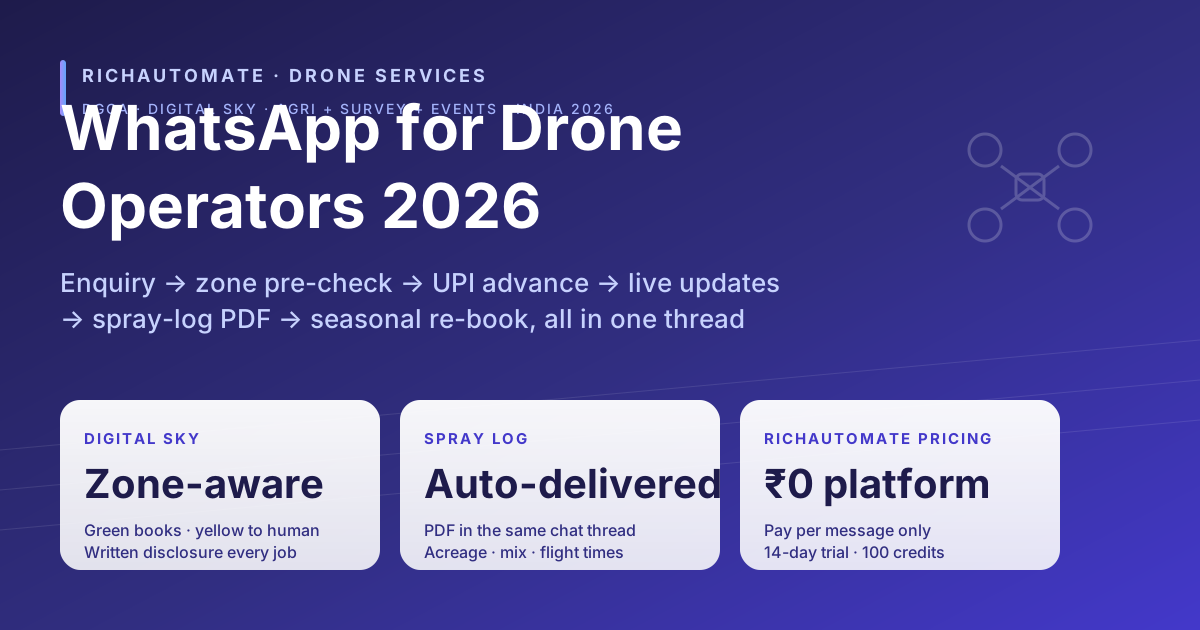
Short answer first: a drone-services operator in India — agri-spraying, surveying and mapping, delivery pilots, wedding and event aerials — can run the entire job lifecycle on WhatsApp: enquiry and acreage-based quoting, KYC and airspace-zone pre-checks, UPI advance collection, weather-triggered reschedules, job-day live updates, spray-log and map-deliverable PDFs, invoicing, and crop-calendar re-book broadcasts. The drone-as-a-service (DaaS) business is a scheduling-and-compliance business wearing a hardware costume: the aircraft flies for minutes, but the booking, the paperwork and the customer reassurance run for days — and all of that lives naturally in chat. This guide walks the full operator lifecycle, the DGCA and subsidy landscape you must disclose around, and the automation stack that keeps a two-pilot outfit looking like an enterprise. (Every regulatory and subsidy specific below is as of 2026 — verify against current DGCA, MoCA and Digital Sky rules before relying on it. General information, not legal advice.)
The Regulator and Subsidy Landscape in Five Minutes
Before a single template gets approved, know the rule stack your customer conversations must respect (all items hedged — these rules are amended frequently; verify the current versions):
- Drone Rules 2021 and amendments (DGCA/MoCA). The base framework: drone categories by weight, Unique Identification Number (UIN) registration on the Digital Sky platform, operational requirements, and penalties. Amendments have repeatedly relaxed and re-tuned specifics — never quote a rule to a customer without checking the current text.
- Digital Sky platform. India's single-window for UIN registration and the interactive airspace map dividing the country into green (generally permitted up to notified limits), yellow (permission required from the relevant authority) and red (no-fly without exceptional clearance) zones. Zone boundaries change — around airports, borders, and temporarily during VIP movement or events.
- Remote Pilot Certificate (RPC). Pilots of most commercially operated drones need an RPC from a DGCA-authorised Remote Pilot Training Organisation (exemptions exist for the smallest categories — verify which apply to your fleet).
- Agri-drone subsidies (SMAM / Kisan Drone ecosystem). Central and state schemes have subsidised agricultural drones for custom-hiring centres, FPOs, agri-graduates and rural entrepreneur programmes — subsidy percentages, eligible categories and budget windows shift between announcements, so mark every number "verify current scheme guidelines". The government has targeted lakhs of subsidised agri-drones in circulation over the scheme horizon (directional, verify).
- PLI scheme for drones. Production-linked incentives for drone and component manufacturing — relevant to you mainly because it keeps expanding the Indian-made fleet (Garuda Aerospace, IoTechWorld, General Aeronautics and Marut Drones are among the prominent Indian makers in the agri and enterprise segments — referenced neutrally, verify any spec with the manufacturer).
- Insurance and local permissions. Third-party insurance requirements apply to commercial operations (verify current mandate scope), and event or urban shoots frequently need local police intimation or NOC over and above airspace clearance — wedding aerials over a city venue are a different paperwork animal from spraying a green-zone farm.
Industry estimates place India's drone services market in the thousands of crores by FY26, with agriculture, surveying (including large public mapping programmes) and inspection as the volume segments — treat all sizing as directional and verify against current published estimates. The point for an operator is simpler: demand is subsidised on the supply side and seasonal on the demand side, which makes booking velocity and repeat rate — not fleet size — the real competitive variable.
Why WhatsApp Beats Phone Calls and Field Agents for Drone Bookings
Most operators today run on a personal number, a phone that rings during flights, and a field agent who collects acreage details on paper. Here is what that costs against a WhatsApp Business API operation:
| Dimension | Phone calls + field agent | WhatsApp Business API |
|---|---|---|
| Quote turnaround | Callback after pilot lands; details re-asked, often wrong acreage | Structured Flow captures crop, acreage, village pin and preferred date in one pass; quote in minutes |
| Compliance trail | Verbal zone assurances, nothing in writing | Zone disclosure, KYC and consent live in the chat thread — timestamped and auditable |
| Advance collection | Cash on job day; no-shows eat slots | UPI link in chat at booking; slot confirmed only on payment |
| Weather reschedules | Morning-of phone roulette; angry customers | Broadcast template the evening before with one-tap reschedule options |
| Deliverables | Spray confirmation is a verbal claim; map files on a pen drive | Spray-log PDF or map deliverable delivered in the same thread, forwardable to the farmer group |
| Repeat business | Depends on the agent remembering the season | Crop-calendar broadcasts re-book last season's customers automatically |
| Scale ceiling | One phone, one conversation at a time | One number, multiple agents, chatbot for the first 80% of every enquiry |
Stage 1–2: Enquiry-to-Quote and the Airspace-Zone Pre-Check
The first message decides whether you look like a professional operation or a man with a drone. Run every enquiry — click-to-WhatsApp ad, QR on the vehicle, referral forward — into a structured intake. For agri jobs, a WhatsApp Flow form collects crop, acreage, village or pin location, tank-mix intent (pesticide, nutrient, bio-stimulant) and preferred window. For survey, delivery-pilot or event work, swap in site address, deliverable type (orthomosaic, contour, video edit) and date. Pricing logic — per-acre slabs for spraying, per-site or per-day for surveys and events — turns the submission into an instant quote card.
The click-to-WhatsApp link generator produces the link and the QR code together if you need both.
Before any money moves, run the zone pre-check: look up the job location against the Digital Sky airspace map and tell the customer, in the chat, what category of airspace their land or venue falls in and what that means for the booking. This is both compliance hygiene and a sales weapon — no phone-only competitor is putting airspace categories in writing.
Airspace-zone disclosure guardrail: never let an automated flow "confirm" a yellow- or red-zone job as if it were routine. Encode the rule into the chatbot: green-zone jobs proceed to booking; yellow-zone jobs get a written disclosure that authority permission is required, a realistic lead-time, and human pilot review before any advance is taken; red-zone requests are declined in-chat with the reason stated. Zone boundaries change on Digital Sky — including temporary restrictions — so re-verify at booking and on the morning of the job, and say so in the thread. The timestamped disclosure protects you; the silent assumption sinks you.
| Zone type (Digital Sky) | What to disclose in chat before booking | Automation behaviour |
|---|---|---|
| Green | "Your location shows as green zone as of today's check; standard operating limits apply; re-verified on job morning." | Proceed to quote → advance → slot. Auto-recheck flagged on job-day checklist. |
| Yellow | "Permission from the relevant authority is required; expect X working days (illustrative); booking is provisional until clearance." | Route to human. No advance collected until pilot confirms the permission path. Status template when clearance lands. |
| Red | "This location is in a no-operation zone; we cannot fly here without exceptional clearance, which we do not undertake for this job type." | Polite automated decline with the reason; offer alternate-location consult. Log the enquiry. |
KYC rides along in the same stage: customer name, land or site details, and for spraying, confirmation of who supplies the chemicals and that label-rate compliance sits with the agronomist or dealer recommendation (your terms PDF, dropped into the chat, does this in one message). Event jobs add the venue NOC question here — verify local police-intimation requirements for the city in question, as practice varies.
Stage 3–4: Booking, UPI Advance, and Pre-Flight Weather Choreography
A slot is confirmed when the advance lands, not when the customer says "pakka". Send the UPI payment link in the thread with the quote card; on payment confirmation, fire the booking-confirmed template carrying date, time window, pilot name and a what-to-prepare checklist — water source for tank mixing on spray jobs, site-access and power notes for surveys, venue-contact details for events.
Then the part phone-based operators handle worst: weather choreography. Spraying has wind-speed and rain constraints; aerial shoots have light windows. The evening before every job, an automated check against a weather feed triggers one of two templates — "all clear, pilot reaches between X and Y" or "wind/rain forecast exceeds our operating limits; tap to pick a replacement slot". One-tap reschedule buttons in the chat turn what used to be a morning of angry calls into a sixty-second self-service interaction, and the slot freed up goes back into the calendar automatically.
Stage 5–6: Job-Day Live Updates and the Report That Closes the Loop
On job day the thread becomes a status feed: pilot en route (with ETA), flight started, flight complete — N acres covered (illustrative format). For a farmer who has heard horror stories about operators who sprayed half the field and left, these three messages are the product. For an event client, "drone is up, capturing the baraat entry" is reassurance money cannot buy.
Get a 1-minute BSP audit on WhatsApp
Drop your WhatsApp number — we line-item your current invoice against Meta India rates in under 60 seconds. India-hosted, DPDP-compliant.
Within hours of landing, deliver the post-job report in the same thread: a spray log for agri jobs (acreage covered, tank mixes, start and end times, operating conditions), or the map deliverable, photo selects or edited reel link for survey and event work. PDF in chat beats email for this customer base by a country mile — it gets opened, and it gets forwarded to the farmer WhatsApp group or the family group, which is your cheapest acquisition channel. The flight-log and Digital Sky operational angles of this report layer are covered in more depth in our earlier piece on Digital Sky, NPNT and flight-log workflows for drone operators — this article is the booking-ops view of the same business.
Stage 7–8: Settlement, Invoice, and the Seasonal Re-Book Flywheel
Balance payment follows the report — UPI link again, then the invoice PDF into the thread. For custom-hiring centres and FPO-affiliated operators, the invoice trail in chat doubles as the paper trail subsidy audits love (verify your scheme's documentation requirements).
The seasonal re-book flywheel: agri-spraying demand is a crop calendar, not a funnel. Every completed job writes crop, acreage, village and job date into your contact attributes — which means next season's pipeline is a segmented broadcast, not a cold-calling campaign. Three weeks before the typical spray window for that crop in that belt (illustrative timing — tune to your agronomy), fire a re-book template: "Last kharif we covered your 6 acres of paddy; the nursery-stage window is coming — reply BOOK to hold your slot at last season's rate." Add a referral hook ("forward this to one farmer in your village; both get a per-acre discount") and the flywheel compounds: illustratively, operators who run calendar-triggered re-books see repeat rates several times higher than those who wait for the phone to ring. Survey and event verticals get the same mechanic on different clocks — financial-year-end for mapping budgets, wedding season for aerials.
The Automation Stack: Stage by Stage
Everything above assembles from five WhatsApp Business API primitives — Flows for structured intake, approved templates for business-initiated messages, a chatbot for FAQ deflection and routing, human handoff for judgement calls (yellow zones, complaints, big-ticket survey scoping), and broadcast segments for seasonal campaigns. Mapped to the lifecycle with the KPI each stage owns and the guardrail it must respect:
| Stage | Automation | KPI to watch | Compliance guardrail |
|---|---|---|---|
| Enquiry → quote | CTWA/QR entry + intake Flow + instant quote card | Enquiry-to-quote time; Flow completion rate | Opt-in captured and logged at first contact |
| KYC + zone pre-check | Digital Sky zone lookup + scripted disclosure + terms PDF | % bookings with written zone disclosure (target 100%) | Yellow/red routed to human; nothing auto-confirmed |
| Booking + advance | UPI link + payment-confirmed template + checklist | Advance conversion rate; no-show rate | Advance only after green-zone confirm or written provisional terms |
| Pre-flight + weather | Evening-before weather check + reschedule template with quick replies | Same-day cancellation rate; reschedule self-serve % | Operating-limit thresholds set by pilot, not marketing |
| Job-day updates | En-route / started / completed status templates | Status-message read rate; mid-job inbound call volume (should fall) | Utility-category templates — no promotional content injected |
| Report delivery | Spray-log / deliverable PDF in thread | Report delivery within X hours (illustrative: 6) | Aerial imagery shared only with the paying customer — see DPDP section |
| Settle + invoice | UPI balance link + invoice PDF | Days-sales-outstanding; balance collection % | Invoice data retained per tax norms; payment via UPI, not wallet screenshots |
| Re-book + referral | Crop-calendar segmented broadcasts + referral template | Repeat-booking rate; referral-attributed jobs | Marketing templates to opted-in contacts only; honour STOP instantly |
The DPDP Carve-Out: Aerial Imagery and Farm Data Are Customer Data
Here is the compliance angle most drone operators have not internalised: under the DPDP Act, the data you collect to do the job — names, phone numbers, land locations — is personal data, and the data your aircraft creates — high-resolution aerial imagery of someone's land, crop-health maps, property surveys — is commercially and personally sensitive in ways a retailer's order history never is. A farm's crop-stress map is competitive information; a property survey can expose disputes; event footage contains hundreds of identifiable faces who never opted in to anything.
Practical posture (general information, verify against current DPDP rules and take advice for your specifics): collect only what the job needs; state in your terms who owns the deliverable and what you retain; never reuse one customer's imagery in marketing without written consent in the thread; set a retention window for raw flight imagery and actually delete on schedule; and route any third-party request for imagery (a neighbour, a buyer, anyone) through the customer. The chat thread itself is your consent ledger — the same WhatsApp trail that runs your bookings documents your notices and permissions, which is one more reason to keep the lifecycle in one channel instead of scattered across calls and paper.
An Illustrative Operator Cohort: What the Numbers Look Like
Composite and illustrative — not client data, not a promise: consider a two-drone agri-spraying outfit in a cotton-paddy belt running roughly 30 enquiries a week in season. Before structured WhatsApp ops: about half of enquiries ever received a quote (pilot was flying), advances were rare, weather mornings burned two hours of calls, and repeat business was whoever remembered the number. After moving the lifecycle onto the API: quote turnaround drops from a day to minutes, advance-backed bookings cut no-shows sharply, the evening weather template removes the morning call storm, and the crop-calendar re-book broadcast fills the next season's first fortnight before the season starts. Illustratively, that operator books materially more acreage per drone per season with the same two pilots — the aircraft were never the bottleneck; the conversations were. A survey-and-events operator sees the same shape with longer deal cycles: the structured intake Flow alone — deliverable type, site, date, budget band — kills the week of back-and-forth that used to precede every proposal.
Anti-Patterns: How Drone Operators Get This Wrong
- Auto-confirming yellow-zone jobs. The chatbot books it, the permission never comes, the customer has a mandap and no drone. Encode the zone gate; route to human.
- Quoting subsidies as fact. "You'll get 50% under SMAM" in a template is a complaint waiting to happen — schemes change between budget cycles. Hedge in writing: "subsidy eligibility per current scheme guidelines, to be verified for your category".
- Running it all on a personal number. No templates, no team inbox, no audit trail, and one ban away from losing every customer thread. Use the Business API.
- Blasting the entire contact list every week. Crop calendars are precise; spam is not. Segment by crop and belt, cap frequency, honour opt-outs instantly — your number's quality rating is an operational asset like your batteries.
- Sharing deliverables loosely. Sending farm imagery to whoever asks in the village group is a DPDP problem and a trust killer. Deliverables go to the paying customer's thread, full stop.
- Skipping the written zone disclosure on green zones. "It was green when we checked" means nothing verbally. The timestamped chat message is the audit trail — send it every time, it costs nothing.
FAQ: WhatsApp for Drone-Services Operators
The five questions operators ask most — whether agri-drone booking can really be automated end-to-end, how airspace-zone rules shape what a chatbot may confirm, what a spray-log delivery flow looks like, how subsidies should be talked about in chat, and what it costs to run this on WhatsApp Business API. Full answers below.
This article is general information, not legal or aviation-regulatory advice. Drone Rules, Digital Sky zone mappings, RPC requirements, subsidy schemes and DPDP rules all change — verify every specific against current DGCA/MoCA publications, the Digital Sky platform and scheme guidelines before acting.
Building the rest of the stack? See how operators run their pipeline in our guide to the best WhatsApp CRM for India 2026, the broader agri-channel playbook in WhatsApp for agri-input dealers, and how to start without spending anything via the WhatsApp Business API free trial guide.
Put your drone operation on autopilot — the booking side, at least
RichAutomate gives Indian drone-service operators WhatsApp Business API with intake Flows, booking templates, UPI-link collection, broadcast segments and human handoff — at ₹0 platform fee, ₹0 setup, ₹0 monthly. Pay per message only: Client Pay ₹0.10/msg with Meta conversation charges billed direct to you, or SaaS Pay ₹1.50 marketing / ₹0.50 utility-auth. 14-day free trial with 100 credits. See full pricing, WhatsApp us at 918160311319, or book a 30-minute walkthrough at https://richautomate.in/book/demo.