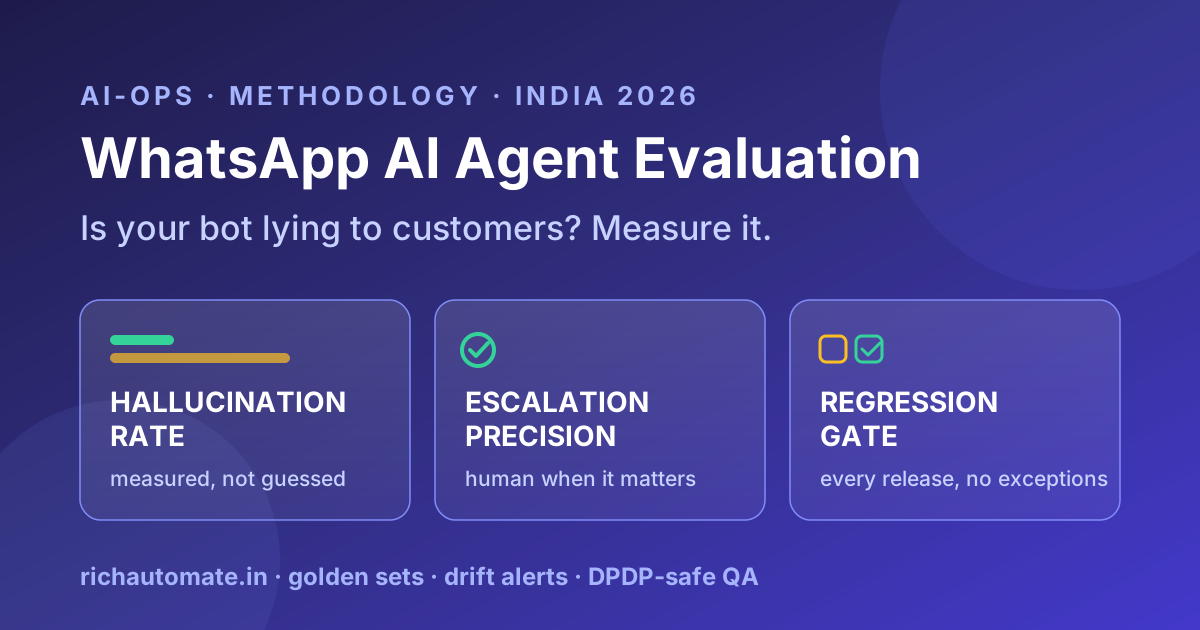
Every Indian business bolting an LLM onto WhatsApp in 2026 — and with Meta's own Business AI rolling out globally (as of 2026, verify current availability), that is rapidly becoming every business — eventually faces the same uncomfortable question: how do I know my AI agent isn't lying to customers? The answer is not "trust the model". It is an evaluation harness: a golden set of 50–200 real conversations, automated hallucination checks against your knowledge base, escalation-precision tests, a regression gate before every prompt or model change, and sampled human review in production. This guide is the practical, checklist-heavy version of that harness — vendor-neutral on models, India-specific on compliance — so you can measure your bot's honesty instead of guessing at it.
Meta's own agent: Meta now offers a built-in AI agent for WhatsApp Business. Before you choose, read our how Meta Business Agent compares with an API chatbot.
Why Evaluation Matters: The Silent-Failure Problem on WhatsApp
WhatsApp is the cruellest channel for a misbehaving AI agent, because failures are silent. On a website chat widget, a frustrated user might rage-click or fill a feedback form. On WhatsApp, they simply stop replying — and you never find out the bot quoted a return policy you don't have, invented a discount, or stonewalled someone who typed "human chahiye" four times. The conversation log looks complete. The customer is gone.
Three properties make WhatsApp uniquely unforgiving here:
- No UI guardrails. There are no buttons constraining the user to happy paths. Free-text in, free-text out — the model's full failure surface is exposed.
- High trust by default. Messages arrive in the same thread as family and friends. A confidently wrong answer from your verified business number reads as an official commitment, not a chatbot guess.
- Per-message economics. Every wasted exchange has a real cost — and a hallucinated promise can cost far more than the message that carried it (a refund honoured, a complaint escalated, a DPDP grievance filed).
The core mindset shift: treat your AI agent like software, not like a hire. You would never ship a payments feature without tests. A prompt change to a customer-facing LLM agent is a release — it needs a test suite, a pass/fail gate, and a rollback plan, exactly like code.
The 5 Metrics That Actually Matter
Teams drown when they try to score everything. In practice, five metrics cover the failure modes that cost money on WhatsApp. All target bands below are illustrative starting points — calibrate against your own baseline after your first measurement pass, not against someone else's benchmark.
| Metric | How to measure | Illustrative target band |
|---|---|---|
| Groundedness / hallucination rate | % of factual claims in bot replies that are supported by your KB or conversation context. Score via human review on a sample, optionally assisted by an LLM-judge that cites the supporting KB passage (judge outputs spot-checked by humans). | ≥ 95% grounded; every ungrounded claim triaged |
| Escalation precision & recall | Precision: of conversations the bot escalated, % that genuinely needed a human. Recall: of conversations that needed a human, % the bot actually escalated. Needs labelled cases. | Recall ≥ 90% (missing a needed handoff is the expensive error); precision ≥ 70% |
| Resolution rate | % of conversations resolved without human help and without the customer reopening within a defined window (e.g. 48h). | Trend upward from your baseline; absolute number varies wildly by use case |
| CSAT proxy | Post-chat 1-tap rating where you can get it; otherwise sentiment of the customer's final messages + reopen rate as a proxy, human-calibrated quarterly. | ≥ 80% positive on rated chats (illustrative) |
| Latency | p50 and p95 seconds from inbound message to bot reply, measured at the WhatsApp layer (not just model time). | p95 under ~10s; users tolerate "typing…" but not silence |
Notice what is not on the list: BLEU scores, perplexity, generic LLM leaderboard rankings. Those measure the model. You are measuring the agent in your business context — the same model with a different KB and prompt is a different product.
Building the Golden Set From Real Chats
The golden set is the heart of the harness: a fixed collection of 50–200 real conversations (start at 50, grow toward 200 as you discover failure modes) with expected outcomes labelled by a human who knows the business. Synthetic test questions written by the prompt author are nearly useless — they test what you already thought of. Real chats test what customers actually do: Hinglish, voice-note follow-ups transcribed badly, three questions in one message, "bhai price kya hai" at 2 a.m.
Build it like this:
- Pull a stratified sample from your real WhatsApp history (de-identified — see the DPDP section below): ~40% common intents, ~30% edge cases and complaints, ~20% escalation-worthy cases, ~10% adversarial or off-topic (people will ask your sari shop's bot about cricket scores).
- Label each case with: expected answer substance (not exact wording), the KB passage(s) that ground it, whether escalation is required, and any hard "must never say" constraints (prices not in the KB, medical/financial advice, competitor commentary).
- Include the trick cases deliberately: questions whose true answer is "I don't know, let me connect you to a human" — because the most dangerous bots are the ones that always answer.
- Freeze and version it. The golden set changes only through reviewed additions, never silently — otherwise your metrics stop being comparable across releases.
Practical shortcut for SMBs: one person who handles customer chats daily can label 50 conversations in an afternoon. That single afternoon buys you a regression gate that most "AI-powered" deployments in the market simply do not have. Do not wait for a data team you don't have.
Hallucination Testing Against Your Knowledge Base
Hallucination on a business bot has a precise, testable definition: a factual claim in the reply that is not supported by your KB, the conversation context, or explicitly configured business data. That definition makes it measurable — claim by claim, against a source of truth you control.
The test loop: run every golden-set case through the bot, extract the factual claims from each reply (prices, timings, policies, availability, names), and check each claim against the KB. An LLM-judge can do the first pass at scale — "does the cited KB passage support this claim: yes / no / partially" — but humans must spot-check the judge on a rotating sample, because judges hallucinate too (as of 2026, no model is a fully reliable grader; verify against current model behaviour before trusting one unsupervised).
Score two distinct things:
- Faithfulness: when the bot answers, is the answer grounded? (Hallucination rate = 1 − faithfulness.)
- Honest abstention: when the KB has no answer, does the bot say so and offer a human — or does it improvise? Improvisation on out-of-KB questions is the single most common failure mode in deployed WhatsApp bots.
If you are still building the bot itself, our GenAI LLM agent build guide for WhatsApp covers the RAG architecture that makes groundedness checkable in the first place — you cannot measure faithfulness to a KB you never wired in.
Escalation-Gate Testing: The "Human Chahiye" Cases
Escalation is a classification problem hiding inside your agent, and it deserves classification metrics. Two numbers, two very different costs:
- Escalation recall (did it hand off when it should have?) — a miss here means an angry customer trapped in a bot loop, typing "human", "agent", "HUMAN CHAHIYE" into the void. This is the reputation-burning error. Test every phrasing your customers actually use, in every language they use: English, Hindi, Hinglish, regional languages, and the universal signal of repeating the same question twice.
- Escalation precision (when it handed off, was it needed?) — a miss here just costs agent time. Annoying, not fatal. This is why the illustrative bands above tolerate lower precision than recall.
Beyond explicit requests, test the implicit escalation triggers: low model confidence, detected frustration or abuse, complaint keywords, payment disputes, anything touching legal or medical territory, and repeated non-resolution (same intent ≥ 2 turns without progress). Each trigger gets golden-set cases that must route to a human — and a handful of near-miss cases that must not, so you catch over-escalation regressions too.
This is also where platform architecture matters more than model choice: an agent without a clean human-handoff path fails recall by construction. RichAutomate's own AI Agent — currently in development — is being built with human-handoff and confidence-gating as first-class primitives rather than bolt-ons; see the roadmap for where it stands.
Get a 1-minute BSP audit on WhatsApp
Drop your WhatsApp number — we line-item your current invoice against Meta India rates in under 60 seconds. India-hosted, DPDP-compliant.
Regression Gating: Rerun the Harness on Every Change
Here is the rule that turns all of the above from a one-time audit into an operating system: any change to the prompt, the model, or the KB triggers a full harness rerun before it reaches customers. Prompt tweaks feel free; they are not. A one-line instruction change can silently break escalation behaviour three intents away. Model version bumps — including ones your provider applies upstream (as of 2026, several providers update hosted models on their own schedule; verify your provider's policy) — are releases whether you asked for them or not.
A workable gate for a small team: block the release if hallucination rate worsens at all on the golden set, if escalation recall drops below your floor, or if any "must never say" constraint fires. Treat CSAT-proxy and latency as warnings that need a human sign-off rather than hard blocks. Produce a one-page per-release scorecard — the five metrics, this release vs last, with diffs highlighted — and archive it. Six months of scorecards is also your audit trail when a customer (or a regulator) asks how you supervise your AI.
| Failure mode | How it's detected | The fix |
|---|---|---|
| Invented price / policy / discount | Groundedness check fails: claim has no supporting KB passage | Add or correct the KB entry; tighten the prompt's "only answer from provided context" instruction; add the case to the golden set |
| Improvises on out-of-KB questions | Honest-abstention cases fail in the harness | Strengthen abstention instructions; route no-retrieval-hit turns to fallback or human instead of the model |
| Misses "human chahiye" in Hinglish / regional language | Escalation-recall cases fail for those phrasings | Expand escalation trigger phrases and language coverage; lower the confidence threshold for handoff |
| Over-escalates trivial FAQs after a prompt change | Escalation precision drops on the regression run | Diff the prompt change; restore or rebalance the handoff instruction; add near-miss cases to the set |
| Stale answers after a price/policy update | Production drift: grounded-but-wrong answers (KB itself outdated) | Make KB updates part of the release process — a KB change is a release and reruns the harness too |
| Slow replies during traffic spikes | p95 latency alert at the WhatsApp layer | Queue + typing indicators; cap retrieval depth; pre-warm or cache common intents |
Production Monitoring and Drift: The Harness Never Sleeps
The golden set tells you the agent can behave; production tells you whether it does. Customers drift — new slang, new products, festival-season question patterns — and a bot that scored clean in March can be quietly failing by Diwali. Minimum viable monitoring:
- Sampled human review: a human reads a fixed random sample of live conversations on a regular cadence (start with something like 20–30 chats a week for an SMB — illustrative, scale with volume) and scores them on the same rubric as the golden set. Same rubric is the key — it makes production scores comparable to harness scores.
- Drift alerts: automated flags when weekly escalation rate, abstention rate, average conversation length, or reopen rate moves beyond a band around its trailing average. You are not alerting on "bad", you are alerting on different — different is what you investigate.
- Feedback harvesting: every production failure a human reviewer finds becomes a new golden-set case. This loop — production finds it, harness prevents its return — is the whole game. Your golden set should grow toward 200 cases through exactly this route.
On tooling: you can run this entire layer manually before you automate any of it. The comparison most teams need:
| Dimension | Manual eval (human review) | Automated eval (scripted + LLM-judge) |
|---|---|---|
| Catches subtle tone / cultural misses | Yes — its core strength | Weak; judges miss what offends a real customer |
| Scales to every release + nightly runs | No — humans don't scale | Yes — its core strength |
| Cost per evaluated conversation | High (skilled human minutes) | Low (compute + judge tokens) |
| Trustworthiness of verdicts | High, with rubric + calibration | Medium — judge needs human spot-checks |
| Right role in the harness | Golden-set labelling, judge calibration, production sampling | Regression gate on every release, claim-level groundedness at scale |
The honest answer is both, sequenced: humans define ground truth and audit the machine; the machine reruns ground truth on every release. Either alone fails — manual-only cannot gate releases, automated-only drifts into grading its own homework.
DPDP-Safe Evaluation: Test on Transcripts Without Burning Trust
Your golden set is built from real customer conversations — which makes it personal data under India's DPDP Act regime until you make it not. Three practices keep the eval programme clean (as of 2026; verify current DPDP rules and timelines with counsel, since obligations are still being operationalised):
- De-identify before evaluating. Strip or mask phone numbers, names, addresses, order IDs and payment references from transcripts before they enter the golden set or any LLM-judge pipeline. The eval needs the shape of the conversation, not the identity in it. De-identified data dramatically reduces your obligation surface.
- Cover QA use in your consent and notice. Your privacy notice should disclose that conversations may be reviewed for quality and service improvement. If transcripts flow to a third-party model provider for judging, that is a processing relationship — name the category, bind the processor contractually, and prefer providers with no-training-on-your-data terms (verify each provider's current policy).
- Set retention limits for eval artifacts. Golden sets, judge outputs and review notes are data too. Define how long raw (pre-de-identification) transcripts live, who can access the eval store, and purge on schedule — an eval corpus quietly accumulating years of customer chats is a breach waiting for a headline.
Teams already running consent-aware WhatsApp ops have a head start here — the same discipline that governs your campaign lists governs your eval data. If your customer data lives in a WhatsApp CRM, our best WhatsApp CRM in India guide covers the consent-and-data-hygiene layer this builds on.
If you are unsure where you stand, the WhatsApp compliance self-audit covers the checks in order.
The 30-Day Rollout Runbook
Everything above, sequenced for a small team alongside the day job:
- Days 1–5 — Baseline: export and de-identify a sample of real conversations; define your five metric definitions in one page; label your first 50 golden-set cases (intents, expected outcomes, escalation flags, must-never-say constraints).
- Days 6–10 — First measurement: run the golden set through the current bot manually; score groundedness, escalation precision/recall, and abstention by hand. This unautomated first pass is the most informative week of the programme — expect surprises.
- Days 11–15 — Triage and fix: rank failures by customer cost (hallucinated commitments first, missed escalations second); fix KB gaps and prompt instructions; rerun the failing cases.
- Days 16–20 — Automate the rerun: script the golden-set run; add an LLM-judge for claim-level groundedness with human spot-checks; produce your first per-release scorecard.
- Days 21–25 — Install the gate: write down the block/warn thresholds; make "prompt, model or KB changed → harness reruns → scorecard reviewed" the only path to production. Socialise it: nobody hot-fixes the prompt on a Sunday night anymore.
- Days 26–30 — Production loop: start weekly sampled human review on the live rubric; configure drift alerts on escalation rate, abstention rate and reopen rate; route every reviewer-found failure into the golden set. The harness is now self-feeding.
If you are earlier in the journey — still deciding whether an AI agent belongs on your WhatsApp number at all — start with the WhatsApp chatbot for business in India pillar, then come back here before you ship anything generative.
FAQ: Evaluating WhatsApp AI Agents
The five questions teams ask most — how big the golden set really needs to be, whether an LLM can grade an LLM, what hallucination rate is acceptable, how often to rerun the harness, and what DPDP actually requires for eval data. Full answers below.
Ship the bot. Keep the receipts.
RichAutomate runs WhatsApp automation for Indian businesses on a simple promise: ₹0 platform, ₹0 setup, ₹0 monthly — pay per message only (Client Pay ₹0.10/msg with Meta billed direct, or SaaS Pay ₹1.50 marketing / ₹0.50 utility-auth), with a 14-day free trial and 100 credits. Our AI Agent — with human-handoff and confidence-gating built in from day one — is in development on the roadmap. See full pricing, WhatsApp us at 918160311319, or book a 30-minute walkthrough at https://richautomate.in/book/demo.
Evaluation scores sit on top of functional checks; start with our WhatsApp chatbot test cases and go-live checklist.