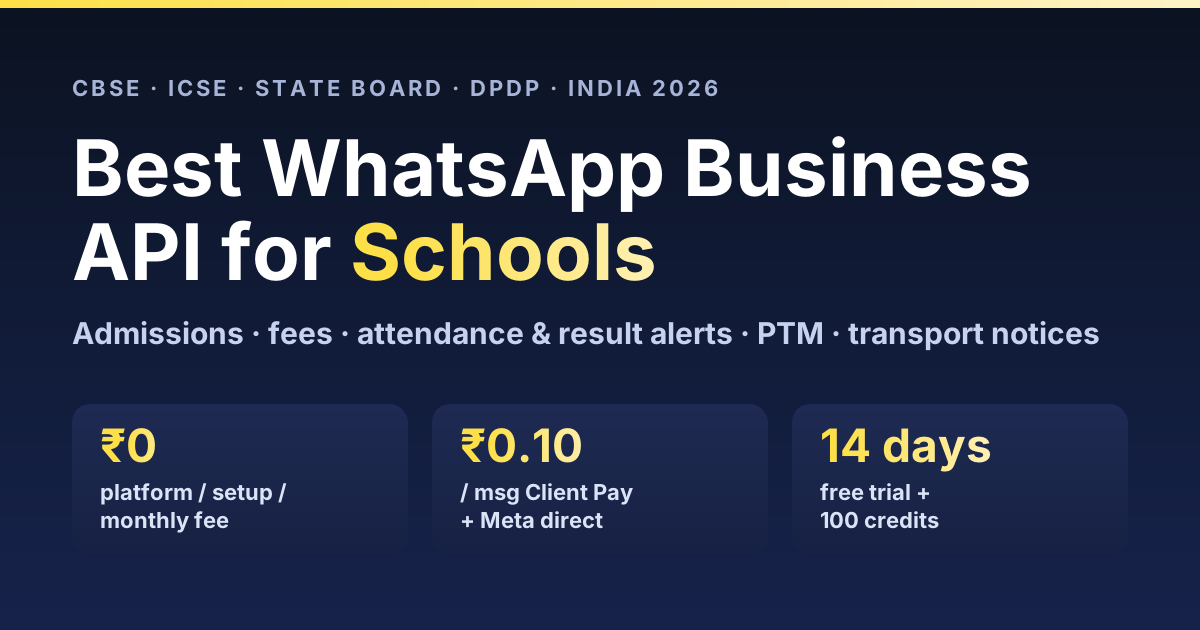
If you run a K-12 school in India — a CBSE day school, an ICSE campus, a state-board institution, or a chain of branches — your parent communication is already happening on WhatsApp. The only question is whether it happens through scattered teacher numbers and broadcast groups that nobody can audit, or through one official, compliant WhatsApp Business API line that captures admission enquiries, sends fee reminders, pushes attendance and result alerts to parents, schedules PTMs, and broadcasts transport and event notices — all logged, all measurable. This guide is the buyer's shortlist: what actually matters when a school chooses a WhatsApp Business API provider in 2026, the real cost math, the children's-data and DPDP angle most vendors ignore, and an honest view of where RichAutomate fits.
The short answer. A school does not need a generic chat tool — it needs WhatsApp wired into the moments that decide whether a parent enquires, enrols, pays on time, and stays informed: capturing an admission enquiry the second it lands, nurturing it to a campus visit, confirming the seat, sending fee due-date reminders before the late fine bites, pushing daily attendance and exam-result alerts so parents are never in the dark, scheduling parent-teacher meetings without phone-tag, and broadcasting transport delays, holiday notices and event invites to the right class lists. The levers that decide the right provider are: zero platform fee, a structured admission-enquiry flow, reminder workflows that cut fee defaults and no-shows, segmented parent broadcasts by class and section, a shared inbox the front office can run, DPDP-aware handling of children's data, and per-message pricing that does not punish a school for messaging 1,200 families every month.
Why WhatsApp, and why the official API specifically
Indian parents open WhatsApp dozens of times a day and almost never open email. The platform sees north of 535 million users in India, and message open rates routinely sit above 90% — the kind of reach a school newsletter or an SMS blast can only dream of. That is exactly why most schools already lean on WhatsApp informally. The problem is the informal version: a dozen teachers sending fee reminders from personal numbers, parent groups of 250 where the important notice drowns under "good morning" forwards, no record of who was told what, and a very real ban risk when a personal number sends hundreds of near-identical messages a day.
The official WhatsApp Business API fixes all of that. One verified school number with a green tick. Template messages approved by Meta for reminders and alerts. Automated flows that capture and qualify admission enquiries. Broadcasts segmented by class, section or transport route. A shared inbox where the admissions desk, the accounts team and the front office can all see and reply to the same conversation. And a clean audit trail for every message — which matters enormously when a parent later says "nobody told me about the fee deadline." For the day-to-day playbook of running this well, our WhatsApp for K-12 schools guide walks through the operational side; this page is about choosing the right provider to run it on.
The seven things a school should actually evaluate
Vendor websites list fifty features. For a school, only seven decide whether the platform earns its keep. Score every provider on these and the shortlist writes itself.
1. Platform fee — the silent budget killer
Most WhatsApp SaaS platforms charge a fixed monthly "platform" or "subscription" fee on top of what Meta charges per message. For a single-campus school that is a recurring line item with no link to value; for a chain it multiplies per branch. The single biggest cost lever is a provider with a genuine ₹0 platform fee so your spend tracks actual messaging, not a seat licence. This is where RichAutomate is deliberately different: no platform fee, no setup fee, no monthly fee. A school pays only for the messages it sends.
2. A structured admission-enquiry flow
Admissions are where WhatsApp pays for itself fastest. A "Click-to-WhatsApp" ad or a website "Enquire on WhatsApp" button should drop the parent into an automated flow that asks for the child's grade, the preferred branch, and a callback time — then routes a qualified lead to the admissions counsellor instantly, while sending the parent a brochure and a campus-visit booking link. Evaluate whether the provider offers a real flow builder (not just canned auto-replies) and whether enquiries land in a system your counsellors can work, not a dead inbox.
3. Reminder and alert workflows
Fee reminders before the due date, exam-result publication alerts, attendance notifications for an absent child, fee-overdue nudges before the late fine — these are template-driven, scheduled, personalised messages. The provider must let you trigger them in bulk from your ERP/SIS data (admission number, parent name, amount, due date) and merge those fields into approved templates. Our deep-dive on WhatsApp fee reminders and parent communication for K-12 schools shows how much fee-collection-on-time improves when the reminder lands where the parent will actually see it.
4. Segmented parent broadcasts
A transport delay on Route 7 should reach only Route 7 parents. A Class 10 board-exam notice should not spam Class 2 families. The platform needs contact segmentation by class, section, branch and transport route, plus broadcast scheduling. Blasting all 1,200 families for every notice trains parents to mute you; precise targeting keeps your messages read.
5. A shared, role-aware inbox
Admissions, accounts and the front office all talk to parents. A shared inbox where each team sees the relevant conversations — with assignment, internal notes and a full history — stops the chaos of personal numbers and lets a substitute pick up a thread without losing context.
6. DPDP and children's-data handling
This is the lever almost every generic comparison skips, and it is the one a school cannot afford to get wrong. More on this below, but at the evaluation stage ask: does the provider keep an auditable opt-in record, can a parent withdraw consent and be suppressed cleanly, and is data stored and processed in a way you could defend to a board, a trust, or a regulator?
7. Per-message pricing that respects volume
A school messages the same families every month — reminders, alerts, notices. The right pricing model is transparent per-message cost with no surprise platform tax, and ideally a model where you pay Meta's conversation rate close to direct rather than a marked-up bundle. Which brings us to the actual numbers.
The real cost math for a school in 2026
Here is what schools get wrong: they compare "plan prices" instead of total cost. The honest total is platform fee + per-message/per-conversation cost × your real monthly volume. Let us run it for a representative 1,000-student school.
| Monthly activity | Approx. messages |
|---|---|
| Fee reminders (3 touches × 1,000 families, 2 fee cycles handled monthly on average) | ~2,000 |
| Attendance / absence alerts | ~1,500 |
| Result & exam notices (seasonal, averaged) | ~1,000 |
| Transport / event / holiday broadcasts | ~1,500 |
| Admission enquiry conversations | ~500 |
| Total (illustrative) | ~6,500 |
On a platform with a fixed monthly fee, you pay that fee before a single message goes out, every month, forever. On RichAutomate there is no such fee. The two ways a school can run the messaging cost:
Client Pay model: you connect your own Meta WhatsApp account, pay Meta's conversation charges directly, and RichAutomate charges a flat ₹0.10 per message for the platform's send/automation layer. No platform fee, no markup on Meta's rate — ideal for schools that want the lowest possible per-message cost and direct visibility on Meta billing.
SaaS Pay model: RichAutomate handles the Meta billing for you and charges an all-in ₹1.20 per marketing/utility message and ₹0.30 per service (session) message — simpler accounting, one invoice, no separate Meta account to manage.
Either way: ₹0 platform fee, ₹0 setup, ₹0 monthly, plus a 14-day free trial with 100 message credits so the admissions and accounts teams can pilot a real fee-reminder run before committing a rupee.
Run the comparison honestly: a competing SaaS at, say, a few thousand rupees a month in platform fees plus per-message charges will, over a school year, cost materially more than a ₹0-platform model carrying the same message volume — and the gap widens for every additional branch. We keep competitor figures deliberately hedged here because BSP pricing changes often; always confirm current rates on each vendor's own pricing page before you sign. The structural point stands regardless of the exact numbers: a fixed platform fee is a cost you pay whether or not it produces value, and schools run on tight, predictable budgets.
DPDP and children's data: the part schools cannot skip
India's Digital Personal Data Protection Act treats the personal data of children with heightened care. For a school, almost every WhatsApp message touches a child's data — a result, an attendance record, a fee status tied to a named student. Three practical obligations shape how a school should configure WhatsApp:
Get a 1-minute BSP audit on WhatsApp
Drop your WhatsApp number — we line-item your current invoice against Meta India rates in under 60 seconds. India-hosted, DPDP-compliant.
- Verifiable parental consent. Processing a child's data generally requires consent from a parent or lawful guardian. Your WhatsApp opt-in should be tied to the parent/guardian on record, and the platform must store that opt-in with a timestamp you can produce later.
- No behavioural tracking or targeted advertising to children. School WhatsApp is for service and information — reminders, alerts, notices — not for profiling or ad targeting. Keep your templates strictly utility/transactional and your marketing (open-house, new-session promotions) aimed at parents, with consent.
- Clean withdrawal and data minimisation. A parent must be able to withdraw consent, and you should send only the data needed for the message. A result alert that says "your ward's report is ready, view in the parent portal" is safer than blasting raw marks into a chat thread.
The platform choice matters here: pick a provider that keeps auditable opt-in/opt-out records, lets you suppress a contact instantly on withdrawal, and does not force you to dump sensitive student data into third-party tools you cannot account for. This is squarely why a school should treat WhatsApp provider selection as a governance decision, not just a marketing one.
What a complete school WhatsApp setup looks like
Bringing the levers together, here is the stack a well-run K-12 school operates on RichAutomate:
| Moment | What WhatsApp does | How it is built |
|---|---|---|
| Admission enquiry | Click-to-WhatsApp ad or site button captures grade, branch, callback time; sends brochure + campus-visit link; routes a hot lead to the counsellor | Flow builder + auto-reply + lead routing |
| Fee reminder | Personalised reminder 7/3/1 days before due date; overdue nudge before late fine | Scheduled template broadcast merged from ERP fields |
| Attendance / absence | Same-day alert to the parent of an absent child | API-triggered utility template from attendance data |
| Result & exam notices | "Report ready" alert with portal link; exam-date and hall-ticket notices | Segmented broadcast by class |
| PTM scheduling | Parent picks a slot via interactive buttons; confirmation + reminder | Interactive flow + reminder template |
| Transport / event | Route-specific delay alerts; holiday, event and circular broadcasts | Segmented broadcast by route/class |
| Front-office queries | Parents reply; admissions/accounts/front-desk handle in a shared inbox | Shared role-aware inbox |
How RichAutomate compares to the obvious alternatives
Schools usually weigh three options. We will be honest about each.
- Personal WhatsApp / broadcast groups (free, informal). Zero cost, but no automation, no audit trail, no segmentation, no green tick, and a real ban risk once you message hundreds of families daily. Fine for a single class teacher; unworkable as a school's official channel.
- Generic WhatsApp SaaS with a monthly platform fee. Capable, but you pay a recurring platform tax regardless of value, and per-branch costs compound. Many are built for e-commerce or support, not the admission-fee-attendance rhythm of a school. Verify their education fit and total cost — not just the headline plan price.
- RichAutomate. Built around the ₹0-platform model, with the flow builder, segmented broadcasts, scheduled reminders, shared inbox and DPDP-aware opt-in handling a school needs — and a 14-day trial with 100 credits to prove it on your own parent list first.
If your primary need is exam-prep coaching rather than a full-day school, our best WhatsApp API for coaching institutes guide is the better fit, and for tuition/board-prep parent comms see WhatsApp for JEE/NEET coaching parent communication. For a broader cross-sector education view, the best WhatsApp API for education in India overview covers colleges, edtech and skilling alongside schools.
Which school should pick which
To be genuinely useful rather than self-serving: a tiny pre-primary with two sections and 60 families may be fine running a single official number with manual reminders — the automation ROI is thin at that scale. A large managed enterprise group that already has a deep CRM and wants a fully white-glove managed BSP with a dedicated success team may prefer an enterprise vendor and should evaluate those on managed-service depth. But for the vast middle — single-campus and multi-branch K-12 schools running 300 to 5,000 students who want professional, compliant, automated parent communication without a recurring platform fee bleeding the budget — RichAutomate's ₹0-platform, pay-per-message model is hard to beat. Start the 14-day trial, run one real fee-reminder cycle, and let the on-time-collection numbers decide.
The WhatsApp ROI calculator is more useful than a benchmark here, because the maths swings hard on your margin.
Rolling it out without disrupting the term
Schools worry that switching to an official WhatsApp line means a painful migration mid-session. In practice the rollout is incremental and low-risk. Week one is the green-tick application and number verification — you can onboard a brand-new dedicated school number or migrate an existing one. Week two, the accounts team imports the parent contact list (admission number, parent name, class, section, route, fee amount, due date) and maps those fields into two or three approved templates: a fee reminder, an attendance alert and a result/notice template. That is enough to run the first real cycle. The admission-enquiry flow and segmented event broadcasts come next, once the team is comfortable. Because there is no setup fee and the 14-day trial carries 100 credits, the school proves the model on a single class or a single fee cycle before extending it campus-wide. No big-bang switch, no upfront spend, no term disruption.
The other practical win is auditability. Every reminder, alert and notice is logged against the parent contact, with delivery and read status. When a parent claims they were never told about a fee deadline or a half-day, the front office pulls the exact message and timestamp in seconds. That single capability quietly removes a recurring source of friction between schools and families — and it is impossible with personal numbers and broadcast groups.
Common objections, answered honestly
"Won't parents find automated messages impersonal?" The opposite, when done right. A reminder that names the child, the exact amount and the due date, delivered to the channel the parent actually reads, is more useful than a generic SMS or a notice in a school diary that never gets seen. Personalisation through merge fields makes automation feel attentive, not robotic.
"We already have a school ERP — do we need this too?" Yes, and they complement each other. The ERP holds the data; WhatsApp is the delivery channel parents actually open. RichAutomate triggers messages from your ERP's fields, so the two work together rather than duplicating effort. You are not replacing the ERP — you are giving it a reach it never had.
"Is there a risk of our number getting banned for mass messaging?" This is precisely why the official API exists. Sending approved utility/transactional templates to parents who have opted in is the compliant, intended use of the platform — the ban risk lives with personal numbers blasting unsolicited content, not with a verified school line sending fee reminders to consenting families. Keep opt-ins clean, keep templates utility-grade, and message the parents who asked to hear from you. No provider can promise immunity, and you should be wary of any that does — but a properly configured school line operating within Meta's rules is exactly what the API was built for.
Run your school's parent communication on one compliant WhatsApp line
Admissions, fees, attendance, results, PTMs, transport and events — automated, segmented, audited, and DPDP-aware, with ₹0 platform fee and a 14-day free trial plus 100 credits. Pay only for the messages you send.
Chat with us on WhatsApp (+91 81603 11319) · Book a 30-minute walkthrough · See pricing & start the free trial
Start your WhatsApp automation free
₹0 platform, setup & monthly — pay only per message. 14-day free trial + 100 credits. Get your free WhatsApp Business API setup in 24–48 hrs.
Chat with us on WhatsApp → Book a 30-min demo