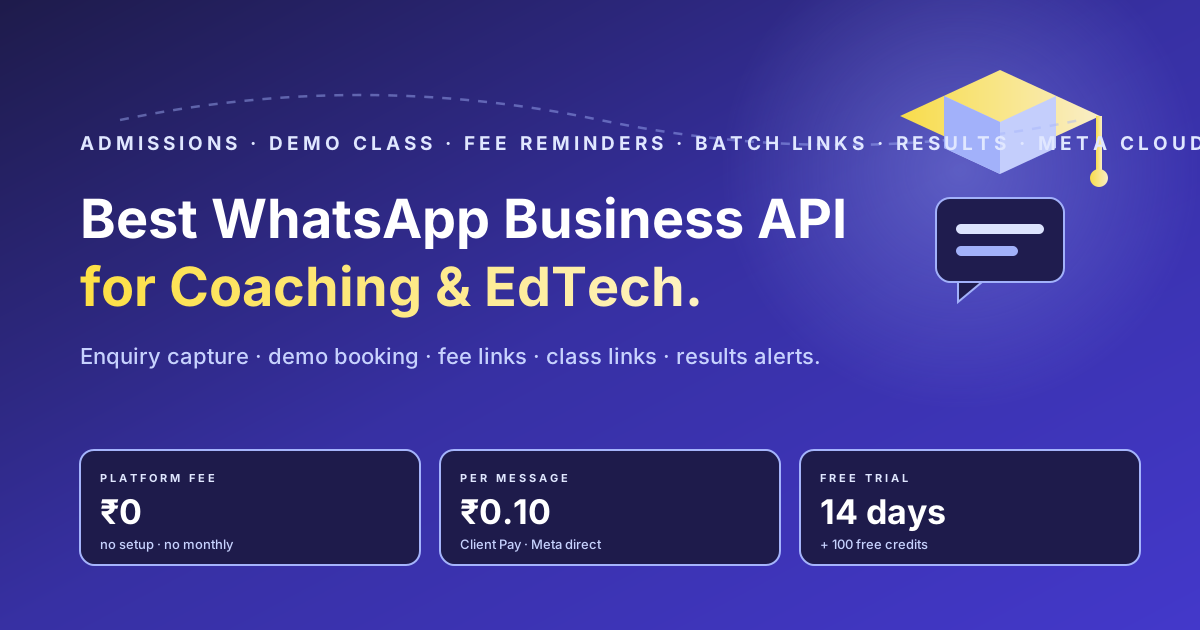
The short answer. A coaching institute or EdTech platform does not need a generic chat tool — it needs WhatsApp wired into the moments that decide whether an enquiry becomes a paid, attending, fee-current student: capturing an admission enquiry the instant it lands, booking a demo or trial class and reminding so the student actually shows up, sending fee-instalment payment links and reminders, broadcasting batch timings and live-class links, pushing attendance and results alerts to students and parents, and re-engaging the leads and droppers who went cold. The levers that decide the right provider are platform fee, a clean way to share course brochures and fee structures, demo-class booking and reminder flows, fee-reminder and payment-link workflows, batch and class-link broadcasts, a shared inbox so counsellors and faculty coordination teams work together, multi-language support, parental-consent handling for minors, and predictable per-message cost. RichAutomate fits the education shape: ₹0 platform fee, ₹0 setup, ₹0 monthly, a flat per-message line, a product catalogue for courses and batches, a multi-number inbox, multi-language templates and a no-code builder for enquiry, demo-booking, fee-reminder and results-alert flows. Be honest, though — a large national EdTech with deep LMS and CRM integration needs may want a full CPaaS, and a single home tutor may only need a shared inbox.
This is a practical, honest guide to choosing a WhatsApp Business API provider for an Indian education business in 2026 — a coaching centre, a test-prep institute (JEE, NEET, UPSC, CAT, banking or board), an EdTech platform, a school or a tuition chain. We cover what education teams actually need from WhatsApp across the enquiry-to-results journey, the criteria that matter for admissions and fee collection, which provider shape fits which kind of institute, an illustrative cost model, a DPDP and parental-consent note for messaging minors, and a one-week rollout plan. Treat every competitor figure as something to verify on their site, every rupee number here as illustrative, and every regulatory point as something to confirm with your own legal and compliance team. For a language and test-prep centre specifically, the full lifecycle is mapped in our language institute & IELTS coaching playbook.
Why coaching institutes and EdTech run on WhatsApp in India
Education in India is an admissions and retention business: a parent or aspirant researches three or four institutes, books a demo class, weighs fees against a competitor down the road, pays in instalments across a long course, and stays only if the institute communicates well about batches, attendance and results. That student and parent already have WhatsApp open all day. They will open a course brochure and fee structure you send on WhatsApp, reply to a demo-class confirmation, forward the institute to a relative deciding alongside them, and respond to a fee reminder or a results alert far faster than they will answer an unknown number from your admissions desk or check email. That responsiveness, on a channel built for trust and for sharing documents and timetables, is exactly why WhatsApp has become the workhorse for Indian coaching centres, test-prep institutes, EdTech platforms and schools: it carries the enquiry, the demo class, the fee payment, the batch link, the attendance and the results — the entire journey where an admission is won, paid and retained.
The customer LTV calculator turns repeat rate and margin into a per-customer number you can budget against.
The official WhatsApp Business API is what lets an education business move past the consumer WhatsApp Business app limits: a verified, green-tick-eligible number that parents trust with an admission decision and fee payment, a course catalogue to share programmes and batches, automated and templated communication at scale, structured enquiry and demo-booking flows, fee-payment-link and instalment reminders, batch and live-class-link broadcasts, attendance and results alerts, and multi-language messaging for families across India. The journey moments that pay for themselves are admission-enquiry capture, demo-class booking and reminders, fee collection, batch and class-link broadcast, results and attendance alerts, and drop-off re-engagement.
- Admission-enquiry capture. A prospect fills a website form, clicks a Google or Instagram ad, or messages your number asking about a JEE or NEET batch; instead of a missed call, an instant WhatsApp flow captures their goal, target exam, class and city, shares the matching course brochure and fee structure from the catalogue, and books a demo — while the intent is still hot.
- Demo-class booking and reminders. The single biggest admissions lever is getting a serious enquiry to actually attend a demo or trial class; a booking flow that lets the student pick a slot, plus reminders the day before and an hour before with the class link, lifts demo show-up rates far above a one-time call.
- Fee-reminder and instalment payment links. Coaching fees run into tens of thousands paid across instalments; a clean payment link for an admission fee or instalment — followed by a paid receipt — turns an intention into collected revenue, and scheduled reminders before each due date cut the awkward follow-up calls and protect cash flow.
- Batch, timetable and live-class-link broadcast. Opted-in broadcasts of batch timings, schedule changes, the day’s live-class or Zoom link, study material and test-series announcements keep a whole batch informed in one send — far more reliable than a noisy class WhatsApp group nobody reads.
- Attendance, results and parent communication. Attendance alerts when a student misses a class, test scores and rank updates, and progress messages to parents keep families engaged and reassured across a long course — which is what earns the renewal for the next year and the referral to a sibling or friend.
What education teams actually need from a WhatsApp Business API
Running WhatsApp for a coaching institute is not the same as running it for a support desk. Admissions are seasonal, the buyer is often a parent deciding for a minor, fees come in instalments across months, you are messaging students and guardians at once, and a single new-batch launch can involve hundreds of enquiries, a counselling team and a faculty-coordination desk. The needs that matter most for an education business:
- Low or zero platform fee. Admissions are seasonal — an admission season is loud, the mid-term is quiet — and the channel should never become a fixed cost that runs whether or not you are enrolling. A per-seat or fixed monthly platform fee on top of message cost is dead weight in an off-season month. A ₹0 platform fee means you only pay for what you send.
- Course, batch and fee-structure sharing. You need a clean way to share course brochures, batch timetables, fee structures and scholarship details over WhatsApp — ideally a native catalogue of courses and batches — so an enquiry turns into a demo class instead of a forwarded PDF nobody opens.
- Demo-class booking and reminder workflows. Slot booking, day-before and hour-before reminders with the class link, and a clean handoff to the counsellor need to be scheduled and reliable, because a demo class that happens is worth ten that were merely promised.
- Fee-reminder and payment-link workflows. Admission-fee and instalment collection, paid receipts, and due-date reminders need to be structured and easy, not a thread of stray screenshots and awkward phone calls.
- Batch broadcast and results/attendance messaging. Batch timing, schedule-change, live-class-link and test-series broadcasts to your opted-in students, plus attendance and results alerts to students and parents, need to be easy to run and easy to segment by batch.
- A shared inbox for counsellors and faculty coordination. Admission counsellors, front-desk staff, the fee-collection team and the academic-coordination desk all need to answer from one place, with enquiries and students assigned and nothing — especially a parent awaiting a results or fee answer — falling between people.
- Predictable per-message cost. A flat, knowable per-message or per-conversation rate lets you model the cost of an admission-season broadcast or a fee-reminder run, instead of decoding a multi-channel wallet bill.
- DPDP-aware and minor-aware handling. Approved templates, parental-consent capture where you message about a minor, opt-in capture, easy opt-out and purpose limitation keep your number healthy and keep student and parent data — names, phone numbers, exam goals and fee records — defensible under India’s data-protection regime, which treats children’s data with extra care.
For where a WhatsApp platform sits next to your admissions CRM and counselling workflow, our best WhatsApp CRM guide is the companion page; and if you want the full picture of what a WhatsApp Business API actually costs, the WhatsApp Business API cost guide breaks down the numbers.
Criteria to compare providers (for coaching institutes and EdTech)
Score any provider against what moves an education P&L — enquiry-to-demo rate, demo-to-admission conversion, on-time fee and instalment collection, batch retention and renewals, and referrals — not the generic enterprise feature list:
| Criteria | Why it matters to a coaching institute or EdTech | RichAutomate |
|---|---|---|
| Platform fee | Admissions are seasonal; the channel should not run as a fixed cost in the quiet mid-term months | ₹0 platform fee, ₹0 setup, ₹0 monthly — pay only per message |
| Course & fee-structure sharing | Sharing course, batch, fee and scholarship detail turns an enquiry into a demo class | Native product catalogue plus no-code enquiry and brochure-sharing flows |
| Demo-class booking & reminders | A demo class that actually happens is the single biggest admissions conversion lever | Slot-booking flows with day-before and hour-before reminder templates and the class link |
| Fee-reminder & payment links | Instalment and admission-fee collection protects cash flow and cuts awkward follow-up calls | Scheduled reminder flows, payment-link sends and paid-receipt confirmations |
| Batch & class-link broadcasts | Batch timing, schedule, live-class-link and test-series sends keep a whole batch informed reliably | Approved broadcasts and templates segmented by batch to opted-in students |
| Results & attendance alerts | Scores, ranks and attendance updates to students and parents drive engagement and renewals | Update templates segmented by batch and student to opted-in families |
| Shared multi-team inbox | Counsellors, front desk, fee team and academic coordination must answer one queue cleanly | Shared inbox with assignment, multiple numbers and accounts |
| Per-message transparency | Model the cost of an admission-season broadcast or a fee-reminder run, not a mystery wallet | Flat per-message line; Client Pay ₹0.10/msg or all-in SaaS Pay |
| DPDP & parental consent | Minors’ data and parent messaging must stay defensible with consent and opt-in/opt-out | Approved-template management, opt-in capture and opt-out handling built in |
The platform fee is the lever institutes underweight most, because the per-message rate looks trivial next to a fifty-thousand-rupee course fee. But across thousands of enquiry replies, demo reminders, fee nudges, batch broadcasts and results alerts every month — loudest during admission season, paid in full even in a quiet mid-term — a fixed platform fee is real money that does not move with admissions. If you are weighing whether to be billed through an all-in rate or pay Meta direct on your own number, our Client Pay vs SaaS Pay billing guide explains both models in plain language.
Honest — which provider fits which education business
Pick RichAutomate if you are a coaching centre, a test-prep institute, an EdTech platform, a school or a tuition chain, and you want WhatsApp doing real work across the enquiry-to-results journey — admission-enquiry capture, demo-class booking and reminders, fee-reminder and instalment payment links, batch and live-class-link broadcasts, attendance and results alerts, parent communication and drop-off re-engagement, and multi-language messaging — without a platform fee running in the quiet mid-term months. The ₹0 platform fee plus a flat per-message line means channel cost tracks enquiry, demo and admission-season volume; the no-code builder lets your team ship enquiry, demo-booking, fee-reminder and results-alert flows and change them for every new batch; the native catalogue and multi-number inbox let counsellors, front desk, fee team and academic coordination work side by side; multi-language templates reach families in their language; and consent, opt-out and template handling are built in. For an education business that wants control, predictable cost, and students who enrol, pay on time and renew, this is the recommended pick.
Get a 1-minute BSP audit on WhatsApp
Drop your WhatsApp number — we line-item your current invoice against Meta India rates in under 60 seconds. India-hosted, DPDP-compliant.
Consider a lighter inbox tool if you are a single home tutor or a tiny tuition setup whose entire need is a shared inbox and a couple of canned replies, and you do not run scheduled demo reminders, fee-payment flows, batch broadcasts or admission campaigns at scale. Lighter tools (as of 2026, verify on their sites) can be a pleasant, cheap shared inbox; just check whether they run the official WhatsApp Business API, what they charge per seat, whether they offer a catalogue and multi-language templates, and whether they can grow with you when you take on multiple batches, a counselling team and a fee desk.
Consider an enterprise CPaaS if you are a large national EdTech platform or a high-volume institute chain that needs deep two-way integration with an LMS and admissions CRM, a fee-collection and instalment engine and multiple payment partners, multi-channel reach (SMS, voice, email and WhatsApp behind one API), and a named account manager with a white-glove SLA. Enterprise platforms such as Gupshup, Infobip, Kaleyra or other large CPaaS vendors (as of 2026, verify on their sites) are built for that managed, high-integration relationship, and a self-serve tool would not replace the integration depth or account management at that scale.
The education economics (illustrative)
Say a mid-size coaching institute running several batches across two centres sends roughly 30,000 WhatsApp conversations a month across enquiry, demos, fees, academics and marketing — for the model below, assume about 22,000 utility or authentication conversations (demo-class confirmations and reminders, fee and instalment payment links, paid receipts, due-date reminders, batch and live-class-link broadcasts, attendance alerts, and results and rank updates) and 8,000 marketing conversations (new-batch and admission-season campaigns, scholarship and offer broadcasts, and re-engagement of cold enquiries and droppers). The figures are illustrative; model your own with real enquiry, demo and admission volumes.
| Model | How it bills the institute | Illustrative effect |
|---|---|---|
| RichAutomate — Client Pay | You are billed by Meta direct for conversations on your own number; RichAutomate adds ₹0 platform fee and a flat ₹0.10/msg platform charge | No platform fee to absorb — channel cost tracks message volume and you keep full visibility on Meta direct billing for your accounts |
| RichAutomate — SaaS Pay | All-in ₹1.20 per marketing and ₹0.30 per utility-or-authentication conversation, ₹0 platform fee, one simple bill (GST-inclusive) | One predictable line; on the mix above most traffic is the cheap ₹0.30 tier, with only admission and offer broadcasts at the ₹1.20 tier |
| Per-seat / platform-fee tool (verify) | A monthly platform or per-seat fee, plus per-message cost (as of 2026, verify on their site) | The fixed fee is paid whether it is admission season or a dead mid-term, on top of message cost — it does not scale down off-season and quietly raises cost per admission |
The point is the shape, not one magic number: a ₹0 platform fee plus a flat per-message line means a quiet mid-term month costs less and an admission surge costs more, in proportion to what you actually send — and because most education messaging is demo, fee, batch, attendance and results-led utility traffic, the bulk of your volume sits in the cheaper tier. Run your own numbers through the WABA cost calculator before you commit. All Meta conversation pricing and GST specifics should be verified as of 2026.
The DPDP and minor-consent edge no institute should skip
An education business holds sensitive data — names, phone numbers, exam goals, academic performance and fee records — about students who are often minors, and it messages both the student and the parent, so how you message and whose consent you hold matters enormously. None of the points below are legal advice; confirm them with your own legal and compliance team against current data-protection rules.
- Parental consent for minors. India’s data-protection framework treats children’s personal data with extra care and generally expects verifiable parental consent before processing it. Where a student is a minor, capture and record the parent or guardian’s consent for admission, fee and academic messaging, and direct sensitive communication to the guardian where appropriate. Confirm the exact obligations with your legal team.
- Consent and opt-in. Capture opt-in at the enquiry, demo or admission stage and only send batch, results and offer broadcasts to people who agreed to receive them. Blasting admission offers at a cold purchased list is the fastest way to get a number reported and your quality rating downgraded.
- DPDP and data minimisation. Names, numbers, exam goals, attendance, marks and fee records are personal — some of it children’s — data. Collect only what an enquiry, admission, fee payment or results update needs, store it with purpose limitation, capture consent, honour opt-out immediately, and keep an auditable trail. Our DPDP compliance checklist is the working reference.
- Well-spaced messaging. Space your reminder, batch and results messages sensibly; relentless daily nudges to a parent mid-decision on admission annoy rather than convert, and hurt your number’s quality rating. A prompt, easy opt-out is what keeps a number healthy.
- The human closes the admission. A bot can capture an enquiry, share a brochure, book a demo, send a fee link and broadcast a results update, but the admission-counselling conversation, the doubt about a competitor, and the reassurance that gets a parent to commit a child’s year and the family’s money stay with your counsellors. The platform is the messenger, not the closer.
How an education team goes live in one week
You do not need to build everything at once. Ship the two or three flows that move admissions first — enquiry capture, demo booking, fee payment — then add the rest. A typical rollout for a single coaching institute or EdTech:
- Day 1 — start the trial and connect your number. Use the 14-day free trial with 100 free credits, then connect or migrate your admissions number onto the official Meta WhatsApp Cloud API and complete business verification. Going live depends on Meta verification — usually a day or two, but treat that as an estimate.
- Day 2 — catalogue and enquiry flow. Load your active courses and batches into the WhatsApp catalogue with brochures, timetables, fee structures and scholarship details, and set up a lead-qualification flow (target exam, class, batch preference, city, budget) that shares matching brochures and books a demo.
- Day 3 — demo, fee and alert templates. Create utility templates for demo-class confirmation and day-before and hour-before reminders with the class link, admission-fee and instalment payment links, paid receipts, due-date reminders, attendance alerts and results and rank updates, and submit them — in your family languages — for Meta approval.
- Day 4 — the shared inbox and counselling handoff. Put admission counsellors, front-desk staff, the fee team and academic coordination into the shared inbox, set assignment rules for hot enquiries and fee-due students, and write quick replies for the common questions (course detail, batch timing, fee plan, scholarship, demo slot).
- Day 5 — fee reminders and an admission or batch campaign. Build scheduled flows for instalment and due-date reminders, and prepare a new-batch or admission-season campaign for your opted-in enquiries and a batch-link broadcast for your enrolled students.
- Days 6–7 — watch, audit and tune. Read the first days of real conversations, confirm enquiries are answered fast and no parent is left without a fee or results answer, fix the steps where students drop off, and only then scale admission broadcasts to your full opted-in base.
What every education team keeps. Whichever provider you use, the official WhatsApp Business API sits underneath, so message types, template rules and Meta policies are the same across tools. What changes is the commercial model — the platform fee that decides your cost per admission, whether you pay Meta direct, and how well the catalogue, multi-language templates, inbox and flows fit a seasonal, instalment-paid, minor-involving business — not the channel itself. To weigh RichAutomate against a popular alternative, see the Wati vs RichAutomate pricing decode, and run your own numbers in the WABA cost calculator before you commit.
The honest bottom line
For an Indian education business — a coaching centre, a test-prep institute, an EdTech platform, a school or a tuition chain — the best WhatsApp Business API provider is the one that turns the channel into more demo attendance, higher demo-to-admission conversion, cleaner fee and instalment collection, better-informed batches, engaged parents and students who renew and refer — without a platform fee running in the quiet mid-term months. RichAutomate is the recommended pick when you want WhatsApp doing real work: ₹0 platform fee, ₹0 setup, ₹0 monthly, flat Client Pay at ₹0.10/msg on your own number with Meta billing you direct, or all-in SaaS Pay at ₹1.20 per marketing conversation and ₹0.30 per utility-or-authentication conversation (GST-inclusive) — plus a 14-day free trial with 100 free credits, a native course catalogue, no-code enquiry, demo-booking, fee-reminder and results-alert flows, multi-language templates, a multi-number shared inbox, and consent, opt-out and template handling built in. Consider a lighter inbox tool if you are a single home tutor needing only a shared chat window, or an enterprise CPaaS if you are a large national EdTech needing deep LMS, CRM and payment-partner integration with an account manager. Pick by the shape of your education business, not by hype. And one honest caveat: no vendor — not RichAutomate, not anyone — can guarantee against a WhatsApp restriction or guarantee delivery, and none of this replaces your own data-protection, parental-consent and opt-in obligations. What keeps an education number healthy is relevant, consented, well-spaced messaging on the official API with a prompt, easy opt-out.
Ready to put WhatsApp across your enquiries, demos, fees and results?
Tell us your courses and batches, rough monthly enquiries, how you collect fees and instalments, and how you message students and parents, and we will model the real cost with you and show you an enquiry, demo-booking, fee-reminder and results-alert flow live — no pressure, no jargon. WhatsApp us at 918160311319, or book a 30-minute walkthrough at https://calendly.com/inrichdaddy/30min and we will set up the course catalogue, the shared inbox and the billing models side by side.
Start your 14-day free trial → · See full pricing · Run the WABA cost calculator
Start your WhatsApp automation free
₹0 platform, setup & monthly — pay only per message. 14-day free trial + 100 credits. Get your free WhatsApp Business API setup in 24–48 hrs.
Chat with us on WhatsApp → Book a 30-min demoIf your counselling team already lives in LeadSquared, start with LeadSquared WhatsApp integration.
Related: Best WhatsApp API for Study Abroad Consultants in India 2026 — the enquiry-to-departure workflow an overseas-education consultancy runs on WhatsApp: consent capture, counselling booking, SOP and document collection, deadline reminders and offer/visa-stage updates.