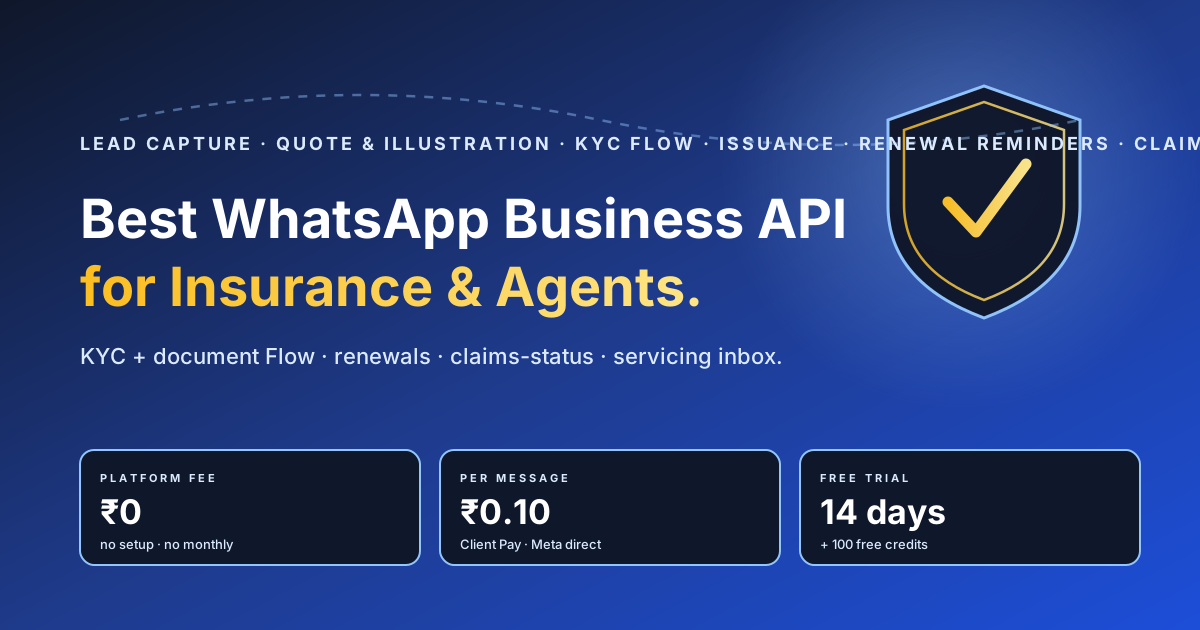
The short answer. An insurance broker, agent or insurer servicing team does not need a generic chat tool — it needs WhatsApp wired into the moments that decide whether an enquiry becomes a paid, in-force, renewing policy: capturing a lead the instant it lands, sharing a quote or benefit illustration the prospect can actually read, collecting KYC and proposal documents through a structured in-chat form, confirming policy issuance, reminding for premium and renewal with a clean payment link before the policy lapses, and answering claims-status and servicing questions without a call-centre queue. The levers that decide the right provider are platform fee, a clean way to share plans and illustrations, a document-and-KYC collection flow, premium-and-renewal reminder workflows, a claims-status and servicing inbox, multi-language support, sensitive-data and consent handling, and predictable per-message cost. RichAutomate fits the insurance shape: ₹0 platform fee, ₹0 setup, ₹0 monthly, a flat per-message line, a product catalogue for plans, a multi-number shared inbox, no-code and native WhatsApp Flows for lead capture, KYC and renewal, multi-language templates, and consent and opt-out handling. Be honest, though — a large insurer with a deep policy-admin and core-system integration may want a full CPaaS, and a single advisor may only need a shared inbox. And nothing here is regulatory advice: confirm every IRDAI and data-protection point with your own compliance team.
This is a practical, honest guide to choosing a WhatsApp Business API provider for an Indian insurance business in 2026 — an insurance broker or aggregator, a corporate agent, an individual agent or advisor, a POSP, or an insurer’s sales-and-servicing team. We cover what insurance teams actually need from WhatsApp across the policy lifecycle, the criteria that matter for lead-to-renewal economics, which provider shape fits which kind of insurance business, an illustrative cost model, a DPDP and IRDAI sensitive-data note, and a one-week rollout plan. Treat every competitor figure as something to verify on their site, every rupee number here as illustrative, and every regulatory point as something to confirm with your own legal and compliance team against current IRDAI and data-protection rules.
Why insurance runs on WhatsApp in India
Insurance in India is a trust-and-follow-up business: a prospect fills a quote form, compares two motor or health plans against the advisor down the road, asks the same three questions about coverage and exclusions, weighs the premium, and then either buys, ghosts, or buys and quietly forgets to renew. That prospect already lives in WhatsApp all day. They will open a benefit illustration you send, reply to a KYC-document request, forward a family-floater quote to a spouse making the decision with them, and respond to a renewal reminder with a payment link far faster than they will answer an unknown call-centre number or read an email that lands in spam. That responsiveness, on a channel built for quick replies and sharing documents and payment links, is exactly why WhatsApp has become the workhorse for Indian brokers, agents, aggregators and insurer servicing desks: it carries the enquiry, the quote, the KYC, the issuance confirmation, the renewal payment and the claims-status update — the entire lifecycle where a policy is sold, paid, kept in force and serviced.
The official WhatsApp Business API is what lets an insurance business move past the consumer WhatsApp Business app limits: a verified, green-tick-eligible number that a prospect trusts with KYC and a premium payment, a catalogue to share plan options, automated and templated communication at scale, structured lead-capture and KYC-collection flows, premium-and-renewal reminder workflows, claims-status and servicing handling, and multi-language messaging for a diverse policyholder base. The lifecycle moments that pay for themselves are lead capture, quote and illustration sharing, KYC and document collection, policy-issuance comms, premium and renewal reminders, and claims-status and servicing.
- Lead capture. A prospect fills a website or aggregator quote form, clicks a Google or Meta ad, or messages your number asking about a motor, health, term or family-floater plan; instead of a missed call, an instant WhatsApp flow captures the basics (product, age band, vehicle or sum-insured need, city), shares the matching plan options, and routes the lead to the right advisor — while the intent is still hot.
- Quote and benefit-illustration sharing. A prospect cannot decide on a screenshot they cannot read; a clean quote card or a benefit-illustration PDF shared in chat — with sum insured, premium, key inclusions and the headline exclusions — lets them compare properly and reply with the one objection that is actually holding them back.
- KYC and document collection. The friction that kills a sale after the prospect has said yes is the document chase. A native WhatsApp Flow that collects KYC details, lets them upload a PAN, Aadhaar reference, RC or medical document in the same thread, and confirms what is still pending, turns a multi-day email-and-call chase into a single guided conversation — with the actual KYC verification done through your own compliant process.
- Policy-issuance comms. When the policy is issued, a confirmation with the policy number, the schedule or e-policy document, and what to do next, closes the loop and reassures the policyholder they are covered — far better than a silent PDF emailed to an address they never check.
- Premium and renewal reminders. The whole economics of an insurance book is persistency: a clean payment link for a renewing motor or health policy — sent well before the due date, followed by a paid confirmation — turns a lapsing policy into retained, renewed business, and scheduled reminders before the grace period ends protect the policyholder’s continuity and your renewal commission.
- Claims-status and servicing. A policyholder mid-claim is anxious, and an opted-in claims-status update, a request for the missing claim document, and a servicing inbox that answers endorsement, nominee-change and coverage questions without a call-centre hold, build the trust that drives renewals and referrals — the quiet engine of an insurance book.
What insurance teams actually need from a WhatsApp Business API
Running WhatsApp for an insurance business is not the same as running it for a support desk. The buyer is deciding on a regulated financial product, you are collecting sensitive KYC and sometimes health data, and if you also handle claim surveys the WhatsApp playbook for IRDAI-licensed surveyors and loss assessors shows how the same stack captures geotagged loss evidence, renewals fall on rolling due dates across the whole book, claims are emotionally charged, and a single renewal-campaign or new-product push can involve thousands of policyholders, an advisor roster and a servicing team. The needs that matter most for an insurance business:
- Low or zero platform fee. An insurance book runs on thin per-policy economics and long renewal cycles; the channel should never become a fixed cost that runs whether or not you are issuing policies. A per-seat or fixed monthly platform fee on top of message cost is dead weight in a quiet quarter. A ₹0 platform fee means you only pay for what you send.
- Plan and illustration sharing. You need a clean way to share plan options, benefit illustrations and premium quotes over WhatsApp — ideally a native catalogue of plans and a tidy way to send a quote PDF — so an enquiry turns into a real comparison and a sale instead of a forwarded screenshot nobody acts on.
- A KYC and document-collection flow. A native WhatsApp Flow to capture proposal details and collect KYC and supporting documents in-chat, with clear pending-document prompts, is what removes the post-yes friction that loses sales — while the binding KYC verification and underwriting stay inside your own compliant systems.
- Premium-and-renewal reminder workflows. Renewal reminders, payment links, paid confirmations and pre-grace-period nudges need to be structured and scheduled, not a thread of stray screenshots, because persistency is where an insurance book’s real value compounds.
- A claims-status and servicing inbox. Claims-status updates, missing-document requests, and endorsement, nominee-change and coverage questions need to be answered from one shared place, with policyholders assigned and nothing — especially an anxious claimant — falling between people.
- Predictable per-message cost. A flat, knowable per-message or per-conversation rate lets you model the cost of a renewal-reminder run or a new-product launch, instead of decoding a multi-channel wallet bill.
- Multi-language and a shared multi-team inbox. A diverse policyholder base needs templates in their language, and the lead desk, advisors, the renewal desk and the servicing team all need to answer from one inbox with assignment, multiple numbers and clean handoffs.
- DPDP-aware and IRDAI-aware handling. Approved templates, opt-in capture, easy opt-out, purpose limitation and careful handling of KYC and health data keep your number healthy and keep policyholder data defensible under India’s data-protection regime — with the insurance-specific conduct, disclosure and record-keeping obligations confirmed against current IRDAI rules with your own compliance team.
For where a WhatsApp platform sits next to your policy-admin and CRM, our best WhatsApp CRM guide is the companion page; and if you want the full picture of what a WhatsApp Business API actually costs, the WhatsApp Business API cost guide breaks down the numbers.
Criteria to compare providers (for insurance brokers and agents)
Score any provider against what moves an insurance P&L — lead-to-issuance conversion, KYC-completion speed, on-time renewals and persistency, claims-servicing trust, and referrals — not the generic enterprise feature list:
| Criteria | Why it matters to an insurance business | RichAutomate |
|---|---|---|
| Platform fee | Thin per-policy economics and long renewal cycles; the channel should not run as a fixed cost in a quiet quarter | ₹0 platform fee, ₹0 setup, ₹0 monthly — pay only per message |
| Plan & illustration sharing | Sharing plan options, quotes and benefit illustrations turns an enquiry into a real comparison and a sale | Native product catalogue plus no-code quote-and-plan-sharing flows and document sends |
| KYC & document collection | The document chase after a prospect says yes is what loses the sale | Native WhatsApp Flows to collect proposal details and KYC documents in-chat with pending prompts |
| Renewal reminders & payment links | Persistency is where an insurance book’s value compounds; pre-due reminders protect renewal commission | Scheduled reminder flows, payment-link sends and paid-confirmation templates |
| Claims-status & servicing | An anxious claimant well-served renews and refers; that trust is the book’s quiet engine | Shared servicing inbox, claims-status update templates and missing-document request flows |
| Multi-language broadcasts | A diverse policyholder base needs renewal, new-product and servicing messages in their language | Approved multi-language templates segmented by product, branch and renewal window |
| Shared multi-team inbox | Lead desk, advisors, renewal desk and servicing must answer one queue cleanly | Shared inbox with assignment, multiple numbers and accounts |
| Per-message transparency | Model the cost of a renewal-reminder run or a product launch, not a mystery wallet | Flat per-message line; Client Pay ₹0.10/msg or all-in SaaS Pay |
| DPDP & IRDAI-aware handling | KYC, health and policy data must stay defensible with consent, opt-out and purpose limitation | Approved-template management, opt-in capture and opt-out handling; insurance-conduct rules confirm with compliance |
The platform fee is the lever insurance teams underweight most, because the per-message rate looks trivial next to a single annual premium. But across thousands of quote replies, KYC prompts, issuance confirmations, renewal reminders and claims-status updates every month — loudest during a renewal season or a new-product launch, paid in full even in a slow quarter — a fixed platform fee is real money that does not move with policies issued. If you are weighing whether to be billed through an all-in rate or pay Meta direct on your own number, our Client Pay vs SaaS Pay billing guide explains both models in plain language.
Honest — which provider fits which insurance business
Pick RichAutomate if you are an insurance broker, a corporate or individual agent, a POSP, an aggregator or an insurer servicing team, and you want WhatsApp doing real work across the policy lifecycle — lead capture, quote and illustration sharing, KYC and document collection, policy-issuance comms, premium and renewal reminders, and claims-status and servicing — without a platform fee running in a quiet quarter. The ₹0 platform fee plus a flat per-message line means channel cost tracks lead, issuance and renewal-season volume; the no-code builder and native WhatsApp Flows let your team ship lead-capture, KYC-collection, renewal-reminder and claims-status flows and change them for every product and renewal window; the native catalogue and multi-number inbox let the lead desk, advisors, the renewal desk and servicing work side by side; multi-language templates reach a diverse policyholder base; and consent, opt-out and template handling are built in. For an insurance business that wants control, predictable cost, and policies that issue, pay, renew and refer, this is the recommended pick — with all conduct and disclosure obligations confirmed against current IRDAI rules with your compliance team.
Get a 1-minute BSP audit on WhatsApp
Drop your WhatsApp number — we line-item your current invoice against Meta India rates in under 60 seconds. India-hosted, DPDP-compliant.
Consider a lighter inbox tool if you are a single advisor or a tiny agency whose entire need is a shared inbox and a couple of canned replies, and you do not run scheduled renewal reminders, KYC-collection flows, claims-status updates or multi-language broadcasts at scale. Lighter tools (as of 2026, verify on their sites) can be a pleasant, cheap shared inbox; just check whether they run the official WhatsApp Business API, what they charge per seat, whether they offer native Flows for KYC and a catalogue and multi-language templates, and whether they can grow with you when you take on multiple products, a renewal desk and a servicing team.
Consider an enterprise CPaaS if you are a large insurer or a high-volume aggregator that needs deep two-way integration with a policy-administration and core insurance system, an underwriting and payment engine and multiple payment partners, multi-channel reach (SMS, voice, email and WhatsApp behind one API), and a named account manager with a white-glove SLA. Enterprise platforms such as Gupshup, Infobip, Kaleyra or other large CPaaS vendors (as of 2026, verify on their sites) are built for that managed, high-integration relationship, and a self-serve tool would not replace the integration depth or account management at that scale.
The insurance economics (illustrative)
Say a mid-size broking and agency business running multiple products sends roughly 30,000 WhatsApp conversations a month across lead, quote, KYC, issuance, renewal and servicing — for the model below, assume about 22,000 utility or authentication conversations (KYC and document prompts, issuance confirmations, renewal payment links, paid confirmations, pre-due reminders and claims-status updates) and 8,000 marketing conversations (new-product launches, cross-sell and family-floater campaigns, festival and tax-season pushes, and win-back of lapsed policyholders). The figures are illustrative; model your own with real lead, issuance and renewal volumes.
| Model | How it bills the business | Illustrative effect |
|---|---|---|
| RichAutomate — Client Pay | You are billed by Meta direct for conversations on your own number; RichAutomate adds ₹0 platform fee and a flat ₹0.10/msg platform charge | No platform fee to absorb — channel cost tracks message volume and you keep full visibility on Meta direct billing for your accounts |
| RichAutomate — SaaS Pay | All-in ₹1.20 per marketing and ₹0.30 per utility-or-authentication conversation, ₹0 platform fee, one simple bill (GST-inclusive) | One predictable line; on the mix above most traffic is the cheap ₹0.30 tier, with only product launches and win-back at the ₹1.20 tier |
| Per-seat / platform-fee tool (verify) | A monthly platform or per-seat fee, plus per-message cost (as of 2026, verify on their site) | The fixed fee is paid whether it is a renewal-season surge or a dead quarter, on top of message cost — it does not scale down off-season and quietly raises cost per policy |
The point is the shape, not one magic number: a ₹0 platform fee plus a flat per-message line means a quiet quarter costs less and a renewal-season surge costs more, in proportion to what you actually send — and because most insurance messaging is KYC, issuance, renewal and claims-status-led utility traffic, the bulk of your volume sits in the cheaper tier. Run your own numbers through the WABA cost calculator before you commit. All Meta conversation pricing and GST specifics should be verified as of 2026.
The DPDP, IRDAI and sensitive-data edge no insurance team should skip
An insurance business holds data — names, phone numbers, KYC identifiers, financial details and sometimes health information — that is sensitive, and it operates inside a regulated regime, so how you message, whose consent you hold and what you record matters a great deal. None of the points below are legal or regulatory advice; confirm them with your own legal and compliance team against current IRDAI and data-protection rules.
- Consent and opt-in. Capture opt-in at the enquiry or proposal stage and only send renewal, cross-sell and product broadcasts to people who agreed to receive them. Blasting offers at a cold purchased list is the fastest way to get a number reported and your quality rating downgraded — and may breach conduct rules, so confirm with compliance.
- DPDP and data minimisation. Names, numbers, KYC identifiers, financial details and any health information are personal — much of it sensitive — data. Collect only what a quote, proposal, issuance, renewal or claim needs, store it with purpose limitation, capture consent, honour opt-out immediately, restrict who in the inbox can see KYC and health details, and keep an auditable trail. Our DPDP compliance checklist is the working reference.
- KYC verification stays in your compliant systems. WhatsApp is a great place to collect a document and prompt for what is pending, but the binding KYC verification, underwriting and record-keeping must run through your own IRDAI-compliant processes — treat the chat as the front door, not the system of record, and confirm the chain with your compliance team.
- Disclosure and conduct. Quotes, illustrations and product communication carry disclosure and conduct obligations under IRDAI rules; what you can say, how you must present premium and exclusions, and what records you keep are regulatory questions — build your templates with your compliance team, not from a marketing instinct.
- Well-spaced messaging and a human close. Space your reminder, renewal and cross-sell messages sensibly; relentless nudges to a policyholder mid-decision annoy rather than convert and hurt your number’s quality rating. And a bot can capture a lead, share an illustration, collect KYC, send a renewal link and update a claim status, but the advice conversation, the suitability discussion and the reassurance that gets a prospect to commit stay with a qualified human. The platform is the messenger, not the adviser.
How an insurance team goes live in one week
You do not need to build everything at once. Ship the two or three flows that move policies first — lead capture, KYC collection, renewal reminder — then add the rest. A typical rollout for a single broking or agency business:
- Day 1 — start the trial and connect your number. Use the 14-day free trial with 100 free credits, then connect or migrate your business number onto the official Meta WhatsApp Cloud API and complete business verification. Going live depends on Meta verification — usually a day or two, but treat that as an estimate.
- Day 2 — catalogue and lead-capture flow. Load your key plan options into the WhatsApp catalogue with headline benefits, and set up a lead-qualification flow (product, age band, sum insured or vehicle, city, budget) that shares the matching plan options and routes the lead to the right advisor.
- Day 3 — KYC, issuance and renewal templates. Build a native WhatsApp Flow to collect proposal details and KYC documents in-chat, and create utility templates for issuance confirmation, renewal payment links, paid confirmations, pre-due reminders and claims-status updates — in your policyholder languages — and submit them for Meta approval. Run every template past compliance.
- Day 4 — the shared inbox and advisor handoff. Put the lead desk, the advisors, the renewal desk and the servicing team into the shared inbox, set assignment rules for hot leads and renewal-due policyholders, restrict who can see KYC and health details, and write quick replies for the common questions (coverage, exclusions, premium, claim process).
- Day 5 — renewal reminders and a campaign. Build scheduled flows for pre-due renewal reminders, and prepare a new-product, cross-sell or tax-season campaign for your opted-in leads and a servicing broadcast for your in-force policyholders — cleared with compliance.
- Days 6–7 — watch, audit and tune. Read the first days of real conversations, confirm leads are answered fast and no policyholder is left without a renewal, KYC or claims answer, fix the steps where prospects drop off, and only then scale broadcasts to your full opted-in base.
What every insurance team keeps. Whichever provider you use, the official WhatsApp Business API sits underneath, so message types, template rules and Meta policies are the same across tools. What changes is the commercial model — the platform fee that decides your cost per policy, whether you pay Meta direct, and how well the catalogue, native KYC Flows, multi-language templates, inbox and renewal workflows fit a regulated, renewal-driven, document-heavy insurance business — not the channel itself. To weigh RichAutomate against a popular alternative, see the Wati vs RichAutomate pricing decode, and run your own numbers in the WABA cost calculator before you commit.
Before you commit to a move, the BSP migration cost calculator gives you the all-in figure rather than the sticker price.
Insurance-specific WhatsApp playbooks worth reading next
This is the buyer-decision page; for the lifecycle in specific lines of insurance, these companion reads go deeper. See WhatsApp for insurance distribution for the broker and agent funnel, WhatsApp for motor insurance and IRDAI for vehicle-policy renewals and compliance, WhatsApp for health insurance cashless claims for the claims-status journey, and WhatsApp and Bima Sugam for where the regulated marketplace is heading. Each cross-references this provider-choice guide.
The honest bottom line
For an Indian insurance business — a broker, a corporate or individual agent, a POSP, an aggregator, or an insurer servicing team — the best WhatsApp Business API provider is the one that turns the channel into more captured leads, faster KYC completion, higher lead-to-issuance conversion, cleaner on-time renewals and stronger persistency, better claims-servicing trust and more referrals — without a platform fee running in a quiet quarter. RichAutomate is the recommended pick when you want WhatsApp doing real work: ₹0 platform fee, ₹0 setup, ₹0 monthly, flat Client Pay at ₹0.10/msg on your own number with Meta billing you direct, or all-in SaaS Pay at ₹1.20 per marketing conversation and ₹0.30 per utility-or-authentication conversation (GST-inclusive) — plus a 14-day free trial with 100 free credits, a native plan catalogue, no-code and native WhatsApp Flows for lead capture, KYC and renewal, multi-language templates, a multi-number shared servicing inbox, and consent, opt-out and template handling built in. Consider a lighter inbox tool if you are a single advisor needing only a shared chat window, or an enterprise CPaaS if you are a large insurer needing deep policy-admin, underwriting and payment-partner integration with an account manager. Pick by the shape of your insurance business, not by hype. And two honest caveats: no vendor — not RichAutomate, not anyone — can guarantee against a WhatsApp restriction or guarantee delivery; and nothing here is regulatory advice — confirm every IRDAI conduct, disclosure and data-protection obligation with your own compliance team. What keeps an insurance number healthy is relevant, consented, well-spaced messaging on the official API with a prompt, easy opt-out.
Ready to put WhatsApp across your leads, KYC, renewals and claims servicing?
Tell us your lines of business, rough monthly leads, how you collect KYC and renewals, and how you handle claims-status and servicing, and we will model the real cost with you and show you a lead-capture, KYC-collection, renewal-reminder and claims-status flow live — no pressure, no jargon, and built to sit alongside your own compliant processes. WhatsApp us at 918160311319, or book a 30-minute walkthrough at https://calendly.com/inrichdaddy/30min and we will set up the plan catalogue, the shared inbox and the billing models side by side.
Start your 14-day free trial → · See full pricing · Run the WABA cost calculator
Start your WhatsApp automation free
₹0 platform, setup & monthly — pay only per message. 14-day free trial + 100 credits. Get your free WhatsApp Business API setup in 24–48 hrs.
Chat with us on WhatsApp → Book a 30-min demo