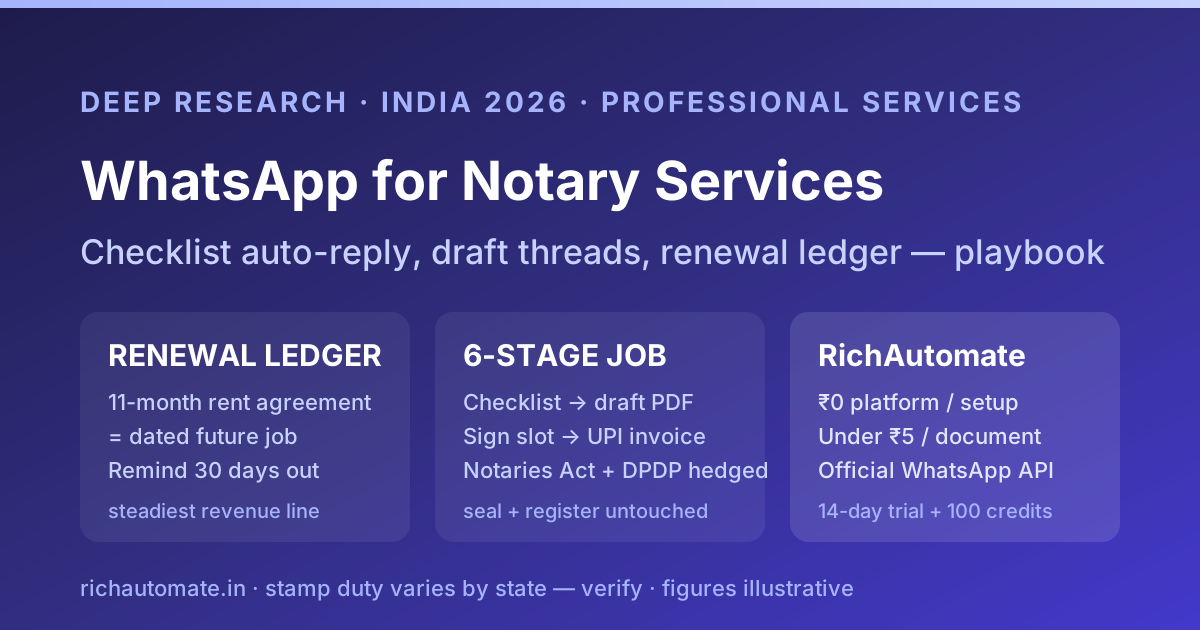
The short answer. A notary or document-writing practice runs on checklists and deadlines — which documents the client must bring, when the draft is ready, when execution happens, and (the goldmine everyone forgets) when the 11-month rent agreement expires. WhatsApp on the official Business API turns each of those into a message: an auto-reply document checklist that answers "kya kya lagega?" before the client visits, a draft-approval thread with versioned PDFs, a ready-for-signing ping, and a renewal reminder engine that brings every rent-agreement client back automatically 30 days before expiry. A practice handling ~80 documents/month runs this for roughly ₹300-500/month in messages on RichAutomate's ₹0-platform model (illustrative math below). One professional note first: notarial acts are governed by the Notaries Act 1952 and state appointment rules — messaging organises the practice, it never substitutes the seal, the register, or in-person execution where law requires it.
From court-complex document writers to notaries handling affidavits, rent agreements, sale-deed drafts and attestation work, the pattern repeats: the client calls twice to ask what to bring, once to ask if it's ready, and disappears at renewal time. All three calls are messages.
The 6-stage document job on WhatsApp
| Stage | What happens | WhatsApp job | Category |
|---|---|---|---|
| 1. Enquiry | "Rent agreement banwana hai, kya lagega?" | Auto-reply per document type: checklist (ID proofs, photos, ownership doc), fee estimate, timing — before any visit | Service |
| 2. Document collection | Client sends IDs, details | Structured intake via Flow or checklist thread; received/pending status visible to both sides | Utility |
| 3. Draft + approval | Draft prepared | Draft PDF in thread, corrections captured in writing, versioned — "aapne bola tha" disputes end here | Utility |
| 4. Execution slot | Signing/attestation visit | Ready-for-signing ping + slot + what-to-bring reminder; stamp-paper/e-stamp status where applicable | Utility |
| 5. Delivery + payment | Executed doc handed over | Scanned-copy delivery (where appropriate) + invoice + UPI link in the same thread | Utility |
| 6. Renewal + repeat | 11-month cycle, annual affidavits | Expiry reminder 30 days out with 1-tap "renew on same terms?" — the retention engine | Utility/Marketing |
The renewal ledger — the money nobody collects
Every rent agreement a practice executes is a dated future job: it expires in 11 months, and the landlord or tenant will need a fresh one — from whoever reminds them first. Most practices keep no expiry ledger, so that repeat work scatters to whichever writer sits nearest the registrar's office that day. The fix is one field captured at execution (end date) and one automated message 30 days before it: "Your rent agreement for [property] expires on [date]. Renew on same terms? Reply YES and we'll prepare the draft." Practices that run this ledger report renewals becoming their steadiest revenue line — acquisition cost zero, trust already earned.
The customer LTV calculator turns repeat rate and margin into a per-customer number you can budget against.
The checklist auto-reply — fewer visits, faster jobs
Half the counter conversations in this trade are the same six questions. A keyword auto-reply per document type — AFFIDAVIT, RENT, GIFT, POA — returns the exact checklist, indicative fee and turnaround. The client arrives once, with everything. The same message doubles as a written fee record, which protects both sides.
Compliance spine (verify each for your state)
Notaries Act 1952 + state rules — notarial register, seal and in-person acts stay exactly as law requires; WhatsApp organises the queue around them, never replaces them. Stamp duty — rates and e-stamping mechanics (SHCIL/state portals) vary by state and instrument; quote as "indicative, confirmed at execution". Registration — where a document needs the Sub-Registrar (leases beyond term limits, sale deeds), say so in the checklist; unregistered-where-required documents are the classic client grievance. Advertising — professional-conduct norms restrict solicitation; keep messaging to existing clients and inbound enquiries, informational in tone. DPDP — ID proofs, property documents and family details are personal data: collect the minimum, restrict access, delete on schedule; treat Aadhaar with masked-copy care. Meta rules — job threads are utility; any renewal-offer framing beyond a pure reminder is marketing category → opt-in, STOP honoured instantly. No platform can promise a "ban-proof" number — consent discipline does that.
Get a 1-minute BSP audit on WhatsApp
Drop your WhatsApp number — we line-item your current invoice against Meta India rates in under 60 seconds. India-hosted, DPDP-compliant.
Cost math (illustrative — verify Meta rates)
| Item | 80-document/month practice | Monthly |
|---|---|---|
| Job threads (checklist, draft, ready, invoice) | mostly inside free 24h service windows; ~600 paid utility × ₹0.50 | ~₹300 |
| Renewal reminders (expiry ledger) | ~150 × ₹0.50 utility + ~100 × ₹1.50 opt-in offers | ~₹225 |
| Platform fee (RichAutomate) | — | ₹0 |
| Total | ~₹525 — under ₹7/document |
Run your own volumes on the WABA cost calculator.
5-point practice checklist: (1) capture agreement end-date at execution — the ledger is the asset; (2) checklist auto-reply per document type; (3) every fee quoted in writing in the thread; (4) draft corrections only in writing, versioned; (5) DPDP hygiene — minimum documents, masked Aadhaar copies, scheduled deletion after handover.
What the software cannot do
It cannot notarise, cannot fix stamp duty, and cannot make the Sub-Registrar's queue move — it makes every checklist instant, every approval written, and every renewal remembered. Related reading: law firms & advocate practices (litigation-side playbook, distinct BCI norms) · CA firms (same document-chase pattern) · DPDP compliance checklist · full cost guide.
Run a notary or document-writing practice? Checklist auto-replies + draft threads + the renewal ledger live in a week. Start the 14-day free trial (100 credits, no card), see pricing, or WhatsApp us at +91 81603 11319 / book a free 30-min call.