Run an architecture practice in India in 2026 — a solo architect taking on residential bungalows and small commercial fit-outs, a boutique studio of five with a handful of live projects, or a growing firm juggling residential, commercial and institutional work across a city — and you already know this is a referral-led, high-ticket, long-cycle profession where the relationship is everything and the project never quite runs on schedule. A parallel deadline-driven, retainer-based workflow is mapped in our WhatsApp playbook for Company Secretary and ROC-compliance firms. A prospective client who saw your work at a friend's house messages for a first consultation; you are on site, you reply two days later, and by then they have signed someone who answered the same evening. A live project drifts because the client approved the concept but never the working drawings, and nobody chased the sign-off, so the contractor is waiting and the blame lands on you. A milestone payment is overdue because the invoice and the stage-completion note went out by email and sank. A site-visit slot gets double-booked across two projects. A delighted past client who would happily refer three more never does, because you never asked, and you have no channel to stay warm. Architecture is a profession where a slow first reply loses a six-figure project, an un-chased approval stalls a build, and a referral you never asked for is the growth you never got — and the entire client relationship now lives on WhatsApp, where the consultation is booked, the drawing is shared, the stage is approved and the referral is made. The practice that turns that WhatsApp relationship into a system — instant enquiry response, consultation booking, project-stage updates, document and approval flows, payment-milestone nudges and an opted-in referral engine — wins the high-value work and keeps the pipeline full. This is the buyer's guide to choosing the best WhatsApp Business API for an architecture practice in India in 2026: what actually matters for this vertical, the project lifecycle it has to carry, and how to pick a platform that respects a high-ticket, referral-led professional service. Treat every commercial and pricing specific below as "verify as of 2026," treat every figure as illustrative, and treat none of this as legal, tax or financial advice.
Why an architecture practice is a WhatsApp problem. An architectural engagement is a high-value, high-trust, multi-month relationship made of decision moments that are all short, time-sensitive messages: the first-consultation enquiry where the fastest credible reply usually wins the project, the scope-and-fee conversation, the design-stage approvals (concept, schematic, working drawings), the drawing and document shares, the site-visit scheduling, the milestone-payment nudge, and the post-handover referral ask. The client already lives on WhatsApp, opens messages within minutes, and judges a professional by responsiveness. A solo architect or small studio that has to choose between being on site and replying to a fresh enquiry will always drop one. WhatsApp is where an architect wins the project by replying first, keeps it moving by chasing approvals and sharing drawings, gets paid on time by nudging milestones, and grows by asking delighted clients for referrals — provided every send is consent-based, professional and genuinely useful. Verify advertising and DPDP data rules as of 2026; nothing here is legal advice, and no platform guarantees against Meta quality or ban actions.
What "best" actually means for an architecture practice
The "best WhatsApp Business API" for an architecture practice is not the one with the most features or the loudest brand — it is the one that fits the specific shape of a high-ticket, referral-led, long-cycle professional service that runs on design-stage approvals and milestone payments. Before comparing logos, get clear on the criteria that actually decide outcomes for this vertical. The table below is the buyer's checklist — weigh each against your own project type and team size as of 2026.
| What to evaluate | Why it matters for an architect | What good looks like |
|---|---|---|
| Speed-to-first-reply on enquiries | A high-ticket project goes to the architect who answers first with a credible response; two days late loses it | Instant auto-reply that captures the brief, with a human follow-up for the consultation |
| Brief & project capture | The fee and fit depend on plot size, project type, scope and budget — qualify before you invest a consultation | Chatbot that captures project type, location, plot size, scope and budget up front |
| Design-stage approvals & document share | A project stalls when a stage approval is never chased; drawings sink in email | Stage-approval requests and secure drawing/document shares on one project thread |
| Site-visit scheduling | Visits across multiple live projects clash; a missed or double-booked visit costs trust and time | Slot confirmation and reminders coordinated across projects |
| Milestone-payment nudges & referrals | Stage payments slip when invoices sink in email; referrals are the practice's main growth and go unasked | Consent-based milestone nudges and a post-handover referral ask |
| Transparent, low pricing | A practice with a handful of high-value clients should not carry a fat per-seat SaaS fee on every login | ₹0 platform fee, pay only per message and Meta's conversation charge |
The reframe most architects eventually make: the platform is not the product — the client relationship and referral pipeline it lets you run is. A practice that picks on price-per-message alone, but cannot reply fast or chase a stage approval, has bought a cheaper way to lose high-value projects and stall live ones. Pick for the project journey, then optimise the cost. For the closely adjacent design-and-build view, the best WhatsApp Business API for interior designers guide and the modular kitchen dealers playbook share much of the same consultative, project-stage shape.
The end-to-end architecture project WhatsApp lifecycle
Here is the full lifecycle an architecture practice can run over WhatsApp, from the first enquiry to the design approvals, the site visits, the milestone payments and the post-handover referral, mapped to the automation at each stage and the guardrail that keeps it ethical. Treat the automation column as a reference pattern and verify advertising and data-protection specifics as of 2026.
| Lifecycle stage | WhatsApp automation | Guardrail (verify 2026) |
|---|---|---|
| 1. Enquiry capture | A referral, portfolio site, Instagram or click-to-WhatsApp ad opens a chat; bot replies instantly and captures project type, location, plot size, scope and budget | Capture consent at first contact; honour opt-out; qualify honestly |
| 2. Consultation & fee | Bot books the first consultation, shares an indicative fee structure and scope note, and routes the conversation to the architect | Honest scope and fee framing; no over-promising on timelines or cost |
| 3. Design stages & approvals | Stage-by-stage drawing shares (concept, schematic, working drawings) with a clear approval request and a record of sign-off | Accurate revisions; explicit approval before the next stage; clear change-of-scope notes |
| 4. Site visits & coordination | Visit slots confirmed and reminded across live projects, with a shared architect-client-contractor thread where appropriate | Honour the slot; minimise personal data on chat; accurate visit notes |
| 5. Milestone payments | Stage-completion note, invoice link and a gentle payment nudge tied to the agreed milestone | Secure payment links only; invoice matches the agreed milestone; no surprise charges |
| 6. Handover & documentation | Final drawing set, completion documents and a clean project-close summary on the thread | Complete, accurate handover; honest about any pending items |
| 7. Referral, review & stay-warm | A post-handover referral ask, a review request, and an opted-in stay-warm note for future work | Opt-in only; easy opt-out; frequency caps so it never feels like spam |
Notice the rhythm: WhatsApp carries a long, high-value project that email and phone tag let drift, then compounds the practice by turning a delighted client into the referral that fills the next slot — which is where an architect's real growth lives. For the developer-and-builder side the real-estate developers guide goes deep, and the WhatsApp for Indian real estate playbook is a useful companion for the property side of the pipeline.
The click-to-WhatsApp link generator produces the link and the QR code together if you need both.
The referral pipeline: where an architecture practice's growth is won
The single most under-run asset an architecture practice owns is its referral pipeline. Most architectural work comes through word of mouth — a past client recommends you to a relative building a house, a contractor passes your name, a happy homeowner shows off the design and gets asked "who did this?" — yet almost no practice does anything deliberate to nurture that referral engine. The delighted client who would happily send three more is never asked, the relationship goes cold the moment the project closes, and the next enquiry is left entirely to chance. WhatsApp turns a finished project into a living referral pipeline: a warm, opted-in post-handover ask, a review request that builds the portfolio's social proof, and a periodic stay-warm note that keeps you top of mind for the friend who is "thinking of building next year." The practice that asks every satisfied client, at the right moment, in a professional and easy-to-act way, compounds its pipeline with the lowest-cost, highest-trust leads there are; the practice that lets the relationship go cold re-competes for cold enquiries forever. Most architects never capture the consent, never ask, and never stay in touch — so the referral that should be the backbone of the practice is left to luck. Done well and honestly — a genuine ask at the right moment, never pestering — the referral engine is the highest-leverage, lowest-cost growth lever an architecture practice has.
Get a 1-minute BSP audit on WhatsApp
Drop your WhatsApp number — we line-item your current invoice against Meta India rates in under 60 seconds. India-hosted, DPDP-compliant.
The referral engine, in one principle. Treat every finished project as the start of a relationship you have permission to keep warm, not a transaction that ends at handover. Capture explicit consent, ask for the referral and review at the moment of delight, store the relationship, cap the frequency so a stay-warm note never feels like spam, and make opting out a single tap. The thread should feel like a trusted professional staying in touch — never like a channel engineered to chase. Verify advertising and DPDP data rules as of 2026; this is not legal advice, and no platform guarantees against Meta quality or ban actions.
Per-seat SaaS vs a ₹0-platform model: the margin question
An architecture practice carries a handful of high-value clients at any time, with long gaps between enquiry waves, so a fixed monthly platform fee charged on every login and every seat is dead weight between projects and an arbitrary tax during them. Most legacy BSPs charge a per-seat or tiered monthly platform fee on top of Meta's own per-conversation charge; a ₹0-platform model charges only for what you actually send. This comparison is directional — verify current pricing on each vendor as of 2026.
| Dimension | ₹0-platform model (RichAutomate) | Typical per-seat / tiered SaaS BSP |
|---|---|---|
| Platform / setup / monthly fee | ₹0 platform, ₹0 setup, ₹0 monthly | Monthly platform fee, often per seat or per tier |
| What you pay for | Only per message + Meta's conversation charge | Subscription + markup on conversations |
| Fit for a low-volume, high-value practice | Costs scale with projects and updates sent; a quiet month costs little | You pay the subscription even between projects |
| Margin impact per project | Messaging cost is negligible against a high-ticket fee | Fixed monthly fee runs whether you have one live project or six |
| Billing transparency | Client Pay: Meta bills you direct at Meta rates | Often a bundled markup you cannot see through |
The conclusion most architects reach: for a low-volume, high-value practice with uneven enquiry flow, a model where the messaging cost is negligible against each fee beats a fixed monthly tax you pay even in the months between projects. Run your own numbers on the WABA cost calculator and read the Client Pay vs SaaS Pay billing breakdown before committing.
The automation stack that runs it
The good news for an architecture practice is that none of this needs custom engineering. The building blocks map onto a standard WhatsApp Business API automation stack: a click-to-WhatsApp and portfolio-site capture flow that captures project type, location, plot size, scope and budget instantly; a chatbot FAQ that answers the predictable questions — typical fee structure, project timelines, services offered, areas covered — without a human; a consultation-booking step with slot confirmation and an indicative scope-and-fee note; a design-stage and document engine with concept, schematic and working-drawing shares, explicit approval requests and a record of sign-off; a site-visit scheduler coordinated across live projects; a milestone-payment engine with stage-completion notes, invoice links and gentle nudges; a handover-and-documentation close; a referral-and-review ask after handover; an opted-in stay-warm note for future work; and a human handoff the moment a client wants to discuss scope, design or a complaint. For the design-and-execution parallels the WhatsApp for modular kitchen and interior guide is a close adjacent reference. The discipline is to keep the chatbot scoped to qualification, FAQs and logistics, and route every design and scope conversation to the architect.
The economics: an illustrative practice cohort
Criteria and architecture are the floor; the reason to run WhatsApp across the project lifecycle is more high-value enquiries won, fewer stalled projects, milestones paid on time, and a referral pipeline that compounds. Consider an illustrative single architecture studio running a mix of referral and portfolio-site enquiries, a few live residential and commercial projects, and an opted-in base of past clients. Every figure below is illustrative — model your own on the calculator.
| Metric (illustrative) | Without WhatsApp lifecycle | With WhatsApp lifecycle |
|---|---|---|
| Speed to first reply on an enquiry | Hours to days, if you reach it between site visits | Seconds; instant acknowledgement, architect follow-up for the consultation |
| High-value projects won against rivals | Lower (a slow reply loses the project) | Higher (instant, credible first response) |
| Projects stalled on un-chased approvals | Common; stages drift | Fewer; stage-approval requests keep it moving |
| Referrals captured from happy clients | Rarely asked | More; opted-in post-handover referral ask |
| WhatsApp messaging cost | ₹0 | Utility approval, scheduling and milestone messages at the cheapest tier |
The asymmetry is the argument: consultation confirmations, stage-approval requests, site-visit reminders and milestone-payment nudges are largely utility-category conversations — the cheapest tier — and they directly reduce the most expensive failures in an architecture practice, namely slow replies that lose a six-figure project, un-chased approvals that stall a live build, milestone payments that slip, and a referral pipeline left entirely to chance. A single extra high-value project won or referral converted a quarter dwarfs the messaging bill, which is negligible against an architectural fee. Run your own figures on the interior designers buyer guide before committing.
Build the architecture project lifecycle on RichAutomate
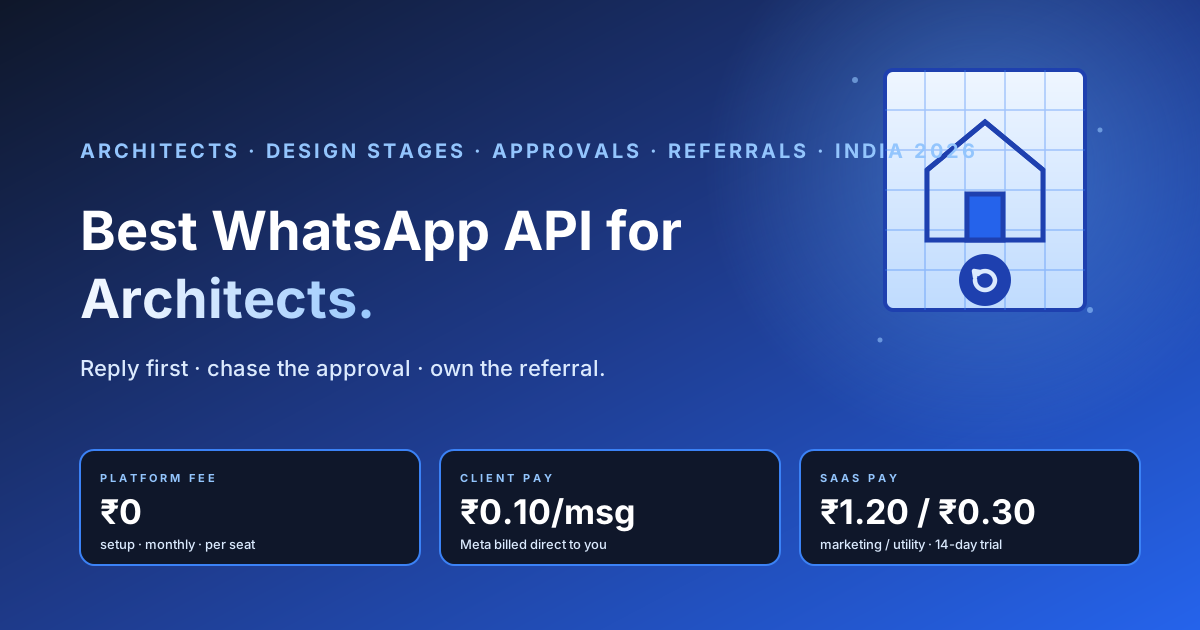
You can stand up the entire client-relationship layer — instant enquiry capture from referrals, portfolio site and ads, chatbot answers on fees, timelines and services, brief-and-project qualification, consultation booking, design-stage drawing shares with approval requests, site-visit scheduling across projects, milestone-payment nudges, clean handover documentation, and an opted-in referral, review and stay-warm engine — without engineering lift, while your design tools and project records stay the source of truth. RichAutomate charges ₹0 platform fee, ₹0 setup, ₹0 monthly. On Client Pay you pay only ₹0.10 per message plus Meta's own per-conversation charge billed to you directly by Meta at Meta's rates; on SaaS Pay it is an all-in ₹1.20 per marketing conversation and ₹0.30 per utility conversation — and consultation confirmations, approval requests, scheduling and milestone nudges are utility conversations, the cheaper category. There is a 14-day free trial with 100 credits, so you can measure the project-win and referral improvement before committing. Keep WhatsApp as the conversation layer, keep your design tools and project records as the source of truth, and verify advertising and DPDP data rules as of 2026. See the full pricing page for details.
Stop letting projects and referrals leak
An architecture practice does not have to lose a high-value project because the first reply came two days late from a site visit, watch a live project stall because nobody chased the working-drawing approval, or let a delighted client who would refer three more go cold the moment the project closed. From the instant referral or click-to-WhatsApp capture, through the brief qualification, the consultation booking, the design-stage drawing shares with approval requests, the site-visit scheduling and the milestone-payment nudges, to the post-handover referral ask — WhatsApp can be the one continuous client thread, while your design tools and project records stay the source of truth. On illustrative numbers that means more high-value projects won, fewer stalled builds, milestones paid on time and a referral pipeline that compounds, for a messaging bill that is negligible against an architectural fee. RichAutomate's pricing stays flat through all of it: ₹0 platform fee, ₹0 setup, ₹0 monthly — Client Pay at ₹0.10 per message with Meta conversation charges billed direct by Meta, or SaaS Pay at ₹1.20 marketing / ₹0.30 utility all-in. Start the 14-day free trial with 100 credits, WhatsApp us at 918160311319, or book a 30-minute walkthrough at https://calendly.com/inrichdaddy/30min. (All cohort, project and referral figures here are illustrative — model your own on the calculator — no platform guarantees against Meta quality or ban actions, and advertising and DPDP rules change; verify the current position as of 2026. This is operational guidance, not legal, tax or financial advice.)
Start your 14-day free trial → · See full pricing · Read the interior designers guide
Related guide: See the WhatsApp Business API guide for marble & granite dealers for a vertical-specific breakdown.
Related: WhatsApp for false-ceiling, POP & gypsum-partition contractors in India (2026) — site-visit booking, per-sqft quotes, stage photos and milestone-payment reminders in one thread.