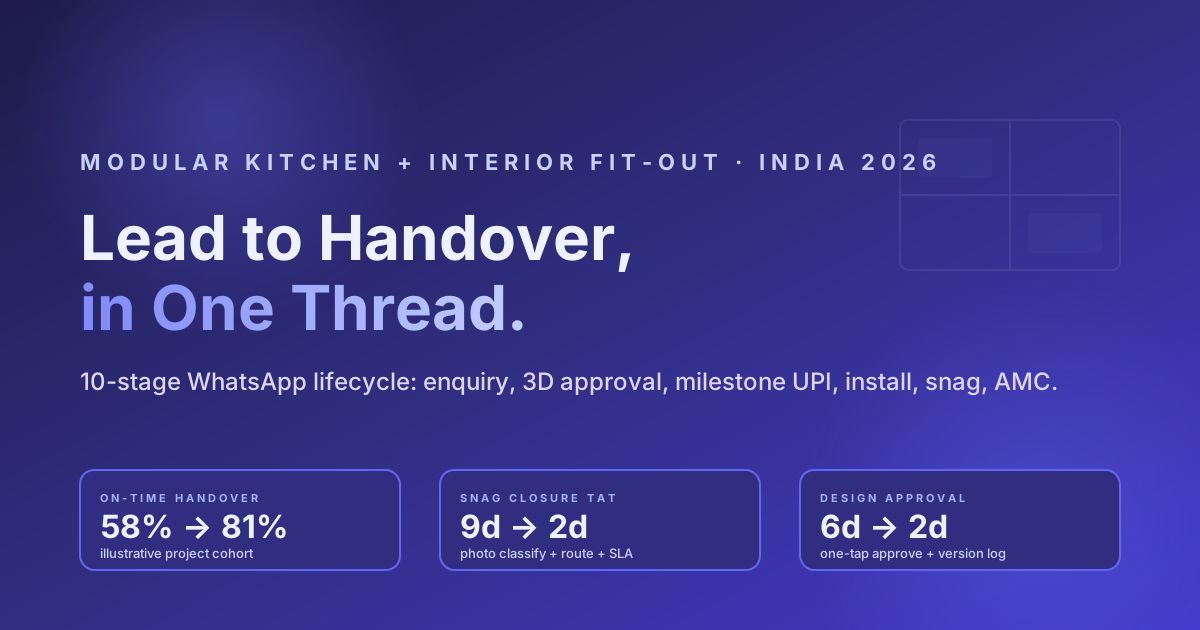
India's home-interior and modular market is directionally a ~₹2.3-2.5 lakh crore opportunity in FY26 by most industry estimates, yet only an estimated 10-12% is organised — the rest is local carpenters, contractors and unbranded fabricators. The modular-kitchen segment alone is a large and fast-compounding slice, with an average B2C project ticket landing in the ~₹3-8 lakh band once cabinetry, countertops, appliances, electricals and false-ceiling are bundled. The buyer is overwhelmingly a smartphone-and-WhatsApp-first urban household: they discover a design firm on Instagram, share their kitchen photos on WhatsApp, and expect the entire project — enquiry, 3D design, quote, milestone payments, factory status, installation and snag-closure — to live in one thread. Players from Livspace, HomeLane, Bonito Designs and Design Cafe down to the organising local carpenter are competing on exactly one axis the customer feels every day: did my project finish on time, on budget, and without the WhatsApp going silent for a week? This guide is the 2026 implementation playbook for the full 10-stage interior fit-out lifecycle on WhatsApp — lead to handover — with the BIS, Consumer Protection Act 2019, RERA-tie-up and GST works-contract carve-outs baked in, two-to-three comparison tables, an illustrative design-firm cohort, and the milestone-payment and snag-list mechanics that actually decide whether a project firm keeps its margin and its referral rate.
Why WhatsApp Is the Project Spine for Interior Fit-Out in 2026
An interior project is not a transaction — it is a 30-90 day, multi-vendor, milestone-funded construction sprint that a household lives through inside their own home. Five structural reasons make WhatsApp the operating spine rather than a CRM add-on:
- The buyer is already there. A typical ₹3-8 lakh kitchen buyer shares site photos, floor plans and inspiration screenshots over WhatsApp before they will ever install a vendor app. App-first design tools see heavy first-session drop-off; the thread does not.
- Milestone payments need a paper trail. Interior projects run on booking advance, design-freeze, pre-dispatch and post-install milestones. Each release needs an auditable approval — a WhatsApp thread with timestamped quote, GST breakup and one-tap UPI link is that trail.
- Service-deficiency is a top consumer-complaint category. Interiors and home-improvement consistently rank among the highest-volume grievance categories on consumer forums. A documented WhatsApp thread of approvals, snag photos and SLA timers is the firm's first line of defence under the Consumer Protection Act 2019.
- Daily install updates kill anxiety. The single biggest driver of bad reviews is silence during the 5-12 day on-site installation window. A daily photo-progress push converts anxiety into trust — and protects the final milestone release.
- Referral is the cheapest channel. A delighted handover that ends with a referral ask in-thread is the lowest-CAC pipeline a design firm has. The thread that managed the project is the same thread that asks for the next one.
The 10-Stage WhatsApp Interior Fit-Out Lifecycle
Each stage maps to a concrete WhatsApp surface — an approved Template, an interactive Flow, or an AI Pathway — plus the regulator touchpoint it must respect. This is the directional flow; exact timelines vary by city and scope.
| # | Stage | WhatsApp surface | Typical window | Regulator / control |
|---|---|---|---|---|
| 1 | Enquiry capture (space + budget + city) | Click-to-WhatsApp ad → Flow form: room type, carcass budget band, pin-code, possession date | Day 0 | DPDP consent at capture; purpose-limited |
| 2 | Site-measurement booking | Flow date-picker + designer assignment + address confirm + reminder Template | Day 1-4 | DPDP — address is locatable PII |
| 3 | 3D-design proposal + approval thread | Moodboard + 3D render images + one-tap "Approve / Request changes" buttons; version log | Day 5-14 | ASCI — no unverifiable "lifetime" claims |
| 4 | Quote + GST works-contract breakup | Itemised BoQ PDF + GST 18% works-contract line + payment-schedule Template | Day 12-18 | GST works-contract 18%; CPA pricing transparency |
| 5 | Milestone-1 booking advance (UPI / EMI) | One-tap UPI / WhatsApp Pay link or no-cost-EMI link via RBI-licensed PA | Day 14-20 | RBI Payment Aggregator norms; advance-payment fairness |
| 6 | Factory-production status | Auto status push at carcass-cut → assembly → QC → dispatch (BIS-graded materials) | Day 18-45 | BIS — IS 303 plywood, laminate, particle board |
| 7 | Site-installation scheduling | Flow slot-picker + crew assignment + pre-install checklist (civil readiness, power, water) | Day 40-50 | Civil-readiness gate; safety |
| 8 | Daily install progress + photo updates | Daily AI Pathway photo push: "Day 3 — base units fixed, countertop tomorrow" | Install window 5-12 days | DPDP — home photos are sensitive (reveal family) |
| 9 | Snag-list capture + closure | Customer one-tap defect photo → auto-classified ticket → SLA timer in-thread | Handover + 0-21 days | CPA 2019 service-deficiency; 21-day grievance SLA |
| 10 | Handover + warranty / AMC + referral | Warranty cert PDF + AMC opt-in + review Flow + referral link with attribution | D+0 from snag-clear | BIS warranty terms; CPA product-liability |
The milestone-payment insight. The two stages that decide a firm's working capital and dispute rate are Stage 5 (booking advance) and the pre-dispatch / post-install releases. Tie each release to a visible deliverable in the thread — design-freeze screenshot, factory-dispatch photo, install-complete snag-clear — and the customer pays faster because they can see what they are paying for. Firms that release payment requests without a linked deliverable see the highest payment-delay and chargeback risk.
FY26 Market Sizing (Directional)
Treat every number here as estimated / directional — the interior category is famously hard to measure because most of it is informal. By industry consensus:
- Home-interior + modular market: ~₹2.3-2.5 lakh crore total addressable in FY26, with the organised share at an estimated 10-12% and compounding faster than the informal tail.
- Modular-kitchen segment: a large, high-growth slice within this — kitchens are the highest-emotion, highest-ticket single room and usually the wedge product for a full-home upsell.
- Average B2C project ticket: ~₹3-8 lakh for a kitchen-plus-wardrobes scope once countertops, appliances, electricals and false-ceiling are bundled; full-home projects run materially higher.
- Buyer digital behaviour: the organised-segment buyer is effectively 100% smartphone-and-WhatsApp-reachable; discovery is Instagram-and-search-led, but the project itself migrates to WhatsApp because that is where photos, approvals and money already flow.
The strategic read: the organised share is small but the fastest-growing, and the firms taking share are not winning on design alone — they are winning on delivery reliability, which is an operations-and-communication problem WhatsApp is uniquely suited to solve.
Regulator and Legal Carve-Out for Interior Projects
| Regulator / law | What it governs | WhatsApp control |
|---|---|---|
| BIS (IS 303 plywood, laminate, particle board) | Material grades, glue class (MR / BWR / BWP), formaldehyde emission | Factory-status Stage auto-attaches BIS grade per SKU; quote states board class explicitly |
| Consumer Protection Act 2019 (+ 2020 e-commerce rules) | Service deficiency, unfair-trade-practice, product-liability, grievance redressal | Snag-list ticket with SLA timer; full approval-and-defect thread retained as evidence |
| GST — works-contract 18% | Composite supply of goods + services (interior fit-out = works contract), distinct from pure-goods supply | Quote Stage shows works-contract 18% line; composite-supply nuance disclosed, no mis-classification |
| RERA (builder tie-ups) | Interior delivered as part of possession / handover in builder-fit-out deals; defect-liability window | Handover cert + defect-liability clock surfaced in-thread for builder-channel projects |
| RBI Payment Aggregator norms | Advance and milestone collection must route through a licensed PA / gateway | UPI / EMI milestone links flow only through RBI-licensed PA (e.g. Razorpay / Cashfree class) |
| DPDP Act 2023 | Customer PII + home photos (address, family members visible) = sensitive; purpose limitation, consent, erasure | Consent at enquiry; photo-retention clock; erasure on request; no resale of moodboards / home imagery |
| ASCI advertising code | Design and warranty claims in marketing Templates | Claim-validator pre-flight: reject "lifetime warranty" / "import-grade" without BIS-backed evidence |
The GST works-contract nuance most firms get wrong. Interior fit-out is generally a works contract — a composite supply of goods (cabinetry, hardware) plus services (design, installation) — taxed at 18% on the composite value, rather than billing modular goods and installation labour as if they were two unrelated line items. Splitting them incorrectly to chase a lower rate is a classifiable risk. The WhatsApp quote Template should state the works-contract treatment plainly so the customer sees one transparent 18% line and the firm has a defensible position. Always verify the exact treatment for your scope with a GST practitioner — composite-supply edges vary.
Book a WhatsApp booking demo
See how brands run bookings, reminders, and re-engagement on WhatsApp — DPDP-compliant, India-hosted. Book a 15-minute demo.
The customer LTV calculator turns repeat rate and margin into a per-customer number you can budget against.
The Snag-List and Dispute Channel — Where Projects Live or Die
Snagging is the moment a happy customer becomes a reviewer — in either direction. The difference between a 2-day and a 9-day snag-closure is almost entirely a communication-and-routing problem, not a craftsmanship one. A WhatsApp-native snag loop works like this:
- One-tap defect capture. Customer photographs the issue (paint chip, hinge mis-align, laminate edge-lift, drawer-glide) and taps a category button. No app, no email, no "I'll call the office."
- Auto-classification + routing. An AI Pathway tags the defect class and routes it to the right trade — carpentry, electrical, plumbing, finishing — not a generic inbox.
- SLA timer in-thread. The customer sees a committed close-by date; the firm sees an ageing ticket. Both are looking at the same clock, which is the entire point under CPA 2019.
- Closure with proof. Snag closed only on a customer-confirmed photo, which becomes the trigger for the final milestone release. Payment and quality close together.
| Milestone / dispute event | Phone / email / spreadsheet | Vendor app | WhatsApp-native |
|---|---|---|---|
| Booking-advance request | Verbal + manual reminder; no trail | App push (often unseen) | One-tap UPI link + timestamped quote in same thread |
| Milestone approval evidence | Scattered emails / screenshots | In-app log (firm-side only) | Customer-visible approval buttons + version log |
| Snag capture | Phone call → lost detail | Form (low adoption) | Photo + category tap, auto-routed in seconds |
| Dispute / CPA evidence | Reconstructed after the fact | Exportable but one-sided | Two-sided timestamped thread, retained end-to-end |
| Final release trigger | Negotiated ad hoc | Manual sign-off | Auto-linked to confirmed snag-clear photo |
Per-Stage Automation Surface and KPI
Match the WhatsApp surface to the job. Templates for outbound proactive notices, Flows for structured capture, AI Pathways for unstructured photo / voice triage.
| Stage | Best surface | Automation | KPI to watch |
|---|---|---|---|
| Enquiry capture | Flow (form) | Room + budget + pin-code + possession in one card | Lead-to-measurement conversion |
| Measurement booking | Flow + Template reminder | Slot-picker + designer auto-assign + D-1 nudge | Measurement no-show rate |
| 3D approval | Template + buttons | Render push + approve / revise + version log | Design-approval cycle time |
| Quote + GST | Template (document) | BoQ PDF + works-contract 18% + schedule | Quote-to-advance conversion |
| Milestone advance | Template (CTA) | One-tap UPI / EMI via licensed PA | Advance-collection TAT |
| Factory status | Template (utility) | Cut → assembly → QC → dispatch push | "Where is my order" inbound volume |
| Install scheduling | Flow | Slot + crew + civil-readiness checklist | Install-start on-time rate |
| Daily progress | AI Pathway | Daily photo + plain-language status | Install-window complaint rate |
| Snag closure | AI Pathway + Template | Photo classify + route + SLA timer | Snag-closure TAT |
| Handover + referral | Flow + Template | Warranty cert + AMC opt-in + referral link | Referral rate; AMC attach |
Illustrative Cohort — A Mid-Size Design Firm (Illustrative)
The following numbers are illustrative of the direction a firm typically sees when it moves project communication onto a structured WhatsApp spine. They are not a guarantee — treat them as a directional model for an organised firm running roughly a few hundred projects a year across two-to-three cities.
| Metric | Before (ad hoc comms) | After (WhatsApp project spine) | Delta |
|---|---|---|---|
| On-time handover rate | 58% | 81% | +23pp |
| Design-approval cycle | 6 days | 2 days | -4 days |
| Milestone-payment delay (avg) | 11 days late | 3 days late | -8 days |
| Snag-closure TAT | 9 days | 2 days | -7 days |
| "Where is my project" inbound calls | High (weekly per project) | Low (status is pushed) | Sharp drop |
| Referral rate | Baseline | Materially higher | + (handover-triggered ask) |
The mechanism is unglamorous: faster approval cycles compress the project calendar, milestone requests linked to visible deliverables get paid sooner, daily install photos pre-empt the angry "what is happening" call, and a snag loop that closes in 2 days instead of 9 turns the final review positive. None of this is a design improvement — it is operations and communication discipline, encoded into the thread.
DPDP and the Sensitivity of Home Photos
Interior projects carry a privacy profile most retail WhatsApp use-cases do not: the firm collects the customer's home address, floor plan, and a stream of photographs of the inside of their house — frequently with family members, valuables and daily-life detail visible. Under the DPDP Act 2023 this is squarely personal data that demands purpose limitation and care. Practical controls:
- Consent at capture. The enquiry Flow states clearly what photos and address data are used for — design and execution — and nothing else.
- No moodboard / home-photo resale. Customer home imagery is never repurposed into marketing without a separate, explicit opt-in.
- Retention clock. Project photos carry a defined retention window; post-handover-plus-warranty, they are erasable on request.
- Access discipline. Only the assigned designer and install crew see a project's photos — not the whole org — minimising the blast radius of any breach.
Anti-Patterns That Wreck Interior Projects on WhatsApp
- Going silent during install. The single worst pattern. A 7-day install with no updates breeds a 1-star review. Push a daily photo even on a slow day.
- Milestone request with no linked deliverable. Asking for a payment release without showing the dispatch photo or snag-clear is what triggers disputes and delays.
- Approvals over phone calls. A verbally "approved" design with no thread record is a CPA liability when the customer later disputes the finish.
- One generic inbox for snags. Un-routed snag photos sit for days. Auto-classify and route to the right trade with an SLA timer.
- Mis-billing the GST works-contract. Splitting a composite works-contract into mis-classified goods-and-labour lines to chase a lower rate is a tax risk, not a clever optimisation.
- Hoarding the customer's home photos. Keeping moodboards and interior photos indefinitely, or reusing them in ads without consent, is a DPDP exposure on sensitive imagery.
12-Week Rollout for a Design Firm
- Week 1-2: Map the 10 stages to existing process; identify where the thread currently goes silent. Stand up the enquiry Flow and DPDP consent copy.
- Week 3-4: Build measurement-booking and 3D-approval Templates with version logging; wire designer auto-assignment.
- Week 5-6: Quote Template with works-contract 18% GST breakup; integrate UPI / EMI milestone links through a licensed PA.
- Week 7-8: Factory-status push (BIS-grade attach per SKU) and install-scheduling Flow with civil-readiness checklist.
- Week 9-10: Daily install-progress AI Pathway and the snag-capture-classify-route-SLA loop tied to final release.
- Week 11-12: Handover cert + AMC opt-in + referral attribution; turn on the KPI dashboard (approval cycle, payment delay, snag TAT, on-time handover, referral rate).
Run your interior projects on a WhatsApp spine with RichAutomate.
Ten-stage lifecycle — enquiry Flow (space + budget + city) → measurement booking → 3D approval with version log → works-contract GST quote → one-tap UPI / EMI milestones → factory-status push → install scheduling → daily photo progress → snag-classify-route-SLA → handover + AMC + referral — with BIS / Consumer Protection Act 2019 / GST works-contract / DPDP carve-outs built in. Illustrative cohort: on-time handover 58% → 81%, design-approval cycle 6d → 2d, snag-closure TAT 9d → 2d. ₹0 platform fee, usage-only billing. Talk to us on WhatsApp at 918160311319 or book a slot.
Related reading: WhatsApp for real-estate builders (RERA + site-visit + EMI), WhatsApp native payments + UPI checkout builder guide, and the best WhatsApp CRM for India 2026. See full pricing.
Related: fabricating windows and doors? Read WhatsApp for uPVC & aluminium window makers in India 2026.
Related: WhatsApp for false-ceiling, POP & gypsum-partition contractors in India (2026) — site-visit booking, per-sqft quotes, stage photos and milestone-payment reminders in one thread.