Run a supermarket or grocery store in India in 2026 — a single neighbourhood self-service store, a 4,000-square-foot supermarket with a home-delivery boy and a billing counter that backs up every evening, or a small regional chain of grocery outlets — and you already know the quiet truth of this business: your customers are loyal to convenience, not to you. The same family that bought their monthly ration from you for three years will switch to a quick-commerce app the day it is two minutes faster, and you will never know why because you have no channel to ask. A regular customer's monthly grocery order — the one that is essentially the same list every month — comes in as a phone call your counter staff scribble down and half-mishear, or it does not come at all because they ordered on an app instead. A festival is coming and you have a beautiful offer on dry fruits and sweets, but no way to reach the 2,000 households who shop with you. A delivery goes out and the customer waits at home with no idea when it will arrive. Stock of a fast-moving item runs out and the regulars who wanted it simply buy elsewhere. Grocery is a high-frequency, low-margin, repeat-by-default business where the entire game is owning the recurring monthly basket and the local relationship — and the customer is already on WhatsApp, taking orders, sharing lists and asking "bhaiya, is this in stock?" The store that turns that everyday WhatsApp chatter into an ordering, delivery-status and offer engine keeps the basket; the one that leaves it to memory and phone calls loses it to an app. This is the buyer's guide to choosing the best WhatsApp Business API for a supermarket or grocery store in India in 2026: what actually matters for this vertical, the order-and-delivery lifecycle it has to carry, and how to pick a platform that does not eat a low-margin grocer's thin profit. Treat every commercial and pricing specific below as "verify as of 2026," treat every figure as illustrative, and treat none of this as legal, tax or financial advice.
Why a grocery store is a WhatsApp problem. A grocery purchase is high-frequency, habitual and intensely local — the same household orders a broadly similar basket every week or month, decides on convenience and trust, and is already messaging the store for lists, stock checks and delivery. The deciding moments are all short messages: the monthly-list order that should be one-tap repeat instead of a mishearing phone call, the "is X in stock?" check, the order-confirmed and out-for-delivery update, the payment link, the back-in-stock nudge, the festival or weekend offer to opted-in regulars, and the loyalty reward that makes the household come back. The customer lives on WhatsApp and opens messages within minutes. WhatsApp is where a grocer owns the recurring basket and the local relationship that a quick-commerce app is trying to take — provided every send is consent-based, honest and genuinely useful. Verify advertising and DPDP data rules as of 2026; nothing here is legal advice, and no platform guarantees against Meta quality or ban actions.
What "best" actually means for a grocery store
The "best WhatsApp Business API" for a supermarket or grocery store is not the one with the most features or the loudest brand — it is the one that fits the specific shape of a high-frequency, low-margin, repeat-by-default business whose single biggest lever is owning the recurring monthly basket and the local relationship. Before comparing logos, get clear on the criteria that actually decide outcomes for this vertical. The table below is the buyer's checklist — weigh each against your own order volume and delivery mix as of 2026.
| What to evaluate | Why it matters for a grocery store | What good looks like |
|---|---|---|
| Order capture & list reorder | The monthly basket is essentially the same list; one-tap reorder beats a mishearing phone call and a quick-commerce app | Catalogue ordering, saved lists and one-tap monthly-basket reorder on chat |
| Stock & price enquiries | "Is X in stock?" and "what's the rate?" are the most common questions; instant answers keep the order in your store | Bot answers stock, price and offer questions, routes the rest to staff |
| Delivery status updates | A home delivery with no ETA breeds anxious calls; the status update is the service experience | Order-confirmed, packed, out-for-delivery and delivered updates on one thread |
| Payment & billing links | Cash-on-delivery ties up the delivery boy; a UPI link gets you paid before the basket leaves | Secure UPI / payment links on the order thread |
| Opted-in offers & loyalty | Festival, weekend and back-in-stock offers to opted-in households drive the repeat basket | Consent-based broadcasts and loyalty rewards with easy opt-out |
| Transparent, low pricing | A high-volume, low-margin grocer cannot carry a fat per-seat SaaS fee on top of thin grocery margins | ₹0 platform fee, pay only per message and Meta's conversation charge |
The reframe most grocers eventually make: the platform is not the product — the recurring relationship it lets you own is. A store that picks on price-per-message alone, but cannot run a one-tap monthly reorder or send a delivery ETA, has bought a cheaper way to lose the basket to a quick-commerce app. Pick for the recurring-basket journey, then optimise the cost. For the adjacent fast-fulfilment view, the WhatsApp for quick-commerce operations guide goes deep, and for the kirana and local-seller angle the ONDC kirana onboarding playbook is a useful companion.
The end-to-end grocery WhatsApp lifecycle
Here is the full lifecycle a grocery store can run over WhatsApp, from the first list order to the delivery update, the payment and the opted-in festival offer, mapped to the automation at each stage and the guardrail that keeps it ethical. Treat the automation column as a reference pattern and verify advertising and data-protection specifics as of 2026.
| Lifecycle stage | WhatsApp automation | Guardrail (verify 2026) |
|---|---|---|
| 1. Order capture | A QR at the counter, a flyer or a website button opens a chat; bot welcomes, shares the catalogue and captures the opt-in | Explicit opt-in at first contact; honour opt-out at any time |
| 2. List & basket build | Customer types or reorders a saved monthly list; bot confirms items, flags out-of-stock and suggests substitutes | Honest stock and substitution; no silent swaps or upsell tricks |
| 3. Order confirmation & payment | Order summary with prices, a secure UPI link, and a delivery or pickup slot | Secure payment links only; accurate prices and slot times |
| 4. Picking & delivery status | Packed, out-for-delivery and delivered updates, with the delivery boy's contact where relevant | Accurate ETAs; minimise personal data on chat; honour the slot |
| 5. Stock & back-in-stock | Bot answers stock and price questions; opted-in back-in-stock nudge when a wanted item returns | Honest availability; opt-in only for nudges; easy opt-out |
| 6. Feedback & complaints | A short post-delivery check and a fast human handoff for a wrong or missing item | Genuine make-good; honest about errors; quick resolution |
| 7. Offers, loyalty & reorder reminders | Opted-in festival, weekend and combo offers, loyalty rewards, and a gentle monthly-basket reorder nudge | Opt-in only; frequency caps; one-tap opt-out so it never feels like spam |
Notice the rhythm: WhatsApp captures the recurring order that a phone call mishears and an app steals, then keeps the household with delivery updates, loyalty and opted-in offers — which is where a grocer's real growth lives. For the festival-offer calendar the WhatsApp festival commerce playbook is a useful companion, and for the loyalty mechanics the WhatsApp loyalty programme architecture guide goes deep.
The recurring monthly basket: where a grocer's growth is won
The single most under-run asset a grocery store owns is the recurring monthly basket. Every regular household buys a broadly predictable list — atta, rice, dal, oil, tea, staples — on a roughly monthly rhythm, and that order is the most valuable, most defensible revenue a grocer has, because it is habitual and high-frequency. Yet most stores leave it entirely to memory and the customer's initiative: the household decides each month whether to call, walk in, or open a quick-commerce app, and the store does nothing to make itself the easy default. WhatsApp turns the monthly basket into a one-tap, owned, defended habit: a saved list the customer reorders with a single tap, a gentle opted-in "time for your monthly groceries?" nudge a few days before they usually run out, a substitute suggestion when something is out of stock, and a delivery slot they choose. The store that makes reordering the monthly basket the single easiest thing the household can do that month owns that revenue; the store that waits to be remembered loses a slice of it every time an app is two minutes faster. Most grocers never save the list, never store the consent, and never send the reminder — so they re-compete for the same loyal household every single month instead of defending a habit. Done well and honestly — real convenience, accurate stock, never spam — the recurring-basket engine is the highest-leverage, lowest-cost growth lever a grocer has.
Get a 1-minute BSP audit on WhatsApp
Drop your WhatsApp number — we line-item your current invoice against Meta India rates in under 60 seconds. India-hosted, DPDP-compliant.
The recurring-basket engine, in one principle. Treat every household as a recurring relationship you have permission to make convenient, not a transaction that depends on them remembering you. Save the list, store explicit consent, cap the frequency so it never feels like spam, send a warm opt-in reorder nudge a few days before they usually run out, and make opting out a single tap. The thread should feel like a store that makes the household's life easier — never like a channel engineered to pester. Verify advertising and DPDP data rules as of 2026; this is not legal advice, and no platform guarantees against Meta quality or ban actions.
Worth knowing the scale of the risk, and the DPDP penalty calculator estimates it from your own numbers.
Per-seat SaaS vs a ₹0-platform model: the margin question
A grocery store runs on thin margins and high volume — hundreds of low-value baskets a week, seasonal spikes around festivals and month-ends — so a fixed monthly platform fee on every counter login is dead weight in the quiet weeks and an arbitrary tax in the busy ones. Most legacy BSPs charge a per-seat or tiered monthly platform fee on top of Meta's own per-conversation charge; a ₹0-platform model charges only for what you actually send. This comparison is directional — verify current pricing on each vendor as of 2026.
| Dimension | ₹0-platform model (RichAutomate) | Typical per-seat / tiered SaaS BSP |
|---|---|---|
| Platform / setup / monthly fee | ₹0 platform, ₹0 setup, ₹0 monthly | Monthly platform fee, often per seat or per tier |
| What you pay for | Only per message + Meta's conversation charge | Subscription + markup on conversations |
| Fit for a low-margin, high-volume grocer | Costs scale with orders and updates sent; a quiet week costs little | You pay the subscription even in a slow week |
| Margin impact on a ₹400 basket | Messaging cost is a few paise against the basket | Fixed fee eats into a thin grocery margin |
| Billing transparency | Client Pay: Meta bills you direct at Meta rates | Often a bundled markup you cannot see through |
The conclusion most grocers reach: for a low-margin, high-volume business, a model where the messaging cost is a few paise against each basket beats a fixed monthly tax you pay whether you do fifty orders or five hundred. Run your own numbers on the WABA cost calculator and read the Client Pay vs SaaS Pay billing breakdown before committing.
The automation stack that runs it
The good news for a grocer is that none of this needs custom engineering. The building blocks map onto a standard WhatsApp Business API automation stack: a QR and counter-flyer capture flow that turns a walk-in into an opted-in WhatsApp contact; a catalogue and list-reorder flow with the product list, saved monthly baskets and one-tap reorder; a chatbot FAQ that answers stock, price, offer and timing questions without a human; an order-and-payment step with an order summary, a secure UPI link and a delivery or pickup slot; a delivery-status engine with packed, out-for-delivery and delivered updates; a back-in-stock nudge for opted-in customers; a feedback and complaint path with fast human handoff; an opted-in broadcast engine for festival, weekend and combo offers plus loyalty rewards and monthly-basket reorder reminders; and a human handoff the moment a customer raises a wrong-item or billing issue. For the cost-modelling side the sweet-shops and mithai buyer guide shares the same festival-and-offer rhythm, and the quick-commerce playbook covers the fast-delivery spine. The discipline is to keep the chatbot scoped to catalogue, stock and status, and route every complaint and billing query to a human.
The economics: an illustrative store cohort
Criteria and architecture are the floor; the reason to run WhatsApp across the grocery lifecycle is more recurring baskets defended, fewer orders lost to apps, smoother deliveries, and an opted-in base you can re-engage every festival and weekend. Consider an illustrative single supermarket running a mix of walk-in counter sales, home-delivery orders, and an opted-in base of regular households with saved monthly lists. Every figure below is illustrative — model your own on the calculator.
| Metric (illustrative) | Without WhatsApp lifecycle | With WhatsApp lifecycle |
|---|---|---|
| Share of monthly baskets ordered direct | Variable; many drift to quick-commerce apps | Higher; one-tap reorder and reminders keep them |
| Order errors from phone-call lists | Frequent mishearings and missed items | Fewer; the order is written, confirmed and saved |
| Anxious "where's my delivery?" calls | Common | Fewer; status updates pre-empt them |
| Reach for a festival or weekend offer | Word of mouth only | Direct; opted-in households hear first |
| WhatsApp messaging cost | ₹0 | Utility order and delivery messages at the cheapest tier |
The asymmetry is the argument: order confirmations, packed and out-for-delivery updates and delivered notifications are largely utility-category conversations — the cheapest tier — and they directly reduce the most expensive failures in a grocery store, namely recurring baskets lost to quick-commerce apps, order errors from misheard phone lists, and a base of loyal households you can never reach when you have an offer. A handful of extra defended baskets and offer-driven orders a week dwarf the messaging bill, which is a few paise against each basket. Run your own figures on the quick-commerce operations guide before committing.
Build the grocery lifecycle on RichAutomate
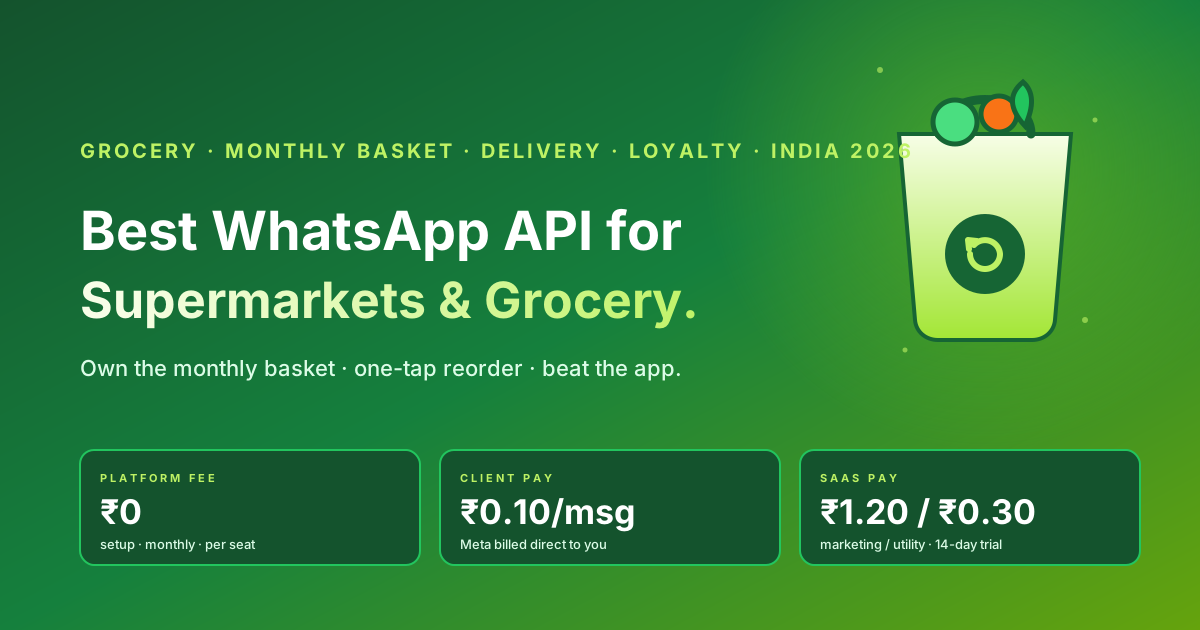
You can stand up the entire recurring-relationship layer — QR and counter capture, a catalogue and one-tap monthly-basket reorder, chatbot answers on stock, price and offers, order and payment with a UPI link and slot, delivery-status updates, back-in-stock nudges, feedback and complaint handling, and opted-in festival, weekend and loyalty broadcasts with reorder reminders — without engineering lift, while your billing counter and stock system stay the source of truth. RichAutomate charges ₹0 platform fee, ₹0 setup, ₹0 monthly. On Client Pay you pay only ₹0.10 per message plus Meta's own per-conversation charge billed to you directly by Meta at Meta's rates; on SaaS Pay it is an all-in ₹1.20 per marketing conversation and ₹0.30 per utility conversation — and order confirmations, delivery updates and reorder reminders are utility conversations, the cheaper category. There is a 14-day free trial with 100 credits, so you can measure the basket-retention lift before committing. Keep WhatsApp as the conversation layer, keep your counter and stock as the source of truth, and verify advertising and DPDP data rules as of 2026. See the full pricing page for details.
Also selling phones or accessories at the counter? See our guide to WhatsApp for mobile phone & accessory retailers.
Stop losing the monthly basket to an app
A grocery store does not have to watch a loyal household drift to a quick-commerce app because it was two minutes faster, mishear a monthly list over a noisy phone call, or sit on a festival offer with no way to reach the 2,000 households who shop with you. From the counter QR capture, through the one-tap monthly-basket reorder, the order and UPI payment, the delivery-status updates, and the opted-in festival, loyalty and reorder reminders — WhatsApp can be the one recurring customer thread, while your counter and stock system stay the source of truth. On illustrative numbers that means more baskets defended, fewer order errors, smoother deliveries, and an opted-in base you can re-engage every festival, for a messaging bill that is a few paise against each basket. RichAutomate's pricing stays flat through all of it: ₹0 platform fee, ₹0 setup, ₹0 monthly — Client Pay at ₹0.10 per message with Meta conversation charges billed direct by Meta, or SaaS Pay at ₹1.20 marketing / ₹0.30 utility all-in. Start the 14-day free trial with 100 credits, WhatsApp us at 918160311319, or book a 30-minute walkthrough at https://calendly.com/inrichdaddy/30min. (All cohort, order and basket figures here are illustrative — model your own on the calculator — no platform guarantees against Meta quality or ban actions, and advertising and DPDP rules change; verify the current position as of 2026. This is operational guidance, not legal, tax or financial advice.)
Start your 14-day free trial → · See full pricing · Read the loyalty programme guide
Related: WhatsApp for roller flour mills (atta/maida) in India 2026 — daily rate broadcasts, B2B order capture and FSSAI-safe document delivery.
Related: GST 2.0 Rate Changes: WhatsApp Retail Pricing 2026 — keeping catalogue prices, MRP stickers and invoices in sync on the effective date, with rates verified by a CA.