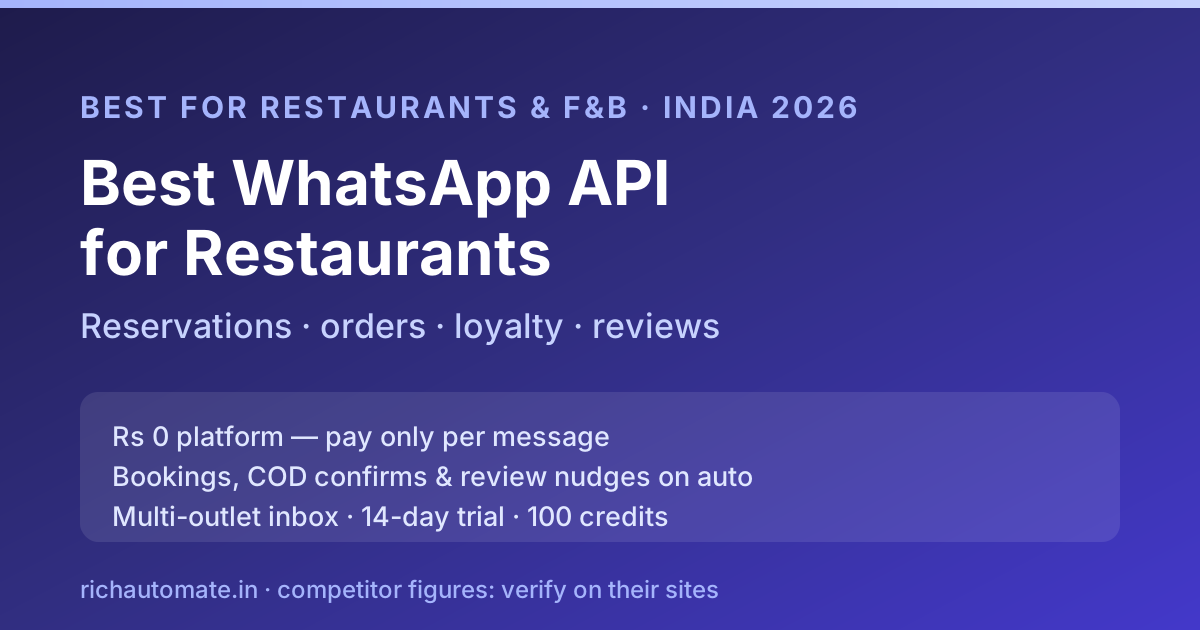
The short answer. A restaurant does not need a generic chat tool — it needs WhatsApp wired into the parts of the business that leak money: empty tables, missed call-in orders, unconfirmed cash-on-delivery, and customers who never come back. The levers that decide the right provider are platform fee, multi-outlet management, how easily you can run a booking and ordering flow without an engineer, and per-message cost you can actually predict. RichAutomate fits the restaurant shape: ₹0 platform fee, ₹0 setup, ₹0 monthly, a flat per-message line, a multi-outlet inbox, and a no-code builder for reservation, order and review flows. Be honest, though — if you only want a shared inbox glued onto a delivery aggregator, a lighter tool may do; and a huge chain across many cities with a deep POS integration may need an enterprise CPaaS. For the bakery counterpart of this playbook, see our guide to bakery and cake-shop WhatsApp automation.
This is a practical, honest guide to choosing a WhatsApp Business API provider for an Indian restaurant, cafe, cloud kitchen, bakery, bar or catering business in 2026. We cover what food-and-beverage operators actually need from WhatsApp, the criteria that matter, which provider shape fits which kind of restaurant, an illustrative cost model, and a one-week rollout plan for a single outlet or a small group. Treat every competitor figure as something to verify on their site, and every rupee number here as illustrative — model your own with real covers and order volumes.
Why restaurants run on WhatsApp in India
In most Indian cities the customer already has WhatsApp open. They message to ask if a table is free on Saturday, to place a Sunday biryani order, to confirm a cake pickup, or to ask whether the kitchen is still serving. The phone rings during the dinner rush and nobody can pick up; the message sits unanswered and the order goes to the place that replied. That gap — between when a guest reaches out and when the restaurant responds — is the single biggest, cheapest revenue leak in food service, and it is exactly what the WhatsApp Business API closes.
The official API is what lets a restaurant move past the consumer WhatsApp Business app limits: automated replies at any hour, reservation and order flows with buttons and lists, broadcast of the day specials to opted-in regulars, delivery and pickup confirmations, and review collection after the meal — all on an approved business number with a green tick path. The four food-service moments that pay for themselves are reservations, takeaway and cash-on-delivery confirmation, loyalty and re-ordering, and post-visit reviews.
- Reservations and waitlist. A booking flow captures party size, date and time without a single phone call, sends a confirmation, and nudges a reminder so the table is not held empty for a no-show.
- Takeaway, delivery and COD confirmation. Direct orders skip aggregator commission, and a confirmation step before dispatch cuts the cash-on-delivery returns that quietly eat margin.
- Loyalty and re-ordering. A “reorder your usual” nudge and a festival or weekend special to opted-in regulars brings repeat covers at almost no cost.
- Reviews and recovery. A polite post-meal message asking for a Google review — or quietly catching an unhappy guest before they post — protects the rating that decides your next walk-in.
What restaurants actually need from a WhatsApp Business API
Running WhatsApp for a kitchen is not the same as running it for a SaaS company. The staff are on the floor, not at a desk; volumes spike at lunch and dinner; and the people answering messages change shift. The needs that matter most for food and beverage:
- Low or zero platform fee. Restaurant margins are thin. A per-seat or monthly platform fee on top of message cost is the first thing that makes WhatsApp feel expensive. A ₹0 platform fee means you only pay for what you send.
- A no-code flow builder. You should be able to build a reservation flow, an order menu and a review nudge yourself — not file a ticket with a developer. Buttons, lists and simple branching cover most restaurant journeys.
- A shared inbox the floor can use. Several staff need to see and reply to the same number across a shift, with a clean handoff so a guest is not answered twice or not at all.
- Multi-outlet management. If you run two cafes or a small group, you want each outlet number manageable from one place rather than juggling logins per branch.
- Predictable per-message cost. A flat, knowable per-message or per-conversation rate lets you budget the channel against covers, instead of decoding a multi-channel wallet bill.
- Compliance and consent built in. Opt-in capture, easy opt-out, and clean approved templates keep your number healthy and keep you on the right side of India data-protection expectations.
For the operational playbooks behind each of these — reservations, FSSAI-aware messaging and loyalty — our restaurant chains WhatsApp guide and the QSR and food-delivery playbook are the companion how-to pages to this buyer-decision guide.
The WhatsApp template approval checker will tell you whether the wording is likely to clear review before you waste a submission.
Criteria to compare providers (for restaurants)
Score any provider against the things that move a restaurant P&L, not the long enterprise feature list:
| Criteria | Why it matters to a restaurant | RichAutomate |
|---|---|---|
| Platform fee | On thin food margins, any monthly or per-seat fee on top of messages is what makes the channel feel costly | ₹0 platform fee, ₹0 setup, ₹0 monthly — pay only per message |
| No-code flow builder | Floor managers build reservation and order flows without a developer | Visual no-code builder with buttons, lists, reminders and branching |
| Shared / multi-agent inbox | Several staff answer one number across a shift with clean handoff | Shared team inbox with assignment and handoff |
| Multi-outlet management | Run several branch numbers from one place as you grow | Manage multiple outlet accounts and numbers |
| Per-message transparency | Budget the channel against covers and orders, not a mystery wallet | Flat per-message line; Client Pay ₹0.10/msg or all-in SaaS Pay |
| Order & payment flows | Take direct orders and confirm COD without aggregator commission | Catalogue, order capture and UPI/payment-link friendly flows |
| Consent & templates | Opt-in, opt-out and approved templates keep the number healthy | Opt-in capture, opt-out handling, template management built in |
The platform fee is the lever restaurants underweight most, because the per-message rate looks small in isolation. If you are weighing whether to have your covers billed through an all-in rate or pay Meta direct on your own number, our Client Pay vs SaaS Pay billing guide explains both models in plain language.
Get a 1-minute BSP audit on WhatsApp
Drop your WhatsApp number — we line-item your current invoice against Meta India rates in under 60 seconds. India-hosted, DPDP-compliant.
Honest — which provider fits which restaurant
Pick RichAutomate if you run an independent restaurant, cafe, bakery, bar, cloud kitchen or a small multi-outlet group and you want WhatsApp doing real work — reservations, direct orders, COD confirmation, loyalty broadcasts and review collection — without a platform fee eating your margin. The ₹0 platform fee plus a flat per-message line means the channel cost tracks your volume; the no-code builder lets a manager set up the flows; and the multi-outlet inbox grows with you. For an owner-operated or small-group restaurant that wants control and predictable cost, this is the recommended pick.
Consider a single-purpose aggregator inbox tool if your whole need is a shared inbox bolted onto your delivery-aggregator chats and a couple of canned replies, and you do not care about reservations, direct ordering or broadcasts. Lighter tools (as of 2026, verify on their sites) can be a pleasant, cheap shared inbox; just check whether they run the official WhatsApp Business API and what they charge per seat, because seat fees add up across a busy floor.
Consider an enterprise CPaaS if you are a large national chain across many cities that needs a deep two-way integration with a specific POS or aggregator, multi-channel reach (SMS, voice, email and WhatsApp behind one API), and a named account manager with a white-glove SLA. Enterprise platforms such as Gupshup or other large CPaaS vendors (as of 2026, verify on their sites) are built for that managed, high-touch relationship, and a self-serve tool would not replace the integration depth or account management at that scale.
The restaurant economics (illustrative)
Say a single outlet sends roughly 3,000 WhatsApp conversations a month — for the model below, assume about 2,200 utility or service conversations (booking confirmations, order updates, COD confirms, reminders) and 800 marketing conversations (specials, festival offers, loyalty nudges). The figures are illustrative; model your own with real covers and order counts.
| Model | How it bills the restaurant | Illustrative effect |
|---|---|---|
| RichAutomate — Client Pay | You are billed by Meta direct for conversations on your own number; RichAutomate adds ₹0 platform fee and a flat ₹0.10/msg platform charge | No platform fee to absorb — channel cost tracks message volume and you keep visibility on Meta direct billing |
| RichAutomate — SaaS Pay | All-in ₹1.20 per marketing and ₹0.30 per utility-or-authentication conversation, ₹0 platform fee, one simple bill | One predictable line; on the mix above the utility-heavy traffic is the cheap ₹0.30 tier, specials are the ₹1.20 tier |
| Per-seat / platform-fee tool (verify) | A monthly platform or per-seat fee, plus per-message cost (as of 2026, verify on their site) | The fixed fee is paid whether it is a busy month or a quiet one, on top of message cost — it does not scale down with covers |
The point is the shape, not one magic number: a ₹0 platform fee plus a flat per-message line means a quiet monsoon month costs less and a Diwali rush costs more, in proportion to what you actually send. Run your own outlet numbers through the WABA cost calculator before you commit. All Meta conversation pricing and GST specifics should be verified as of 2026.
How a restaurant goes live in one week
You do not need to build everything at once. Ship the two or three flows that move money first, then add the rest. A typical one-outlet rollout:
- Day 1 — start the trial and connect your number. Use the 14-day free trial with 100 free credits, then connect or migrate your restaurant number onto the official Meta WhatsApp Cloud API. Going live depends on Meta verification — usually a day or two, but treat that as an estimate.
- Day 2 — reservations and order menu. In the no-code builder, set up a booking flow (party size, date, time, confirmation, reminder) and a takeaway order flow off your menu. These two carry most of the value.
- Day 3 — confirmations and reminders. Create utility templates for booking confirmation, order-ready and COD confirmation, and submit them for Meta approval.
- Day 4 — the floor inbox. Put your shift staff into the shared inbox, set assignment rules so messages do not get double-answered, and write a few quick replies for common questions (timings, address, veg options).
- Day 5 — loyalty and reviews. Add an opted-in specials broadcast and a polite post-visit review nudge. Capture opt-in at booking and honour opt-out from the first message.
- Days 6–7 — watch and tune. Read the first few days of real conversations, fix the points where guests drop off, and only then add loyalty tiers, festival campaigns or a second outlet.
What every restaurant keeps. Whichever provider you use, the official WhatsApp Business API sits underneath, so message types, template rules and Meta policies are the same across tools. What changes is the commercial model — the platform fee that decides your cost, and whether you pay Meta direct — not the channel itself. For cloud-kitchen and dark-store specifics see our cloud kitchen ops guide; for where a WhatsApp platform sits next to your guest list and CRM, see the best WhatsApp CRM guide; and if you sell packaged food, our FSSAI labelling note covers the compliance edge.
The honest bottom line
For an Indian restaurant, cafe, cloud kitchen or small F&B group, the best WhatsApp Business API provider is the one that turns the channel into reservations, direct orders, repeat covers and protected reviews without a platform fee eating thin margins. RichAutomate is the recommended pick when you want WhatsApp doing real work: ₹0 platform fee, ₹0 setup, ₹0 monthly, flat Client Pay at ₹0.10/msg on your own number with Meta billing you direct, or all-in SaaS Pay at ₹1.20 per marketing conversation and ₹0.30 per utility-or-authentication conversation — plus a 14-day free trial with 100 free credits, a no-code flow builder, a shared multi-outlet inbox, and consent and template handling built in. Consider a lighter aggregator-inbox tool if all you need is a shared chat window, or an enterprise CPaaS if you are a large multi-city chain needing deep POS integration and an account manager. Pick by the shape of your restaurant, not by hype. And one honest caveat: no vendor — not RichAutomate, not anyone — can guarantee against a WhatsApp restriction. What keeps a restaurant number healthy is relevant, consented, well-spaced messaging on the official API with a prompt, easy opt-out.
Ready to put WhatsApp on the menu?
Tell us how many outlets you run and your rough monthly covers, and we will model the real cost with you and show you a reservation, order and review flow live — no pressure, no jargon. WhatsApp us at 918160311319, or book a 30-minute walkthrough at https://calendly.com/inrichdaddy/30min and we will set up the booking flow, the floor inbox and the billing models side by side.
Start your 14-day free trial → · See full pricing · Run the WABA cost calculator
Related: sell or service commercial kitchen equipment? See WhatsApp for commercial kitchen equipment dealers in India 2026 — win the breakdown ticket + the AMC.