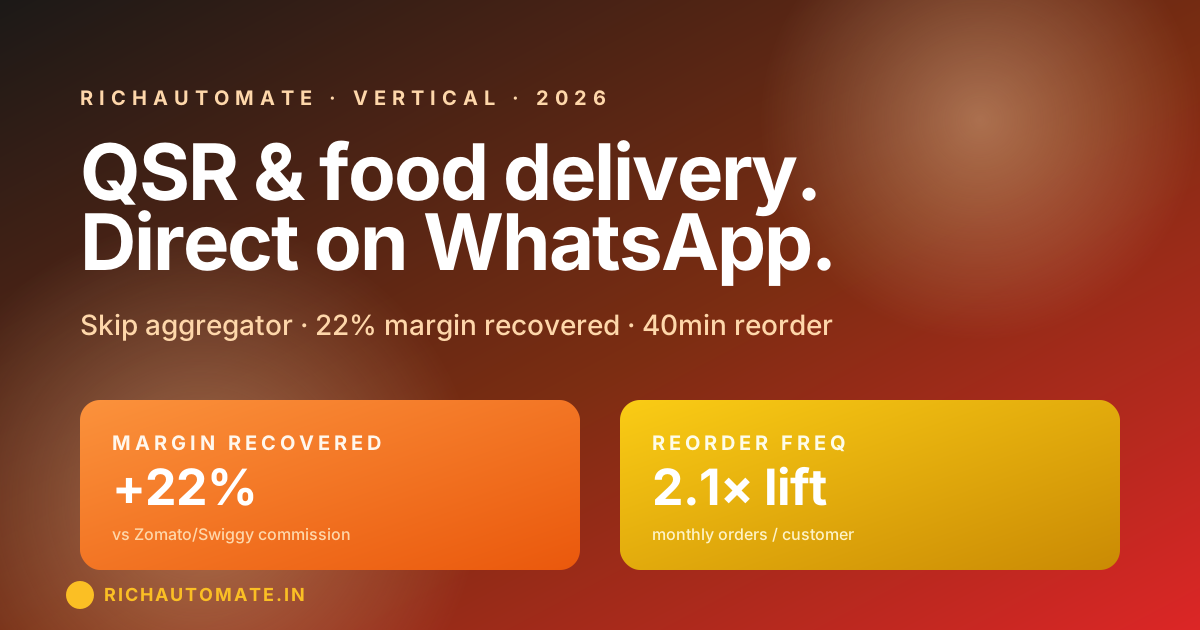
Indian QSR + cloud-kitchen + restaurant economics is broken in 2026. Zomato + Swiggy take 22-32% commission per order, demand 18-24% extra discount funding during "visibility boosts", and own the customer relationship — meaning the brand never sees the phone number, never owns the reorder, and pays full CAC again next time. The math is brutal: a ₹420 order on Zomato leaves the brand ₹260-290 net contribution after commission + discount funding + packaging, whereas a ₹420 order direct on WhatsApp leaves ₹360-380. The 2026 fix Indian QSR brands are running: dual-channel — keep aggregators for top-of-funnel discovery, drive every existing customer to WhatsApp ordering for direct margin. This guide is the implementation playbook.
The Aggregator Tax: What Indian QSR Actually Pays
| Cost line | % of order value | Notes |
|---|---|---|
| Platform commission | 22-28% | Higher for new brands, lower for top-tier with leverage |
| Visibility boost / ads | 4-8% | De facto required for category page ranking |
| Discount funding | 10-18% | Brand-funded portion of platform offers |
| Packaging mandate | 2-4% | Branded vs platform-branded |
| Payment gateway | 2% | Bundled in platform commission |
| Total aggregator load | 40-58% | Net contribution before food cost |
On a ₹420 average order, brand keeps ₹260-290 net before food cost (typically 32-38%). True margin per aggregator order: ₹100-160. Direct WhatsApp order on same ₹420: ₹360-380 net before food cost, true margin ₹220-260 — a 2× margin uplift on the same customer.
The Seven WhatsApp Moments That Drive QSR Direct-Order
| Moment | Trigger | WhatsApp action | Lift target |
|---|---|---|---|
| Aggregator-to-direct migration | Customer's 2nd-3rd aggregator order | QR on bill / packaging insert: "Reorder direct + 10% off" | 32-48% migrate to direct in 60 days |
| 1-tap reorder | Existing customer at usual order time | "Same as last time?" with full menu fallback | Reorder in 40 sec vs 4 min on app |
| Lunchtime nudge | 11:30 AM weekdays for office customers | Personalised carousel based on past orders | 22-34% open-to-order rate |
| Dinner combo upsell | Customer in cart, dinner items only | Suggested side + dessert with combo discount | +₹64 AOV uplift |
| Out-of-stock substitute | Item unavailable mid-order | 2-3 SKU substitute carousel + 1-tap swap | 78% retain order vs cancel |
| Order tracking + delivery | Order placed | Real-time prep + dispatch + ETA in thread | "Where's order" tickets -82% |
| Loyalty milestone | 5th, 10th, 20th order | Free dish unlock + tier badge | +24% order frequency |
Real Indian QSR Numbers
5-outlet North Indian cloud-kitchen, ₹420 AOV
| Metric | Aggregator-only | Aggregator + WhatsApp direct |
|---|---|---|
| Orders / month | 14,200 | 13,800 aggregator + 6,400 WhatsApp = 20,200 |
| Net contribution / order | ₹146 | Aggregator ₹146 + WhatsApp ₹312 = blended ₹199 |
| Total monthly contribution | ₹20.7L | ₹40.2L |
| Customer LTV (12 month) | ₹2,840 | ₹6,180 |
| Reorder frequency / customer / month | 1.4 | 2.9 |
South Indian QSR chain, 12 outlets, ₹280 AOV
| Metric | Without WhatsApp | With |
|---|---|---|
| Direct order share of total volume | 0% | 34% |
| Net margin recovered / month | — | ₹14.8L |
| Aggregator dependency reduced | — | 34 percentage points |
| Customer phone ownership | 0% | 62% (and growing) |
Catalog Architecture: WhatsApp-Native Menu
Indian QSR brands run three patterns:
The BSP migration cost calculator covers the costs people forget: the overlap month and re-approving every template.
- WhatsApp Catalog with native UPI checkout. Best for sub-50 SKU menus. Customer taps menu → 1-tap UPI pay → order routes to outlet POS. Sub-90-second order completion.
- Hybrid: WhatsApp menu + minisite checkout. 50+ SKU menus or complex modifier choices (extra cheese, no onion, spice level). WhatsApp shows top-15 carousel; deep-link to mobile-optimised minisite for full menu + customisation.
- WhatsApp-as-concierge + outlet phone. Premium / fine-dine. WhatsApp for menu + reservations + takeaway; complex orders confirmed by outlet manager.
Operating Rule
The single highest-leverage move for any Indian QSR running on aggregators is printing a WhatsApp QR + 10% direct-discount on every aggregator order's bill / packaging insert. 32-48% of repeat customers migrate to direct ordering within 60 days. The aggregator pays for the customer acquisition; you keep them on direct from order 2 onwards. Pure margin recovery, zero added CAC.
Get a 1-minute BSP audit on WhatsApp
Drop your WhatsApp number — we line-item your current invoice against Meta India rates in under 60 seconds. India-hosted, DPDP-compliant.
The Six Anti-Patterns That Wreck QSR WhatsApp
- Treating WhatsApp as a customer support channel only. Customers will order if you make ordering native; if you reply with "please use Zomato" you train them to bypass you.
- Too many menu items in one message. Carousel of 8-12 SKUs converts; full 60-item menu in one message kills the order. Curate by daypart + customer history.
- Manual order confirmation. Customer waits 12 minutes for "order received" response = goes back to Swiggy. Auto-confirm + payment link within 30 seconds.
- No offline-to-direct handoff. Customer orders dine-in or aggregator, never gets onboarded to direct WhatsApp. QR on bill / table tent / packaging is mandatory.
- Marketing template for order updates. Order received, prep started, dispatched, delivered = utility. Sending these as marketing burns 8x cost + lower deliverability.
- Identical loyalty programme to aggregator. Customer perceives no value to migrate. Direct WhatsApp loyalty must be measurably better — extra menu items, faster reorder, exclusive freebies.
Trigger + Routing Architecture
Customer scans QR on bill / table / package → enters WhatsApp thread
Auto-reply utility template within 5 sec:
  "Welcome — here's 10% off your next direct order. Tap to see menu."

Menu interaction → POS-synced inventory check → cart build
Cart → 1-tap UPI checkout (WhatsApp Pay or Razorpay link)
Order placed → routed to nearest outlet POS via webhook
Auto-utility templates fire:
  Order received (T+0) → prep started (T+3 min) → dispatched (T+15 min) → ETA + courier name (T+18 min) → delivered (T+38 min)

Daily 11:30 AM cron:
  Identify customers with 2+ orders in past 30d, no order in past 7d
  Personalised lunch carousel based on past orders
  Utility template since behaviour-triggered

Loyalty engine:
  Order count tracked per customer
  Milestone unlock (5th, 10th, 20th) → automated free-dish credit added
  Notification via WhatsApp utility template

Quarterly:
  Cohort analysis: aggregator → direct migration rate
  LTV uplift on direct vs aggregator-only customers
  Top 10% reorder frequency cohort → priority queue + premium loyalty
Compliance + Operational Notes
- FSSAI compliance — Food delivery via WhatsApp must include FSSAI license number on order confirmations. Brand outlets retain operational FSSAI; not a barrier.
- DPDP Act 2023 — explicit opt-in at QR scan for WhatsApp marketing + offers + order updates.
- Meta categorisation — order received, prep, dispatch, delivered, ETA = Utility (₹0.115/msg). Lunch nudge, combo upsell, loyalty milestone = depends on context — behaviour-triggered with customer context = Utility; broad promo broadcasts = Marketing (₹0.96/msg).
- Inventory sync — POS to WhatsApp Catalog sync every 60-90 sec to prevent ordering out-of-stock items. Catalog showing unavailable items = quality complaint risk.
- Refund / cancellation — auto-trigger refund template within 1 hour of cancellation; UPI refund to source within 24 hours. Slow refunds destroy direct-order trust.
Run QSR direct-order on RichAutomate.
POS-synced WhatsApp Catalog. UPI native checkout. Lunchtime + dinner nudge automation. Loyalty engine with milestone unlocks. Pre-approved utility templates for order lifecycle. Aggregator-to-direct QR migration toolkit. 14-day trial, no card.
Related reading
- WhatsApp for Restaurant Chains India 2026: FSSAI + Ops
- WhatsApp for Beauty + Cosmetics D2C India 2026: Seven Moments, 38% Repeat Rate, Real Category Numbers
- WhatsApp for Indian Automotive Dealerships 2026: 24% Lead-to-Delivery, 78% Y3 Service Retention, Real Dealer Numbers
- WhatsApp for Indian Event Ticketing + Venue 2026: 38% Day-1 Sell-Through, 8% No-Show Rate, Real Cohort Numbers
- DPDP Act WhatsApp Compliance Checklist India 2026
Related: WhatsApp for ice-cream parlours & frozen-dessert brands in India 2026 — seasonal launch broadcasts, franchise-enquiry funnel, deep-freeze distributor orders, cold-chain batch traceability and near-expiry clearance on one thread.