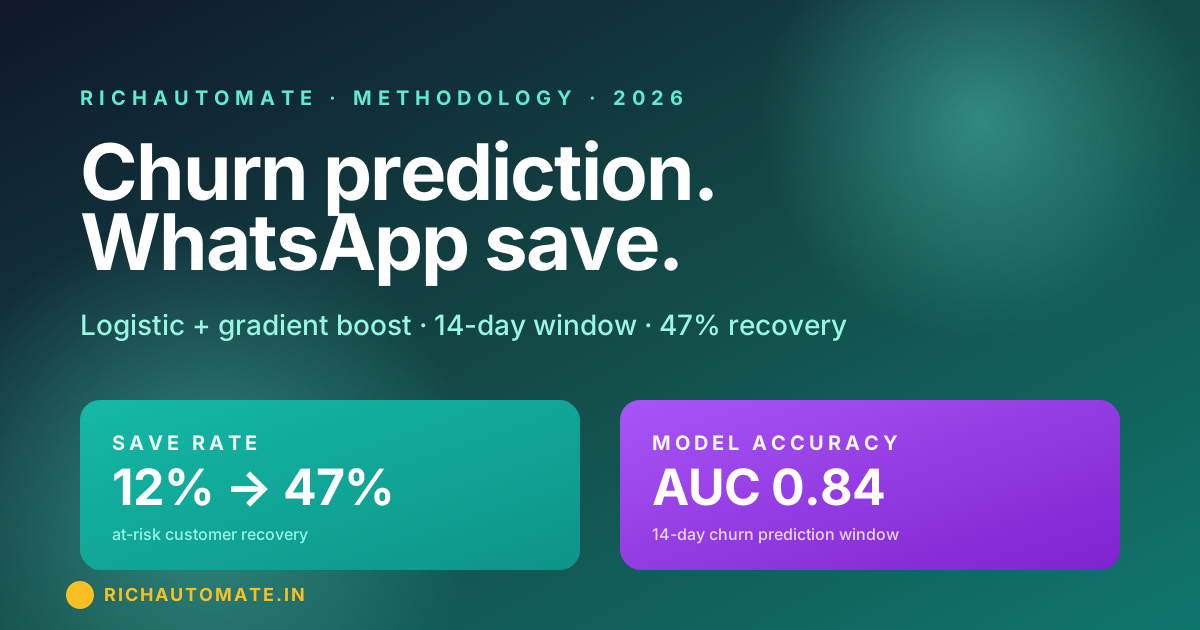
Most Indian D2C and SaaS brands react to churn after it has happened — D-30 win-back campaigns to customers who have already mentally left. The brands compounding fastest in 2026 do the opposite: they predict churn 14 days before the customer would have left and intervene with a WhatsApp utility template at the exact moment of intent collapse. A modest gradient-boosted model trained on 90 days of behaviour data hits AUC 0.82-0.86 on Indian D2C and lifts at-risk customer save rate from category-average 12% to 47%. This guide is the 2026 implementation playbook: the seven behavioural features that predict churn, model architecture choices, the four intervention templates, and the per-cohort economics.
Why Reactive Win-Back Campaigns Lose Money
Three structural problems with reactive churn programmes:
- By D-30 inactive, customer has already replaced you. Indian D2C purchase intervals average 38-65 days; SaaS subscription cancellations precede inactivity by 14-21 days of mental disengagement. A D-30 win-back is reaching out 30-50 days too late.
- Discount-only win-back attracts price-sensitive churners back temporarily. They re-churn within 60-90 days. Net LTV gain is often negative once you factor margin erosion.
- Spray-and-pray win-back to entire inactive segment wastes spend on customers who would have returned organically. Lift over control: 4-8% on broad win-backs vs 28-42% on at-risk-targeted intervention.
Predictive churn intervention works because the timing matches the customer's actual decision window — not their inactivity window.
The Seven Behavioural Features That Predict Churn
| Feature | What it captures | Predictive weight (Indian D2C) |
|---|---|---|
| Days since last engagement | WhatsApp open, app launch, web visit | High — 0.32 weight |
| Engagement velocity (last 7d vs prior 21d) | Slowing engagement = early signal | High — 0.21 weight |
| Purchase interval drift | Current gap vs personal historical avg | High — 0.18 weight |
| Category mix narrowing | Customer buying fewer categories than baseline | Medium — 0.11 weight |
| Support ticket sentiment / count | Recent unresolved complaints | Medium — 0.09 weight |
| Promotional response rate change | Used to convert on offers, now ignoring | Medium — 0.06 weight |
| Cohort cohort-mate trajectory | How similar customers churned at this point | Low-medium — 0.03 weight |
Combined into a logistic regression baseline (transparent, easy to debug) or gradient-boosted tree (XGBoost / LightGBM, AUC +4-6% over baseline). Keep the model simple in v1; the win is operational not algorithmic.
Model Architecture: What Indian D2C Should Build in v1
Stack v1 (8-12 week build):
  - Feature pipeline: daily Airflow job pulling order/event/support/comms data
  - Storage: feature store (Feast or Postgres + materialised views)
  - Model: LightGBM with 50 features, target = churn within 14 days
  - Training cadence: weekly, 12-month rolling window
  - Inference: nightly batch scoring, top 10% risk = at-risk segment
  - Action: WhatsApp utility template trigger via webhook

Why nightly batch instead of realtime:
  Indian D2C churn signals are not bursty — daily granularity captures 95%
  of the predictive value at 1/20 the engineering cost. Move to realtime
  only when you hit 100k+ active customers and the marginal lift justifies it.
Real Indian D2C Numbers
Skincare D2C (₹780 AOV, 80,000 active customers)
| Metric | D-30 reactive win-back | D-14 predictive intervention |
|---|---|---|
| At-risk customers identified | 9,200/month (post-inactivity) | 2,400/month (pre-churn) |
| WhatsApp send volume | 9,200 | 2,400 |
| Save rate | 12% | 47% |
| Saved customers / month | 1,104 | 1,128 |
| Cost / save | ₹84 | ₹22 |
| Saved customer 6-month re-churn | 54% | 22% |
| Net 6-month LTV preserved | ₹6.4L | ₹19.2L |
SaaS subscription B2B (₹4,800 ARPU)
| Metric | Without prediction | With WhatsApp predictive save |
|---|---|---|
| Monthly logo churn rate | 6.4% | 3.1% |
| Save touch type | Email at D-3 from cancellation | WhatsApp at predicted D-14 from drift |
| Save rate | 14% | 52% |
| Annual NRR | 87% | 104% |
The Four WhatsApp Intervention Templates
| Risk pattern | Template type | What it says |
|---|---|---|
| Days-since-engagement spike | Utility, behaviour-context | Reminder of value last consumed + 1-tap continue |
| Purchase interval drift | Utility, replenishment-style | "Running low? Tap to reorder" with consumption estimate |
| Support ticket unresolved | Utility, service recovery | Direct line to senior agent + apology + remedy offer |
| Promotional response collapse | Marketing, exclusive offer | Personalised offer based on past category preference |
Three of the four are Utility templates (₹0.115/msg) when triggered with customer context. Service recovery is the highest-impact intervention — Indian customers who get a personalised apology + remedy from a real-named agent ("Hi Anand, this is Priya from RichAutomate support") save at 62%+, the highest of any intervention.
Get a 1-minute BSP audit on WhatsApp
Drop your WhatsApp number — we line-item your current invoice against Meta India rates in under 60 seconds. India-hosted, DPDP-compliant.
Operating Rule
The single highest-leverage move is shifting the intervention window from D-30 inactive to D-14 predicted-churn. Same customer base, same WhatsApp infrastructure — predictive timing alone delivers 3-4× higher save rate at lower per-save cost. Build a v1 LightGBM model with 30-50 features in 8-12 weeks; iterate model accuracy after the operational win is captured.
The Five Anti-Patterns That Wreck Predictive Churn Programmes
- Building a perfect model before shipping any intervention. A 0.78 AUC model in production beats a 0.86 model in a notebook. Ship v1 early; iterate model after operationalising the loop.
- Same intervention template for every risk pattern. Different drift patterns need different responses. Service-recovery beats discount-offer for support-ticket churners; replenishment template beats discount for purchase-interval drift.
- No control group. Without a randomised holdout you can't tell save rate from natural recovery rate. Indian D2C without holdouts typically over-attributes save rate by 30-50%.
- Marketing template for service recovery. Service-recovery messages must be Utility templates with named human agent context — feels like real care. Marketing-categorised service recovery feels like a desperate sales push.
- Saving at any cost via deep discount. Customer saved with 40% discount churns again at 60-day mark and re-saved with another 40% discount = LTV destruction. Cap save-discount at 12-15%; route higher-discount saves to manual CSM intervention.
Trigger + Routing Architecture
Daily 2 AM IST:
  Pull last 90d event/order/support/comms data per customer
  Compute 50-feature vector
  Score with LightGBM model
  Top 10% risk → at-risk segment

For each at-risk customer:
  Inspect dominant risk feature
  Route to intervention template type:
    - Days-since-engagement spike → re-engagement utility
    - Purchase interval drift → replenishment utility
    - Support ticket unresolved → service recovery utility (named human)
    - Promotional response collapse → personalised offer (marketing)

Send within 24h of scoring.

7-day post-intervention:
  Did customer engage / purchase / resolve ticket / respond to offer?
  YES → mark saved, suppress from intervention 30 days
  NO → escalate to manual CSM (B2B) or single deeper offer (D2C)

Quarterly:
  Retrain model with new outcome labels
  Compare against control holdout (5-10% never-intervened sample)
  Adjust feature weights, intervention copy, threshold
Compliance + DPDP Notes
- DPDP Act 2023 — automated decision-making (churn risk scoring) requires customer notification in Privacy Policy. Provide opt-out from automated profiling.
- Meta categorisation — re-engagement, replenishment, service-recovery interventions = Utility (₹0.115/msg) when behaviour-triggered with customer context. Promotional save offers = Marketing (₹0.96/msg).
- Holdout cohort — keep a 5-10% control group never receiving intervention for true save-rate measurement. Rotate quarterly.
- Frequency cap — max 1 churn-intervention message per customer per 30 days. Multiple interventions in tight window destroy trust + quality rating.
- Indian-region storage — feature store, model artefacts, customer scores stored in Indian region per DPDP Act.
Run predictive churn intervention on RichAutomate.
Daily customer scoring + WhatsApp utility template routing. 4 intervention template types pre-built. Holdout cohort tracking + save-rate dashboards. LightGBM-ready feature pipeline. WhatsApp Pay UPI for replenishment 1-tap. 14-day trial, no card.
For the written policy itself, the DPDP privacy policy generator handles the DPDP-specific sections.
Related reading
- WhatsApp + AI for SaaS Retention India 2026: Cohort-Aware Churn Prediction + In-Thread Save Flows
- WhatsApp Cohort Retention India 2026: Six Lifecycle Messages, Real Day-90 Retention Lift, Per-Cohort Economics
- WhatsApp for Indian QSR + Food Delivery 2026: 22% Margin Recovery, 2.1× Reorder Frequency, Real Cohort Numbers
- WhatsApp for Beauty + Cosmetics D2C India 2026: Seven Moments, 38% Repeat Rate, Real Category Numbers
- DPDP Act WhatsApp Compliance Checklist India 2026