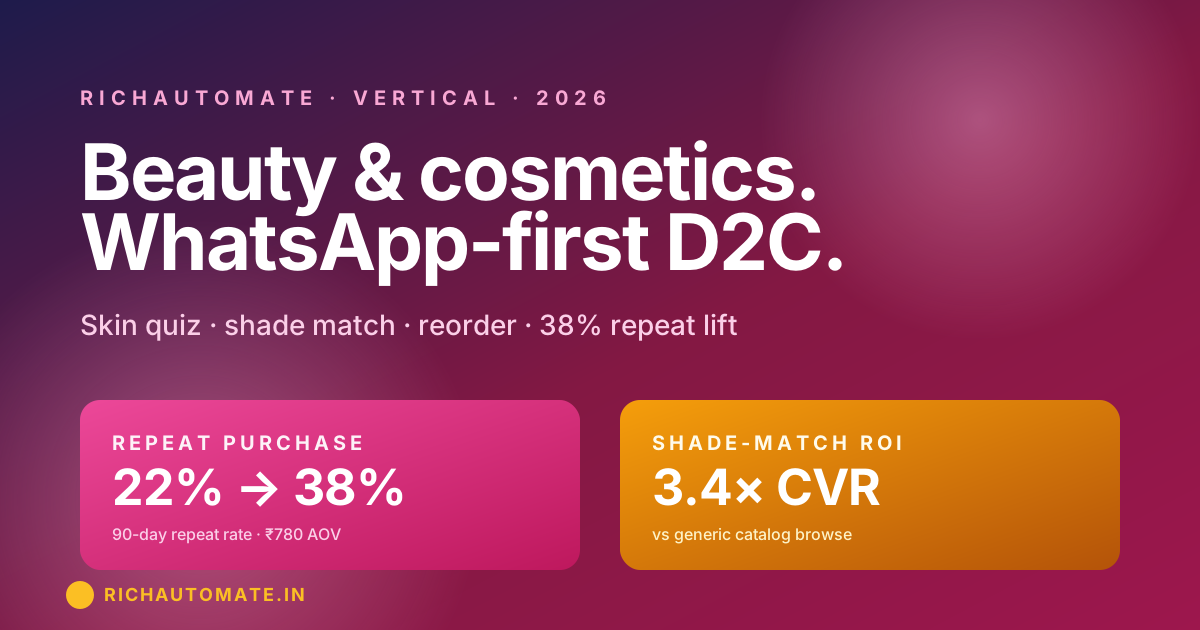
A large share of beauty product also sells through direct-selling distributors, whose onboarding-and-payout lifecycle we cover in our direct-selling & MLM distributor-compliance playbook. Indian beauty + cosmetics D2C is a ₹38,400 cr category in 2026 growing 22% YoY, but the unit economics inside the category are brutal: average AOV ₹680-980, gross margin 58-72%, and CAC at ₹420-1,100 means brands typically don't recover acquisition cost until purchase 2 or 3. Repeat purchase is the entire game. The brands beating the category average are the ones who replaced their email lifecycle programmes with WhatsApp-first conversational commerce — skin quiz at first purchase, shade-match consultation in-thread, replenishment reminders, and 1-tap reorder. This guide is the 2026 implementation playbook for Indian beauty D2C: the seven WhatsApp moments that move repeat rate, real category benchmarks, the catalog architecture, and the compliance + cataloguing pattern.
Why Beauty D2C Lives or Dies on Repeat Purchase
Three numbers anchor every Indian beauty D2C P&L:
- First-purchase margin contribution — typically negative or near-zero after CAC. ₹780 AOV × 65% margin = ₹507 contribution; ₹620 CAC = -₹113 net.
- 90-day repeat rate — the number that decides whether the brand compounds. Indian beauty D2C category average: 22%. Top quartile: 38%. WhatsApp-driven brands: 38-46%.
- 12-month LTV per acquired customer — drives whether you can scale paid acquisition. Category average ₹1,840; WhatsApp-driven ₹3,420-4,800.
A 16-point lift in 90-day repeat rate doubles 12-month LTV. WhatsApp is the only channel with the open-rate, conversation continuity, and Indian penetration to actually move the number.
The Seven WhatsApp Moments That Move Beauty D2C Repeat Rate
| Moment | Trigger | WhatsApp action | Lift target |
|---|---|---|---|
| Pre-purchase shade match | Customer browses but doesn't convert | 3-question shade quiz → personalised SKU | 3.4× CVR vs generic browse |
| D-0 onboarding | First purchase confirmed | Welcome + skin/hair profile quiz + product-specific routine | +12% Day-7 retention |
| D-3 application tutorial | Order delivered, no usage signal | Short video / GIF: how to use product correctly | +18% chance of repeat |
| D-21 finish-line nudge | Days remaining estimated by SKU size | "Running low? Tap to reorder" with 1-tap UPI | +22% repeat in window |
| D-30 cross-sell | Customer used primary product | Recommendation based on routine completion | +15% bundle uplift |
| D-60 routine upgrade | Customer engaged + active | "Ready for next step?" routine progression | +8% AOV uplift |
| D-90 referral | Engaged repeat customer | 1-tap referral with reward visible | 22-40% next-cohort growth |
Real Indian Beauty D2C Numbers
Skincare D2C (₹780 AOV, 8,500 first-purchasers/month)
| Metric | Email + push lifecycle | WhatsApp-driven |
|---|---|---|
| D-7 retention | 34% | 52% |
| D-90 repeat purchase rate | 22% | 38% |
| Average orders / customer / 12 months | 2.1 | 4.4 |
| 12-month LTV | ₹1,640 | ₹3,432 |
| CAC payback period at ₹620 CAC | 3.4 months | 1.2 months |
Colour cosmetics D2C (₹620 AOV, 12,000 first-purchasers/month)
| Metric | Without shade match | With WhatsApp shade match |
|---|---|---|
| Conversion rate (browse → buy) | 2.4% | 8.2% |
| Return rate (wrong shade) | 14% | 4% |
| Net contribution / first order | ₹298 | ₹412 |
| D-90 repeat rate | 18% | 34% |
Catalog Architecture: WhatsApp Native Catalog vs External Storefront
Indian beauty brands fall into three patterns:
Run your figures through the WhatsApp ROI calculator before committing to a monthly spend.
Get a 1-minute BSP audit on WhatsApp
Drop your WhatsApp number — we line-item your current invoice against Meta India rates in under 60 seconds. India-hosted, DPDP-compliant.
- WhatsApp-only catalog (Meta native). Inventory synced via Catalog API. 1-tap WhatsApp Pay UPI checkout. Best for sub-100 SKU brands. Conversion 2.4-3.8× higher than external redirect.
- Hybrid: WhatsApp catalog + Shopify deep links. Most common. Discovery + recommendation in WhatsApp; complex variant selection on Shopify. Smooth handoff via deep links with pre-filled cart.
- WhatsApp-as-concierge + external storefront. Premium / niche brands (₹2,000+ AOV). Personalised consultation drives selection; checkout on D2C site. Used when the average basket has 3-5 items and AOV justifies friction.
Operating Rule
The single highest-leverage move for any Indian beauty D2C above ₹2cr ARR is the D+21 finish-line reorder nudge with 1-tap WhatsApp Pay checkout. Calculate days-remaining per SKU based on usage rate; trigger a utility template at predicted 70% consumption. Brands that ship this single touch lift 90-day repeat rate by absolute 8-14 points — half the LTV gain comes from this one trigger.
The Six Anti-Patterns That Wreck Beauty D2C WhatsApp
- Generic broadcast to entire list. Skincare for oily-skin customer gets serum-for-dry-skin promo. Opt-out spike + quality rating drop. Segment by skin/hair profile + routine stage.
- No shade match for colour cosmetics. Returns rate 14% vs 4% with shade-match flow. Margin destroyed by reverse logistics.
- Reorder reminder at random intervals. Shipping "refill?" at D+10 when product lasts 30 days = annoyance. At D+45 = customer already bought competitor. Calculate per SKU.
- Application tutorial as text-only. Beauty needs visual demonstration. Send short video / GIF / carousel. Beauty engagement 4× on visual vs text.
- Marketing template for transactional moments. Order confirmation, shipping update, finish-line reorder = utility (₹0.115). Sending these as marketing (₹0.96) burns 8× cost + lower deliverability.
- Skipping post-purchase routine education. Customers who don't learn application correctly don't see results don't repeat. D+3 tutorial halves the no-result complaint volume.
Trigger + Routing Architecture
order.created → backend stores customer_id + first_purchase_at + SKU + skin_profile (if quiz done)
Quiz submission → tags customer with skin_type / hair_type / concern_tier
Cron daily 10 AM IST scans:
  D+0 first-purchase → onboarding template + routine
  D+3 no-usage signal → application tutorial (video)
  D+21 estimated finish-line → 1-tap reorder utility
  D+30 routine-active → cross-sell recommendation
  D+60 routine-engaged → upgrade nudge
  D+90 repeat-customer → referral CTA
Suppression: 14-day post-purchase, STOP keyword global, opt-out per customer
Categorisation: utility for transactional / triggered, marketing for promo broadcasts only
Compliance + Cataloguing Notes
- DPDP Act 2023 — explicit opt-in at first purchase for lifecycle WhatsApp updates. Audit-log timestamp + consent text version.
- Meta categorisation — finish-line reorder, replenishment reminder, application tutorial all qualify as Utility (₹0.115/msg) when behaviour-triggered with customer context. Promo broadcasts must use Marketing (₹0.96/msg).
- Catalog API sync — keep WhatsApp Catalog inventory synced 4-6× daily; out-of-stock SKUs in WhatsApp catalog hurt customer trust + Meta quality rating.
- STOP keyword — single STOP suppresses all future sends. Frequency cap: max 3-4 marketing messages per customer per 14 days.
- Indian-region storage — customer behaviour, skin profile, purchase history per DPDP Act.
Run beauty D2C WhatsApp on RichAutomate.
Skin quiz + shade match flows. Behaviour-triggered finish-line reorder with WhatsApp Pay UPI. Per-skin-type segmentation, application tutorial templates, suppression + frequency cap built in. Pre-approved utility templates. 14-day trial.
Related reading
- WhatsApp Catalog & In-Chat Commerce India 2026: Single + Multi Product Messages, WhatsApp Pay UPI, Real Conversion Numbers
- WhatsApp for Indian QSR + Food Delivery 2026: 22% Margin Recovery, 2.1× Reorder Frequency, Real Cohort Numbers
- WhatsApp Churn Prediction ML + Intervention India 2026: 47% Save Rate, AUC 0.84, Real Cohort Numbers
- WhatsApp for Fast-Fashion D2C India 2026: Drop-Day Alerts, Size-Fit Quiz, 4.1× Sell-Through Lift
- DPDP Act WhatsApp Compliance Checklist India 2026