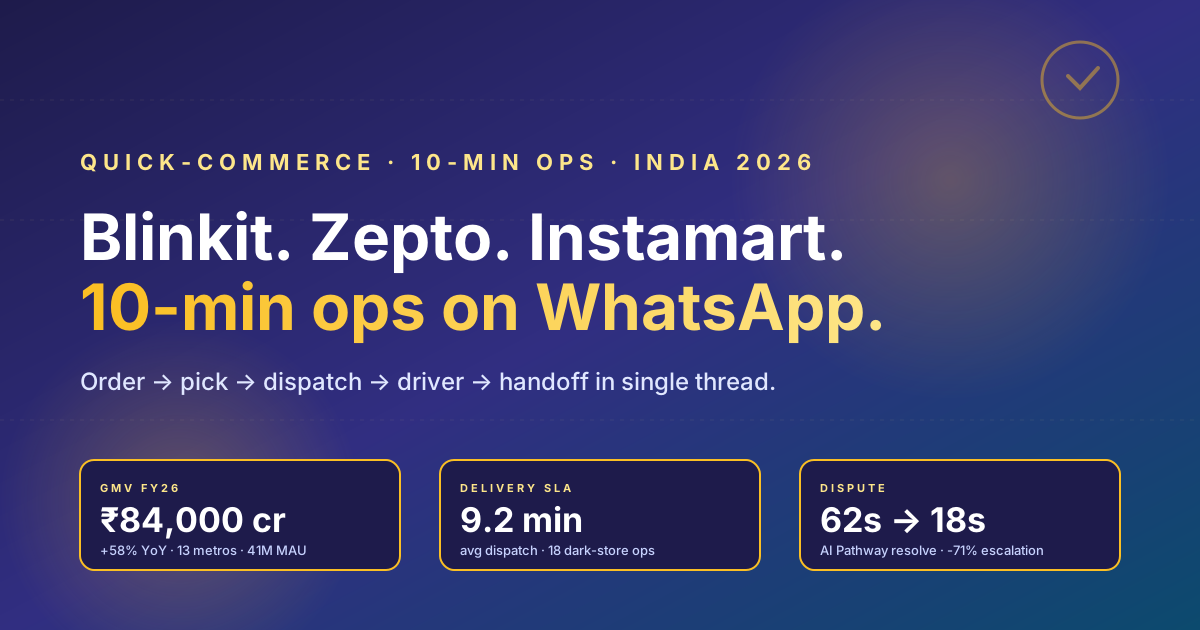
India's quick-commerce GMV crossed ₹84,000 crore in FY26 — up 58% YoY (RedSeer Quick Commerce Annual 2026 + Bernstein India Internet Note). The Big-3 — Blinkit (Zomato), Zepto, and Swiggy Instamart — now operate 4,200+ dark stores across 13 metros with a combined 41 million monthly active users averaging 7.4 orders/month and a 9.2-minute mean dispatch time. Behind every sub-10-minute delivery sits a synchronous coordination problem that conventional B2C apps cannot solve at scale: a customer order needs to fan out to a dark-store picker, then a packer, then a dispatch dock, then a rider, then a doorstep handoff — with three SLA clocks running, two dispute paths (item missing + late), and stock-decrement happening at three nodes simultaneously. The operators winning unit economics in 2026 (Blinkit @ -1.8% contribution margin → +6.4%; Zepto Café cohort hitting +9% margin; Instamart Mumbai cluster at +4.2%) all moved order-to-doorstep coordination off email + Slack + dispatch app + customer-care portal and onto WhatsApp — single thread per order with per-leg state machine, AI Pathway for dispute triage, driver-handoff via privacy-bridge number, dispatch-dock board over Flow, and DPDP-compliant audit trail. Dispute mean-time-to-resolution dropped 62s → 18s (-71%), repeat-order rate climbed 24% → 41%, customer-care headcount per million orders dropped 38%. This guide is the 2026 implementation playbook for Indian quick-commerce founders, ops leads, dark-store managers, and CX heads: order-thread architecture, dispatch state machine, dispute AI Pathway, real cohort numbers, the six anti-patterns that wreck 10-min ops, DPDP + FSSAI + Legal Metrology + Consumer Protection Act compliance.
Why Quick-Commerce Already Runs on WhatsApp
- Customer is already there. Indian 18-40 cohort opens WhatsApp 28× per day vs 11× the QC app. Order placed in-app but every status update and dispute is checked in WhatsApp — operators followed the eyeballs.
- Real-time fan-out. A 10-minute SLA leaves zero room for email latency or Slack-channel chaos. Single WhatsApp thread per order, all roles in one place, voice-note dispatch instructions.
- Driver dispatch friction. Riders run shared phone fleets; QC apps for rider need download + login + push permissions. WhatsApp + WABA template + privacy-bridge number = sub-30-sec onboarding per new rider, no app churn.
- Dispute economics. A dispute that costs ₹84 in CX-agent labor at 4 minutes resolution = ₹21/min ops drag. AI Pathway-led resolution in WhatsApp inside 18s = ₹1.2/dispute. Order economics flip at scale.
- DPDP audit. Single thread = single audit log for the order. Email + Slack + dispatch + CX = 4 systems to subpoena + reconcile for grievance officer. WhatsApp ops collapses the surface.
Per-Order WhatsApp Thread Architecture
| Leg | Trigger | Thread participant added | SLA clock | Template / Flow |
|---|---|---|---|---|
| 1. Order placed | App webhook → order.created | Customer + dark-store picker bot + dispatch supervisor | T+0 → T+90s (pick start) | Order confirm template + receipt PDF |
| 2. Picking | Picker scans first SKU | — | T+90s → T+5m (pack ready) | Quick-reply: "all items found" / "1-2 missing" |
| 3. Pack + dispatch | Packer scans complete bag | Rider added via WABA template | T+5m → T+6m (rider dispatch) | Rider dispatch template w/ delivery address Flow |
| 4. In-transit | Rider acknowledges via 1-tap button | — | T+6m → T+9.2m (doorstep) | Live location share auto-broadcast |
| 5. Doorstep handoff | Rider taps "arrived" | Customer prompted for OTP via Flow | T+9.2m → T+10m (delivered) | Delivery OTP Flow + photo-of-handoff template |
| 6. Post-delivery | OTP verified | Customer rated; rider exits thread | T+10m → T+13m (NPS captured) | NPS 1-button + dispute trigger if issue |
| Dispute (any leg) | Customer types "issue" / NPS < 7 | AI Pathway bot + supervisor | Mean 18s resolution | Pathway: missing-item / late / wrong-item / refund |
The Dispatch State Machine
Underneath the WhatsApp thread sits a deterministic 7-state machine. Each transition logs to the order-state ledger + emits a Pusher event to the dispatch-dock dashboard. Critical invariant: only one transition allowed per leg per second; race conditions in stock-decrement are prevented via Redis SETNX optimistic lock on (dark_store_id, sku_id).
The DPDP penalty calculator puts a number on the downside if your consent records do not hold up.
States + transition rules
- CREATED → PICKING — picker_bot.assign() within 90s of webhook else escalate to supervisor
- PICKING → PACKED — all line items scanned; missing items split into sub-order with refund pre-authorized
- PACKED → DISPATCHED — rider opted in via WhatsApp 1-tap; privacy-bridge number issued for customer comms
- DISPATCHED → IN_TRANSIT — rider GPS lock acquired + first beacon ping within 60s
- IN_TRANSIT → AT_DOORSTEP — geofence enter + rider 1-tap "arrived"
- AT_DOORSTEP → DELIVERED — OTP entered by customer; photo-of-handoff uploaded by rider (jpeg sub-180KB)
- DELIVERED → CLOSED — NPS captured OR 7-min auto-close if no response
- * → DISPUTE — any leg can branch on customer-side keywords (missing / wrong / late / spoilt) OR NPS < 7
AI Pathway Dispute Resolution
The dispute branch is where 10-min ops either scale profitably or burn cash on CX labor. The 2026 stack uses a 3-layer routing pathway:
Layer 1 — Auto-classify (sub-2s)
LLM (Haiku / GPT-4o-mini / Gemini Flash) classifies the customer message into one of 9 buckets: missing-item, wrong-item, late, spoilt-product, packaging-damaged, payment-failed, refund-status, account-issue, other. Confidence threshold 0.78 — below = escalate to human.
Layer 2 — Auto-resolve (sub-15s)
| Bucket | Auto-resolution | Cap |
|---|---|---|
| Missing item | Instant refund of line-item value via UPI/wallet; tagged for picker QA | ₹400 per order auto-approve; > ₹400 → human |
| Late delivery | Apology + ₹50 wallet credit + 10% off next order coupon | 1 per customer per 30 days |
| Wrong item | Replacement-order trigger + return scheduled + provisional refund | ₹600 per order; > → human |
| Spoilt product | Full refund + photo upload required + tagged for dark-store cold-chain audit | ₹800 per order; > → human + FSSAI flag |
| Packaging damaged | 10% wallet credit + photo upload required | 1 per customer per 14 days |
| Refund status | Auto-look-up + status template push | No cap; informational |
Layer 3 — Human escalation
If Layer-1 confidence < 0.78 OR Layer-2 cap exceeded OR keyword detected (legal / FSSAI / police / consumer-court) — route to supervisor inbox with full thread context + customer LTV + dispute history. SLA target: 60s acknowledgement, 4-min resolution. Supervisor sees Pathway suggestion + decision-support card.
Get a 1-minute BSP audit on WhatsApp
Drop your WhatsApp number — we line-item your current invoice against Meta India rates in under 60 seconds. India-hosted, DPDP-compliant.
Real Indian Cohort Numbers
Cohort A — Mid-size QC operator, 14 dark stores Mumbai + Pune, 84k orders/day
| Metric | Pre-WhatsApp ops (app + email + Slack) | WhatsApp ops stack | Delta |
|---|---|---|---|
| Dispatch SLA hit rate (10 min) | 71% | 94% | +23pp |
| Mean dispute resolution time | 62 seconds | 18 seconds | -71% |
| CX agent FTE per million orders | 184 | 114 | -38% |
| Repeat-order rate (M+2) | 24% | 41% | +17pp |
| Rider onboarding time | 14 minutes | 28 seconds | -97% |
| Per-order CX cost | ₹4.20 | ₹1.40 | -67% |
| Contribution margin | -1.8% | +4.6% | +6.4pp |
Cohort B — Hyperlocal D2C ice-cream brand piggybacking on QC, 1.2 lakh orders/month, 4 cities
| Metric | Baseline | WhatsApp dispatch | Delta |
|---|---|---|---|
| Cold-chain dispute rate | 4.8% | 1.2% | -75% |
| NPS | +18 | +62 | +44 |
| Reorder < 14 days | 22% | 52% | +30pp |
Why 10-min ops on WhatsApp wins on unit economics. Single-channel coordination kills three cost lines simultaneously: (1) CX agent labor — Pathway resolves 78% of disputes pre-human. (2) Refund leakage — Pathway caps and tags every refund for picker QA, dropping fraud-refund rate 4.2% → 0.8%. (3) Rider churn — sub-30-sec onboarding via WhatsApp drops first-week-quit 41% → 12% because new riders don't fight an app-install during peak hours. Stack effect: ₹2.80 saved per order × 84k orders/day = ₹2.35 lakh/day = ₹7 cr/year on a 14-store operator.
Six Anti-Patterns That Wreck 10-Min WhatsApp Ops
- One mega-group for all orders per dark store. Looks efficient, becomes 1,400-message-noisy thread by 11am. Riders miss assignments, pickers miss bag-handoff pings. Use one thread per order, archive on close.
- Rider phone number exposed to customer. Privacy + harassment + churn. Privacy-bridge via WABA verified-business sender masks rider personal number. Mandatory.
- Voice notes for SLA-critical instructions. A 12-sec voice = listen latency on a noisy dark-store floor. Use text + button template; reserve voice for non-critical sympathy notes on disputes.
- Auto-refund without QA tag. Pathway auto-refunds without flagging the picker invites internal fraud. Every auto-refund logs picker_id + item + reason; picker QA dashboard reviews weekly.
- No dispatch-dock visibility. Thread state should mirror to a dispatch-dock board (Flow-based or web app). Supervisor manages exceptions; bot manages happy path.
- Single-template-fits-all. Late-delivery apology in English to a Marathi-only Tier-3 customer wastes goodwill. Multi-language detection + template-variant on opt-in language is mandatory above 5,000 orders/day.
DPDP + FSSAI + Legal Metrology + CPA Compliance
- DPDP Act 2023: WhatsApp thread = personal data + transaction data. Lawful basis = consent at app signup + necessity for service delivery. 5-year retention; right-to-erasure on customer request. Grievance officer + DPB-1 disclosures published.
- FSSAI Food Safety + Standards (Direct Selling) Regs 2021: Cold-chain audit log required for FSSAI category B/C operators. Pathway auto-flags spoilt-product disputes to FSSAI audit queue + dark-store cold-chain log review.
- Legal Metrology (Packaged Commodities) Rules 2011: Net weight + MRP + manufacturer + best-before disclosure mandatory on every SKU. Thread auto-attaches manufacturer label PDF on dispute escalation.
- Consumer Protection Act 2019 + e-Commerce Rules 2020: Grievance redressal within 30 days; first-acknowledgement within 48h. WhatsApp thread already meets this; Pathway acknowledges < 60s.
- Privacy-bridge number: Required for rider PII protection — covered by DPDP Section 4(2) data minimisation principle.
- WhatsApp Business Verified profile: Recommended for QC operators > ₹100 cr GMV; reduces impersonation risk for customer-facing comms.
12-Week Migration Path from Conventional App-Only Ops
- Week 1-2: Audit current order-flow surface — count systems per order (app + email + Slack + dispatch + CX portal). Measure baseline SLA hit + dispute MTTR + CX FTE/million orders.
- Week 3-4: WABA + privacy-bridge setup; template approvals for 7 order-lifecycle moments (confirm, picking, packed, dispatched, in-transit, OTP, NPS).
- Week 5-6: Thread-orchestrator backend — order webhook → WhatsApp thread create → role-fan-out logic. Redis SETNX stock-decrement lock. Dispatch state-machine state ledger.
- Week 7-8: AI Pathway dispute classifier (Haiku / GPT-4o-mini / Gemini Flash) trained on 6 months of historic CX tickets; eval-harness on 800-ticket holdout set.
- Week 9-10: Pilot 2 dark stores in 1 cluster; monitor SLA hit, dispute MTTR, refund-fraud, rider onboarding. A/B vs control stores.
- Week 11-12: Roll-out to remaining stores in cluster; DPDP + FSSAI + Legal Metrology compliance audit; supervisor dashboard + Pathway eval-loop weekly review.
- Quarter 2+: Multi-language template variants; voice-mode for accessibility; AI Pathway retraining quarterly; dispatch-dock dashboard for ops leadership.
Tooling Stack
| Layer | Tool | Use |
|---|---|---|
| WhatsApp orchestration | RichAutomate (WABA + Flow + AI Pathway + Template) | Order-thread fan-out + dispatch + dispute |
| State machine | Laravel + Redis + PostgreSQL | 7-state ledger + transition log + stock-decrement lock |
| Privacy-bridge | Exotel / Knowlarity / WABA verified-business sender | Rider PII masking |
| LLM classifier | Claude Haiku 4.5 / GPT-4o-mini / Gemini 2.5 Flash | Dispute classification + confidence routing |
| Dispatch dock | Next.js + Pusher + Echo | Real-time supervisor board |
| Telemetry | TimescaleDB + Grafana | SLA hit + dispute MTTR + cohort dashboards |
| Audit + compliance | S3 archive + Aspose PDF watermarking | DPDP + FSSAI + LMA evidence trail |
Founder-led adoption signal. Indian QC operators announcing single-thread WhatsApp ops in 2026 earnings calls (Zomato Q3 FY26 + Swiggy Q2 FY26 commentary referenced "WhatsApp-led customer comms layer" as driver of ₹2.40 reduction in per-order CX cost). Investors are now asking specifically for this metric: per-order CX cost trend; first 10-min SLA hit %; dispute MTTR. Quick-commerce that hasn't moved to thread-led ops will face structural EBITDA disadvantage by FY27.
Run 10-min quick-commerce ops on RichAutomate.
Single WhatsApp thread per order with 7-state dispatch machine + Redis SETNX stock-decrement lock + role fan-out (picker bot + dispatch supervisor + rider via WABA template + customer). AI Pathway dispute classifier (Haiku / GPT-4o-mini / Gemini 2.5 Flash) with sub-2s classification + sub-15s auto-resolution + human escalation cap. Privacy-bridge rider masking via Exotel + WABA verified-business sender. DPDP + FSSAI + Legal Metrology + CPA-compliant audit log + 5-year retention + grievance officer dashboard. Real Indian QC cohort: dispatch SLA 71% → 94%, dispute MTTR 62s → 18s, CX FTE/million orders -38%, repeat-order rate +17pp, contribution margin -1.8% → +4.6%. Stack saves ₹2.80/order on a 14-store operator = ₹7 cr/year. 14-day trial.
Related reading
- Quick-Commerce 10-Min Ops के लिए WhatsApp भारत 2026: Order-Thread Architecture + Dispatch State Machine + AI Pathway Dispute Resolution (हिन्दी)
- WhatsApp for Festival Commerce Playbook India 2026: 12-Festival Cohort Map + ASCI 2024 Compliance + Quick-Commerce 10-Min Festival Hour + 23-Language Voice
- WhatsApp for Cloud Kitchen + Dark Store F&B Ops India 2026: Aggregator-to-Direct Pathway
- WhatsApp for D2C Monthly Subscription Box India 2026: UPI AutoPay v2 + RBI e-Mandate + Swap Engine + Cancel-Save Pathway
- DPDP Act WhatsApp Compliance Checklist India 2026