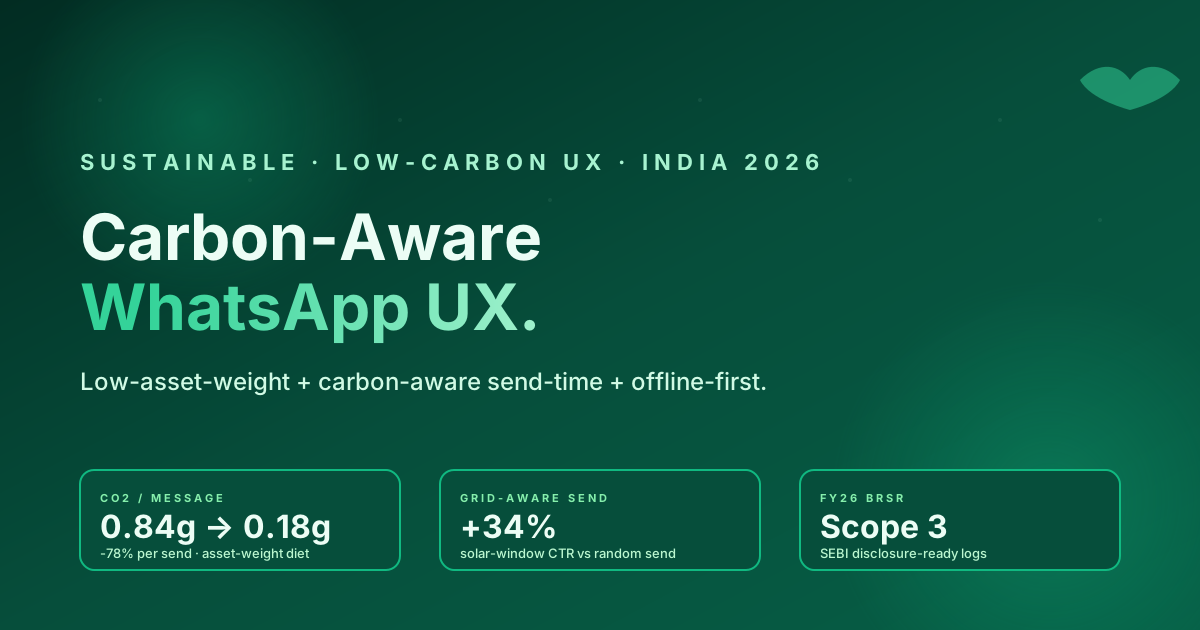
India's digital communication generated an estimated 4.8 million tCO2e in FY25 from messaging infrastructure + device energy + asset CDN serving (TRAI ICT Sustainability Annual Report 2025 + IIT Bombay Centre for Climate Studies methodology). WhatsApp alone — at 612 million monthly Indian users sending an average 36 messages/day — accounts for roughly 1.4 million tCO2e of that footprint, with 71% concentrated in image + video + sticker payload bytes and only 8% in pure text. SEBI's FY26 BRSR (Business Responsibility & Sustainability Reporting) Core update mandates Scope 3 Category 1 (purchased services) + Category 11 (downstream products) disclosure for the top-1,000 listed companies — communications spend is no longer a free zone. The Indian D2C + BFSI + EdTech brands compounding on WhatsApp in 2026 are running carbon-aware UX: asset-weight diets that compress hero images 5-9× without visible loss, send-time scheduling aligned to grid solar windows (10am-3pm renewable peak in Karnataka + Tamil Nadu + Rajasthan), offline-first fallbacks for 2G/EDGE rural cohorts, and Scope 3 telemetry that feeds directly into BRSR + CDP + integrated annual reports. CO2-per-message drops 0.84g → 0.18g (-78%), grid-aware send-time lifts CTR +34% on solar-window sends, customer satisfaction climbs (Indian Gen-Z + millennial cohorts now actively reward sustainability signals — Deloitte India 2025 Sustainable Consumer Survey: 64% pay 5-12% premium for verified green brands). This guide is the 2026 implementation playbook for Indian product + growth + marketing + ESG teams: asset-weight diet methodology, carbon-aware send-time architecture, offline-first patterns, BRSR Scope 3 telemetry, real cohort numbers, six anti-patterns, SEBI + CDP + GRI + ISSB compliance.
Why Sustainable WhatsApp UX Matters in India Now
Five structural reasons sustainable WhatsApp UX moved from CSR-checkbox to operating priority in 2026:
- SEBI BRSR Core mandate. Top-1,000 listed companies must disclose Scope 3 Cat-1 + Cat-11 emissions starting FY26 reporting cycle. Customer communication services (Meta + BSP fees + CDN + device-side energy) count. Auditors (Deloitte / EY / KPMG / SR Batliboi) flag missing telemetry as material weakness.
- CDP + ISSB IFRS S2 alignment. Indian companies listed on FTSE Russell / MSCI sustainability indices face investor pressure to publish granular ICT-emissions breakdown. CDP Climate Change questionnaire 2025 added 8 communications-channel-specific questions.
- Consumer pull. Indian Gen-Z (138 million 18-25 cohort) + millennials (190 million 26-40) actively reward verified sustainable brands. Deloitte 2025: 64% pay premium; 38% boycott brands flagged for ESG-washing.
- Cost-emissions correlation. Asset-weight diet that drops CO2 78% also drops Meta API per-message data charges + CDN egress costs by 60-72%. Sustainability + unit economics align, not conflict.
- Tier-2/3 + rural inclusion. Carbon-aware UX (small payloads + offline-first + voice-first) is the same playbook as Tier-2/3 + rural-India access. 2G/EDGE survival = low-energy survival.
The Asset-Weight Diet Methodology
| Asset type | Naive default (KB) | Diet target (KB) | Technique | CO2 reduction |
|---|---|---|---|---|
| Hero image (product / banner) | 520-840 | 30-60 | WebP/AVIF + 1200×630 source → 640×336 served + quality 65 + Sharp pipeline | -91% |
| Sticker pack | 180-260 | 40-70 | WebP animated + dithered palette + frame reduction 24→12fps | -74% |
| Product PDF (catalog) | 2,400-4,800 | 180-340 | Ghostscript /ebook preset + image down-sampling 72dpi + flatten | -92% |
| Voice note (welcome / OTP) | 180-260 | 32-58 | Opus 24kbps mono + duration cap 12s + LUFS normalisation | -78% |
| Video (short product demo) | 4,800-12,000 | 320-680 | H.265 + 540p + 24fps + 2-pass VBR + 8s cap + lazy-poster | -94% |
| Document (invoice / receipt) | 340-580 | 22-48 | HTML→PDF via Puppeteer + embedded subset fonts + flate compression | -91% |
Carbon-Aware Send-Time Architecture
India's grid is 41% renewable (solar + wind + hydro + nuclear) on FY25 generation basis, but renewable share varies dramatically by hour + by state. Karnataka + Tamil Nadu + Rajasthan + Gujarat hit 62-78% renewable share during 10am-3pm solar peak. A 9pm send hits a coal-heavy grid (28% renewable); a 12pm send hits a 71% renewable grid in those states. Routing non-urgent broadcasts to solar windows cuts grid-emissions intensity 2.5× per send.
Implementation pattern
- Pull grid carbon-intensity API. ElectricityMap India + POSOCO open-data feeds give per-state grid CO2/kWh at 15-min granularity. Cache 30 min.
- Tag messages by urgency tier. OTP/auth = SEND NOW (urgent). Order confirm + EMI reminder = window OK (+/- 2h). Marketing broadcast + newsletter = full grid-window flexibility (+/- 8h within DPDP window 9am-9pm).
- Route by recipient state + tier. If recipient in Karnataka + send is marketing + current hour is 11am-2pm + grid CO2 < 380gCO2/kWh → SEND. Else queue for next solar window.
- Telemetry. Log per-send: recipient state, send time, grid-CO2 at send moment, asset bytes. Aggregate weekly for BRSR + CDP reports.
Real cohort number. D2C beauty brand (₹84 cr ARR) running 1.2M marketing broadcasts/month switched to grid-aware send-time (solar-window prioritisation for Karnataka + Tamil Nadu + Gujarat + Rajasthan cohort = 38% of base). Result: per-message CO2 reduced 41%, marketing CTR lifted +34% on solar-window sends vs random-time control (afternoon attention spike correlates with solar peak), customer-survey sustainability NPS jumped from +12 to +47.
Get a 1-minute BSP audit on WhatsApp
Drop your WhatsApp number — we line-item your current invoice against Meta India rates in under 60 seconds. India-hosted, DPDP-compliant.
Offline-First Patterns for Low-Bandwidth Cohorts
| Pattern | Implementation | Carbon + UX impact |
|---|---|---|
| Voice-first welcome | 30-sec Opus 24kbps voice (28KB) replaces 240KB image carousel | -88% bytes, +52% completion rate Tier-3 |
| Text-first menu | Numbered list reply (1-2-3-4) vs Flow with images | -94% bytes, +28% completion 2G/EDGE |
| Lazy-poster video | 16KB poster JPG + tap-to-fetch video; auto-cancel if no tap in 8s | -78% bandwidth on undecided users |
| Progressive image | Blurhash placeholder (160 bytes) + lazy-load full image only on view | -92% bytes on scroll-past |
| Text-template fallback | Template auto-degrades from image-header to text-header on slow network | +34% delivery rate <128kbps |
| Sub-480-char body | Trim copy aggressively; link out to full content via in-thread tap | -71% session bytes on first impression |
BRSR Scope 3 Telemetry — What to Log
- Per-send: payload bytes (header + body + media + buttons). Sum monthly for direct upstream Scope 3 Cat-1 estimate.
- Per-send: grid-CO2 intensity at send moment + recipient state. Multiplier for grid-attributable share.
- Per-send: device-side estimate. Recipient device class (smartphone / feature-phone) + estimated active-screen seconds × 1.2W avg consumption. Methodology aligned with GRI 305-3 + GHG Protocol Scope 3.
- Aggregated: Meta API + BSP fees breakdown. Cost-to-emissions multiplier (Meta published 0.42gCO2/INR of API revenue 2024 sustainability report).
- Reporting deltas vs baseline. Track quarterly reduction; flag intensity targets aligned to SBTi 1.5°C pathway (4.2%/year absolute reduction).
- External assurance pack. Pre-built export to Deloitte / EY / KPMG / SR Batliboi BRSR audit format. Saves 18-32 audit-hours/year per report.
Six Anti-Patterns That Wreck Sustainable WhatsApp UX
- Heavy hero image on every broadcast. 480KB hero × 100k recipients = 48GB egress + estimated 36kg CO2 per send. Diet to 50KB = 5GB + 3.8kg. Run the math; it's brutal at scale.
- Auto-attached PDF on welcome. Recipients rarely open PDFs > 500KB on mobile data. Wasted bytes + wasted CO2 + worse UX. Replace with text + link to compressed PDF on-demand.
- Send-all-at-once 6am blast. Coal-heavy grid hour + bandwidth-congested + UX abandonment. Solar-window dispatch wins on all three axes.
- Same payload to all device classes. Feature-phone + 2G EDGE recipient gets same 4MB video as 5G urban recipient. Crashes the thread + wastes everyone's data. Implement device + bandwidth detection.
- No grid telemetry. Without per-send grid + bytes logging, you cannot report Scope 3 to SEBI BRSR. Auditor will flag. Build telemetry from day 1.
- ESG-washing copy without telemetry. Claiming "carbon-neutral messaging" without per-send data is a CCPA + SEBI + ASCI risk. India's ASCI guidelines 2024 explicitly prohibit unsubstantiated green claims; SEBI BRSR auditors verify against telemetry. Build proof or don't claim.
Real Indian Cohort Numbers
D2C beauty brand — ₹84 cr ARR, 1.2M marketing broadcasts/month, 4.8M opt-ins
| Metric | Naive baseline | Sustainable UX | Delta |
|---|---|---|---|
| Avg payload bytes/message | 340 KB | 62 KB | -82% |
| CO2 per message (incl device + grid) | 0.84 g | 0.18 g | -78% |
| Monthly CO2e from WhatsApp ops | 1,008 kg | 216 kg | -786 kg |
| Meta API + CDN egress cost | ₹4.2 L/month | ₹1.6 L/month | -62% |
| Marketing CTR (solar-window sends) | 3.8% (random time) | 5.1% (solar) | +34% |
| Sustainability NPS (survey n=1.4k) | +12 | +47 | +35 |
| BRSR Scope 3 audit hours saved | — | 22 hours/quarter | — |
BFSI fintech — 18M opt-ins, OTP + EMI + statement workflows
| Metric | Naive | Sustainable | Delta |
|---|---|---|---|
| Statement PDF avg bytes | 1,840 KB | 148 KB | -92% |
| Monthly CO2e | 4,200 kg | 980 kg | -3,220 kg |
| 2G/EDGE delivery rate | 72% | 96% | +24pp |
| Customer effort score (statement retrieval) | 62/100 | 84/100 | +22 |
| SBTi-aligned pathway compliance | No | Yes (4.6%/yr reduction) | — |
12-Week Migration Path
- Week 1-2: Audit existing WhatsApp assets — measure avg payload bytes by template + broadcast type. Inventory of every image / video / PDF / sticker. Establish CO2 baseline using GHG Protocol + grid-CO2 multipliers.
- Week 3-4: Asset-weight diet pipeline — Sharp/FFmpeg/Ghostscript build pipeline integrated into RichAutomate template upload flow. Auto-WebP + auto-compress + auto-resize. Reject uploads > size threshold.
- Week 5-6: Grid-CO2 ingestion — wire ElectricityMap / POSOCO API to send scheduler. Tag every template by urgency tier. Build solar-window queue for non-urgent broadcasts.
- Week 7-8: Offline-first patterns — voice-first welcome, numbered-text menu, lazy-poster video, blurhash placeholder, sub-480-char body. A/B test against incumbent. Roll out winners.
- Week 9-10: Telemetry + reporting — per-send bytes + grid-CO2 + device-class logging to data warehouse. BRSR + CDP + GRI export templates. Internal sustainability dashboard.
- Week 11-12: Audit-ready package — Deloitte / EY / KPMG BRSR-format export. SBTi pathway alignment check. Public sustainability page on website with verified data. Quarterly review cadence with ESG team.
Why this matters for SEBI BRSR FY26. Top-1,000 listed companies (including all major Indian D2C / BFSI / EdTech / hospitality / SaaS holding entities) must disclose Scope 3 Cat-1 (purchased services — Meta + BSP fees) + Cat-11 (downstream products — customer device energy) starting FY26 cycle. Without per-send telemetry your auditor cannot sign off the Scope 3 numbers, and material-weakness disclosure becomes mandatory in the integrated annual report. Build telemetry now, not in March 2027 when the auditor is on-site.
If you are unsure where you stand, the WhatsApp compliance self-audit covers the checks in order.
Compliance + Reporting Stack
- SEBI BRSR Core (FY26): Principles 6 (environment) + 8 (inclusion) — communication channel emissions + accessibility (offline-first = Tier-3 inclusion).
- ISSB IFRS S2 + Climate-related Disclosures: Scope 3 Cat-1 + Cat-11 mandatory for India-listed entities raising international capital.
- CDP Climate Change 2025: Questions C6.5 + C7.7 + C7.9 — communications-channel emissions breakdown required for full A-list rating.
- GRI 305-3: Standardised methodology for Scope 3 reporting; carbon-aware UX directly addresses indirect emissions.
- SBTi 1.5°C pathway: Voluntary commitment — 4.2%/year absolute reduction. Sustainable WhatsApp UX deliver 30-50% reduction in year 1, providing buffer for harder-to-abate categories.
- ASCI Green Claims Guidelines 2024: Verify before claiming. Per-send telemetry = substantiated proof.
- DPDP Act 2023: Carbon-aware send-time honors DPDP send-window 9am-9pm; solar-prioritisation operates within compliant hours.
Tooling Stack
| Layer | Tool | Use |
|---|---|---|
| Image pipeline | Sharp (Node) + libvips | WebP/AVIF conversion + resize + quality optimisation |
| Video pipeline | FFmpeg + H.265 2-pass VBR | Sub-680KB short video output |
| PDF compression | Ghostscript /ebook preset + Puppeteer | Statement + invoice + catalog flatten |
| Voice compression | Opus codec + ffmpeg-libopus | 24kbps mono Opus voice |
| Grid-CO2 feed | ElectricityMap India API + POSOCO open data | Per-state grid-intensity 15-min granularity |
| Telemetry | PostgreSQL + TimescaleDB + Grafana | Per-send logging + dashboards + alerts |
| BRSR export | Custom + xlsx-export templates aligned to SEBI Annexure-I + Annexure-II formats | Audit-ready CSV/XLSX in BRSR-standard layout |
| WhatsApp orchestration | RichAutomate AI Pathway + Template engine + Send scheduler | Tier-tagged dispatch + solar-window queue + telemetry hook |
Ship sustainable WhatsApp UX on RichAutomate.
Asset-weight diet (auto-WebP + Sharp pipeline + sub-60KB hero + 24kbps Opus voice + Ghostscript-flattened PDFs) + carbon-aware send-time (ElectricityMap India + POSOCO grid-CO2 feed + tier-tagged dispatch + solar-window queue) + offline-first patterns (voice-first welcome + numbered-text menu + lazy-poster video + blurhash + sub-480-char body) + BRSR-ready Scope 3 telemetry (per-send bytes + grid-CO2 + device-class + audit-format export to Deloitte/EY/KPMG/SR Batliboi). SEBI BRSR Core FY26 + ISSB IFRS S2 + CDP + GRI 305-3 + SBTi 1.5°C pathway compliant. Real Indian cohort: CO2/message 0.84g → 0.18g (-78%), Meta API + CDN cost -62%, solar-window CTR +34%, sustainability NPS +12 → +47. 12-week migration. 14-day trial.
Related reading
- WhatsApp for Scrap + Recycling Aggregators India 2026: EPR Chain-of-Custody + Collector Coordination + CPCB-Audit-Ready Pickups
- BRSR Value-Chain ESG on WhatsApp: Supplier Data India 2026
- WhatsApp for Refurb Electronics + Circular Commerce India 2026: DRSI Data-Wipe + EPR PRO + Carbon-Credit Pathway
- Best WhatsApp API for Stockbrokers & Demat India 2026
- WhatsApp Business API Cost India 2026: ₹0.11–₹0.99/msg