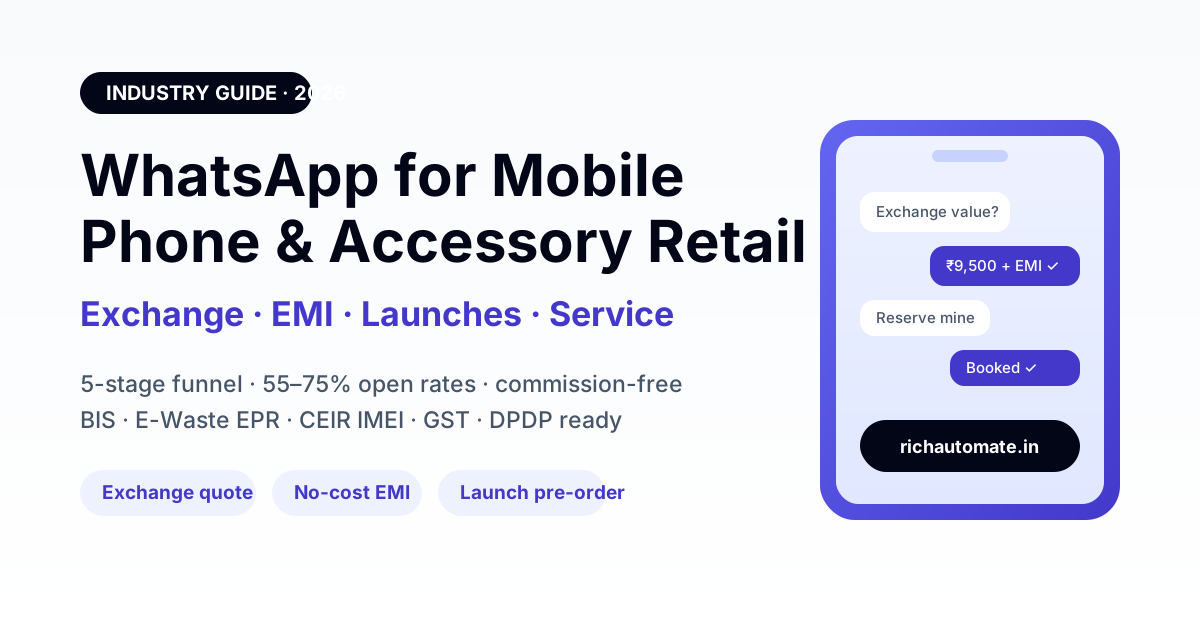
Mobile phone and accessory shops in India use WhatsApp to run a five-stage retail funnel: opt-in launch-and-offer broadcasts segmented by brand and budget, an exchange & EMI pre-qualification flow where the customer sends a photo and IMEI of the old phone and gets an instant trade-in quote, reserve/pre-order for flagship drops, invoice-plus-e-warranty fulfilment with a payment link and accessory add-on, and a service/AMC re-engagement thread for screen-and-battery tickets, insurance renewals and upgrade nudges. For a single-store dealer, a multi-brand chain or a Croma-style large-format outlet, this converts India's two demand engines — new-launch hype and the festive exchange-offer rush — into an automated, commission-free channel that Amazon and Flipkart never touch.
Why WhatsApp fits mobile retail specifically
Phone retail is high-value, high-consideration walk-in commerce where the customer already messages the shop before visiting. Four structural advantages make it a natural WhatsApp funnel:
- The purchase is researched, not impulsive. A buyer comparing a ₹18,000 phone against three alternatives wants specs, EMI options and exchange value in writing before walking in. A WhatsApp number that answers those in one thread wins the footfall from the shop next door.
- Exchange is the killer flow. More than a third of smartphone sales in India now involve a trade-in. "Send a photo and the IMEI of your old phone" returning an instant indicative quote is the single highest-converting message a mobile shop can send — it turns a browsing enquiry into a committed visit.
- Launches are hype cycles. A flagship drop, a limited colour/variant allocation, a festive-only price — scarcity plus a one-tap "Reserve mine" button drives pre-orders the way no hoarding or SMS ever could.
- Demand is brutally seasonal and event-driven. The Diwali/festive quarter, back-to-school, new-launch weeks and result-season upgrades tell you exactly when to broadcast what, and to whom.
The same broadcast-and-service logic works for adjacent hardware verticals — see our playbooks for tyre retail & fitment and used-car dealerships, where trade-in and inspection flows mirror phone exchange almost exactly.
The five-stage lifecycle
Stage 1 — Launch & offer broadcasts (opt-in brand/budget tags)
Build the list at the counter and on the shelf: a QR standee at billing ("Get launch prices & exchange offers on WhatsApp"), a line on every invoice, a table card near the demo units. The opt-in flow asks two things — preferred brands (Apple, Samsung, OnePlus, Vivo, Oppo, Xiaomi, realme, Nothing) and budget band (under ₹15k / ₹15–30k / ₹30–60k / flagship) — and writes them as contact tags. Broadcasts then go only to matching tags:
- "iPhone 17 pricing + exchange bonus this week" → Apple + flagship tags only.
- "Samsung A-series festive drop, no-cost EMI" → Samsung + mid-budget tags.
- "Power banks, buds & cases — festive combo" → accessory-interest tag across the base.
Segmented sends at 3,000-contact scale routinely see 55–75% open rates because every message is pre-qualified by the buyer's stated brand and budget. Blast the whole list with every model and you burn opt-outs before the festive quarter even starts.
Stage 2 — Exchange & EMI pre-qualification flow
This is the highest-leverage flow in mobile retail. The journey:
- Customer sends a photo of the old phone plus its IMEI (dial *#06#) to your WhatsApp number, or picks the model from a Flow dropdown.
- Staff (or an AI agent) returns an indicative trade-in quote against your buyback price map — condition tiers pre-loaded so most quotes are lookups, not haggling.
- EMI eligibility, in the same thread: present no-cost EMI tenures and the finance partners you support (Bajaj, HDFC, IDFC, cardless options) so the customer arrives knowing the monthly number.
- Book a visit or home-delivery slot with the net-of-exchange price locked for 48 hours.
Before you accept any exchange handset, run its IMEI through the government Sanchar Saathi / CEIR lookup to confirm it is not blacklisted, lost or stolen — bake that check into the counter step of the flow, because knowingly dealing a blocked IMEI is a serious liability. Do the KYC-doc capture for EMI (PAN, Aadhaar/address proof) with data minimisation in mind — collect only what the financier mandates, and never store Aadhaar images in an open chat archive.
Stage 3 — Reserve & pre-order for launches
Every flagship launch gets a pre-order broadcast with a Reserve quick-reply button. The flow captures model + variant (storage/colour) + quantity, tags the contact against the SKU, and replies with a confirmation and expected date. For allocated launches (limited colours, Day-1 stock), append a token-advance payment link — paid reservations hold a unit, free reservations hold 24 hours after arrival. On launch day, one utility message per reservation: "Your [model] is in — collect till Saturday or reply DELIVER." The same flow rescues out-of-stock walk-ins: the counter taps the customer into a back-in-stock tag and the restock broadcast fires automatically.
Stage 4 — Purchase, e-warranty & accessory add-on
Every order resolves through one fulfilment pair: a payment link (UPI/card via your gateway, or the EMI hand-off) and a fulfilment choice (in-store pickup or local delivery). Attach the digital invoice and the e-warranty/extended-warranty PDF to the confirmation message so the customer never loses the bill — a huge service-desk saver at claim time. Then the highest-margin nudge in the business: an accessory add-on prompt inside the same thread — case, tempered glass, buds, 45W charger, screen-protection plan — which converts at 30–45% when offered at the moment of purchase rather than after. Delivery/status updates ride on utility templates at ₹0.115 each: order confirmed, out for delivery, delivered.
Stage 5 — Service, insurance & upgrade re-engagement
Retention is where a neighbourhood store beats the marketplace, and after-sales is the engine:
Get a 1-minute BSP audit on WhatsApp
Drop your WhatsApp number — we line-item your current invoice against Meta India rates in under 60 seconds. India-hosted, DPDP-compliant.
- Service tickets: "Screen cracked? Reply SERVICE for a repair quote and pickup" — a two-tap ticket with status pushes (received → diagnosed → ready) keeps the repair in your shop instead of a mall service centre.
- Insurance/protection renewal: a utility reminder 30 days before a screen-protection or device-insurance plan lapses recovers renewal revenue that otherwise silently churns.
- Upgrade + buyback loop: an 18–24-month post-purchase nudge — "Your [model] is worth ₹X in exchange today; here's this year's upgrade" — feeds the Stage-2 exchange flow and closes the loop.
- Old-device buyback & e-waste: promote a take-back offer that doubles as your E-Waste Rules collection channel (see compliance below).
A customer messaged usefully 6–10 times a year — offers, service, upgrade — buys their next two phones from you instead of comparison-shopping a marketplace on price alone.
The season calendar: what to broadcast, when
| Window | Demand spike | WhatsApp play |
|---|---|---|
| Jan–Mar | New-year launches, budget season | Launch-price broadcasts to brand tags; exchange-your-old-phone campaign; result-season student upgrades |
| Apr–Jun | Summer flagship drops, weddings | Pre-order flows for flagships; premium gifting combos; no-cost-EMI push to mid-budget tags |
| Jul–Aug | Mid-year, monsoon lull | Accessory & protection-plan broadcasts; service/AMC re-engagement; back-in-stock alerts |
| Sep–Nov | Festive quarter — the peak | Full exchange + EMI flow at scale; festive price broadcasts; run it like a festival commerce campaign |
| Dec | Year-end offers, gifting | Combo/gift-hamper broadcasts; buyback-and-upgrade loop; clear old inventory to back-in-stock tags |
Compliance corner: heavier than most retail
- BIS mandatory registration (CRS). Mobile phones, power banks, chargers/adapters and lithium battery packs fall under the BIS Compulsory Registration Scheme — every unit you sell must carry a valid BIS registration and the standard mark. Stock only CRS-compliant, registered products; selling non-registered devices or grey-market imports without valid BIS marking exposes you to seizure and penalty. Keep supplier BIS documentation on file.
- E-Waste (Management) Rules 2022 + EPR. Electronics are notified e-waste. If you take back old devices (and Stage-5 buyback means you do), route them only to authorised recyclers/refurbishers and keep the trail — never to the informal scrap chain. Producers carry EPR targets on the CPCB portal; as a retailer your role is compliant collection and channelling. Position your buyback offer as a responsible take-back — it is both a compliance asset and a marketing hook.
- Sanchar Saathi / CEIR IMEI check. Before buying or reselling any used/exchange handset, verify the IMEI on the government CEIR portal to confirm it is not blocked, lost or stolen. Dealing a blacklisted IMEI is a legal exposure you can automate away by making the check a mandatory counter step in the exchange flow.
- GST & Legal Metrology. Smartphones attract 18% GST and most accessories 18% (verify the current schedule with your CA); bill line-item-wise and carry per-line tax in your WhatsApp quote so it matches the final invoice. Pre-packed accessories must declare MRP, net quantity, manufacturer/importer and consumer-care details under Legal Metrology — sell open, billed line-wise, if you assemble your own combos.
- DPDP on EMI/exchange KYC (data minimisation). EMI and device-insurance capture PAN, Aadhaar or address proof — sensitive personal data under the Digital Personal Data Protection Act, 2023. Collect only what the financier or insurer mandates, use it solely for that purpose, do not retain document images in an open chat archive, and state a clear retention and consent line in the flow. For any customer under 18, verifiable parental consent applies (Section 9).
The tech stack
- WhatsApp Business API (not the free app) — you need multi-agent counter access, broadcast segmentation beyond 256 contacts, template automation and API hooks into billing/inventory. The free app caps every one of these.
- Interest-tag CRM: contact attributes for brand, budget band, accessory interest and service history driving segmented broadcasts.
- Flows/forms: a native in-chat form for opt-in preferences, exchange details (model, condition, IMEI) and slot selection beats a 10-message question chain.
- Catalog: load current models, accessory combos and protection plans so "browse" happens inside the chat.
- Payment links: your UPI/gateway link or EMI hand-off pasted into the quote — no marketplace commission, money lands in your account.
- AI agent (optional, high leverage): answers "what's the exchange value of my [model]?" and "EMI on [model]?" against your price maps, and hands anything ambiguous to staff.
India's mobile phone and accessories retail runs into lakhs of crores annually across a vast base of organised chains and independent multi-brand stores (directional — verify against current trade estimates); almost none of the independent segment has a direct, owned digital channel to its own customers. That is the gap this stack closes for a few thousand rupees a month in conversation charges — a fraction of one festive-day margin. Multi-brand electronics counters can extend the same playbook across their whole shelf, much like supermarkets and grocery chains and toy retailers already do.
To see what non-compliance would actually cost, the DPDP penalty calculator sizes the exposure against your contact volume.
7-day rollout plan
- Day 1: Get WhatsApp Business API access on your shop number; verify business details; set profile, hours and catalog basics.
- Day 2: Define your tag taxonomy (brands, budget bands, accessory interest, service history, local-radius) and build the opt-in flow.
- Day 3: Print the QR standee + invoice line; brief counter staff on the 10-second opt-in pitch and the IMEI/CEIR check habit; start collecting.
- Day 4: Draft and submit templates — launch/offer broadcast, exchange-quote, EMI eligibility, reserve/pre-order, order-ready, delivery updates, service ticket, renewal reminder.
- Day 5: Pre-load your buyback price map (model × condition) and accessory combos; wire payment links and the EMI partner hand-off into the quote message.
- Day 6: Dry-run the full exchange flow with 3 staff phones — photo + IMEI in, quote out, EMI number, slot, ready-ping — and confirm the CEIR check step.
- Day 7: First segmented broadcast to the opening list (this week's launch by brand/budget); measure opens, replies, opt-outs; fix copy before scaling into the festive quarter.
Put your mobile store on WhatsApp before the festive quarter
RichAutomate gives phone and accessory retailers the full stack — brand/budget-tag broadcasts, exchange & EMI pre-qualification flows, launch pre-orders, payment links, service tickets and an optional AI agent — at ₹0 setup, ₹0 monthly, ₹0 platform fee. Client Pay is ₹0.10/message plus Meta's rates billed direct at cost (₹0.8631 marketing / ₹0.115 utility on the 2026 India card); SaaS Pay is ₹1.50 marketing / ₹0.50 utility all-inclusive on one INR GST invoice. Start with a 14-day free trial and 100 free credits, or book a 30-minute walkthrough — full rate math in our WhatsApp Business API cost guide.
Related reading: WhatsApp for Mobile & Electronics Repair India 2026 Guide walks through the same WhatsApp setup for a neighbouring use case.