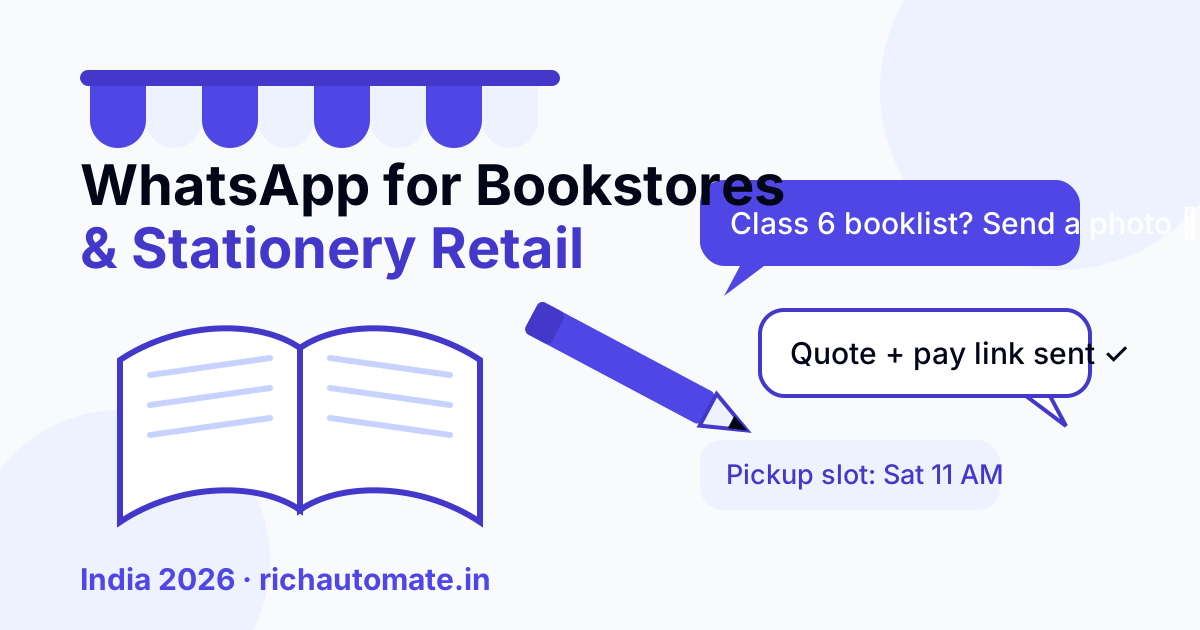
Bookstores and stationery shops in India use WhatsApp to run a five-stage retail funnel: opt-in new-arrival and genre broadcasts, reserve/pre-order flows for bestsellers and signed editions, a school-booklist bulk-order flow where parents send a photo of the list and get a quote, pickup/delivery with a payment link, and book-club re-engagement threads. For an indie bookshop, a chain outlet or a book-café, this turns two seasonal gold mines — the June school-reopening booklist rush and the Diwali gifting spike — into a repeatable, automated revenue engine instead of a queue at the counter.
Why WhatsApp fits book and stationery retail specifically
This is consumer walk-in retail — the funnel is completely different from the B2B trade we've covered before (see our guides for book publishers & distributors and stationery & office-supplies distribution, which serve the supply side of the same shelf). The consumer side has four structural advantages on WhatsApp:
- The school booklist arrives as a photo. Every June, parents walk in clutching a printed class list — or increasingly, a photo of one. A WhatsApp number that accepts that photo, returns an itemised quote and a pickup slot converts the single most painful retail queue in India into an asynchronous order pipeline.
- Book buying is preference-driven and repeat. A reader who bought two thrillers wants to hear about the next thriller — not your entire catalogue. Interest tags (genre, author, age-band, exam board) make broadcasts feel like a bookseller's recommendation, not spam.
- Pre-order hype cycles are WhatsApp-native. A new release from a big author, a signed-edition allocation of 40 copies, a limited planner drop — scarcity plus a one-tap "Reserve mine" button is the highest-converting message a bookshop can send.
- Stationery demand is brutally seasonal. Exam season, school reopening, Diwali gifting, new-year planners — the calendar tells you exactly when to broadcast what, months in advance.
The five-stage lifecycle
Stage 1 — New-arrival & genre-preference broadcasts (opt-in interest tags)
Build the list at the counter and on the shelf: a QR standee at billing ("Get new arrivals in your genre on WhatsApp"), a line on the bill, a table tent in the café section. The opt-in flow asks two questions — genres/interests (fiction, non-fiction, kids by age-band, competitive-exam prep, regional language) and format (books, stationery, both) — and writes them as contact tags. Then broadcasts go only to matching tags:
- "New in crime fiction this week" → thriller tag only, 6–10 titles as a carousel or catalog message.
- "Class 9 CBSE guides restocked" → parent tags for that board/class.
- "Japanese stationery drop — 30 pieces" → stationery-collector tag.
Segmented sends at 3,000-contact scale routinely see 60–80% open rates because every message is pre-qualified by the reader's own stated interest. Blast the whole list with everything and you'll burn opt-outs in a month.
Stage 2 — Reserve & pre-order flow (bestsellers, signed editions)
Every hyped release gets a pre-order broadcast with a Reserve quick-reply button. The flow captures name + quantity, tags the contact against the title, and replies with a confirmation and expected date. For paid pre-orders (signed editions, limited allocations), append a payment link — paid reservations hold stock, free reservations hold 48 hours after arrival. On release day, one utility message per reservation: "Your copy is in — pickup till Saturday, or reply DELIVER." The same flow handles out-of-stock walk-ins: instead of "we'll call you," the counter staff taps the contact into a back-in-stock tag and the restock broadcast goes out automatically.
Stage 3 — School-booklist bulk orders (the June gold mine)
This is the highest-revenue flow of the year for most Indian bookshops. The parent journey:
- Parent sends a photo of the school's booklist (or types school + class) to your WhatsApp number.
- Staff (or an AI agent) itemises it against your price list — pre-load the top 15–20 schools' lists in April so 80% of quotes are template lookups, not manual work.
- Quote goes back as one message: line items, what's in stock vs. 2-day procurement, total, and a payment link for advance or full payment.
- Payment confirms the order; the parent picks a pickup slot (spread the load across the day — no more Saturday-morning crush) or opts for home delivery.
- Ready notification fires when the bundle is packed, with the slot reminder.
Shops that ran this in 2025 report the pattern clearly: the queue moves online, average basket grows (add-on prompts — covers, labels, geometry box — convert at 25–40% when offered inside the quote), and the same parents come back for mid-year top-ups because the channel already exists.
The WhatsApp template approval checker will tell you whether the wording is likely to clear review before you waste a submission.
Stage 4 — Pickup, home delivery & payment links
Every order — booklist, pre-order, or a plain "do you have this title?" enquiry — resolves through the same fulfilment pair: a payment link (UPI/card via your gateway) and a fulfilment choice (pickup slot or delivery). Delivery within 3–5 km via your own runner or a hyperlocal courier turns a bookshop into a same-day D2C operation with zero marketplace commission. Status updates ride on utility templates at ₹0.115 each — order confirmed, out for delivery, delivered — which is cheaper than a single SMS and infinitely more read.
Stage 5 — Book-club re-engagement & recommendation threads
Retention is where bookshops beat marketplaces, and book clubs are the engine. A monthly "reading circle" broadcast to opted-in members — this month's pick, meetup date at the café, a member discount on the title — keeps the list warm between purchases. Layer on:
Get a 1-minute BSP audit on WhatsApp
Drop your WhatsApp number — we line-item your current invoice against Meta India rates in under 60 seconds. India-hosted, DPDP-compliant.
- Recommendation threads: "Finished [last purchase]? Readers who loved it are picking up these 3" — a 60-day post-purchase nudge keyed off order history.
- Reading streaks for kids: parents opt into a monthly age-appropriate picks message; school-holiday reading challenges drive footfall in May and December.
- Café hooks (for book-cafés): event invites — author signings, poetry evenings, board-game nights — sent to the local-radius tag fill weekday evenings.
The re-engagement math is the same one that works for toy retailers: a customer messaged usefully 8–10 times a year buys 2–3× more often than one who only sees your shop when walking past it.
The season calendar: what to broadcast, when
| Window | Demand spike | WhatsApp play |
|---|---|---|
| Jan–Feb | Board/competitive exam season | Guide-book + exam-stationery bundles to parent/student tags; last-minute restock alerts |
| Mar–Apr | New academic year (ICSE/state boards, South India) | Collect school booklists early; "send your list now, skip the June rush" campaign |
| May–Jun | School reopening — booklist rush | Full booklist flow (Stage 3); pickup-slot scheduling; add-on bundles |
| Jul–Aug | Mid-year top-ups, project season | Craft/project-supply broadcasts to parent tags; back-in-stock alerts |
| Sep–Oct | Festive gifting begins | Gift-wrap + book-hamper catalogue; corporate bulk-gifting outreach |
| Oct–Nov | Diwali gifting peak | Premium stationery/planner/box-set gifting broadcasts — run it like a festival commerce campaign |
| Dec | Holiday reading, new-year planners | Planner/diary pre-orders; kids' holiday reading challenge; year-end book-club special |
Compliance corner: light, but real
- GST split on mixed baskets. Printed books are nil-rated under GST, while stationery items carry their own rates — the 2025 GST rate rationalisation moved several school-stationery items (exercise books, pencils, erasers, sharpeners) to nil/lower slabs while other items still attract 5–18% (verify the current schedule with your CA — rates were actively revised in late 2025). A booklist bundle is therefore a mixed-rate invoice: bill line-item-wise, never as a flat-rate "school kit", and make sure your quote flow carries per-line tax so the WhatsApp quote matches the final invoice.
- Legal Metrology on packaged stationery. Pre-packed stationery (pen sets, paint boxes, paper reams) must declare MRP, net quantity, manufacturer/importer and consumer-care details. If you assemble your own "school kits" as sealed packages, those declarations become your responsibility — sell them as open bundles billed line-wise to stay clean.
- Consumer-protection returns. Once you take prepaid orders and deliver, you're distance selling — state a clear return/replacement policy (misprinted books, wrong editions, damaged goods) in the order-confirmation message itself. A one-line policy in the template saves ten arguments a month.
- Minors' data on school-list orders (DPDP Section 9). The booklist flow touches children's education data, so keep the record about the parent: the WhatsApp number, name and consent are the parent's; store class/school only as order metadata. Never build broadcast segments on a child's identity ("message all Class 4 kids"), never ask for the child's name or photo in the flow, and don't run behavioural targeting off children's data — the Digital Personal Data Protection Act, 2023 explicitly prohibits tracking and targeted advertising directed at children. "Parents of Class 4, XYZ School" as a tag on the parent's consented contact is fine; a child profile is not.
The tech stack
- WhatsApp Business API (not the free app) — you need multi-agent access at the counter, broadcast segmentation beyond 256 contacts, template automation and API hooks into billing. The free app caps every one of these.
- Interest-tag CRM: contact attributes for genre/board/class/format tags, driving segmented broadcasts.
- Flows/forms: a native in-chat form for opt-in preferences and pickup-slot selection beats a 6-message question chain.
- Catalog: load bestsellers, stationery bundles and gift hampers so "browse" happens inside the chat.
- Payment links: your existing UPI/gateway link pasted into the quote — no marketplace commission, money lands in your account.
- AI agent (optional, high leverage): answers "do you have [title]?" against your inventory export, drafts booklist quotes from the pre-loaded school lists, and hands anything ambiguous to staff.
India's book and stationery retail market runs well into the tens of thousands of crores annually across ~20,000+ organised and lakhs of independent outlets (directional — verify against current trade estimates); almost none of it has a direct digital channel to its own customers. That's the gap this stack closes for a few hundred rupees a month in conversation charges.
7-day rollout plan
- Day 1: Get WhatsApp Business API access on your shop number; verify business details; set profile, hours, catalog basics.
- Day 2: Define your tag taxonomy (genres, boards/classes, stationery interests, book-club, local-radius) and build the opt-in flow.
- Day 3: Print the QR standee + bill-line; brief counter staff on the 10-second opt-in pitch; start collecting.
- Day 4: Draft and submit templates — new-arrival broadcast, pre-order/reserve, booklist quote, order-ready, delivery updates, book-club monthly.
- Day 5: Pre-load your top schools' booklists and price maps; wire payment links into the quote message.
- Day 6: Dry-run the full booklist flow with 3 staff phones — photo in, quote out, payment, slot, ready-ping.
- Day 7: First segmented broadcast to the opening list (new arrivals by genre); measure opens, replies, opt-outs; fix copy before scaling.
Put your bookshop on WhatsApp before the next booklist season
RichAutomate gives bookstores and stationery retailers the full stack — interest-tag broadcasts, reserve/pre-order flows, booklist quote pipelines, payment links and an optional AI agent — at ₹0 setup, ₹0 monthly, ₹0 platform fee. Client Pay is ₹0.10/message plus Meta's rates billed direct at cost (₹0.8631 marketing / ₹0.115 utility on the 2026 India card); SaaS Pay is ₹1.50 marketing / ₹0.50 utility all-inclusive. Start with a 14-day free trial and 100 free credits, or book a 30-minute walkthrough — full rate math in our WhatsApp Business API cost guide.