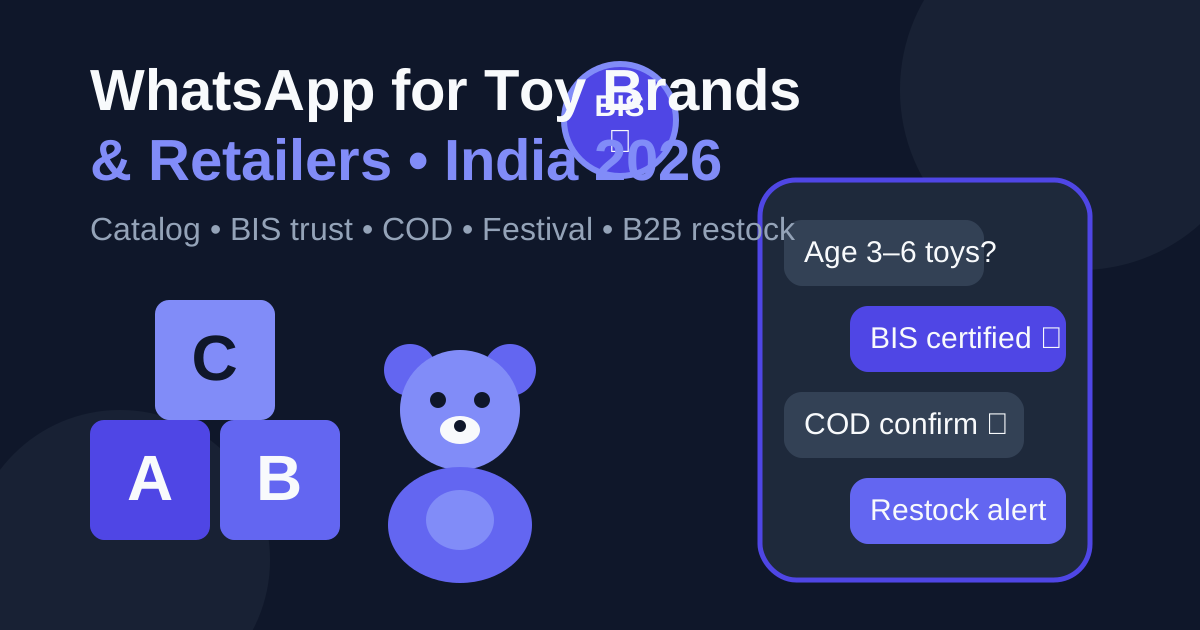
Toy brands and retailers in India can use the WhatsApp Business API in 2026 to run catalog-based product discovery by age group, share BIS/ISI-mark certification proof inside the chat, confirm COD orders, and push festival and birthday campaigns — at ₹0.115 per utility message and ₹0.8631 per marketing message on Meta's India rate card. On a zero-platform-fee provider like RichAutomate, a toy retailer's all-in cost stays between ₹0.215 and ₹0.9631 per message on the Client Pay plan, with no monthly software rent eating into thin toy-margin economics.
India's toy market has been on a policy-driven tear since the import-substitution push began — domestic manufacturing clusters in Delhi NCR, Karnataka and Gujarat now feed everyone from D2C wooden-toy brands to kirana-adjacent toy shops. What almost all of them share: the buyer is a parent, the decision is emotional plus safety-driven, and the conversation already happens on WhatsApp. This playbook covers the full lifecycle — discovery, compliance reassurance, order confirmation, campaigns, and B2B restock alerts to your retailer network — plus the DPDP guardrails that matter more in this category than any other.
Why does WhatsApp matter for toy brands and retailers in India in 2026?
Three structural reasons make WhatsApp the highest-leverage channel for toys specifically:
- The buyer is a parent, not the end user. Parents research toys the way they research schools — they ask questions, want photos and videos, and want reassurance on safety. A WhatsApp thread handles all three in one place; a product page handles none of them interactively.
- Toys are occasion-driven. Diwali, Children's Day, Christmas, Rakhi (for younger siblings), birthdays, and exam-result rewards create sharp demand spikes. Occasion-triggered WhatsApp campaigns with a 7–14 day lead time consistently outperform always-on ads because the intent window is known in advance.
- The trade channel still dominates. Despite D2C growth, most toy volume in India moves through distributors and multi-brand retail counters. WhatsApp is the natural B2B2C rail — the same API account can run consumer campaigns and retailer restock alerts on separate templates.
Compare this with email (single-digit open rates for retail in India) and SMS (no images, no catalog, no two-way thread) and the channel decision makes itself. The real questions are compliance, message economics, and workflow design — covered below.
How do BIS QCO, ISI mark, Legal Metrology and GST affect toy sellers on WhatsApp?
Toys are one of the most tightly regulated consumer categories in India, and your WhatsApp workflows should treat compliance as a selling point, not a chore.
- BIS Quality Control Order (QCO): Toys sold in India have been under a mandatory BIS certification regime since 2021, requiring the ISI mark under the relevant Indian Standards (IS 9873 series for non-electric toys, IS 15644 for electric toys). The scope has been widened and enforcement tightened since the original QCO — exact coverage, exemptions for certain artisanal/handicraft toys, and age-band definitions have shifted over time, so (verify current rules) against the latest BIS notification before making compliance claims in customer-facing messages.
- Legal Metrology (Packaged Commodities) Rules: Pre-packaged toys must declare MRP, net quantity, manufacturer/importer details, country of origin, and customer-care contact. If you sell via WhatsApp catalog, the same declarations should be visible or available on request in the thread — treat the PDP conversation as an extension of the pack.
- GST: Toys have historically sat on a split rate — broadly, non-electronic toys (tricycles, scooters, dolls, board pieces without electronics) at 12% and electronic/battery-operated toys at 18%. Rate classifications get litigated and revised, so (verify current rules) and confirm your HSN mapping with your CA before quoting tax-inclusive prices in chat.
The WhatsApp angle: parents increasingly ask "is this BIS certified?" before buying — especially after news cycles about unsafe imported toys. A saved quick-reply that sends your BIS licence number, the ISI-marked packaging photo, and the applicable IS standard turns a compliance cost into a conversion asset. Brands that answer this question in under a minute close the sale; brands that go silent lose it to the next seller.
What does the full WhatsApp lifecycle look like for a toy business?
Stage 1 — Catalog + age-group discovery
The single most useful segmentation in toys is the child's age band, and WhatsApp catalogs plus a short qualifying flow capture it naturally:
- Entry point: a click-to-WhatsApp ad, QR code on packaging or shelf, or "Chat with us" on your store page.
- First bot question: "Shopping for what age group?" with quick-reply buttons — 0–18 months, 1.5–3 years, 3–6, 6–9, 9–12, 12+.
- Second question: occasion (birthday gift / festival / everyday play / return gift bulk order) and budget band.
- The bot then sends a filtered catalog section — WhatsApp's native product catalog supports collections, so map collections to age × category (STEM kits, soft toys, board games, ride-ons, outdoor).
Store the age band and occasion as contact attributes. That one data point powers everything downstream: birthday campaigns next year, age-appropriate upsells ("your catalog says 3–6, here are the new puzzle sets"), and suppression logic so a parent of a toddler never gets a Nerf-blaster blast.
Stage 2 — BIS-cert reassurance inside PDP threads
When a parent taps a product in the catalog and asks a question, that thread is your product detail page. Pre-build reassurance blocks per SKU family:
- BIS licence number + ISI-mark packaging photo (image message, not just text).
- Age-grading and choking-hazard note for under-3 SKUs — this is both a safety duty and a trust signal.
- Material and washability info for soft toys; battery-compartment screw-lock note for electronic toys.
- A short video of the toy in use — video answers "will my kid actually play with this" better than ten paragraphs.
Because these replies land inside the 24-hour customer-service window opened by the parent's own message, they are free-form service messages at zero Meta cost. The most persuasive content in your entire funnel costs you nothing to deliver.
Stage 3 — Order confirmation + COD verification
Toys skew heavily COD, and COD in gifting categories has a nasty RTO (return-to-origin) problem: the gift occasion passes, the buyer's enthusiasm fades, the parcel comes back. WhatsApp utility messages at ₹0.115 each are the cheapest RTO insurance available:
- Order confirmation immediately on order placement, with items, amount, and delivery estimate.
- COD confirm button — a template with "Confirm order" / "Cancel" quick replies. Unconfirmed COD orders older than 24 hours get one reminder, then a human follow-up. Sellers running this pattern typically see meaningful RTO reduction because junk and impulse-regret orders self-cancel before shipping.
- Dispatch + out-for-delivery updates, each a ₹0.115 utility message. For a gift order, add "Ordered as a gift? Reply GIFT and we'll add free wrapping" — a service-window reply that upsells at zero message cost.
Stage 4 — Festival and birthday campaigns
This is where the age-band attribute compounds. Campaign calendar for an Indian toy seller:
- Birthday automation: if you captured the child's birth month at Stage 1 (ask the parent, frame it as "so we can suggest age-right toys"), fire a campaign 2–3 weeks before — when the parent is actively gift-planning and party-planning. This is the highest-converting single automation in the category.
- Diwali / Children's Day (14 Nov) / Christmas: segment by age band and last-purchase category. A parent who bought a STEM kit gets the new robotics set, not a generic "SALE 40% OFF" blast.
- Return-gift bulk offers: parents planning birthday parties buy 15–30 identical small toys. A dedicated "return gifts under ₹199" campaign to anyone who mentioned a birthday recently converts at bulk-order values.
- Exam-season rewards (March–April): "results out — reward time" is a uniquely Indian toy-buying occasion worth its own template.
Each of these is a marketing template at ₹0.8631 per delivered message. At even a conservative 1.5–2% conversion on a well-segmented list with an average order of ₹800–1,500, the arithmetic is comfortably positive — but only if you segment. Blasting your full list monthly is how toy brands get their marketing templates paused and their quality rating downgraded. Frequency-cap marketing sends to 2–4 per contact per month.
Get a 1-minute BSP audit on WhatsApp
Drop your WhatsApp number — we line-item your current invoice against Meta India rates in under 60 seconds. India-hosted, DPDP-compliant.
Stage 5 — Restock alerts to retailers (the B2B2C angle)
If you're a toy brand or distributor, your retailer network is a second WhatsApp audience — and arguably the more profitable one per message:
- Restock nudges: "Your last order of [fast-moving SKU] was 45 days ago — typical sell-through is 30 days. Reorder?" with a quick-reply order button. This is operational, recurring revenue on ₹0.115 utility messages (where the message qualifies as utility — transactional, tied to the existing trade relationship; promotional new-line announcements are marketing templates).
- New-launch trade previews: send retailers the new range with trade pricing 2 weeks before the consumer campaign, so shelves are stocked when consumer demand hits. This choreography — trade first, consumer second — is what separates brands from box-movers.
- Scheme and slab communication: quantity-slab offers, festival trade schemes, and payment-due reminders all run as structured templates instead of the sales rep's personal number (which walks out the door when the rep does).
- Order collection via flows: a WhatsApp-native order form (SKU, quantity, delivery date) removes the phone-call-and-notebook ordering ritual that still dominates toy distribution.
Run consumer and trade audiences as separate tags with separate template libraries on the same WhatsApp Business API number, or on two numbers under one WABA if volumes justify it.
What does WhatsApp API messaging cost a toy brand in 2026?
Meta hiked India conversation rates by roughly 10% on 1 January 2026 — marketing went from ₹0.7846 to ₹0.8631 per message. The provider you choose determines what gets added on top. Here is the 2026 math for a toy retailer sending 5,000 marketing messages and 8,000 utility messages (order confirms, COD confirms, dispatch updates, retailer restock alerts) per month:
| Cost head | Meta direct rate | RichAutomate Client Pay | RichAutomate SaaS Pay | Typical legacy BSP |
|---|---|---|---|---|
| Platform / monthly fee | — | ₹0 | ₹0 | ₹1,500–₹25,000/mo |
| Setup fee | — | ₹0 | ₹0 | ₹0–₹15,000 |
| Marketing message | ₹0.8631 | ₹0.8631 + ₹0.10 = ₹0.9631 | ₹1.50 inclusive | ₹0.95–₹1.40 |
| Utility / auth message | ₹0.115 | ₹0.115 + ₹0.10 = ₹0.215 | ₹0.50 inclusive | ₹0.30–₹0.60 |
| Service reply (24h window) | ~₹0.115 (first 1,000/month free) | ~₹0.115 + ₹0.10 platform | Included | Varies |
| Monthly total (5k mktg + 8k utility) | — | ₹6,536 | ₹8,400 | ₹9,150–₹36,800 |
Two things stand out. First, the utility tier is where toy businesses live — COD confirms, shipping updates, and retailer restock alerts are all ₹0.115 Meta-rate messages, so a provider's utility markup matters more than its marketing markup. Second, fixed monthly platform fees are poison for seasonal businesses: a toy retailer's send volume in October–December can be 4–5× the June volume, and a per-message model means costs track revenue instead of accruing during the off-season. For the full comparative math across providers, see the state of WhatsApp Business API pricing in India 2026 and the detailed WhatsApp Business API cost breakdown for India. If you're still evaluating vendors, start with the best WhatsApp Business API platforms in India for 2026.
How should toy marketers handle DPDP and children-adjacent marketing?
This is the section toy sellers skip at their peril. India's Digital Personal Data Protection (DPDP) Act treats children's data as a special category — processing a minor's personal data requires verifiable parental consent, and tracking or behavioural advertising directed at children is restricted (verify current rules and the final DPDP Rules for implementation specifics). For a WhatsApp toy funnel, the operating principles are clear regardless of how the fine print settles:
To see what non-compliance would actually cost, the DPDP penalty calculator sizes the exposure against your contact volume.
- Parents are the audience. Always. Your WhatsApp contact is the parent's number, your opt-in is the parent's opt-in, and your copy addresses the parent ("toys your 5-year-old will love"), never the child ("hey kids!"). Never knowingly message a number belonging to a minor.
- Collect the minimum about the child. Age band and birth month are enough to run every workflow in this playbook. You do not need the child's name, photo, school, or exact birthdate — and each extra field you skip is DPDP exposure you don't carry.
- Frame data collection honestly. "Tell us the age group so we recommend age-safe toys" is a legitimate, parent-beneficial purpose. Buried profiling is not.
- Honour opt-outs instantly and keep consent records. Every marketing template should carry a stop mechanism, and your platform should log opt-ins with timestamp and source — this is your evidence trail if a complaint ever lands.
- Meta's own commerce and advertising policies add a second layer on top of Indian law — child-directed targeting is restricted on Meta surfaces too, so the parent-audience framing keeps you aligned with both regimes at once.
Handled this way, DPDP is not a blocker — it's a moat. Toy sellers who can show parents a clean, consent-first data practice win the trust battle that actually decides toy purchases.
Why RichAutomate for toy brands and retailers?
RichAutomate is a WhatsApp Business SaaS built on Meta's Cloud API with pricing designed for exactly this kind of seasonal, utility-heavy business:
- ₹0 platform fee, ₹0 setup fee, ₹0 monthly fee — you pay only for messages sent.
- Client Pay: ₹0.10 per message platform charge, with Meta's rates (₹0.8631 marketing / ₹0.115 utility-auth) billed to you directly at cost — full transparency, no hidden markup.
- SaaS Pay: ₹1.50 per marketing message and ₹0.50 per utility/auth message, all-inclusive, if you'd rather have one simple bill.
- 14-day free trial with 100 free credits — enough to wire up your catalog flow, COD confirmation templates, and a retailer restock pilot before paying anything.
- Product catalogs, no-code chatbot flow builder for the age-band qualifier, broadcast campaigns with tag-based segmentation, shared team inbox for PDP-thread queries, and a developer API for connecting your order system to dispatch-update templates.
Full plan details are on the RichAutomate pricing page, and if raw cost is your deciding criterion, see why it ranks as the cheapest WhatsApp Business API in India.
How do you get started?
A practical first-30-days sequence for a toy brand or retailer:
- Week 1: Get WhatsApp Business API access (you'll need business documents; GST registration is effectively required to go live). Build your catalog with age-band collections. Draft the BIS-reassurance quick replies per SKU family.
- Week 2: Launch the age-band qualifier bot and COD-confirmation utility templates. Add the WhatsApp entry QR to packaging and the store counter.
- Week 3: Onboard your top 20 retailers onto restock-alert templates. Measure reorder response rate against the phone-call baseline.
- Week 4: Run your first segmented campaign — one age band, one occasion, one offer. Measure delivered → read → replied → ordered, then scale what worked into the festival calendar.
Message RichAutomate on WhatsApp at +91 81603 11319 or book a 30-minute walkthrough at calendly.com/inrichdaddy/30min — bring your catalog and your busiest festival date, and leave with a working funnel plan.
Related: WhatsApp for toy manufacturers in India 2026 — the factory-side playbook: golden-sample approval gate, BIS Toys QCO certificate clock, e-Way Bill dispatch and export-document collection.