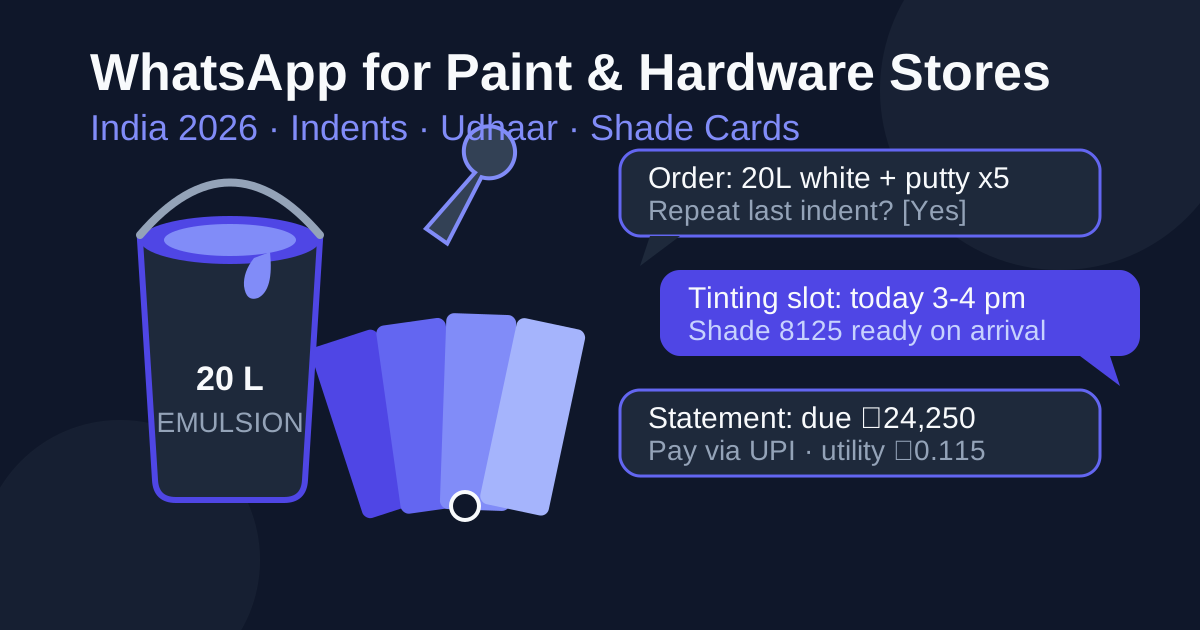
Paint and hardware stores in India use the WhatsApp Business API in 2026 to take recurring contractor indents, send credit-ledger (udhaar) reminders at ₹0.115 per utility message, share shade cards and colour-visualizer links, book tinting-machine slots, and run monsoon and festival repaint campaigns at ₹0.8631 per marketing message. A single counter number with automation replaces the daily chaos of missed calls from painters, handwritten order chits, and month-end khata disputes — for a typical dealer, the entire messaging bill runs under ₹2,000 a month.
This is a classic unglamorous-distribution business: a paint dealer's real customers are not homeowners walking in for one litre of enamel — they are the 40–200 painters, contractors, plumbers, electricians, and site supervisors who order the same SKUs week after week and settle accounts monthly. Every one of them is already on WhatsApp. The store that structures those conversations wins the repeat order; the store that doesn't loses it to whoever picks up the phone first.
Why do paint & hardware stores need WhatsApp automation in 2026?
India's decorative paints market is estimated at roughly ₹70,000+ crore and still growing high-single digits, with hardware, sanitaryware, plumbing, and electrical retail adding several times that. Almost all of it flows through counter-sales dealers and distributors — exactly the businesses where the order channel is a phone call at 8 a.m. from a contractor standing at a site.
The operational problems are the same in Ludhiana, Coimbatore, and Guwahati:
- Order capture is verbal. A painter calls, the counter boy scribbles "20L Apcolite white + 5 kg putty + rollers", and half the disputes later are about what was actually said.
- Credit is the business model. Contractors buy on 15–45 day khata. Chasing payment by phone call is awkward and inconsistent; not chasing it kills cash flow.
- Shade selection is a bottleneck. Customers want to see 8–10 shades before committing; physical shade cards go missing and site visits waste staff time.
- The tinting machine is a queue. One machine, one operator, and contractors who all arrive at 10 a.m. wanting 20 litres tinted "abhi".
- Demand is brutally seasonal. Pre-monsoon waterproofing, post-monsoon repaint, and the Diwali/wedding-season rush account for a huge share of annual revenue — and most dealers do zero structured outreach before any of them.
WhatsApp fixes each of these with a written, timestamped, automated channel. Below is the playbook, use case by use case, with real 2026 message costs.
How do recurring contractor indents work on WhatsApp?
The highest-value flow for any dealer is B2B ordering from repeat trade buyers. Instead of calls, you give every contractor one structured way to place an indent:
- Keyword or button-driven order flow. The contractor sends "order" (or taps a button on your last message) and a chatbot flow walks them through: brand → product line → shade code → pack size → quantity → site/delivery address. The output lands with your counter team as a clean, structured order — no interpretation needed.
- Repeat-indent shortcut. Because trade buyers order the same basket repeatedly, the flow can offer "Repeat last order?" as the first option. One tap re-creates last week's indent. This alone converts a 4-minute call into a 10-second interaction.
- Order confirmation as a utility message. Once the counter accepts the order, an automated confirmation goes out — items, quantities, rate (if you show trade rates), expected ready time. That written confirmation is your dispute killer, and it costs ₹0.115 as a utility template.
- Ready-for-pickup / dispatched alerts. When the material is billed and loaded, a second utility message tells the contractor or his driver it's ready. No more "aa jao, ho gaya kya?" calls.
For a dealer with 100 active trade accounts averaging 6 orders a month, that's ~600 confirmations plus ~600 ready alerts = 1,200 utility messages ≈ ₹138/month in Meta fees. The time saved at the counter is worth far more than that per day.
How do credit-ledger (udhaar) reminders work without souring relationships?
Credit collection is where WhatsApp quietly earns its keep. The psychology matters: a phone call demanding money feels confrontational; a neutral, automated statement message feels like process. Contractors respond better to the machine than to the owner.
A working reminder ladder looks like this:
- Monthly statement (utility, ₹0.115): "Your account statement for June: purchases ₹84,250, payments ₹60,000, outstanding ₹24,250. Reply STATEMENT for the itemised PDF." Sending the ledger as a PDF attachment inside the conversation makes it verifiable and professional.
- Due-date nudge (utility): 3 days before the agreed credit period ends — amount, due date, and your UPI ID or a payment link. Putting UPI in the message is the single biggest collection accelerator: the contractor can settle from the site in 20 seconds.
- Overdue escalation: Day 3 and day 10 past due, still polite, still automated. Only after that does the owner make a personal call — now backed by three written, timestamped reminders.
- Payment received confirmation: Auto-acknowledge every payment with the updated balance. This builds trust in the ledger and pre-empts "maine to de diya tha" disputes.
Dealers who move from ad-hoc calling to a structured WhatsApp reminder ladder typically report faster collection cycles simply because the reminder actually goes out every time, to every account, on schedule — something no busy counter staff manages manually. At ₹0.115 per reminder, running the full ladder on 150 credit accounts costs about ₹70–₹100 a month.
One caution: keep reminder copy factual and account-specific. Reminder templates about a customer's own transactions are utility templates under Meta's 2026 classification; adding promotional lines ("also check our new emulsion range!") can get the template reclassified as marketing at 7.5x the price — and mixing dunning with promotion annoys people anyway.
How do shade-card sharing and colour-visualizer links work on WhatsApp?
Shade selection is the most media-heavy part of a paint sale, and WhatsApp is a media channel:
- Digital shade cards on demand. A customer types "shade card" or picks a brand from a menu, and the bot sends the relevant shade-card PDF or image set instantly — Asian Paints, Berger, Nerolac, Dulux, JSW, Birla Opus, whichever brands you stock. No more torn physical fan decks.
- Visualizer links. Every major paint company now ships a free online colour visualizer where customers upload a wall photo and preview shades. Your bot can send the right visualizer link with a one-line instruction. The customer does the browsing at home; they come to your counter with a shade code, not a vague idea.
- Shade-code capture. When the customer replies with a shade code (e.g., "8125 Creamy White"), that's a structured input your flow can log straight into the order — feeding the tinting workflow below.
- Photo-based matching. Customers routinely send a photo of a neighbour's wall asking "yeh shade hai kya?" Route those to a human agent inside the shared team inbox; the conversation is free inside the 24-hour service window.
All inbound-triggered shade conversations happen inside the 24-hour customer-service window, which is free on Meta's 2026 rate card. This entire use case costs you nothing per message.
If you message outside India, the WhatsApp pricing calculator by country has the per-country rates.
How does tinting-machine slot booking reduce counter chaos?
The tinting (computerised colour dispensing) machine is a shared, capacity-constrained resource — which makes it a perfect slot-booking use case, the same pattern clinics and salons use:
- Book-a-slot flow: Contractor sends the shade code, base, and quantity; the bot offers available time windows ("Today 12–1 pm / 3–4 pm / Tomorrow 10–11 am"); one tap confirms.
- Prep-ahead advantage: Because the shade code and base arrive before the contractor does, your operator can stage the base paint and queue the formula. The contractor walks in, collects, leaves — 5 minutes instead of 40.
- Slot confirmation + ready alert: Two utility messages (₹0.23 total per booking) replace an average of three phone calls.
- No-show reduction: A reminder 30 minutes before the slot keeps the queue honest during the Diwali rush.
This is also a subtle loyalty lock-in: once a contractor is used to booking tinting on your WhatsApp number, switching to the dealer across the road means going back to standing in a queue.
Get a 1-minute BSP audit on WhatsApp
Drop your WhatsApp number — we line-item your current invoice against Meta India rates in under 60 seconds. India-hosted, DPDP-compliant.
How should dealers run monsoon and festival repaint campaigns?
Paint demand in India moves on two clocks — weather and festivals — and WhatsApp broadcasts are how you get ahead of both:
- Pre-monsoon (April–June): Waterproofing and exterior-coating push to society committees, contractors, and past exterior-paint buyers. "Monsoon is 6 weeks away — book your terrace waterproofing inspection now."
- Post-monsoon (September–October): The classic repaint window before Diwali. Segment past customers by last purchase date: anyone who painted 3–5 years ago is due. A marketing template with a festival offer at ₹0.8631/message to 1,000 past customers costs ₹863 — one converted whole-house repaint job (₹40,000–₹1,00,000 in material) pays for years of campaigns.
- Wedding season & regional festivals: Onam in Kerala, Durga Puja in Bengal, Ugadi in the south — repaint peaks are regional; segment by pin code if you serve multiple areas.
- Contractor-side campaigns: Trade schemes, new SKU launches, and monsoon-stock advisories ("stock waterproofing compounds before the rains — last year we ran out in week 2") go to your painter list. Painters forward good scheme messages to each other; your broadcast travels.
Discipline matters: send to opted-in lists, segment tightly, and keep frequency to 2–4 marketing touches a month per contact. Meta's quality rating punishes blast-everyone behaviour with reduced messaging limits, and no provider can promise your number is immune to enforcement — least of all if you spray unsolicited messages.
What does WhatsApp Business API cost a paint or hardware store in 2026?
Meta hiked India conversation rates about 10% on 1 January 2026 (marketing went from ₹0.7846 to ₹0.8631 per message). The full picture, including what a typical dealer actually spends:
| Message type | Meta rate (India, 2026) | Typical dealer use |
|---|---|---|
| Marketing template | ₹0.8631 / message | Monsoon/festival campaigns, trade schemes |
| Utility template | ₹0.115 / message | Order confirmations, ready alerts, udhaar reminders, slot bookings |
| Authentication template | ₹0.115 / message | OTP (rare for dealers) |
| Service conversation (24h window) | ~₹0.115 (first 1,000/month free; ₹0 on SaaS Pay) | Shade-card requests, order queries, photo matching |
A worked monthly example for a mid-size dealer — 150 trade accounts, 1,500 walk-in customer contacts:
| Activity | Volume / month | Meta cost |
|---|---|---|
| Order confirmations + ready alerts (utility) | 1,200 | ₹138 |
| Credit reminders + statements (utility) | 500 | ₹58 |
| Tinting slot bookings (utility) | 300 | ₹35 |
| Festival/monsoon campaign (marketing) | 1,200 | ₹1,036 |
| Shade cards, queries, support (service) | 2,000+ | ₹0 |
| Total Meta fees | ~5,200 msgs | ~₹1,267 |
On RichAutomate's Client Pay plan, add ₹0.10/message platform fee (~₹520 here) for a total around ₹1,800/month — with zero platform, setup, or monthly fee. Compare that against providers charging ₹1,500–₹5,000 monthly platform fees before a single message: the full breakdown is in our WhatsApp Business API cost in India 2026 guide, and the market-wide rate analysis lives in our state of WhatsApp Business API pricing in India report.
What about BIS marks and Legal Metrology compliance?
Two regulatory threads touch paint and hardware retail, and your WhatsApp content should respect both:
- BIS certification. Several product categories a hardware counter sells — including cement (ISI mark mandatory under BIS quality control orders) and a growing list of items under Quality Control Orders — require BIS marking. Paints have applicable IS standards (e.g., IS 15489 for plastic emulsion), and QCO coverage has been expanding across chemical and building-material categories; whether a given paint SKU is under mandatory certification depends on the current QCO list (verify current rules). Practical WhatsApp angle: when contractors or institutional buyers ask "ISI mark hai?", your product-catalog messages can carry the BIS/ISI status per SKU — a genuine trust signal for government and society projects that demand certified material.
- Legal Metrology. Packaged goods — paint tins, putty bags, adhesive packs — fall under the Legal Metrology (Packaged Commodities) Rules: declared net quantity, MRP, manufacturer details, and consumer-care information must appear on packaging, and retailers should not sell above MRP (verify current rules). For WhatsApp, this means: quote rates against MRP honestly in your price-list messages, show pack sizes exactly as declared (20L, 10L, 4L, 1L), and never paper over quantity in trade offers. It also gives you a legitimate utility-message use case: sharing the itemised GST invoice PDF, which institutional buyers increasingly demand on WhatsApp anyway.
Neither regime restricts WhatsApp messaging itself — but a dealer whose digital catalog displays BIS status and MRP-transparent pricing looks like the safe choice to every site supervisor placing a lakh-rupee order.
Why RichAutomate for paint & hardware stores?
RichAutomate is built for exactly this kind of high-frequency, thin-margin distribution business, where the platform fee has to be near zero for the economics to work:
- ₹0 platform fee, ₹0 setup fee, ₹0 monthly fee. You pay only for what you send.
- Client Pay plan: ₹0.10 per message platform fee + Meta's rates billed direct to you (₹0.8631 marketing / ₹0.115 utility-auth). Best if you send volume and want raw Meta pricing.
- SaaS Pay plan: ₹1.50 per marketing message and ₹0.50 per utility/auth message, all-inclusive — one simple line item, no Meta billing setup.
- 14-day free trial with 100 free credits — enough to wire up the indent flow and credit reminders on your real number before paying anything.
- Visual flow builder for the order-taking bot, broadcast campaigns with segmentation for festival pushes, a shared team inbox so the counter staff and owner see the same conversations, and template management for your utility reminders.
If you're comparing options, start with our pillar on the cheapest WhatsApp Business API in India, see how vendors stack up in the best WhatsApp Business API providers in India 2026 roundup, and check the current RichAutomate pricing page for plan details.
How does a dealer get started this week?
- Day 1–2: Get a WhatsApp Business API number live (a fresh number or your existing counter number — note that going live on the API effectively requires GST registration for business verification). Import your contractor list with consent.
- Day 3–4: Build the indent flow (order → confirm → ready alert) and submit utility templates for approval: order confirmation, ready-for-pickup, monthly statement, payment reminder, slot confirmation.
- Day 5: Upload shade-card PDFs and visualizer links as auto-replies. Turn on the tinting slot flow.
- Week 2: Send your first segmented campaign — post-monsoon repaint to customers whose last paint purchase is 3+ years old, or a trade-scheme broadcast to your painter list.
Everything above runs on the free trial before you commit a rupee. Message us on WhatsApp at +91 81603 11319 or book a 30-minute walkthrough at calendly.com/inrichdaddy/30min — bring your khata book and your busiest contractor's order history, and we'll map the first three automations live on the call.