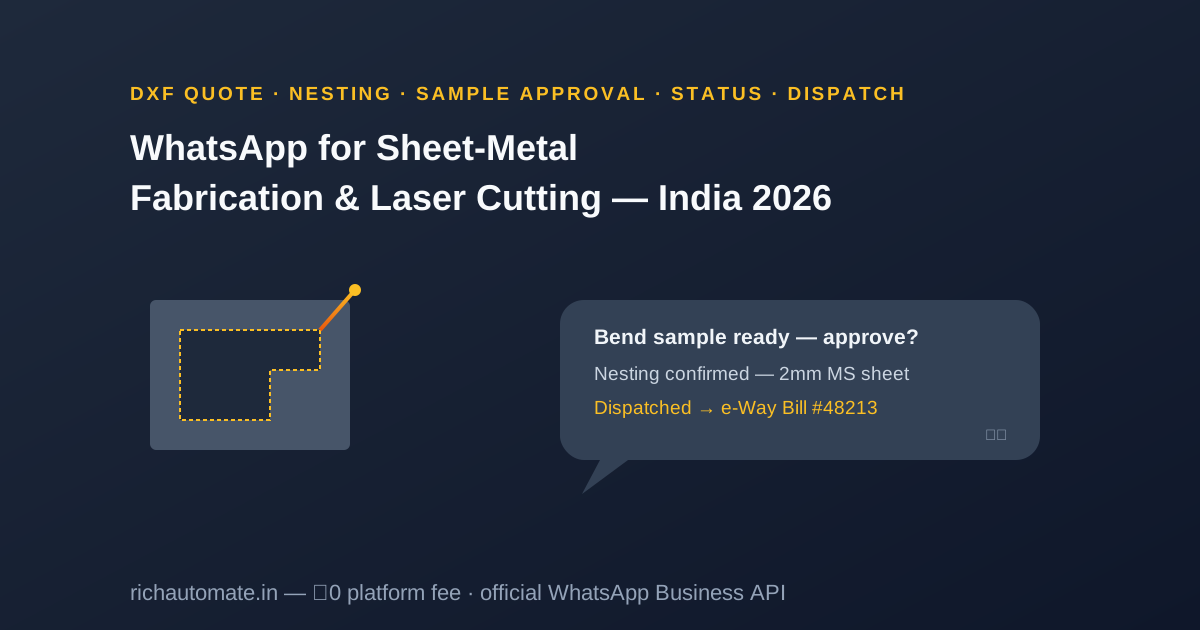
A sheet-metal fabrication or laser-cutting shop lives on approvals that arrive too late. A customer sends a DXF file for quoting, the shop nests it against sheet stock and quotes a price, the customer wants a bend-sample photo before committing to the full run, and by the time all that back-and-forth happens over email and phone calls, the machine sits idle waiting for a "yes" that could have arrived in minutes over WhatsApp. This is a lifecycle built for fast approvals, not long email threads.
Why this is an approval-speed business, not a tracking business
Unlike a delivery fleet or a subscription service, a job shop's bottleneck isn't visibility — it's decision latency. A customer approving a bend sample or confirming a material grade holds up an entire machine slot; every hour that approval sits unread is an hour of idle capacity the shop can't get back. WhatsApp fits because the person approving a sample is almost always looking at their phone within minutes, not their email within a day.
The second reason this vertical suits WhatsApp: photos. A bend-angle check, a laser-cut edge-finish sample, a powder-coat colour match — these are all easier to approve from a photo sent in a chat thread than from a formal document. The approval trail this creates (photo + timestamp + "approved" reply) also becomes useful evidence if a dispute arises later about what was actually signed off.
The six-loop lifecycle
| Stage | What happens on WhatsApp | Why it matters |
|---|---|---|
| 1. DXF-file intake + quote | Customer sends a DXF/drawing file via WhatsApp document upload, shop replies with a quote referencing material grade, thickness, and quantity | Skips a formal RFQ portal for repeat customers and small jobs — the file and the quote live in the same searchable thread |
| 2. Nesting/material confirmation | Shop confirms sheet size, nesting layout, and material availability before cutting starts, customer confirms go-ahead | Prevents a cut run starting on the wrong material grade or thickness — a mistake that wastes both material and machine time |
| 3. Bend/finish-sample approval | Photo of the first bend sample or cut-edge finish sent for approval before the full batch runs | This is the money message — a same-day sample approval is the difference between a job finishing this week or sitting queued behind approvals |
| 4. Production-status push | Update when cutting starts, when bending/welding/finishing begins, and when QC is complete | Reduces "what's the status" calls, which eat into shop-floor supervisor time during a shift |
| 5. Dispatch + e-way bill | Dispatch confirmation with e-way bill number and expected delivery window | Gives the customer's receiving team a heads-up to plan unloading, especially for oversized fabricated parts |
| 6. Reorder/repeat-job nudge | A nudge for recurring jobs (same part, different batch) referencing the last approved drawing and pricing | Repeat job-shop work is high-margin and low-friction — a simple "same as last time?" message converts faster than a fresh RFQ cycle |
Regulatory and compliance spine (hedged — verify current rules)
Job-shop fabrication sits across MSME, tax, and quality-certification regimes, none of which the bot should ever resolve on its own judgment:
- MSME Udyam registration — most sheet-metal and laser-cutting shops qualify as MSMEs, which affects payment-term protections under the MSMED Act and eligibility for various state/central schemes (verify current registration status and applicable benefits).
- GST e-invoicing and e-way bill — dispatch of fabricated goods above threshold values requires e-way bill generation; the bot can push the e-way bill number/reference, never generate or interpret GST classification.
- Factories Act, 1948 — shops operating with power-driven machinery above worker-count thresholds fall under state factory-licensing rules (verify current state notification and applicability to shop size).
- ISO 9001 / customer-specific quality requirements — many OEM customers require documented quality-management-system evidence; approval-photo threads can support this trail but never substitute for the formal QMS documentation.
- DPDP Act, 2023 — customer drawings, part specifications, and pricing discussed over WhatsApp are commercially sensitive; purpose-limited handling and no forwarding to unrelated parties applies.
What the bot should never do
It never approves a bend sample or quality check on its own — that judgment stays with the customer and the shop's QC team — never quotes a price without shop sign-off on material availability, never certifies ISO/quality compliance, never generates or interprets e-way bills/GST classification, and never shares one customer's drawing or pricing with an unrelated party. It intakes, reminds, and routes — the engineering and quality decisions stay human.
Get a 1-minute BSP audit on WhatsApp
Drop your WhatsApp number — we line-item your current invoice against Meta India rates in under 60 seconds. India-hosted, DPDP-compliant.
Illustrative cost math
A shop running 150 jobs/month might see, per job: 1 quote message + 1 nesting-confirmation + 1-2 sample-approval exchanges + 2 production-status pushes + 1 dispatch confirmation — roughly 6-7 utility-category messages per job, or 900-1,050 messages/month. On Client Pay (₹0 platform fee + ₹0.10/message + Meta's per-conversation fee billed directly), that's illustratively ₹1,400-2,200/month — verify current Meta conversation rates. SaaS Pay alternative: ₹1.50/marketing, ₹0.50/utility conversation, all-in. Against even one job saved from a stalled-approval delay, this is a rounding error.
One-week rollout for a single shop
- Day 1-2: Connect WhatsApp Business number, import active customer contacts, set up document-upload handling for DXF/drawing files.
- Day 3: Template the quote-confirmation and nesting-confirmation messages.
- Day 4: Build the sample-approval flow — photo upload from shop floor, approval reply capture.
- Day 5: Set up production-status push templates tied to shop-floor stage changes.
- Day 6: Template dispatch confirmation with e-way bill reference field.
- Day 7: Go live on new jobs, monitor approval turnaround time for a week before extending to full customer base.
Who fits which platform
A small shop running a handful of jobs a week can manage fine on manual WhatsApp with basic templates for quotes and dispatch. Once volume crosses into dozens of concurrent jobs with multiple approval stages per job, a proper WhatsApp Business API setup — structured document intake, photo-approval capture, and status-push automation tied to shop-floor stages — removes the single biggest bottleneck in this business: an approval that sits unread while a machine slot goes idle. Shops already running an ERP/MES system for job tracking should look for API integration into that system rather than a standalone tool — WhatsApp becomes the fast-approval and notification layer on top of the existing production system of record.
Rather than writing from scratch, pull a close match out of the WhatsApp template library and edit it.
RichAutomate runs on the official WhatsApp Business API — ₹0 platform fee, ₹0 setup, ₹0 monthly minimum. Client Pay is ₹0.10/message plus Meta's rate billed direct; SaaS Pay is ₹1.50/marketing and ₹0.50/utility conversation, all-in. 14-day trial, 100 free credits, no card required to start. As always: never any promise of "no ban" for bulk or unsolicited sends — proper opt-in and the official API are what keeps a WABA in good standing, not a specific tool.
Related reading
- Best WhatsApp Business API for Manufacturing B2B Distribution
- Best WhatsApp Business API for EV Component Manufacturers
- DPDP Act 2023 Compliance Checklist
- Best WhatsApp CRM
- Client Pay vs SaaS Pay
- WhatsApp Business API Cost
Related: WhatsApp for electroplating & powder-coating job shops in India (2026) — RFQ, job-work challan, QC records and dispatch in one thread.
Fabricated assemblies that need stress relieving after welding go out to a heat treatment job work vendor, and the returning batch needs a furnace chart against your work order. Track that outward leg the same way you track cutting nests.