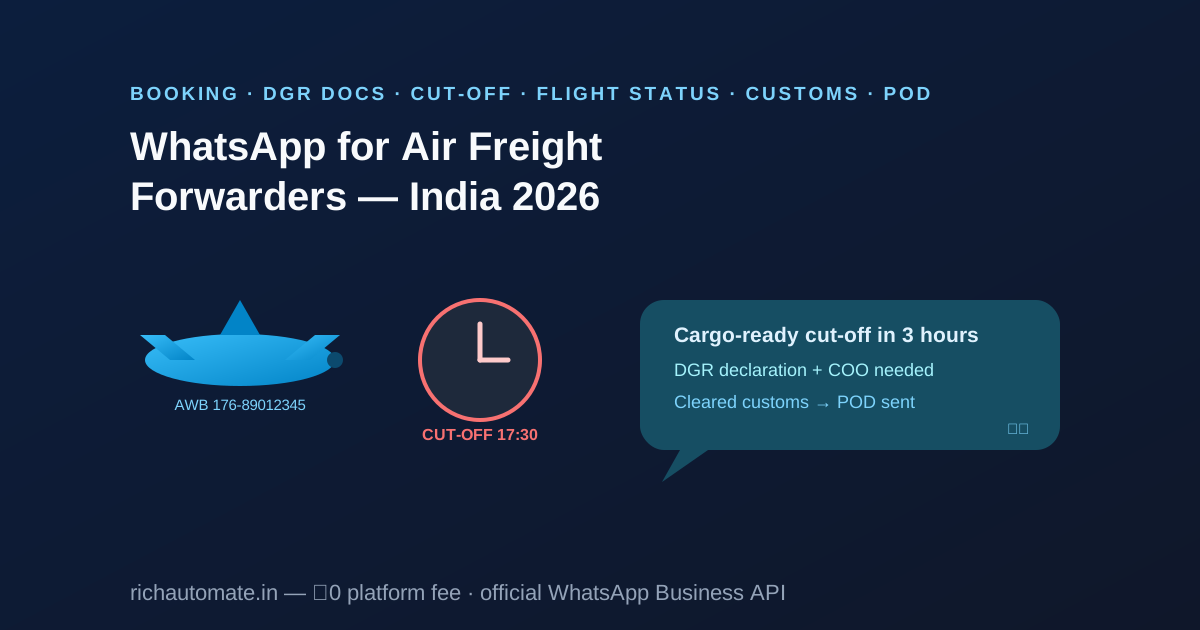
An air freight forwarder's entire business is a chain of deadlines — a flight cut-off, a customs clearance window, a consignee waiting at the other end. Miss one link and the shipment misses the flight, or worse, misses a perishable/pharma temperature window. Every one of those deadlines today gets chased over phone calls and WhatsApp texts anyway. The question is whether that chase is organised — AWB number, flight, cut-off time, all logged — or scattered across a forwarder's personal phone.
Why air freight forwarding is a deadline business, not a tracking business
Ocean freight gives you weeks. Air freight gives you hours. A cargo-ready cut-off missed by 30 minutes doesn't mean "next week" — it means the shipment sits at the airport for a day or more waiting for the next available flight, and every day of delay on a time-sensitive or perishable shipment is a client relationship at risk. That single fact — the compressed timeline — is why WhatsApp fits this vertical better than email: a cut-off reminder needs to land as a push notification the shipper actually sees in the next ten minutes, not sit in an inbox.
The second reason WhatsApp fits is document chase. Air cargo carries a specific document set — IATA Dangerous Goods Regulations (DGR) declarations for anything hazardous, Certificate of Origin, phytosanitary/PGA certificates depending on cargo type — and every missing document is a customs hold. A structured document-collection Flow beats a chain of "please send the COO" emails that get buried.
The six-loop lifecycle
| Stage | What happens on WhatsApp | Why it matters |
|---|---|---|
| 1. Booking confirmation + AWB issue | Shipper gets the AWB number, routing, and estimated flight the moment the booking is confirmed with the airline/GSA | The AWB number becomes the reference for every message that follows — one thread per shipment, not scattered across calls |
| 2. IATA-DGR / PGA document collection | A Flow requests the exact document set needed for that cargo type (DGR declaration, COO, phytosanitary certificate) with a clear deadline | Missing documents are the #1 cause of a shipment missing its planned flight — a specific ask beats a generic "send documents" email |
| 3. Cargo-ready + cut-off reminder | A reminder timed against the airline's cargo acceptance cut-off, with enough lead time for last-mile trucking to the airport | This is the money message — a cut-off reminder that lands with real lead time is the difference between making the flight and a costly next-flight rebooking |
| 4. Flight status + ETA push | Departure confirmation, any flight change/delay, and updated ETA at destination | Consignees and shippers both want to know the moment a flight is delayed — proactive notice beats a client calling to ask |
| 5. Arrival + customs clearance nudge | Arrival notice, customs clearance status updates, any query/hold flagged with what document resolves it | A customs hold notified same-day (with the specific document needed) can resolve in hours instead of the shipment sitting for days |
| 6. POD / delivery confirmation | Delivery confirmation to consignee, POD copy shared, invoice/billing thread opened | Closes the loop with a document trail useful for both the forwarder's own records and any claims process |
Regulatory and compliance spine (hedged — verify current rules)
Air cargo forwarding sits across aviation, customs, trade, and foreign-exchange regulation, none of which the bot should ever resolve on its own judgment:
The WhatsApp compliance self-audit is a quick way to find which of these you are actually missing.
Get a 1-minute BSP audit on WhatsApp
Drop your WhatsApp number — we line-item your current invoice against Meta India rates in under 60 seconds. India-hosted, DPDP-compliant.
- DGCA and BCAS — Regulated Agent (RA) / Known Consignor (KC) status governs who can tender cargo for carriage; a forwarder operating as an RA has specific security-screening obligations (verify current DGCA/BCAS circulars).
- IATA CASS and DGR — Cargo Accounts Settlement System governs billing between forwarders and airlines; Dangerous Goods Regulations govern hazmat air cargo declarations (verify current IATA DGR edition).
- Customs (ICEGATE) — import/export clearance runs through India's customs electronic gateway; the bot can nudge for documents, never file a Bill of Entry/Shipping Bill or interpret customs classification.
- DGFT — export incentive schemes, restricted/prohibited cargo lists, and licensing requirements vary by commodity (verify current DGFT policy for the specific cargo category).
- RBI FEMA — cross-border payment and FIRC/BRC (Foreign Inward Remittance Certificate/Bank Realisation Certificate) requirements apply to export transactions; reminders only, never a compliance opinion.
- DPDP Act, 2023 — shipper/consignee contact details and shipment content descriptions are personal/commercial data requiring purpose limitation and secure handling.
What the bot should never do
It never issues or amends an AWB, never files customs documentation or interprets a customs hold's resolution, never certifies DGR compliance or classifies a shipment as hazardous/non-hazardous, never quotes a customs duty or FEMA compliance status as advice, and never shares one client's shipment/commercial detail with an unrelated party. It confirms, reminds, and routes — classification, filing, and compliance judgment stay with the licensed cargo agent and customs broker.
Illustrative cost math
A forwarder handling 300 shipments/month might see, per shipment: 1 booking confirmation + 1-2 document-chase messages + 1 cut-off reminder + 1-2 flight-status pushes + 1 arrival/customs update + 1 POD confirmation — roughly 6-7 utility-category messages per shipment, or 1,800-2,100 messages/month. On Client Pay (₹0 platform fee + ₹0.10/message + Meta's per-conversation fee billed directly), that's illustratively ₹2,200-3,200/month — verify current Meta conversation rates. SaaS Pay alternative: ₹1.50/marketing, ₹0.50/utility conversation, all-in. Against the value of even one avoided missed-flight rebooking or customs-hold delay, this is a rounding error.
One-week rollout for a single forwarding office
- Day 1-2: Connect WhatsApp Business number, import active shipper/consignee contacts, build the booking-confirmation template.
- Day 3: Build the document-collection Flow with the standard DGR/COO/phytosanitary document set as options.
- Day 4: Set up the cut-off reminder sequence tied to each shipment's flight cut-off time.
- Day 5: Template flight-status and arrival-notice pushes, test against one live shipment end-to-end.
- Day 6: Add the customs-clearance-nudge template with placeholder fields for hold reasons.
- Day 7: Go live on new bookings, monitor delivery and response rates before extending to the full shipment book.
Who fits which platform
A small forwarding office running a handful of shipments a week can manage fine on manual WhatsApp with templates. Once volume crosses into dozens of shipments a month across multiple shippers and destinations, a proper WhatsApp Business API setup — one conversation thread per AWB, automated cut-off reminders tied to flight schedules, and a document-collection Flow — removes the single biggest operational risk in this business: a missed cut-off because a reminder didn't reach the right person in time. Larger forwarders running an existing freight-management or CASS-integrated system should look for API integration into that system rather than a standalone tool — WhatsApp should be the notification layer on top of the existing AWB/booking system of record, not a second ledger to reconcile.
RichAutomate runs on the official WhatsApp Business API — ₹0 platform fee, ₹0 setup, ₹0 monthly minimum. Client Pay is ₹0.10/message plus Meta's rate billed direct; SaaS Pay is ₹1.50/marketing and ₹0.50/utility conversation, all-in. 14-day trial, 100 free credits, no card required to start. As always: never any promise of "no ban" for bulk or unsolicited sends — proper opt-in and the official API are what keeps a WABA in good standing, not a specific tool.
Related reading
- WhatsApp for Custom House Agents (CHA) & Freight Forwarders
- WhatsApp for TReDS Invoice Discounting
- DPDP Act 2023 Compliance Checklist
- Best WhatsApp CRM
- Client Pay vs SaaS Pay
- WhatsApp Business API Cost
For the sea-side equivalent of this playbook, read WhatsApp for ship chandlers and marine supply in India.