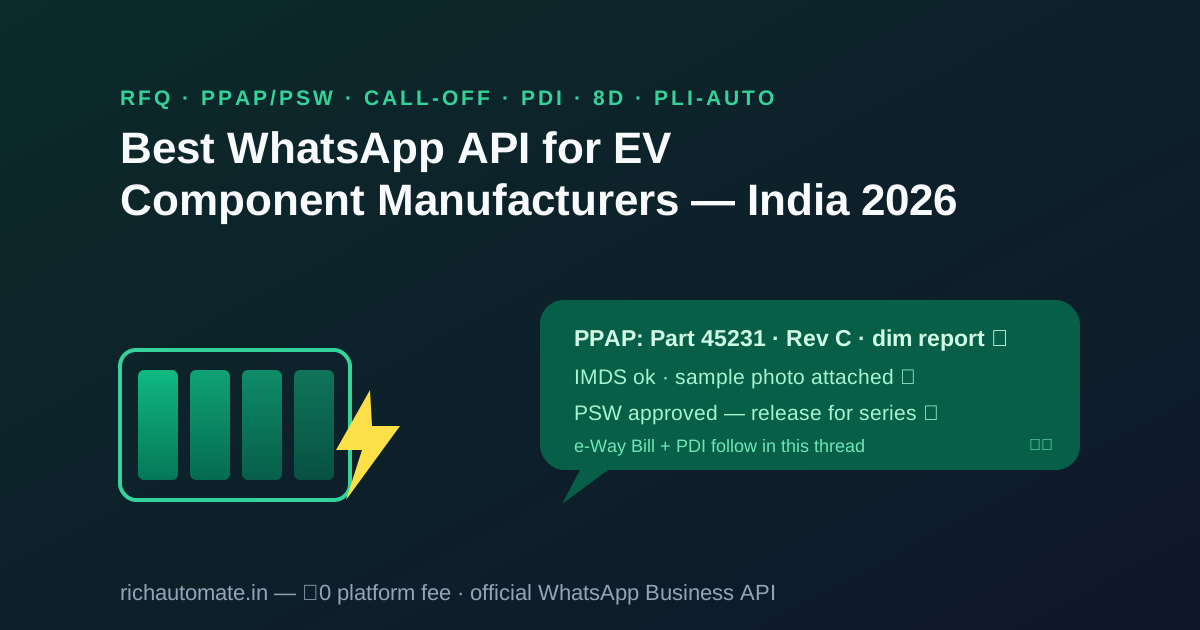
The short answer. An EV component manufacturer lives or dies on part approval: the PPAP pack, the PSW sign-off, the deviation note when a lot drifts out of spec — and every one of those is a document exchange with a demanding OEM or Tier-1 buyer that today rides on email threads nobody can find at audit time. WhatsApp on the official Business API turns that exchange into a tracked, timestamped thread: the PPAP/PSW approval message — part number, drawing revision, dimensional report, IMDS/CAMDS status, sample photo — into the buyer's own WhatsApp thread, and their "approved, ship" landing in the same place. Around it sit RFQ acknowledgements, schedule-agreement (JIT/kanban) call-off confirmations, dispatch with e-Way Bill + PDI report, 8D/deviation alerts, and PLI-Auto / localization-certificate coordination. A supplier with ~80 active OEM/Tier-1 part programs runs the loop for roughly ₹900-1,500 a month on RichAutomate's ₹0-platform model (illustrative below). Compliance first: PLI-Auto localization rules, AIS-156 / CMVR type-approval, ARAI/ICAT testing, BIS and GST all touch this trade — verify current requirements with your authority and the OEM's SQA team.
An OEM buyer forgives a slow quote. They never forgive a PPAP dispute with no record — a rejected PSW at the gate stops your line and theirs. Put the part-approval pack, the call-off and the deviation note in one thread per program, and the audit answers itself.
Why WhatsApp fits an EV component manufacturer
Tier-1 and OEM supplier-quality teams already run on chat for the day-to-day — the problem is that chat lives on personal numbers, with no record, no template discipline and no audit trail. The official WhatsApp Business API keeps the same speed the buyer expects but makes every part-critical exchange a logged, templated, opt-in message on your company number. For an EV-component maker feeding two-wheeler, three-wheeler, e-bus and passenger-EV programs, that means the PPAP status, the schedule call-off and the deviation alert stop living in one engineer's inbox.
The 6-loop supply cycle on WhatsApp
| Loop | What happens | WhatsApp job | Category |
|---|---|---|---|
| 1. RFQ + feasibility | OEM floats an enquiry for a part | RFQ acknowledgement + feasibility-commit date into the buyer's thread | Utility |
| 2. PPAP / PSW approval | Part submitted for approval before series supply | Part no. + drawing rev + dimensional report + IMDS status + sample photo into the SQA thread before dispatch — the approval-dispute ender | Utility |
| 3. Schedule call-off | JIT/kanban releases against a schedule agreement | Call-off confirmation + committed dispatch date in the same thread | Utility |
| 4. Dispatch + PDI | Lot ships to the plant | Invoice + e-Way Bill + PDI report + vehicle details + delivery POD | Utility |
| 5. Deviation / 8D | A lot drifts or a line reject is raised | Deviation alert + 8D status updates referencing part + lot number | Utility |
| 6. Programme updates | Localization, PLI, price revisions | Opt-in programme bulletins to buyer SQA/purchase contacts | Opt-in Marketing |
The PPAP/PSW approval message — the money message
Every gate rejection starts the same way: the part was "approved on a call", nothing versioned in writing, and the OEM's incoming-quality team sees a drawing revision that doesn't match. The discipline is one thread per part program: before the series lot leaves, the approval pack goes in — part number, drawing revision, the dimensional/functional report, IMDS/CAMDS declaration, a photo of the submitted sample — and the buyer's "PSW approved, release" lands in the same thread. If quality disputes on arrival, the conversation starts from a declared, acknowledged submission level instead of two memories of a phone call. The same thread carries the call-offs and the 8D history, so a supplier audit is a scroll-up, not a scramble.
Get a 1-minute BSP audit on WhatsApp
Drop your WhatsApp number — we line-item your current invoice against Meta India rates in under 60 seconds. India-hosted, DPDP-compliant.
Regulator + compliance spine (verify everything)
- PLI-Auto + localization — the Auto/ACC PLI schemes tie incentives to Domestic Value Addition; localization certificates and DVA evidence move between you and the OEM. Coordinate on the record, but the certificate itself is a signed compliance document, not a chat message. Verify current DVA thresholds.
- AIS-156 / CMVR type-approval — EV components (esp. battery, BMS, cells, chargers) feed vehicle type-approval; your part's test status affects the OEM's homologation. The bot carries status; it never certifies conformity.
- ARAI / ICAT testing — test-report submission and retest coordination can ride WhatsApp threads; the reports are issued by the test agency, not by you.
- BIS + quality standards — where BIS or IS standards apply to the component, declared conformity and marking discipline stand outside the chat.
- GST + e-Way Bill — job-work movement, inter-state supply and e-invoicing rules apply; verify with your CA.
- DPDP Act 2023 — buyer SQA/purchase contacts and programme data are personal/business data; collect with consent, honour deletion. See the DPDP checklist.
The carve-out — what the bot must never do
The automation records and coordinates. It must never certify conformity or approve a PSW on its own (approval is the OEM SQA's call — the bot only carries the submission), never quote a localization/DVA figure as its own promise, never commit revised dispatch dates through a line stoppage or material shortage it cannot see, and never broadcast to buyer contacts who haven't opted in. Evidence and coordination — nothing more.
The DPDP penalty calculator puts a number on the downside if your consent records do not hold up.
What it costs — illustrative math on RichAutomate
A supplier with 80 active part programs across a handful of OEM/Tier-1 buyers: ~600 utility messages a month (RFQ acks, PPAP/PSW submissions, call-off confirmations, dispatch + PDI + POD, deviation/8D updates), with the fast back-and-forth riding free inside 24-hour service windows. On Client Pay: ₹0 platform + ₹0.10/message with Meta charges billed direct; on SaaS Pay: ₹1.50 marketing / ₹0.50 utility all-in. Monthly ≈ ₹900-1,500 on Client Pay. Verify current Meta rates; workings in the cost breakdown and Client Pay vs SaaS Pay. 14-day trial, 100 free credits, ₹0 platform/setup/monthly.
One-week rollout
- Day 1-2: Official API on the plant/SQA number; import buyer SQA + purchase contacts with consent + opt-in tags.
- Day 3: RFQ-ack and PPAP/PSW-submission templates (part no., drawing rev, report, IMDS, sample photo) submitted.
- Day 4: Call-off confirmation + dispatch/PDI/POD formats; deviation/8D alert template.
- Day 5: Programme-bulletin format + opt-in collection message to existing buyer contacts.
- Day 6-7: Pilot on the 5 highest-volume part programs, then the full book.
Who fits which platform
RichAutomate fits the independent EV-component or auto-component maker that wants the RFQ-to-8D loop at ₹0 platform cost. A plain shared inbox fits a single-program job shop. Enterprise CPaaS with deep ERP/QMS integration fits large Tier-1s with SAP-native supplier portals. Related reading: manufacturing & B2B distribution, auto-parts aftermarket distribution, two-wheeler EV & battery swap, and the best WhatsApp CRM guide.
Standing honesty line: no platform — ours included — can promise a ban-proof WhatsApp number; opt-in discipline protects it the way a clean PPAP record protects the program. Put the part-approval pack on the record. Start the 14-day free trial or see pricing.