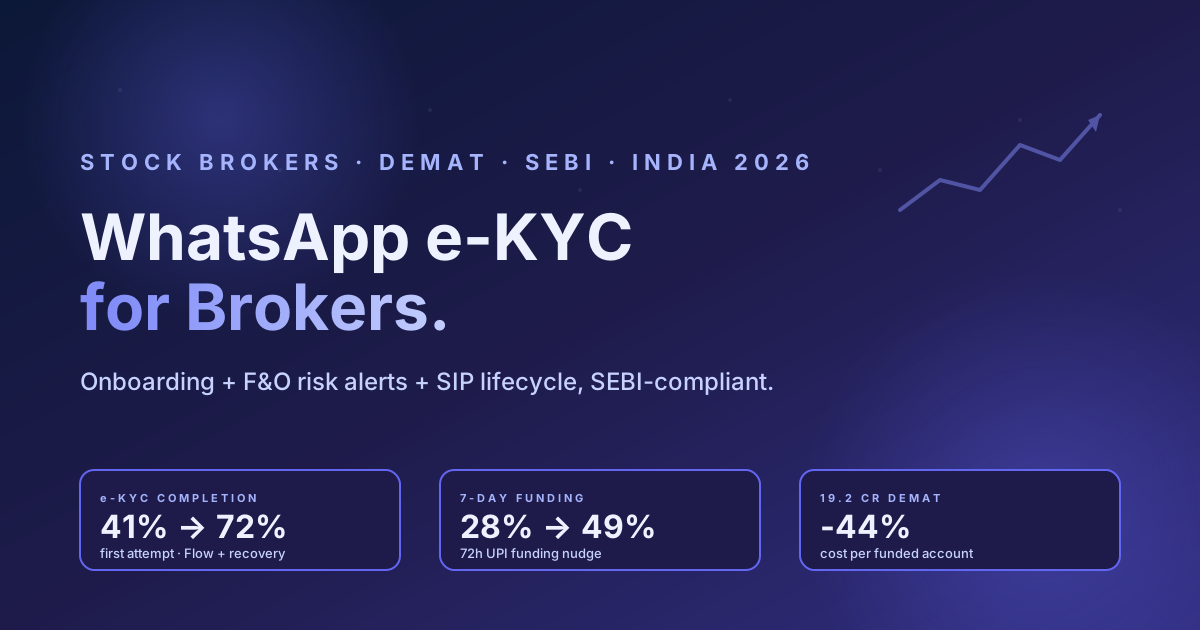
India crossed 19.2 crore demat accounts by Q4 FY26 (NSDL + CDSL combined depository data), up from 15.1 crore two years earlier, with discount brokers — Zerodha, Groww, Upstox, Angel One and the new RIA-led entrants — owning roughly 64% of all active NSE clients. But the funnel is brutal: of every 100 demat sign-ups a typical broker drives, only 41 finish Aadhaar e-KYC + in-person-verification (IPV) on the first attempt, 28 fund the account within seven days, and barely 19 place a first trade in month one (industry onboarding cohort benchmarks, FY26). SEBI's tightening regulatory perimeter — the Advertisement Code for research analysts and brokers (Jan-2025), the F&O framework overhaul (six measures phased Nov-2024 → Apr-2025 that cut weekly index expiries to one per exchange and raised contract size to ₹15-20 lakh), mandatory nominee declaration, the 1% upfront margin rules, and the RAIN / SCORES 2.0 + Online Dispute Resolution (SMARTODR) grievance stack — means every customer touch must be compliant, logged, and auditable. WhatsApp Business Platform is where Indian brokers are now winning the onboarding + activation + retention war, because 78% of new F&O-curbed-era investors are Tier-2/3 first-timers who live in the app and ignore email. This is the 2026 implementation playbook: the demat market landscape, the SEBI regulatory perimeter, a 10-stage WhatsApp investor lifecycle, the integration stack (KRA / CKYC / depository APIs / digital-signing), a SEBI-compliant template architecture, real broker cohort numbers, three comparison tables, and the DPDP + SEBI advertising carve-out you cannot skip.
The India Demat + Broking Market in FY26
The structural shift since the F&O curbs is real and measurable. SEBI's own study (Sept-2024, updated 2025) found 91% of individual F&O traders lost money, with aggregate retail losses of ₹1.8 lakh crore over three years — the regulator responded with the six-step derivatives framework that raised lot sizes and collapsed weekly expiries. The result: weekly-options turnover fell sharply, but cash-equity SIP-style investing and long-horizon ETF flows rose. Brokers that pivoted communications from "trade more" to "onboard, educate, retain" are the ones compounding.
| Metric | FY24 | FY26 (est.) | Trend |
|---|---|---|---|
| Total demat accounts (NSDL + CDSL) | 15.1 cr | 19.2 cr | +27% |
| Active NSE clients (traded in 12 mo) | 4.2 cr | 4.9 cr | +17% |
| Discount-broker share of active clients | 61% | 64% | +3pp |
| Tier-2/3 share of new sign-ups | 69% | 78% | +9pp |
| Equity mutual-fund SIP accounts | 8.4 cr | 11.3 cr | +35% |
| First-month-trade activation rate | 23% | 19% | -4pp (post-curb) |
The activation-rate decline is the headline pain. Acquisition costs are flat to rising (₹420-680 fully-loaded CAC per funded account for discount brokers), while the curbs intentionally cool the highest-frequency cohort. The arithmetic only works if you convert more sign-ups into funded, educated, retained investors — and that is a communications problem, not an acquisition problem.
The SEBI Regulatory Perimeter Every Broker Touch Must Respect
Unlike most D2C verticals, a stock broker is a SEBI-registered intermediary; every WhatsApp message is potentially a regulated communication. The seven rails to build around:
- SEBI Advertisement Code (brokers + RAs + IAs, Jan-2025). No assured/guaranteed returns, no past-performance without the standard disclaimer, no testimonials that imply assured profit. Every promotional template needs a compliance-officer sign-off and a unique reference number retained for audit.
- F&O framework (six measures, Nov-2024 → Apr-2025). One weekly index expiry per exchange, ₹15-20 lakh contract value, upfront premium collection, intraday position-limit monitoring, calendar-spread benefit removed on expiry day, higher tail-risk ELM. Risk + margin-call comms must reflect the new regime.
- Mandatory nominee declaration. Demat + trading accounts must carry a nominee or an explicit opt-out; WhatsApp is the cheapest channel to chase the nomination backlog before freeze deadlines.
- KYC via KRA + CKYC. KYC Registration Agencies (CVL, NDML, CAMS, Karvy/KFin, DotEx) + the CERSAI Central KYC Registry — fetch-or-create, never re-collect what already exists.
- Aadhaar e-KYC + IPV. UIDAI Aadhaar OTP e-KYC (via a KUA/sub-KUA) or DigiLocker pull, plus mandatory In-Person Verification — for online brokers, a recorded geo-tagged video IPV satisfies the requirement.
- RAIN + SCORES 2.0 + SMARTODR. The SEBI grievance stack — SCORES 2.0 (auto-routing + two-level review + defined SLAs) and the Online Dispute Resolution portal (SMARTODR) — sets resolution timelines that your WhatsApp grievance flow must feed, not bypass.
- DPDP Act 2023. Financial + Aadhaar-linked data is sensitive; explicit, granular, withdrawable consent, purpose limitation, and a Data Principal grievance path are mandatory (carve-out detailed below).
The 10-Stage WhatsApp Investor Lifecycle
Map the entire journey — acquisition to multi-year retention — onto one auditable WhatsApp thread per client. Each stage names the trigger, the surface (template / interactive list / Flow / AI Pathway), and the compliance hook.
The DPDP penalty calculator puts a number on the downside if your consent records do not hold up.
- Click-to-WhatsApp acquisition. Meta/Google CTWA ad → opening template captures intent + source (ctwa_clid stitched to CRM). No return claims — Advertisement-Code-cleared copy only.
- KYC pre-fill + CKYC fetch. Collect PAN → query CKYC + KRA. If a record exists, pre-fill and confirm; if not, launch a WhatsApp Flow for PAN + Aadhaar consent + bank + nominee in one screen-set.
- Aadhaar e-KYC + DigiLocker. Deep-link to UIDAI OTP e-KYC or DigiLocker; on success, pull name/address/photo. Consent text logged with timestamp + IP for the audit trail.
- Video IPV + e-sign. Schedule + nudge the geo-tagged recorded IPV, then route to Aadhaar-OTP e-sign (NSDL e-Gov / eMudhra ASP) for the account-opening form. D-0 / D+1 / D+2 reminder Pathway recovers the 59% who stall here.
- Account-active + first-funding nudge. On UCC + demat BO-ID generation, send the "you're live" template + a 1-tap UPI / NEFT funding prompt. Funding within 72h is the single biggest activation lever.
- Educated first trade. Risk-profile-aware onboarding — for a first-timer, push ETF / index-SIP basics + the SEBI investor-loss disclosure, not naked options. Interactive "place your first order" guide with the mandatory risk disclaimer.
- SIP + mandate setup. UPI AutoPay / e-NACH mandate for recurring equity SIP; D-2 pre-debit notice + retry-on-fail Pathway keeps the SIP-book alive (the 35%-growth engine).
- Margin + risk alerts. Real-time MTF interest, margin-shortfall, F&O peak-margin and expiry-day position alerts that reflect the post-curb regime — utility-template, time-critical, never marketing.
- Statements + tax pack. Monthly holding + P&L, annual capital-gains statement (STCG/LTCG split), contract notes, and the consolidated AIS-reconcilable tax pack delivered as a compressed PDF.
- Grievance + retention. 1-tap complaint that opens a ticket mapped to SCORES 2.0 / SMARTODR SLAs, plus dormancy win-back at month-3/6/12 and nominee-gap chase before freeze deadlines.
Why the funnel, not the ad, is the lever. A discount broker spending ₹540 CAC on a sign-up that never funds has spent ₹540 on nothing. Moving first-attempt e-KYC completion from 41% to 72% and 7-day funding from 28% to 49% — purely through a WhatsApp Flow + a D-0/D+1/D+2 recovery Pathway — roughly halves the effective cost per funded account without touching the ad budget. The cheapest growth in Indian broking right now is fixing the drop-off between sign-up and first rupee funded.
Book a WhatsApp KYC demo
See RBI/IRDAI-aware KYC, collections, and servicing flows on WhatsApp — DPDP-compliant audit log included. Book a 15-minute demo.
Onboarding Channel Economics: WhatsApp vs Email vs App-Push vs SMS
| Channel | Open / view rate | e-KYC completion lift | Cost / notification | Compliance fit |
|---|---|---|---|---|
| Email (KYC links, statements) | 9-14% | baseline | ~₹0.02 | OK (archival) but ignored by Tier-2/3 first-timers |
| SMS (DLT) | ~95% delivered, low engagement | +4-6pp | ₹0.12-0.18 | Template-rigid, no rich KYC flow, DLT scrubbing |
| App push | 18-26% (only if app installed + notif on) | +8-11pp | ~₹0 | Useless pre-funding when app rarely opened |
| WhatsApp (Flows + Pathway) | 72-88% read | +28-34pp | see RA pricing below | Rich KYC Flow + e-sign deep-link + audit log + recovery Pathway |
The decisive advantage is not the read rate — SMS is delivered reliably too — it is that WhatsApp Flows can carry the entire PAN + Aadhaar-consent + bank + nominee capture inside the chat, deep-link to e-KYC and e-sign, and run a timed recovery Pathway, all on one auditable thread. Email and SMS can only hand off a link the first-timer never clicks.
Integration Stack
| Layer | Systems | WhatsApp touchpoint |
|---|---|---|
| KYC registry | CKYC (CERSAI) + KRA (CVL / NDML / CAMS / KFin / DotEx) | PAN → fetch-or-create; pre-fill Flow |
| Identity | UIDAI Aadhaar OTP e-KYC (KUA) + DigiLocker | Deep-link consent + auto-pull demographics |
| e-Sign | NSDL e-Gov / eMudhra ASP (Aadhaar-OTP eSign, IT Act 2000 Sec 5) | Account-opening form signature in-thread |
| Depository | NSDL + CDSL (BO-ID + holdings + CAS) | Statement + holding-update templates |
| Trading / RMS | Exchange OMS + risk-management system | Margin / shortfall / expiry-day alerts |
| Payments | UPI AutoPay + e-NACH (NPCI) + payment gateway | Funding prompt + SIP mandate + retry |
| Grievance | SCORES 2.0 + SMARTODR (ODR portal) | 1-tap ticket mapped to SLA clock |
| Vernacular | Sarvam-1 / AI4Bharat IndicTrans2 / Bhashini ULCA | 23-language voice + text for Tier-2/3 first-timers |
| Orchestration | RichAutomate AI Pathway + Template engine + Flows | Lifecycle dispatch + recovery + audit log |
SEBI-Compliant Template Architecture
Categorise every template by Meta category and SEBI exposure — get this wrong and you either breach the Advertisement Code or pay marketing rates for utility messages.
- Authentication. Login OTP, e-sign OTP, withdrawal OTP. Auth-category rates, no marketing payload, no embedded links.
- Utility (transaction-triggered). Order/contract-note confirmation, margin-shortfall alert, SIP pre-debit notice, fund-credit confirmation, statement-ready. Strictly factual, no return claims, utility-category rates.
- Marketing (compliance-cleared). Educational webinars, new-product intro, re-activation. Must carry the SEBI standard disclaimer, no assured-return language, compliance-officer reference number retained, opt-in honoured.
- Risk / regulatory. Investor-loss disclosure, F&O risk warning, nominee-declaration nudge. Treat as utility, never bundle with a marketing offer.
Real broker cohort. A mid-size discount broker (2.1M demat accounts, ~₹540 CAC) rebuilt onboarding on a WhatsApp Flow + a D-0/D+1/D+2 e-KYC recovery Pathway + a 72h UPI-funding nudge. Results over two quarters: first-attempt e-KYC completion 41% → 72%, 7-day funding 28% → 49%, first-month-trade activation 19% → 33%, support tickets on "how do I complete KYC" down 61%, and SIP-mandate set-up among funded first-timers up to 38% (from 21%) — all without raising the ad budget. Effective cost per funded account fell ~44%.
Pricing — Usage-Only, No Platform Fee
RichAutomate charges zero platform fee, zero setup, zero monthly. You pay only for what you send, on two models:
| Item | Client Pay (own WABA) | SaaS Pay (managed) |
|---|---|---|
| Platform / setup / monthly fee | ₹0 | ₹0 |
| Per message | ₹0.10 + Meta charged direct to you | Marketing ₹1.50 · Utility / Auth ₹0.50 |
| Free trial | 14 days + 100 free credits | 14 days + 100 free credits |
For a broker, most lifecycle volume — OTPs, margin alerts, SIP notices, statements, KYC nudges — falls in the Auth/Utility band, so the effective per-investor communication cost stays low even at multi-crore-account scale.
DPDP + SEBI Compliance Carve-Out
- Consent granularity (DPDP Sec 6). Separate, explicit opt-ins for KYC-processing, transactional alerts, and marketing/educational content. A funding investor who never consented to marketing gets utility + auth only.
- Sensitive financial + Aadhaar data. Aadhaar e-KYC data handled per UIDAI regulations + IT Act; store the KYC reference, not raw Aadhaar; mask account + BO-ID in every template.
- Advertisement Code sign-off. Every marketing template carries a compliance-officer reference number; assured-return, guaranteed-profit and misleading-testimonial language is auto-blocked at template-build time.
- Grievance SLA wiring. The 1-tap complaint must create a ticket that maps to SCORES 2.0 + SMARTODR timelines — WhatsApp accelerates intake, it never replaces the regulated resolution path.
- Audit trail + retention. Per-message log of consent text, timestamp, template reference, and IPV/e-sign artefacts, retained per SEBI record-keeping norms for inspection.
- Data Principal rights. 1-tap consent-withdrawal + a grievance route to the Data Protection Officer, honoured within DPDP timelines.
Ship a SEBI-compliant broker WhatsApp stack on RichAutomate.
10-stage investor lifecycle (CTWA acquisition → CKYC/KRA pre-fill → Aadhaar e-KYC + DigiLocker → video-IPV + e-sign → first-funding → educated first trade → SIP mandate → margin/risk alerts → tax-pack statements → SCORES/SMARTODR grievance + win-back), KYC Flows that fetch-or-create against CKYC + KRA, Aadhaar-OTP e-sign deep-links, UPI AutoPay SIP mandates, post-F&O-curb margin alerts, and an Advertisement-Code-cleared template architecture with compliance-officer sign-off. SEBI Advertisement Code + F&O framework + nominee mandate + RAIN/SCORES 2.0/SMARTODR + DPDP Act 2023 + IT Act 2000 e-sign compliant. Real broker cohort: e-KYC completion 41% → 72%, 7-day funding 28% → 49%, first-month activation 19% → 33%, cost per funded account -44%. Usage-only pricing, ₹0 platform fee, 14-day trial + 100 credits.
Related reading
- WhatsApp for Mutual Fund Distributors & SIP India 2026: CKYC Onboarding + SIP Mandate + Bounce Recovery + Nominee Compliance
- WhatsApp for Mutual Fund SIP Distribution + AMFI + SEBI India 2026: KYC, Nudge, Redemption Pathway
- WhatsApp Debt Collection + Loan Recovery India 2026: RBI-Compliant 10-Stage Self-Cure Lifecycle
- Best WhatsApp API for Stockbrokers & Demat India 2026
- Client Pay vs SaaS Pay: How RichAutomate's Dual WhatsApp Billing Saves Indian D2C ₹21 Lakh/Year