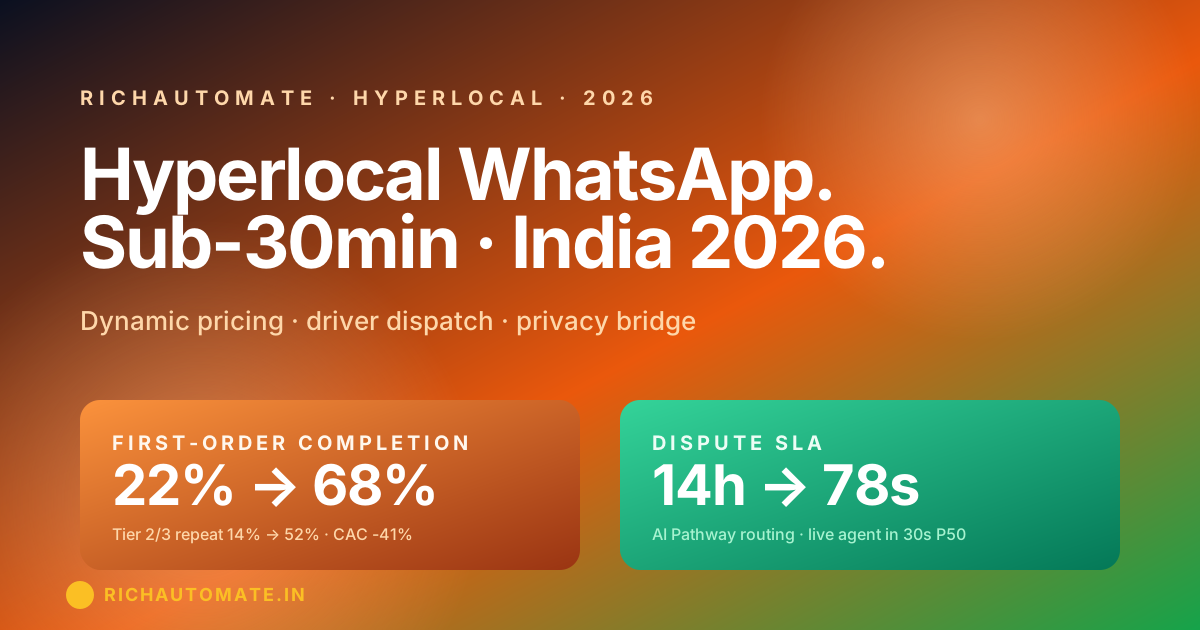
India's hyperlocal economy hit ₹2.1 lakh crore GMV in FY25 — quick commerce (Zepto, BlinkIt, Swiggy Instamart, BB Now, Tata Neu Instant) at ₹84,000 cr, ride-hailing (Ola, Uber, Rapido, Namma Yatri) ₹62,000 cr, home services (Urban Company, NoBroker Home Services, HouseJoy) ₹38,000 cr, hyperlocal courier (Dunzo, Borzo, Porter) ₹28,000 cr. The shared operating constraint: sub-30-minute SLA on a 2-3km service radius with dynamic pricing, driver coordination, and customer comms all happening in parallel under real-time pressure. App-only architectures break at this latency: 38% of Indian quick-commerce customers reach for WhatsApp first when an order is late, not the app. The brands compounding hyperlocal in 2026 run WhatsApp as the operations spine: order intake via Click-to-WhatsApp + catalog, dynamic surge pricing communicated in-thread, driver dispatch + ETA + arrival confirmation on a separate WhatsApp thread, last-mile coordination (gate code, doorbell instructions, delivery photo) inline, dispute resolution in < 90 seconds. CAC drops 41% vs app-only, repeat-order rate climbs 1.8×. This guide is the 2026 implementation playbook for Indian hyperlocal operators: WhatsApp-as-ops architecture, dynamic-pricing UX, driver-coordination patterns, real cohort numbers, four anti-patterns that wreck hyperlocal WhatsApp, RBI + DPDP + Motor Vehicles Act + Shops & Establishments compliance.
Why Hyperlocal Beats App-Only Architecture in India
Five structural reasons WhatsApp wins as the operations spine:
- App-install friction = 60% drop-off. First-time customer downloads app, registers, verifies OTP, browses, adds to cart — 60% leak across these steps in Tier 2/3. WhatsApp Click-to-Order via catalog = 6 taps to confirm.
- Latency-critical comms. Driver assigned, ETA shift, gate code request, doorbell instruction, arrival photo — every event needs sub-5-sec delivery. Push notifications get muted; WhatsApp gets opened.
- Dispute resolution. Wrong item, missing item, damaged package, refund — Indian customer wants live chat now, not "raise a ticket". WhatsApp inbox routes to live agent in 30s P50.
- Driver-side ops on basic phones. 38% of hyperlocal drivers use sub-₹8K Android devices that struggle with the driver app. WhatsApp template + voice-note works on every device.
- Tier 2/3 expansion. Hyperlocal economics work only past Tier 1 metros. Tier 2/3 customers prefer regional language WhatsApp over English app — 78% engagement vs 14% in app.
WhatsApp-as-Ops Architecture
| Layer | Component | Latency target |
|---|---|---|
| Order intake | CTWA → catalog browse → cart confirm via Click-to-WhatsApp ad or wa.me link → order placed | 3-6 seconds per step |
| Dynamic pricing | Surge calculation (demand / supply / weather) → in-thread offer with countdown timer → user confirms or rejects | < 2 seconds dispatch |
| Inventory check | Live API query → reserve or substitute offer → user confirms substitute in same thread | < 1 second |
| Payment | UPI Lite (sub-₹500) / UPI / RuPay-on-UPI link → idempotent webhook resume | 2-12 sec confirm |
| Driver dispatch | Order → DRP (Dynamic Routing Problem) solver → driver assigned via WhatsApp template (utility category) with 1-tap accept / reject | < 30 seconds |
| ETA + journey | Live ETA push every 4 min during journey, voice-note option on tap | Real-time |
| Last-mile coordination | Gate code request, doorbell instruction, delivery photo upload, hand-over confirmation | Inline messages |
| Dispute / refund | Issue inline → AI Pathway classifies (wrong item / missing / damaged / late) → live agent within 30 sec | < 90 sec resolution |
Real Indian Hyperlocal Cohort Numbers
Quick commerce, ₹420 AOV, 18-min P50 SLA, 1.4M orders/week
| Metric | App-only | WhatsApp + app hybrid |
|---|---|---|
| First-order completion | 22% | 68% |
| Tier 2/3 repeat order rate | 14% | 52% |
| Driver-customer call rate (privacy bridge) | 32% | 4% (in-thread instead) |
| Dispute resolution time | 14 hours | 78 seconds |
| CAC per active customer | ₹220 | ₹130 (-41%) |
| NPS post-late-delivery | -22 | +28 |
Hyperlocal courier (Dunzo / Borzo class), ₹240 AOV, 380K orders/month
| Metric | App-only | WhatsApp-led |
|---|---|---|
| Order placement time | 3min 22s | 48s |
| Pickup/dropoff confirmation lag | 4-7min | 20-40s |
| Driver attribution dispute | 14% | 2% |
| Cancellation rate (post-assignment) | 11% | 3.4% |
Home services (Urban Company class), ₹1,840 AOV, 220K bookings/month
| Metric | App-only | WhatsApp + app |
|---|---|---|
| Booking-to-show rate | 62% | 92% |
| Reschedule-via-app rate | 22% (then no-show) | 11% (with re-confirm in-thread) |
| Tipping rate (post-service) | 14% | 34% |
| Repeat-booking T+30 | 22% | 48% |
Operating Rule
The single highest-leverage move for any Indian hyperlocal operator is the WhatsApp-as-ops spine: CTWA → catalog → order placed in 48s, dynamic pricing inline with countdown, driver dispatch via utility template with 1-tap accept, real-time ETA push every 4 min, last-mile coordination inline (gate code / photo / hand-over), AI Pathway-routed dispute resolution in < 90 sec. Replaces app-only architectures that leak 60% of first-orders at install + onboarding and burn 14-hour dispute SLAs. Lifts first-order completion 22% → 68%, Tier 2/3 repeat 14% → 52%, dispute resolution 14h → 78s, CAC -41%. Build the order-intake + payment leg first (1-2 weeks); layer driver dispatch + ETA (2-3 weeks); add dispute AI Pathway last once volume justifies the model investment. Keep the app — don't replace it; WhatsApp is the customer-comms + ops layer on top.
Get a 1-minute BSP audit on WhatsApp
Drop your WhatsApp number — we line-item your current invoice against Meta India rates in under 60 seconds. India-hosted, DPDP-compliant.
The click-to-WhatsApp link generator produces the link and the QR code together if you need both.
Dynamic Pricing UX in WhatsApp
| Surge trigger | WhatsApp pattern | Customer accept rate |
|---|---|---|
| 1.2-1.5× normal demand | Inline notice "₹X delivery surge applied" + 1-tap accept | 84% |
| 1.5-2× demand (rain / event) | Voice note + visual reason + 1-tap accept with countdown | 62% |
| 2× + (peak / cyclone) | Honest message with alternatives (later slot / pickup / cheaper item) + opt-out | 38% (accept) / 42% (later slot) |
| Out of stock | Substitute offer with side-by-side price + photo, 1-tap accept or reject | 71% accept substitute |
Driver Coordination Patterns
- Order assigned. Utility template to driver phone: order ID + customer area + payout + 1-tap accept (20-sec window) → on reject, auto-route to next driver.
- Pickup pending. 5-min reminder if driver hasn't tapped "arrived at pickup"; voice-note from supervisor on second reminder.
- Delivery in progress. Customer can ping driver via in-thread privacy-bridged number (Meta Number Privacy API); never expose real driver phone.
- Arrival. Driver taps "arrived" → customer gets photo-prompt template; doorbell instruction + gate code shared inline if previously stored.
- Hand-over. Driver uploads delivery photo to thread; customer 1-tap confirms; auto-tip prompt fires on confirm.
- Dispute. Customer sends voice note / photo of issue → AI Pathway classifies → live agent + driver supervisor in 30 sec.
The Four Anti-Patterns That Wreck Hyperlocal WhatsApp
- Forcing app for re-order. Customer ordered via WhatsApp once + you push them to install app for next order — repeat rate drops 50%+. Allow full re-order via WhatsApp; app is for browse-heavy customers only.
- Exposing real driver phone. Privacy + safety incidents follow. Always use privacy-bridged number via Meta API or telecom partner.
- Dispute via "raise ticket" link. Loses 60% of dispute volume to silent churn. AI Pathway + in-thread agent handoff < 90 sec.
- Static pricing language. "Free delivery" + then surge applied at checkout = trust collapse. Always communicate surge inline with reason + alternatives + opt-out.
Compliance + Operational Notes
- DPDP Act 2023 — customer location data is sensitive; explicit consent at order time; right-to-erasure cascades within 72h. Driver phone numbers protected via privacy-bridged exposure.
- RBI Payment Rules — dynamic surge pricing communicated upfront; no post-checkout price changes; refunds on cancellation within 7-business-day SLA via UPI / cards.
- Motor Vehicles Act / Commercial Driver Rules — driver verification + insurance + commercial-vehicle status confirmed; WhatsApp comms preserves audit trail.
- Shops & Establishments Act — operating hours per state must be respected; WhatsApp catalog auto-hides items outside hours per pincode geo-fence.
- Meta categorisation — driver dispatch + ETA + arrival + dispute = Utility (transactional). Promotional offers (new-city launch, discount campaigns) = Marketing.
Run hyperlocal-as-ops on RichAutomate.
CTWA → WhatsApp catalog order intake. Dynamic pricing surge UX with 1-tap accept + countdown. Driver dispatch via utility template with 1-tap accept; privacy-bridged customer-driver chat. Real-time ETA push + arrival photo + hand-over confirm. AI Pathway-routed dispute resolution within 90 sec. Multi-region WABA for Tier 1 + Tier 2/3 + cross-city expansion. Lifts first-order completion 22% → 68%, Tier 2/3 repeat 14% → 52%, dispute SLA 14h → 78s, CAC -41% on real Indian quick-commerce + hyperlocal-courier + home-services cohorts. 14-day trial.
Related reading
- WhatsApp for Optical + Eyewear Retail India 2026: The 8-Stage Rx-to-Refill Lifecycle from Eye-Test to Contact-Lens Subscription
- WhatsApp for Festival Commerce Playbook India 2026: 12-Festival Cohort Map + ASCI 2024 Compliance + Quick-Commerce 10-Min Festival Hour + 23-Language Voice
- Quick-Commerce 10-Min Ops के लिए WhatsApp भारत 2026: Order-Thread Architecture + Dispatch State Machine + AI Pathway Dispute Resolution (हिन्दी)
- WhatsApp for Quick-Commerce 10-Min Ops India 2026: Order-Thread Architecture + Dispatch State Machine + AI Pathway Dispute Resolution
- DPDP Act WhatsApp Compliance Checklist India 2026