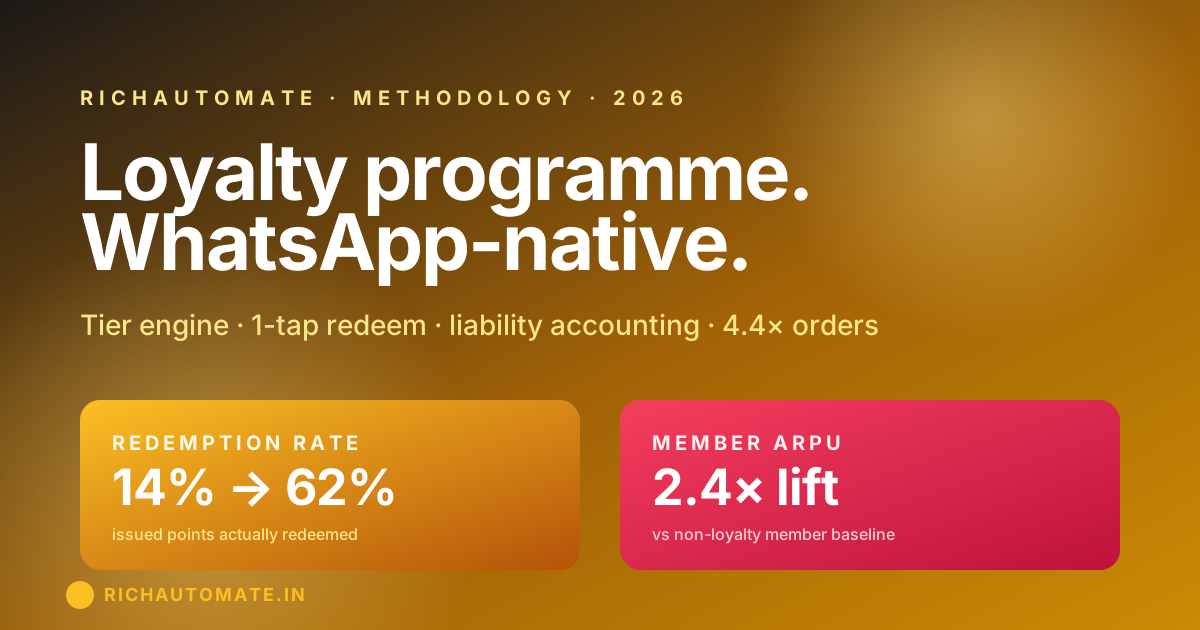
Indian D2C and retail brands have been running loyalty programmes since 2010 — Tata Neu, Jio Reliance Smart, Shoppers Stop First Citizen, hundreds of mid-market brands, every airline + hotel chain. The mature-market problem in 2026 is not enrolment (mostly solved) — it's redemption. Industry data shows 14% of issued loyalty points actually get redeemed; the rest sit on the brand's books as unrealised liability + customer frustration. The brands compounding faster than category re-engineered their loyalty programmes WhatsApp-native: balance visible in thread, 1-tap redemption at checkout, tier-progress nudges that feel like a game, expiry warnings that drive action. Redemption rate climbs from 14% to 62%; member ARPU lifts 2.4× vs non-loyalty baseline. This guide is the 2026 implementation playbook for Indian D2C, retail, hospitality, airline, and BFSI brands running loyalty: the data model, tier engine, redemption mechanics, accounting treatment, real cohort numbers, and the compliance pattern.
Why Most Indian Loyalty Programmes Underperform
Three structural problems:
- Points balance not where the customer is. Customer signs up at POS, balance shows in app the customer never opens. By next purchase, balance forgotten + unredeemed.
- Redemption friction at checkout. "Apply my points" requires logging into separate portal, copying code, pasting at checkout. 60-70% of would-be redeemers abandon.
- Generic tier mechanics. "Spend ₹50,000 in 12 months for Gold" is invisible until the customer is 3% of the way there. WhatsApp-native programmes nudge at every progress milestone.
The Loyalty Data Model
| Entity | Fields | Notes |
|---|---|---|
| members | customer_id, tier, joined_at, last_activity_at, language | tier auto-recalculated nightly |
| points_ledger | customer_id, transaction_id, type (earn/redeem/expire/adjust), points, expires_at | append-only ledger; balance = sum of unexpired earns - sum of redeems |
| tier_definitions | tier_name, qualifying_metric (₹spend / orders / visits), threshold, perks | typically Bronze / Silver / Gold / Platinum |
| tier_history | customer_id, tier, achieved_at, expires_at | tier downgrade typically 12-month rolling window |
| perks | tier, perk_type, value, conditions | e.g., Gold = 2× points + free shipping + birthday offer |
| redemption_options | id, name, points_cost, eligibility_tier | e.g., 500 pts = ₹50 off, 2,000 pts = free product |
The Seven WhatsApp Loyalty Moments
| Moment | Trigger | WhatsApp action | Lift target |
|---|---|---|---|
| Earn confirmation | Order placed / action completed | "You earned 80 points (balance 1,240)" utility template | Balance recall +6× |
| Tier progress nudge | Customer crosses 70% / 90% of next tier threshold | "You're ₹420 from Gold — unlocks free shipping forever" | Tier-up rate 22% → 64% |
| Tier achieved celebration | Customer crosses tier threshold | Welcome to Gold + perks summary + early redemption offer | D-30 tier-active rate 38% → 78% |
| Redeem at checkout | Cart total above redemption threshold | "Use 500 points = ₹50 off this order? Tap to apply" | Redemption CVR 14% → 62% |
| Expiry warning | 30 / 14 / 7 days before points expire | "800 points expire in 7 days — redeem now" + 1-tap option | Expiry-prompted redemption +280% |
| Birthday / anniversary | Member milestone date | "Bonus 200 points + Gold-only birthday offer" | Engagement +42% |
| Tier downgrade warning | 30 days before rolling-12-month tier expires | "₹X more spend keeps Gold" + offer | Tier renewal 48% → 78% |
Real Indian D2C + Retail Loyalty Numbers
Beauty D2C, 80,000 loyalty members, 3-tier programme
| Metric | App + email loyalty | WhatsApp-native loyalty |
|---|---|---|
| Balance check / member / month | 0.4 | 2.8 (passive — sees in thread) |
| Redemption rate (issued points actually used) | 14% | 62% |
| Member orders / year | 2.1 | 4.4 |
| Member ARPU vs non-member | +34% | +138% |
| Tier-up rate (Bronze → Silver+) | 22% | 64% |
| Programme NPS | 32 | 71 |
Multi-outlet retail (apparel chain), 320k members, 4-tier programme
| Metric | Without WhatsApp loyalty | With |
|---|---|---|
| Annual liability written off (expired points) | ₹4.2cr | ₹1.1cr |
| Member-vs-non-member transaction frequency | 1.6× | 3.2× |
| Average order value (member) | ₹2,200 | ₹2,840 |
| Cross-outlet redemption rate | 8% | 34% |
Redemption Mechanics: Where Most Programmes Lose Customers
Three patterns Indian brands run for redemption:
Rather than writing from scratch, pull a close match out of the WhatsApp template library and edit it.
Get a 1-minute BSP audit on WhatsApp
Drop your WhatsApp number — we line-item your current invoice against Meta India rates in under 60 seconds. India-hosted, DPDP-compliant.
- Auto-suggest at cart. Cart total exceeds threshold → backend pushes utility template offering point redemption with 1-tap apply. Highest-CVR pattern; redemption rate 62% in real D2C pilots.
- Member-initiated browse-and-redeem. Customer types "balance" or "redeem" → bot returns balance + redemption catalog. Mid-CVR; works for engaged customers.
- Tier-perk auto-application. Tier perks (free shipping for Gold) auto-applied at checkout; customer doesn't need to redeem points. Highest perceived value; lowest accounting complexity.
Operating Rule
The single highest-leverage move for any Indian D2C / retail brand running loyalty is the auto-suggest redemption at cart, with 1-tap apply via WhatsApp utility template. Cart total exceeds threshold → backend pushes "Use 500 points = ₹50 off?" with 1-tap confirmation. Redemption CVR climbs from 14% to 62%; member ARPU lifts 2.4×. Build this single touchpoint first; layer tier nudges, expiry warnings, and birthday mechanics over the next 90 days.
The Six Anti-Patterns That Wreck Loyalty Programmes
- Points-only programmes with no tier mechanic. Points are transactional; tiers are emotional. Customers chase tiers more than points. Combine both — points within tiers.
- Identical perks across tiers. "Bronze = 1× points, Silver = 1.5×, Gold = 2×" is forgettable. Perks must include qualitative differentiation — early access, free shipping, premium support, exclusive products.
- Short expiry on earned points. 90-day expiry forces redemption but breeds resentment. 12-24 month rolling expiry with proactive warnings works better.
- Marketing template for tier achievement / earn confirmation. Earn confirmation, balance update, tier achievement, expiry warning = utility (₹0.115/msg) since transactional with member context. Marketing categorisation triggers cost burn + quality flags.
- No multi-channel redemption. Points earned online but not redeemable offline (or vice versa) = 50-70% liability write-off. Unify earn + redeem across all channels.
- Skipping accounting reconciliation. Points are a liability on balance sheet. Without daily ledger reconciliation + actuarial estimation of expiry, audit risk + financial misstatement. ERP integration mandatory.
Trigger + Routing Architecture
Order completed → backend:
  Calculate points earned (base × tier multiplier × promo multiplier)
  Insert points_ledger entry (type=earn, expires_at=now+12mo)
  Recalculate tier (rolling 12-month qualifying metric)
  If tier changed → tier_history insert + perks unlock
  Push utility template:
    "Earned 80 points (balance 1,240) — you're Silver"

Daily 2 AM cron:
  Tier recalculation per active member
  Tier downgrade alerts: 30 days before rolling-12mo expiry
  Points expiry alerts: 30 / 14 / 7 days before earn batch expires
  Birthday / anniversary detection → bonus + offer

Cart event (customer added items):
  Backend checks: cart_total >= redemption_threshold AND member.balance >= 500
  If yes: push utility template with redemption suggestion + 1-tap apply
  If declined: no further nudge in same cart session

Redemption applied:
  points_ledger insert (type=redeem)
  cart total adjusted
  utility template: confirmation + new balance

Tier expiry approaching:
  Member receives utility template 30 / 14 / 7 days before:
    "₹X more spend keeps Gold — Gold gives free shipping forever"

Quarterly:
  Liability reconciliation: outstanding points × monetary value
  Actuarial expiry estimation: 14-22% of issued points typically expire
  P&L impact: expired points = revenue recognition (was deferred)
  Audit trail: all ledger movements with timestamps + reason codes
Accounting + Compliance Notes
- Liability accounting (Ind-AS 115) — issued loyalty points create a contract liability; revenue is deferred until points are redeemed or expire. Quarterly liability balance reconciliation mandatory for audited companies.
- DPDP Act 2023 — loyalty programmes capture purchase history + preferences (sensitive data category in some interpretations). Explicit consent + storage controls required.
- Meta categorisation — earn confirmation, tier achievement, balance update, expiry warning, redemption confirmation = Utility (₹0.115/msg). Tier-up promo broadcasts, generic loyalty re-engagement = Marketing (₹0.96/msg).
- RBI guidelines (BFSI loyalty) — bank + card loyalty programmes have additional disclosure + redemption-cap rules.
- Tax (income / GST) — point redemptions may attract GST depending on whether treated as discount, free supply, or alternate consideration. Consult tax advisor for category-specific treatment.
Run loyalty programme on RichAutomate.
Tier engine + points ledger built in. Auto-suggest redemption at cart with 1-tap apply. Tier-progress nudges + expiry warnings + birthday mechanics. ERP-synced liability reconciliation. Pre-approved utility templates for full loyalty lifecycle. Lifts redemption rate 14% → 62% and member ARPU 2.4× on real Indian D2C + retail pilots. 14-day trial.
Related reading
- WhatsApp Tiered Onboarding by Expertise Level India 2026: 82% Completion, 2.6× LTV Lift, Three-Tier Architecture
- Best WhatsApp API for D2C Brands India 2026
- WhatsApp B2B SaaS Trial-to-Paid Conversion Playbook India 2026: 28% CVR, Founder-Led Save, PQL Architecture
- WhatsApp Post-Purchase NPS + Review Collection vs Email India 2026: 38% Response Rate, 6.2× Review Volume
- WhatsApp Business API Cost India 2026: ₹0.11–₹0.99/msg