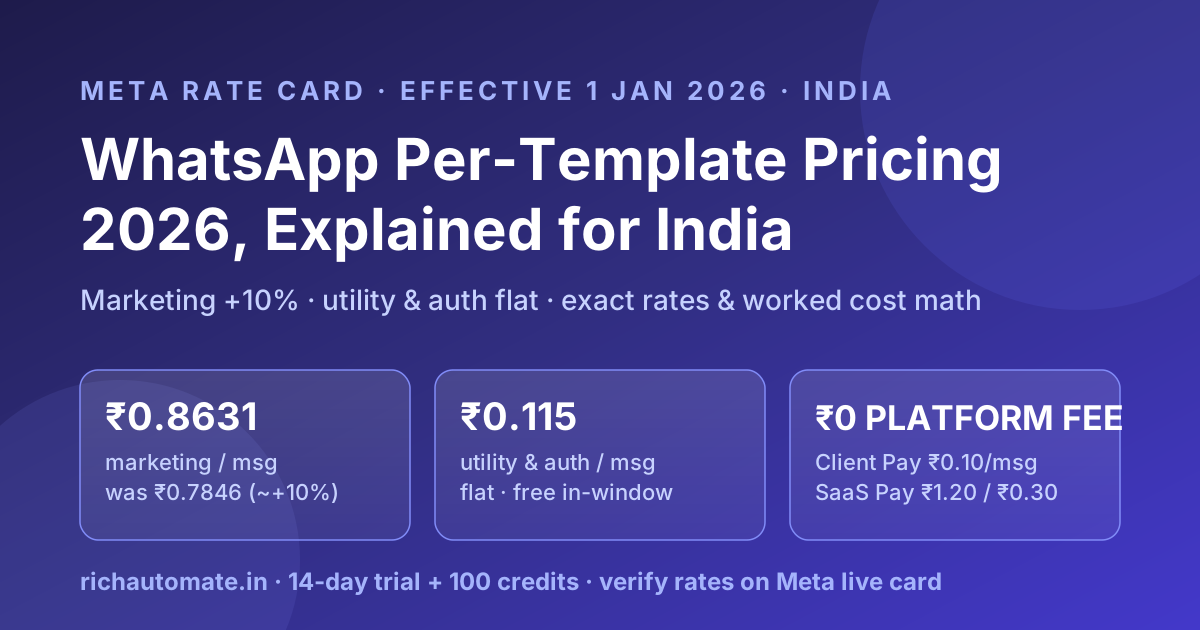
On 1 January 2026, Meta revised its WhatsApp Business Platform rate card for India — and unlike the quiet mechanics change that retired conversation billing, this one moved actual numbers. Marketing template messages rose from ₹0.7846 to ₹0.8631 per delivered message (a ~10% increase), while utility and authentication templates sit at ₹0.115 each and service replies stay free. If you run promotions on WhatsApp in India, your per-message cost just went up roughly a paisa-and-a-half on every marketing send — and at festival-season volume that compounds fast. This is the plain-English India explainer: exactly what the 2026 per-template rates are, worked cost examples by category, who feels it most, and how to claw the increase back through utility-first sending. Every rate here should be cross-checked against Meta's live India rate card — rates revise periodically and your WABA's billing currency and GST treatment may vary.
What Changed on 1 January 2026
Two things are easy to conflate, so let us separate them cleanly. First, across 2025 Meta retired conversation-based billing (the 24-hour bundled session) in favour of per-message, per-template-category billing — that is the mechanical shift, and we cover the migration playbook in our per-message pricing migration guide. Second, on 1 January 2026 Meta published a new India rate card on top of that model, raising the marketing number. This article is about that second event: the exact 2026 India prices and what they cost you per send.
Rates differ per market, and the WhatsApp pricing calculator by country shows the current per-conversation cost for each country you message.
The headline is a marketing-category increase of roughly 10%. Utility and authentication held at their low per-message rates. Service — free-form replies inside the customer's open 24-hour window — remains free, as it has since late 2023. So the 2026 change is narrowly targeted: it taxes outbound promotional volume and leaves transactional and support traffic essentially untouched.
The 2026 India Per-Template Rate Card
Here are the Meta base rates for India effective 1 January 2026. These are platform rates published in Meta's pricing guidance — your Business Solution Provider may add a markup on top, and 18% GST applies in India over and above these figures. Always confirm the current numbers against Meta's live documentation before you budget.
Meta hiked marketing rates 10% — do not let BSP markup inflate it further. ₹0 monthly fee keeps every blast near Meta base cost.
Zero platform fee. Pay only per message. 100 free credits to test on your own number today.
Start free 14-day trial| Template category | Old rate (pre-2026) | 2026 India rate | Change |
|---|---|---|---|
| Marketing (promotions, offers, re-engagement, broadcasts) | ₹0.7846 | ₹0.8631 | ≈ +10% |
| Utility (order, shipping, payment, appointment updates) | ₹0.115 | ₹0.115 | Flat |
| Authentication (OTPs, verification codes) | ₹0.115 | ₹0.115 | Flat |
| Authentication — International (OTPs to non-India numbers) | — | ₹2.30 | Premium tier |
| Service (free-form replies inside the 24h window) | Free | Free | Unchanged |
The free in-window nuance still applies — and matters more than ever in 2026. A utility template delivered while the customer's 24-hour service window is open is free under Meta's current rules (verify). The same utility template fired after the window lapses is a ₹0.115 paid send. And service replies — anything free-form you send while the window is open — are always free. With marketing now the only category that rose, the strategic prize is to shift as much genuine value as possible into utility templates timed into open windows, where the marginal Meta cost is zero.
Worked Cost Examples (India, 2026 Rates)
Numbers make the change concrete. The following are simple, base-rate illustrations at the 2026 India figures above — they exclude 18% GST and any BSP markup, and are for direction, not a quote.
Example 1 — A 50,000-contact Diwali marketing blast
One marketing template to 50,000 opted-in contacts:
- 2025 rate: 50,000 × ₹0.7846 = ₹39,230
- 2026 rate: 50,000 × ₹0.8631 = ₹43,155
- Increase: ₹3,925 per blast — roughly 10% more, before GST.
Run that campaign weekly through the festival quarter (say 12 sends) and the year-on-year delta is about ₹47,100 on this one audience alone. Multiply across audiences and the "small" 10% becomes a real line item.
Example 2 — A D2C order-journey, marketing-categorised vs utility-first
A brand sends four messages per order — confirm, shipped, delivered, review-ask — to 10,000 orders/month. If all four are marketing-categorised:
- 4 × 10,000 × ₹0.8631 = ₹34,524/month
Re-architected so confirm/shipped/delivered are proper utility templates timed into open windows (free under current rules) and only the review-ask is marketing:
- 1 × 10,000 × ₹0.8631 = ₹8,631/month
- Saving: ~₹25,893/month (~75%) for an identical customer experience.
The 2026 increase didn't cause this gap — the per-template model did — but the increase makes fixing it more valuable than ever. Model your own mix in the WABA cost calculator before you commit a campaign budget.
Example 3 — An OTP / authentication-heavy fintech
A lender sending 200,000 domestic OTPs/month pays 200,000 × ₹0.115 = ₹23,000/month — completely unaffected by the 2026 change, because authentication held flat. The lesson: if your WhatsApp motion is auth and utility, the 1 January 2026 rate card is a non-event for you. The increase is a marketing tax, not a platform-wide one.
Get a 1-minute BSP audit on WhatsApp
Drop your WhatsApp number — we line-item your current invoice against Meta India rates in under 60 seconds. India-hosted, DPDP-compliant.
Who Feels the 2026 Increase — and Who Doesn't
| Sender type | 2026 impact | First move |
|---|---|---|
| High-volume marketer (festival blasts, weekly promos) | Pays ~10% more on every marketing send; compounds at scale | Re-forecast Q3–Q4 budgets at ₹0.8631; cut redundant promo touches |
| D2C / e-commerce with mixed journeys | Pays more only on the marketing-categorised messages | Move confirm/shipping/delivery to utility templates in-window — see our D2C WhatsApp guide |
| Transactional sender (logistics, payments, appointments) | No change — utility held flat | Audit that utility templates are actually categorised utility, not marketing |
| OTP / auth-heavy (fintech, login flows) | No change — authentication held flat at ₹0.115 | Confirm OTP templates use the authentication category |
| Support-led (customers message first) | Pays least — service replies stay free | Drive inbound via CTWA / click-to-chat so windows open on the customer's initiative |
The throughline: the 2026 rate card rewards businesses whose WhatsApp is transactional and inbound-led, and asks for more from those who lean on outbound marketing volume. If a competitor's BSP quoted you a flat per-message number that "didn't change in January," ask whether they absorbed the increase or simply hadn't passed it through yet.
How to Cut Cost Under the 2026 Rates
You cannot negotiate Meta's rate card, but you control your category mix and your timing — which is where the real money is. Five levers, in order of impact:
- Utility-first sending. Every message that is genuinely a transaction update belongs in a utility template, not a marketing one. At ₹0.115 vs ₹0.8631 that is a ~7.5× per-message difference — and free if it lands in an open window. Audit your estate and reclassify honest transactional copy to utility before Meta's enforcement sweep does it for you (it reads content and recategorises — see our template categories guide).
- Window-aware dispatch. Check whether a contact's 24-hour service window is open before sending utility templates. If it is, the send is free under current rules; if it opens predictably, schedule into it. Timing is now a pricing lever.
- Collapse marketing sequences. Per-message pricing means a four-message promo costs four sends. Fold teaser + offer + reminder into one richer template (carousel, multi-button) and reserve the marketing rate for sends that convert.
- Frequency caps. At ₹0.8631 each, the fourth ignored promo of the week is pure waste. Cap marketing touches per contact; you lose nothing with people who matter and delete the paid long tail.
- Measure cost per category weekly. Your invoice now decomposes as messages × category rate. Track cost-per-delivered and cost-per-conversion by category so a rate revision or reclassification shows up in days. Pair this with the ten cost levers in our WABA cost-optimisation guide.
The 2026 reframe in one line: the marketing rate going up makes the gap between marketing (₹0.8631) and utility (₹0.115, free in-window) the single most valuable number on your invoice. Businesses that move genuine value into utility flows don't just dodge the increase — they cut their WhatsApp bill while sending the same volume.
Where Your Platform Fee Fits — and Where RichAutomate Stands
Meta's per-template rate is one layer of your cost; the platform layer your BSP charges on top is the one you actually control. Many providers add per-message markups, monthly platform fees, or both — and a Meta rate increase is exactly when those markups hurt most. RichAutomate's pricing is flat and honest: ₹0 platform fee, ₹0 setup, ₹0 monthly. You choose:
- Client Pay — ₹0.10 per message to the platform, while Meta bills you directly at its live per-category rates (the new ₹0.8631 marketing / ₹0.115 utility-auth land on you raw and transparent — you see exactly what the 2026 card costs, with nothing hidden).
- SaaS Pay — ₹1.20 per marketing message and ₹0.30 per utility/authentication message, with Meta's pass-through bundled into one predictable number so a mid-year rate revision doesn't blow up your forecast.
A 14-day trial with 100 credits lets you baseline your real category mix against the 2026 rates before committing a rupee. Compare the two billing modes in Client Pay vs SaaS Pay explained, see full pricing, or read why teams pick us over legacy CRMs in our best WhatsApp CRM for India 2026 roundup.
FAQ: Meta's 1 January 2026 WhatsApp Pricing Change in India
The five questions teams ask most about the new India rate card — short answers below, full detail and worked examples above. What exactly changed on 1 January 2026? What is the new marketing rate? Did utility and authentication go up? Are utility messages free inside the service window? And how do I cut cost under the new rates? In one line: only marketing rose (≈10%, to ₹0.8631), utility and auth held flat at ₹0.115, in-window utility stays free under current rules, and the fastest saving is moving transactional value into utility templates timed into open windows.
These per-template rates are the biggest line in your monthly WhatsApp API cost, which is why the API is cheaper than the "is it free?" question assumes.
The 2026 rate card raised marketing. Cut it back before festival season.
Marketing rose to ₹0.8631 on 1 January 2026; utility and auth held at ₹0.115; service stays free. The lever is utility-first, window-aware sending. Run it on RichAutomate — flat pricing, no platform fee: Client Pay ₹0.10/message with Meta billed direct, or SaaS Pay ₹1.20 marketing / ₹0.30 utility-auth, 14-day trial + 100 credits. Every Meta rate here should be verified against the live India rate card; example figures exclude GST and BSP markup and are illustrative. WhatsApp 918160311319 or book a pricing walkthrough at https://calendly.com/inrichdaddy/30min.
Start your WhatsApp automation free
₹0 platform, setup & monthly — pay only per message. 14-day free trial + 100 credits. Get your free WhatsApp Business API setup in 24–48 hrs.
Chat with us on WhatsApp → Book a 30-min demoRelated: WhatsApp MM Lite API 2026 — Meta's delivery-optimised way to send marketing messages, and the two honest facts: same marketing rate, same opt-in duty.