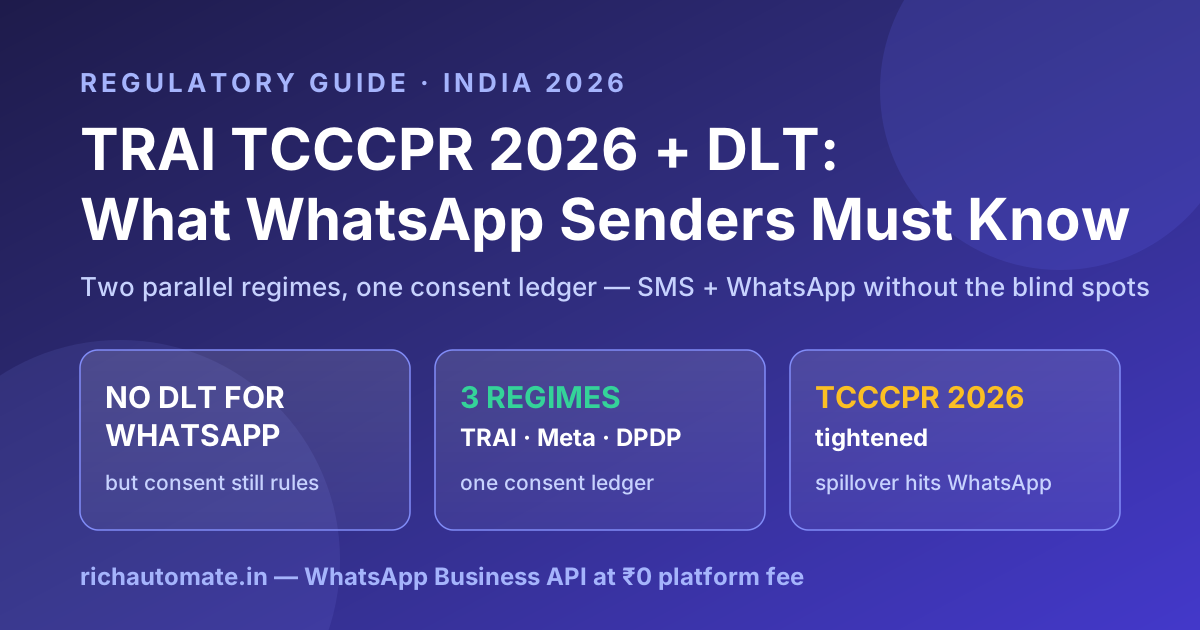
Short answer first: WhatsApp Business messaging is not governed by TRAI's TCCCPR or the DLT registry — those apply to SMS and voice on telecom networks. But if you concluded "so the 2026 TCCCPR tightening doesn't concern us", you are reading the map and missing the terrain. Brands run SMS and WhatsApp side by side, regulators are converging on a single idea — provable, revocable consent — and every aggressive SMS sender squeezed out by tighter DLT enforcement is migrating to WhatsApp, where Meta's quality system is the gatekeeper waiting for them. This guide explains the two parallel regimes, what the 2026 amendments actually change for your WhatsApp strategy, and how to build one consent ledger that satisfies TRAI, Meta and the DPDP Act at once. (As of 2026 — verify every regulatory specific below against current TRAI regulations, Meta policy and DPDP rules. General information, not legal advice.)
TCCCPR and DLT in 60 Seconds — What TRAI Actually Regulates
The Telecom Commercial Communications Customer Preference Regulations (TCCCPR) are TRAI's framework for controlling unsolicited commercial communication — spam — on telecom networks: SMS and voice calls. The Distributed Ledger Technology (DLT) registry is its enforcement machinery: every business sending commercial SMS must register as a Principal Entity, register its sender headers (those six-character IDs like "VM-ACMEIN"), register every message template, and bind consent records — all on blockchain-backed platforms run by telecom operators.
Through 2024–2026, TRAI has been tightening this regime in successive amendments and consultations: stricter message classification (transactional vs service vs promotional), tighter header and template traceability so every SMS can be traced to a registered sender and a registered template, crackdowns on header misuse and "telemarketer laundering", harder rules around consent acquisition and the customer preference register (the DND system), and increasing attention to AI-generated spam and unregistered URL/callback patterns inside messages. The specifics — effective dates, penalty slabs, which amendment introduced what — move frequently; verify the current consolidated TCCCPR text and TRAI's latest directions before acting on any clause. But the direction of travel is unambiguous: India's SMS channel is becoming one of the most tightly regulated commercial messaging environments in the world.
The Two Parallel Regimes: TRAI Governs the Pipe, Meta Governs the Platform
Here is the structural fact that confuses most marketing teams: WhatsApp messages do not travel on telecom signalling networks as SMS does — they are data-channel messages on Meta's platform. TRAI's TCCCPR jurisdiction attaches to telecom resources (numbering, SMS routes, voice), so WhatsApp Business API messaging sits outside DLT registration entirely. No Principal Entity registration, no header registration, no DLT template upload for your WhatsApp traffic (as of 2026 — verify, since regulatory perimeter questions like OTT communication regulation resurface in TRAI consultation papers periodically).
But "outside TCCCPR" does not mean "unregulated". WhatsApp has its own rule stack — Meta's Business Messaging Policy, template approval, opt-in requirements, quality ratings and messaging limits — plus the DPDP Act sitting above both channels as India's data-protection law. Three regimes, three enforcers, one customer:
| Dimension | TCCCPR + DLT (SMS/voice) | Meta / WhatsApp Business | DPDP Act |
|---|---|---|---|
| Who enforces | TRAI via telecom operators and DLT platforms | Meta, algorithmically and via policy review | Data Protection Board of India |
| What is registered | Sender entity, headers, templates, consent records on DLT | WABA + business verification; templates approved by Meta | No registry; obligations attach to processing personal data |
| Consent model | Explicit consent / preference register (DND categories); scrubbing against DND before send | Documented opt-in required for business-initiated messages; user can block/report instantly | Free, specific, informed, unambiguous consent; right to withdraw as easily as given |
| Primary penalty | Header/template suspension, sender blacklisting, financial disincentives (verify current slabs) | Quality-rating drops, messaging-tier cuts, template pausing, WABA restriction or ban | Monetary penalties on data fiduciaries (verify current amounts and rules status) |
| Speed of enforcement | Days to weeks, complaint-driven | Hours to days, signal-driven and automated | Slow, case-driven |
| Applies to WhatsApp? | No (as of 2026 — verify) | Yes, fully | Yes — phone numbers and chat data are personal data |
Read the last column twice. WhatsApp escapes one regime and remains fully inside two others — and the one it escapes is, ironically, the slowest-moving of the three. Meta's enforcement is faster than TRAI's, and it needs no complaint to trigger: enough users tapping "block" does the job automatically.
"WhatsApp Doesn't Need DLT" — True, But Dangerously Incomplete
The nuance that separates compliant operators from future case studies: it is true that your WhatsApp traffic needs no DLT registration. It is not true that your DLT obligations are irrelevant to your WhatsApp programme. If you run SMS and WhatsApp to the same customer base — and almost every Indian brand at scale does — you have one consent reality expressed in two regulatory languages. A customer who registered DND preferences against promotional SMS, or withdrew consent under DPDP, has communicated something about your brand, not about a channel. Honouring it on SMS while re-targeting the same person on WhatsApp may be technically outside TCCCPR — and squarely inside DPDP's consent-withdrawal obligations, Meta's opt-in policy, and the customer's tolerance before they tap "block and report".
This is the trap in treating channels as silos: the SMS team scrubs against DND and DLT consent records; the WhatsApp team keeps its own opt-in list in the BSP dashboard; nobody reconciles the two. The result is a brand that is simultaneously compliant in each silo and incoherent to the customer — and customer incoherence is exactly what Meta's quality system measures.
What the 2026 Tightening Actually Changes for WhatsApp Strategy
None of the TCCCPR amendments rewrite WhatsApp's rules directly. They change your WhatsApp strategy through three indirect channels (every specific here hedged — verify against TRAI's current regulations and consultation papers):
- SMS gets harder and more traceable, so traffic shifts. Tighter header/template traceability, URL whitelisting inside SMS, and consent-record scrutiny raise the operational cost of promotional SMS. Marginal and grey-zone senders respond by moving budgets to WhatsApp, where unit economics are better anyway. Expect category-level noise: more competitors in your customers' WhatsApp inboxes, and Meta tuning enforcement in response.
- Regulatory logic converges on provable consent. TRAI's consent-registration push, DPDP's consent-manager architecture and Meta's documented-opt-in requirement are three implementations of one principle: you must be able to prove who agreed, to what, when, and how they can revoke. Building that proof once, properly, satisfies all three. Building it three times, badly, satisfies none.
- The perimeter question won't stay closed forever. TRAI consultation papers have periodically examined OTT communication services. As of 2026 WhatsApp business messaging remains outside TCCCPR (verify), but a brand whose consent architecture only works because WhatsApp is unregulated has built on sand. Architect as if convergence is coming — because directionally, it is.
The Spillover Effect: Meta Quality Enforcement Is the New DLT
Follow the aggressive sender's journey. Squeezed by DLT enforcement on SMS — headers suspended, templates rejected, consent records demanded — they migrate the same list and the same blast mentality to WhatsApp. What they meet is not a regulator but an algorithm: WhatsApp's quality rating, computed continuously from user blocks, reports and reads. Low quality cuts your messaging tier (how many unique users you can initiate to per day), pauses templates, and at the extreme restricts the WABA itself. There is no appeal hearing and no grace period measured in months.
Get the DPDP WhatsApp checklist
A founder-led WhatsApp reply with the DPDP consent + audit-log checklist for WhatsApp Business messaging. India-hosted. No spam.
In practice, Meta's quality system performs the same economic function DLT performs for SMS — it makes spam expensive — but faster and with less paperwork. The strategic insight for legitimate senders: the migration wave makes disciplined senders relatively stronger. While list-blasters burn their quality ratings, brands with genuine opt-ins, segmented sends and honoured opt-outs inherit the channel. If you are planning the SMS-to-WhatsApp move yourself, do it the disciplined way — our SMS-to-WhatsApp migration playbook covers the mechanics of porting journeys and lists without porting the spam habits.
Run your figures through the WhatsApp ROI calculator before committing to a monthly spend.
One Consent Ledger, Three Regimes
The unifying move is a single, internal consent ledger: one system of record for every consent event across channels, from which DLT records, WhatsApp opt-in proof and DPDP compliance are all derived views. Per contact, per channel, per purpose, it stores:
| Consent source | What you store | What it proves, and to whom |
|---|---|---|
| Website / checkout opt-in checkbox | Timestamp, page URL, exact consent text shown, channel(s) and purpose(s) selected, IP/device hint | Meta opt-in documentation; DPDP "specific and informed" consent; feeds DLT consent registration for the SMS leg |
| WhatsApp inbound ("Hi", keyword, CTWA click) | Message ID, timestamp, the click-to-WhatsApp ad or entry point, first-message content | Meta opt-in + 24-hour service-window basis; DPDP unambiguous action |
| IVR / missed-call / SMS keyword | Caller ID, timestamp, recording or keyword log | DLT consent record for SMS; cross-channel evidence if you message the same number on WhatsApp (state the channel in the flow) |
| Paper / in-store form | Scanned form, date, staff ID, purposes ticked | Weakest form — digitise immediately; acceptable as DPDP evidence only if specific and legible (verify current rules) |
| Withdrawal / opt-out (any channel) | Timestamp, channel, method ("STOP", DND registration, WhatsApp block signal, unsubscribe link) | The most important row: propagates to ALL channels — DND scrub list, WhatsApp suppression list, DPDP withdrawal log |
The payoff: when consent is one ledger instead of three spreadsheets, every regulator's question becomes a query. TRAI/DLT asks "show consent for this SMS" — query. Meta asks "document this opt-in" — query. A DPDP grievance asks "when did this person withdraw and what did you do" — query. The same architecture that answers auditors also protects your quality rating, because suppression actually propagates: the customer who opted out on SMS stops hearing from you on WhatsApp too, and never gets the chance to block you. Compliance and deliverability stop being separate projects.
Pair the ledger with the DPDP layer properly — our guide to what the DPDP Rules change for WhatsApp businesses in 2026 covers notice, consent-manager and grievance mechanics in depth.
The Sender-Reputation Playbook: A 5-Stage Send Pipeline
Operationally, regime convergence collapses into one pipeline that every business-initiated WhatsApp message should pass through. Numbers below are illustrative defaults — tune to your data:
- Consent gate. No send without a ledger entry covering this channel and this purpose. Withdrawals and DND signals (for cross-channel coherence) are suppressed here, automatically — not in a monthly cleanup.
- Segmentation and frequency cap. Cap business-initiated marketing touches (illustrative: 2–4 per contact per month), segment by engagement recency, and exclude contacts who have ignored your last several campaigns — non-engagement predicts blocks.
- Template discipline. Send marketing content only via approved marketing templates; never disguise promotion as utility (Meta reclassifies and may penalise — and TRAI's parallel crackdown on misclassified SMS shows where regulator thinking goes). Keep template language matching what the user actually opted into.
- Quality-signal monitoring. Watch quality rating, block rate and read rate per campaign, daily during sends. A falling read rate is your early-warning radar; a quality drop is the air-raid siren. Pause, diagnose, shrink the segment — never "push through".
- Feedback loop into the ledger. Blocks and reports are consent signals: write them back as withdrawals. A customer who blocked you on WhatsApp should drop out of your SMS journeys too. That is what cross-regime coherence looks like in practice.
Which Sender Are You? Exposure and First Moves by Archetype
| Sender archetype | Regulatory / platform exposure | First move |
|---|---|---|
| SMS-heavy brand adding WhatsApp | DLT-compliant on SMS but no WhatsApp opt-in trail; risks importing blast habits into a faster-punishing channel | Do not port the SMS list wholesale. Run a re-permission campaign; seed the consent ledger before the first marketing template goes out |
| WhatsApp-first D2C / SMB | Outside TCCCPR but fully inside Meta + DPDP; consent often informal ("they messaged us once") | Formalise opt-in capture at every entry point (CTWA, website widget, QR); log it; add a working opt-out keyword |
| Marketing/compliance head running both channels | Dual-silo risk: each channel compliant alone, incoherent together; withdrawal leakage between silos | Build the unified consent ledger; make opt-outs propagate cross-channel within 24h; assign one owner for both regimes |
| Aggressive bulk sender migrating from DLT pressure | Maximum: Meta quality enforcement will throttle or ban faster than TRAI ever did | Change the model, not the channel — segment, cap frequency, earn opt-ins. The arbitrage you are chasing does not exist |
| Agency / BSP-reseller managing client WABAs | Portfolio risk: one spammy client can taint shared infrastructure and your reputation with Meta | Enforce a minimum consent standard contractually; monitor per-client quality ratings; fire clients who blast |
Wherever you land in the table, the compliance fundamentals are the same — opt-ins, template categories, the 24-hour window, grievance handling. Our WhatsApp Business compliance FAQ for India answers the thirty questions that follow this article.
FAQ: TCCCPR, DLT and WhatsApp
The five questions compliance and marketing heads ask most — whether WhatsApp needs DLT registration, what the 2026 TCCCPR changes mean for WhatsApp senders, whether DND applies to WhatsApp, how to reconcile consent across SMS and WhatsApp, and whether TRAI could regulate WhatsApp in future. Full answers below.
This article is general information, not legal advice. TCCCPR amendments, DLT platform rules, Meta policies and DPDP rules all change; verify every specific against current official sources or counsel before acting.
Run both channels from one consent-clean platform
RichAutomate gives Indian businesses WhatsApp Business API with opt-in capture, opt-out automation, template management and quality-rating visibility built in — at ₹0 platform fee, ₹0 setup, ₹0 monthly. Pay per message only: Client Pay ₹0.10/msg with Meta conversation charges billed direct to you, or SaaS Pay ₹1.50 marketing / ₹0.50 utility-auth. 14-day free trial with 100 credits. See full pricing, WhatsApp us at 918160311319, or book a 30-minute compliance-and-setup walkthrough at https://richautomate.in/book/demo.
Choosing an SMS vendor for DLT routes, OTPs and fallback? Compare options in our guide to the best CPaaS providers in India for 2026.
What DLT actually adds to your SMS bill is covered in our bulk SMS price India 2026 guide.