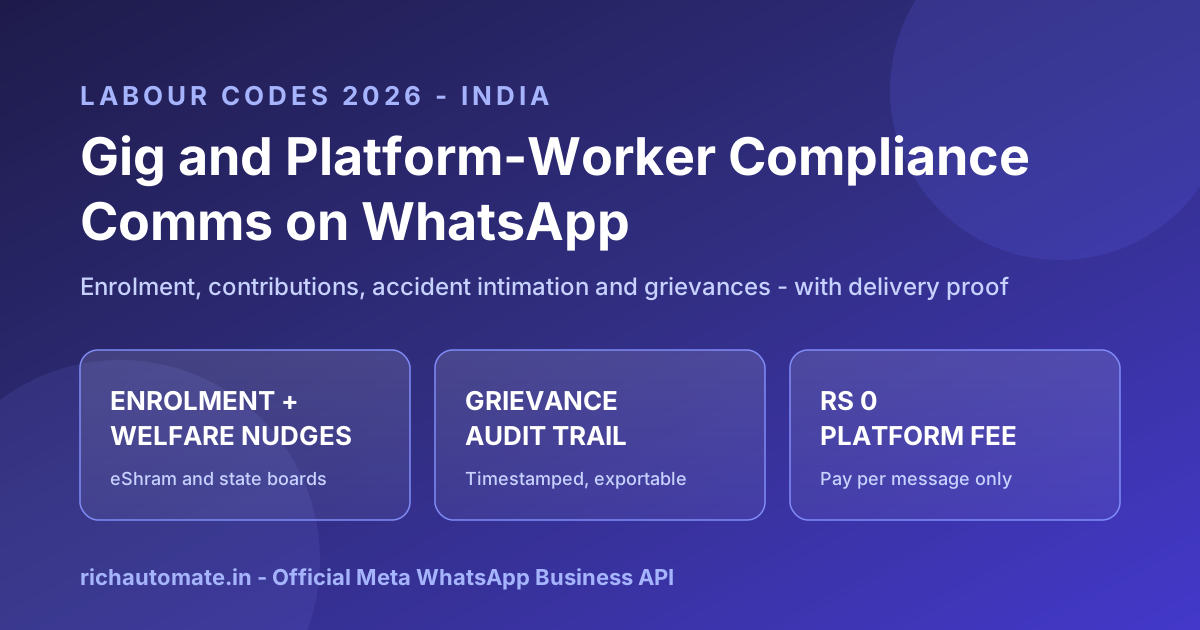
India spent the better part of two decades consolidating dozens of central labour laws into four Labour Codes — on Wages, Industrial Relations, Social Security, and Occupational Safety, Health and Working Conditions — and as enforcement machinery comes alive through 2026, one set of provisions matters more to app-economy companies than any other: the Code on Social Security's explicit recognition of gig workers and platform workers as categories the law sees, counts and protects. For a delivery platform, ride-hailing network, home-services marketplace or micro-task app, that recognition translates into a very practical problem that has nothing to do with legal theory and everything to do with operations: how do you run enrolment drives, contribution disclosures, accident intimations and statutory grievance channels across a workforce of lakhs of workers who do not sit in an office, do not check email, and live — professionally and personally — on WhatsApp? This article maps the four Codes to what they actually touch for a platform employer, then walks the five-stage worker-comms lifecycle that compliance teams are building on WhatsApp in 2026 — with the one property that separates compliance communication from ordinary notification: proof. Timelines, rates, thresholds and state rules below are deliberately unhedged on detail because they keep moving — verify every Labour-Code, eShram and state-welfare-board specific against current government sources as of 2026. This is general information, not legal advice.
Why 2026 is the year this stops being theoretical
The four Labour Codes were enacted years ago, but enactment and enforcement are different lives. Implementation has rolled out in phases — central rules, state rules, registration infrastructure like the eShram portal for unorganised and gig workers, and pioneering state-level gig-worker welfare legislation in states such as Rajasthan, Karnataka and Telangana that moved ahead of the central timeline with their own boards, levies and registration mandates (each at its own stage of notification and enforcement — verify the current status of every state's law as of 2026). The direction of travel is unmistakable: platforms are being asked to register their workers, contribute toward welfare funds, disclose what they deduct and contribute, report accidents, and answer grievances — and to prove they did all of it. A compliance posture that lives in a spreadsheet and an annual filing will not survive contact with a welfare-board audit or a labour inspector asking "show me that this worker was informed." The platforms getting ahead of this in 2026 are treating worker communication itself as a compliance artefact: every enrolment nudge, every contribution statement, every grievance acknowledgement — timestamped, delivered to a verified number, and logged.
The four Codes, mapped to a platform employer
Most coverage of the Labour Codes is written for traditional employers. Here is the platform-employer view: what each Code touches for a business whose workforce is gig or platform workers, and what that means for the communication layer.
| Code | What it touches for platform employers | WhatsApp-comms implication |
|---|---|---|
| Code on Wages | Floor-wage concepts, timely payment, deduction rules — applicability to gig relationships varies by how the engagement is structured (verify as of 2026) | Payout and deduction transparency messages: what was earned, what was deducted, why — pushed per cycle, not buried in an app tab |
| Code on Social Security | The big one: defines gig worker, platform worker and aggregator; provides for welfare schemes funded in part by aggregator contributions linked to turnover (rates and caps as notified — verify as of 2026); eShram/registration linkage | Enrolment and e-KYC document collection, scheme-awareness nudges, contribution disclosures, accident/insurance intimation — all needing delivery proof |
| Industrial Relations Code | Dispute-resolution and grievance machinery concepts; the extent of application to non-employee gig relationships is one of the contested edges (verify as of 2026) | A structured, logged grievance intake channel with acknowledgement and resolution trail — the artefact any dispute process will ask for |
| OSH & Working Conditions Code | Safety, working-conditions and welfare duties — directly for any employed staff (hubs, warehouses, dark stores), and as emerging good practice toward gig fleets | Safety advisories, heat/weather alerts, accident-reporting flows, training confirmations — with read evidence, not just broadcast hope |
Two honest caveats before going further. First, the legal question of whether a given platform relationship is employment, gig work or platform work — and which Code provisions therefore bite — is exactly the kind of question that needs counsel, not a blog. Second, this article is about the communication and evidence layer of compliance. The system of record for registrations and contributions is and remains the government's own infrastructure — eShram, welfare-board portals, and whatever state systems apply. WhatsApp is the channel that gets workers to those systems and proves you tried.
What the Social Security Code actually asks of an aggregator
Strip the Code on Social Security's gig provisions to their operational skeleton and a platform employer faces roughly five recurring obligations, each of which is — at its core — a communication workflow. Workers must be registered (eShram and any applicable state board), which means collecting identity and bank details and getting workers through a registration journey they will not complete unprompted. Welfare contributions linked to the aggregator's turnover must be paid into notified funds (the mechanics, rates and state-level cess variants are notified separately and keep evolving — verify as of 2026), and the deduction-and-contribution picture must be transparent to the worker, because nothing erodes trust or invites complaints like an unexplained line item. Accidents must be intimated and insurance claims supported quickly — for a rider on the road, the first hour matters. And grievances must have a channel that demonstrably works: received, acknowledged, escalated, resolved, recorded. None of this is exotic. All of it dies quietly if the only channel is an in-app notification centre that a worker opens twice a month.
The core idea, stated once and meant: compliance communication is not ordinary notification, because its value is only realised when something goes wrong — an inspection, an audit, a dispute, a claim. At that moment, "we sent it" is worthless and "here is the timestamped delivery record, the worker's structured response, and the resolution trail" is everything. Compliance comms need proof of delivery and proof of capture, not just delivery. That is the entire argument for running this layer on a channel with per-message delivery states and structured-input Flows, logged in a system you can export — rather than on broadcast SMS into the void or an app inbox nobody opens. The proof requirement is also why this layer must run on the official WhatsApp Business API with consent — an unofficial tool's screenshots prove nothing and risk the channel itself.
The 5-stage worker-comms lifecycle on WhatsApp
Here is the lifecycle compliance teams are converging on, stage by stage — with the WhatsApp capability that carries it, the message category it sensibly falls under (workers consent to operational comms at onboarding; category handling per Meta's current rules — verify as of 2026), and the evidence each stage leaves behind.
| Lifecycle stage | WhatsApp feature | Message category | Evidence captured |
|---|---|---|---|
| 1. Onboarding & e-KYC document collection | WhatsApp Flows for structured forms; media messages for ID/bank document upload; checklist nudges | Utility (worker-initiated onboarding thread) | Consent record, submitted fields, document receipt timestamps |
| 2. eShram / welfare-board enrolment nudges | Template reminders with deep link to the official portal; status check-ins ("done / stuck / need help" quick replies) | Utility | Delivery + read states per nudge; worker's self-reported status; escalation log for "stuck" |
| 3. Contribution & deduction transparency | Per-cycle statement message: earned, deducted, contributed, period — pushed every cycle | Utility | Timestamped statement per worker per period — the disclosure trail an inspector asks for |
| 4. Accident / insurance intimation | Inbound keyword or button → guided Flow capturing what/where/when + photos; instant acknowledgement; claim-status updates | Utility (worker-initiated) | Incident timestamp, structured report, acknowledgement time, claim-update trail |
| 5. Grievance channel with audit trail | Always-on inbound channel; structured grievance Flow; ticket ID issued in-chat; resolution updates | Utility / service conversation | End-to-end grievance record: received → acknowledged → escalated → resolved, all timestamped |
Notice what every row has in common: the worker never has to install anything new, and every interaction leaves a record by default. Stage 4 deserves emphasis — an accident-intimation flow that a rider can trigger with one word, that captures location and photos in a structured Flow and issues an acknowledgement inside a minute, is simultaneously the most humane and the most audit-ready thing a platform can build this year. The mechanics of structured capture here are the same ones field teams use for attendance and site reporting — covered in our field-force operations and attendance guide — pointed at a statutory purpose.
Where this is NOT the gig-operations playbook
A scope note, because we have written about gig fleets before and the two articles answer different questions. Our gig rider and logistics playbook is the operations layer — shift fills, surge calls, payout-day comms, rider engagement, the day-to-day running of a fleet on WhatsApp. This article is the 2026 compliance-reaction layer that the Labour Codes bolt on top of those same rails: statutory enrolment, welfare-contribution transparency, accident intimation and grievance records — communication whose purpose is to satisfy a legal obligation and whose output is evidence. Same channel, same workers, different job. Run both, and let the compliance flows borrow the trust the operations flows have already earned.
Get the DPDP WhatsApp checklist
A founder-led WhatsApp reply with the DPDP consent + audit-log checklist for WhatsApp Business messaging. India-hosted. No spam.
State welfare boards: the map is not uniform
The central Code is only half the picture. Several states moved early with their own platform-based gig-worker welfare laws — Rajasthan legislated first, Karnataka followed with its own Act and welfare-fee model, and Telangana has driven its own framework — typically combining a state welfare board, mandatory platform registration of workers, a levy or cess on platform transactions, and worker-facing welfare schemes. The operative word is variation: registration formats, levy bases, timelines and enforcement intensity differ state by state, several other states have draft or announced frameworks in the pipeline, and the interaction between state boards and the central Social Security Code is still being worked out in practice. Verify the current status of every state you operate in as of 2026 — and design your comms layer for it. Concretely: tag every worker with their working state, template your enrolment and disclosure messages so state-specific variants are a content change rather than a re-build, and treat multilingual delivery (the languages your workers actually read) as a compliance feature, not a nice-to-have. A Kannada-language welfare-board enrolment nudge with a deep link converts; an English-only PDF does not.
Why WhatsApp, against the alternatives
The honest comparison for statutory worker comms is not "WhatsApp versus nothing" — it is WhatsApp against SMS, email and your own app's notification centre, across the dimensions that decide whether a compliance message actually lands and leaves a trail.
| Dimension | SMS | In-app notification | WhatsApp Business API | |
|---|---|---|---|---|
| Reach for gig workforces | Universal but increasingly ignored | Low — many workers rarely use email | Only workers active in-app that day | Near-universal where workers already live |
| Delivery / read evidence | Delivery receipts, no read signal | Open tracking is unreliable | Weak, platform-internal | Per-message sent/delivered/read states, loggable |
| Structured two-way capture | None beyond keyword replies | Forms via links, high drop-off | Possible but app-dependent | Flows: forms, document upload, buttons in-thread |
| Rich media (ID docs, statements, photos) | No | Yes, but unread | Limited | Native — images, PDFs, documents both ways |
| Language fit | Plain text only | Poor on mobile | App-locale bound | Full multilingual, per-worker language templates |
| Audit-trail export | Fragmented across DLT/operator logs | Mailbox-bound | Locked inside the app's backend | Conversation + state log in your platform, exportable |
SMS still has a place as a fallback for the unreachable tail, and your app remains the workspace. But for the compliance lifecycle — where the test is "did the worker receive, understand and respond, and can you prove it" — the per-message state model plus structured Flows is the difference between a communication programme and a communication record.
The DPDP carve-out: worker data is personal data
Running statutory comms over WhatsApp means processing worker PII — identity documents, bank details, accident reports, grievance narratives, welfare-fund figures — and the DPDP Act 2023 does not care that the data subject is a worker rather than a customer. The discipline: take consent at onboarding with a clear notice of purpose (statutory enrolment, contribution disclosure, safety and grievance communication — in language the worker reads); practice purpose limitation, which concretely means the compliance-comms consent does not become a marketing licence, and welfare and grievance data is not mined for engagement campaigns; apply minimisation — collect the fields the registration or claim actually needs, not everything the form designer could imagine; and think hard about retention, because grievance and accident records pull in two directions — labour-law evidence obligations argue for keeping them, DPDP's storage-limitation principle argues against keeping them forever — so set a documented retention schedule with counsel rather than defaulting to "keep everything". Grievance handling itself is a DPDP obligation too, on the data-protection side as much as the labour side. The full channel-level discipline is in our DPDP compliance checklist for WhatsApp; verify all DPDP specifics against the current Act and Rules as of 2026.
Use the customer LTV calculator to work out how much a repeat customer justifies spending to keep.
The 7-point worker-comms compliance checklist: 1) Verified WhatsApp number for every active worker, captured with consent and a purpose notice at onboarding — in the worker's language. 2) Enrolment journeys (eShram + applicable state boards) as guided, nudged Flows with self-reported status and a human-escalation path — never a one-shot blast. 3) A per-cycle contribution-and-deduction statement pushed to every worker — earned, deducted, contributed, period — so transparency is the default, not a response to complaints. 4) A one-word accident-intimation trigger with structured capture (what/where/when + photos) and acknowledgement inside minutes. 5) An always-on grievance channel that issues a ticket ID in-chat and logs received → acknowledged → resolved with timestamps. 6) State-tagged workers and state-variant templates, so Karnataka/Rajasthan/Telangana-style board differences are content changes, not re-builds (verify each state as of 2026). 7) An exportable evidence pack: delivery/read states, Flow submissions, and grievance trails you can hand an inspector or welfare board on request.
How RichAutomate fits — honestly scoped
RichAutomate runs this layer on the official Meta WhatsApp Business API: template campaigns with per-message sent/delivered/read states for the nudges and statements, WhatsApp Flows for structured e-KYC, accident and grievance capture, a flow builder for the keyword-triggered journeys, a shared team inbox so escalations reach a human, contact attributes for state/language/enrolment-status segmentation, and full conversation logs you can export as the evidence pack. The boundary matters as much as the feature list: the platform helps you deliver, remind, capture and log — it does not make your company compliant with the Labour Codes, does not compute statutory contributions or levies, and is not the system of record (eShram and the welfare-board portals are). Compliance is a posture your legal and ops teams own; this is the channel layer that gives that posture reach and proof. Commercially, the economics fit lakh-scale workforces precisely because there is no per-seat or platform tax: ₹0 platform fee, ₹0 setup, ₹0 monthly — pay per message only, on Client Pay at ₹0.10 per message with Meta's conversation charges billed to you directly, or SaaS Pay at ₹1.50 per marketing message and ₹0.50 per utility message all-in, with a 14-day free trial and 100 free credits to pilot an enrolment-nudge journey on one city's fleet before scaling. If you are also choosing where worker records, consent state and conversation history live together, our best WhatsApp CRM comparison is the companion read; model your per-cycle statement volumes on the pricing page.
This article is general information about worker-communication workflows for platform employers in India, not legal advice. The four Labour Codes, the Code on Social Security's gig- and platform-worker provisions, aggregator-contribution mechanics, eShram registration requirements, and state welfare-board laws in Rajasthan, Karnataka, Telangana and elsewhere are at varying stages of notification and enforcement and change over time — verify every specific against current central and state government sources as of 2026, with qualified labour-law counsel. No rates, percentages, thresholds or deadlines are stated here because they must be taken from official notifications, not a blog. DPDP Act 2023 references are directional and must likewise be verified as of 2026. RichAutomate is a communication platform: it helps deliver, remind, capture and log; it does not compute statutory contributions, is not the system of record for registrations or welfare funds, and cannot make an employer compliant. Pricing (₹0 platform / ₹0 setup / ₹0 monthly, Client Pay ₹0.10/message with Meta billed directly, SaaS Pay ₹1.50 marketing / ₹0.50 utility, 14-day trial with 100 credits) is current as described but should be confirmed on the pricing page.
Build the worker-comms compliance layer before the inspector asks for it
RichAutomate runs on the official Meta WhatsApp Business API with WhatsApp Flows for e-KYC, accident and grievance capture, template journeys for enrolment nudges and contribution statements, per-message delivery and read evidence, state/language segmentation, a shared team inbox for escalations, and exportable conversation logs — the proof layer the Labour-Code era demands. ₹0 platform fee, ₹0 setup, ₹0 monthly: pay per message only on Client Pay ₹0.10/msg (Meta billed to you directly) or SaaS Pay ₹1.50 marketing / ₹0.50 utility. It helps you deliver, remind and log — your legal team owns compliance itself. 14-day free trial with 100 credits to pilot one fleet's enrolment journey. See full pricing, WhatsApp us at 918160311319, or book a 30-minute walkthrough at https://richautomate.in/book/demo.
For the bureau actually collecting the changed inputs each month, the operational detail sits in WhatsApp for payroll and PF/ESIC compliance firms.