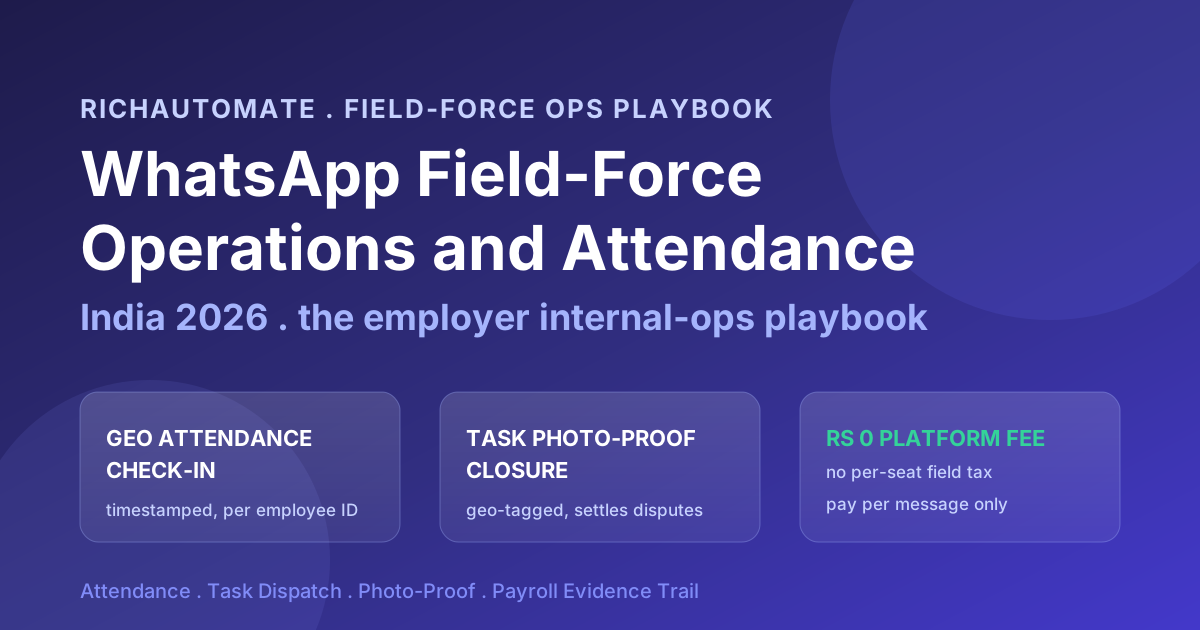
If you run a distributed field team in India — service technicians, merchandisers, surveyors, delivery and installation crews, in-store promoters — rig operators and pump crews included, as our borewell drilling & submersible pump lifecycle playbook shows — your hardest daily problem is not the work itself. It is proving the work happened. Was the technician actually at the customer's flat at 11 a.m.? Did the merchandiser really restock the shelf, or just say he did? Was the installation closed properly, or will it bounce back as a complaint next week? That proof is scattered across phone calls, a supervisor's memory, a few WhatsApp groups and a payroll spreadsheet, and when a customer disputes a visit or an employee disputes a day's pay, you cannot assemble it. WhatsApp, used as a structured field-operations layer rather than a noisy group chat, becomes the single thread that carries geo-tagged attendance check-in/out, task assignment, and task-closure photo-proof — filed against the employee ID, per shift, per task. The killer asset is a timestamped, geo-tagged photo logged at every task closure: it settles "was the work done / was he on-site" disputes and quietly builds a payroll-and-attendance evidence record at the same time. This guide is the employer's internal-ops playbook. Every figure here is illustrative and directional, and every labour, working-hours, EPF/ESI and DPDP specific must be verified against current official sources as of 2026. This is general information, not legal advice.
Why field-force operations break at attendance, dispatch and proof
A field business rarely loses money because a worker is incapable. It loses money at the seams. A customer deducts or refuses to pay claiming nobody showed up on a date you cannot disprove. A promoter marks himself "present" from home, and you pay a full day for a no-show you only discover at month-end. A task is reported "done" but the photo-proof — the restocked shelf, the sealed installation, the signed survey — does not exist, so the rework lands on you. An employee disputes his attendance and you have nothing but a supervisor's word against his. The field team is spread across a city or a state, works on the move, and reports through phone calls and ad-hoc messages that vanish into a group's scroll. The production — bodies doing visits — is usually fine. The evidence of it is where revenue, payroll trust and customer goodwill leak. A structured WhatsApp thread closes exactly that gap: it timestamps every check-in and task closure and attaches the proof to it, so the record is built passively as the day runs.
Why WhatsApp fits a distributed field team
The field chain spans people who would never log into the same heavy software. The technician on a bike has a basic Android phone and WhatsApp, nothing more — no app to install, no portal password to forget. The area supervisor managing fifteen field staff needs to push the day's task list and pull a closure photo fast, on the move. The ops and HR desk juggles attendance, wage calculation and EPF/ESI records. The one tool every link already has open, all day, is WhatsApp. It carries photos, PDFs, location pins and voice notes natively, works on a cheap handset in a basement or a rural shop with patchy data, threads a whole worker's day in one place, and reaches a surveyor in a village as easily as a promoter in a mall. You are not asking a field worker to adopt new software — you are routing the proof he already generates into one auditable thread, tied to his employee ID. That is why WhatsApp fits where a dedicated field-force app, with its login friction and per-seat cost, often does not reach the last worker. To keep the customer- and team-facing relationships organised on top of this attendance layer, an operator can pair it with the best WhatsApp CRM for India on the same number.
The six-stage field-ops lifecycle on WhatsApp
Map the field day as six handovers, each a WhatsApp checkpoint that captures evidence before the next stage proceeds. The discipline is simple: nothing advances until this stage's proof is in the thread, filed against the employee ID and the task ID.
| Stage | What happens on WhatsApp | Evidence captured |
|---|---|---|
| 1. Shift-start geo check-in | Worker sends a geo-tagged check-in at shift start from his own phone; system stamps time and location against the employee ID | Geo-tagged check-in time and location |
| 2. Daily stand-up + task dispatch | Supervisor broadcasts the day's stand-up and assigns each task — address, customer, checklist — to a named worker | Task list, assignee, dispatch timestamp |
| 3. On-site task execution | Worker runs the task checklist and updates status (en route / arrived / in progress) from the field | Checklist responses, status timeline |
| 4. Task-closure photo-proof | Worker closes each task with a timestamped, geo-tagged photo (the done work) logged against the task ID and employee ID | Geo-tagged closure photo, time, task ID |
| 5. Escalation ladder | An exception — failed visit, customer not home, SLA breach — routes up to the supervisor with reason and evidence | Exception reason, escalation trail, photos |
| 6. Shift-end check-out + day roll-up | Worker checks out; the day's attendance, tasks closed and photo-proofs roll up into a payroll-evidence summary | Check-out time, tasks-closed count, attendance record |
The employee ID is the spine — every check-in, task, photo and check-out downstream is filed against it, so any worker's full day can be reconstructed in seconds when a customer or an employee disputes it. This is the operating model; the labour and wage names attached to stages 1 and 6 must be verified as of 2026.
The task-closure photo-proof and geo-attendance trail — the real differentiator
Everything above exists to produce one asset: a complete, time-ordered evidence trail tied to an employee ID. This is what separates a WhatsApp-run field team from a WhatsApp-chatty one, and it does two jobs at once. It settles the "was the work done / was he on-site" dispute. When a customer claims the technician never came on the 14th, or that the installation was botched, you forward that task's record: here is the geo-tagged check-in near the site, here is the closure photo of the sealed unit, time-stamped, here is the checklist the worker completed. A dispute that used to be your word against the customer's — and usually ended in a refund or a free revisit — collapses into one message. It builds a payroll-and-attendance evidence record. The same geo-check-ins that proved presence to the customer also prove the working day for pay: who started when, who actually reached a site versus marked himself present from home, who closed how many tasks. At month-end, attendance is not a supervisor's guesswork — it is a queryable trail. The evidence is the same bundle whether the questioner is a customer defending an invoice or an employee defending a day's wage; you build it once, passively, as a by-product of running the day on WhatsApp.
The photo-proof rule: no task is "closed" without a timestamped, geo-tagged photo in the thread, and every check-in and photo is filed against the employee ID and task ID — not the contact, not just the date, the worker and the task. If you cannot pull a named worker's full day — every check-in, every closure photo, every task — in under a minute, you do not have an evidence trail; you have a chat history. Build the employee ID and task ID first; everything else hangs off them. And capture geo-location for the shift-attendance and task-proof purpose only, scoped to the people who need it for rostering and disputes — not as continuous tracking of where a worker is every minute.
WhatsApp vs a dedicated field-app vs phone calls
Most field operators today run on a mix of phone calls to supervisors, ad-hoc WhatsApp groups, and sometimes a dedicated field-force-management app on the larger accounts. Here is why a structured WhatsApp layer outperforms each for the day-to-day attendance-and-proof job specifically.
| Need | Dedicated field-force app | Phone calls / ad-hoc groups | Structured WhatsApp |
|---|---|---|---|
| Worker adoption | Install, login, training; last worker often skips it | Already used, but unstructured | Already open all day; zero install, tied to employee ID |
| Attendance with location proof | Yes, but only if the worker opens the app | "I'm at the site" — no proof | Geo-tagged check-in/out from the worker's own phone |
| Task-closure photo-proof | Supported; depends on app usage | Photos lost in a group scroll | Timestamped geo-photo filed against the task ID |
| Remote / low-bandwidth sites | Heavier app struggles on patchy data | Works, but no record | Works on any cheap Android, threaded history |
| Dispute / payroll retrieval | Possible, behind a separate login | Hunt across calls and chats; gaps lose the dispute | Forward the worker's day — proof in order, in seconds |
| Cost to deploy | Per-seat licence for every field worker | Free but unaccountable | Pay per message on the API; no per-seat field tax |
WhatsApp does not replace your payroll system, your formal HR system of record, or a specialised app where a complex workflow genuinely needs one — it is the field-facing surface that pulls the right proof into one thread at the right moment, on the device every worker already carries, without anyone chasing photos in a group.
Get the India 2026 WhatsApp BSP price comparison
Wati vs AiSensy vs Interakt vs RichAutomate: Meta rates, platform fees and hidden costs, side by side. We send it to your WhatsApp in a minute.
Per-stage automation, KPI and guardrail
Automation should serve the evidence trail and the KPI, never run ahead of a human signoff on a regulated fact such as final attendance or pay. Map each stage to the metric it moves and the guardrail it must respect.
| Stage | Automation | KPI moved | Guardrail |
|---|---|---|---|
| Geo check-in | Prompt check-in at shift start; flag missing | On-time check-in % | Attendance is evidence, not auto-marked present |
| Stand-up + dispatch | Broadcast stand-up; push each worker his task list | Tasks dispatched on time % | Named assignee per task; no blind broadcast of customer PII |
| Task execution | Checklist prompts; status-update nudges | Checklist-completion rate | Worker confirms each step; no auto-completion |
| Closure photo-proof | Block closure until a geo-photo is attached | Photo-proof capture % | Photo for the proof purpose; not continuous tracking |
| Escalation | Auto-route exceptions and SLA breaches up | Exception resolution time | Facts only; a human owns the resolution |
| Check-out + payroll roll-up | Compile attendance + tasks into a day summary | Attendance-accuracy % | Final attendance and pay human-confirmed (verify 2026) |
DPDP and employee PII — geo as attendance, not surveillance
A field worker's record is dense personal data — name, phone, photo, bank and wage details, and geo-location captured at check-in, check-out and every task closure. Under the Digital Personal Data Protection Act, 2023 (verify the current rules and any thresholds as of 2026), that data is processed for an employment purpose, and the discipline that makes the evidence trail work is the same discipline DPDP rewards. Collect only what the job and statutory record genuinely need (purpose limitation and data minimisation). Be clear with the worker, in plain language, about why location and photos are collected and how they are used. Be honest about the line that matters most: geo-location here is captured for shift attendance and task-proof — discrete points tied to a check-in, a check-out and a task closure — not continuous, all-day surveillance of where the worker is. Capturing a location pin when a task is closed is proof the work happened; pinging a worker's position every five minutes is tracking, and you should not do it. Retain records only as long as the dispute window, the working-period and the statutory retention genuinely require, and treat your messaging platform as a processor whose retention and access terms you have checked. A well-run field thread is already minimal, purposeful and auditable — which is exactly what DPDP asks for. For the operational mechanics of notice, consent and retention, see our DPDP Act 2023 WhatsApp business compliance checklist. WhatsApp is not your system of record for regulated facts — a person confirms final attendance and pay; the thread merely stores the proof. This is general information, not legal advice; verify against the current DPDP rules as of 2026.
To see what non-compliance would actually cost, the DPDP penalty calculator sizes the exposure against your contact volume.
The attendance-trust flywheel: the same threads that captured a month of clean geo-attendance and task-closure photos are your strongest asset on two fronts at once. With customers, a service business that can instantly produce the closure photo and the on-site check-in wins disputes it used to refund — fewer free revisits, fewer charge-backs, a higher renewal rate. With your own field staff, an attendance record that is evidence rather than a supervisor's guess builds payroll trust: workers who are paid accurately for the days they truly worked, with the proof on hand, dispute less and churn less. Reliable evidence lowers your customer-dispute losses, your wage arguments and your field-staff turnover together. Close every day with the check-out roll-up, and over a few payroll cycles the evidence trail compounds into an operation that is cheaper to run and harder for either side to game.
This is the employer's own field staff — distinct from hiring, staffing and gig
Be clear about what this playbook is and is not, because we have written adjacent pieces that look similar but solve a different problem. This is the employer running its own existing field staff day to day — the attendance, dispatch and proof of people already on your rolls. It is not recruitment: hiring and onboarding new people is the job of our WhatsApp HR recruitment and offer-letter automation guide. It is not a staffing marketplace matching workers to households or businesses — that is our domestic-workers app onboarding piece. And it is not a gig platform onboarding independent riders at scale — that is our gig-rider logistics guide. This model is horizontal: it applies across the verticals we have already covered, wherever an employer deploys its own staff into the field. The closest vertical instance is our private security and PSARA guide, which applies the same geo-attendance and evidence-trail idea to a licensed guard force under PSARA — that piece carries the security-specific licensing and verification layer; this piece is the general, cross-industry field-ops version for any employer with technicians, merchandisers, surveyors, installation crews or promoters.
A 30-day rollout runbook
Days 1–7 — design the spine. Define your employee ID and task ID scheme and the six-stage gate map; list the exact attendance and statutory records your payroll and any contracts demand today (verify working-hours, EPF/ESI and Shops & Establishments requirements as of 2026 with your HR or compliance desk). Days 8–14 — wire attendance and dispatch. Stand up the geo check-in/out flow tied to the employee ID, and the daily stand-up broadcast that pushes each worker his named task list. Days 15–21 — wire execution and photo-proof. Add the task checklist and status updates, and the closure step that blocks "done" until a timestamped, geo-tagged photo is attached against the task ID. Days 22–27 — wire escalation and payroll roll-up. Turn on the exception-and-SLA escalation ladder and the shift-end check-out that compiles attendance and tasks into a payroll-evidence summary; pilot on one team and one supervisor. Days 28–30 — review and harden. Pull a random worker and try to reconstruct his full day — check-in, every closure photo, check-out — in under a minute; fix any gap, assign an owner, and confirm the geo-data scope stays attendance-and-proof, not surveillance. Timelines and all figures here are illustrative and directional — adapt to your team size and task mix, and verify every labour, working-hours and DPDP specific as of 2026. See full pricing to size the per-message cost against your field-team volume.
This article is general information, not legal, labour or compliance advice. India's employment and labour framework (working-hours and the labour codes, EPF, ESI, minimum wage, Shops & Establishments) and the DPDP Act 2023 all change, and clauses, thresholds, rates and retention periods are revised regularly. Numbers, cohort figures and sizing here are illustrative and directional. Geo-location for attendance must be handled as shift-and-task proof under employment purpose limitation, not continuous surveillance. Verify every specific against the current official sources as of 2026 and consult qualified advisors before relying on any point here.
Run your field-force attendance and photo-proof on WhatsApp
RichAutomate gives field-force operators the official Meta WhatsApp Business API with a no-code flow builder, geo-location check-in/out, photo and PDF capture, employee- and task-based threads, daily stand-up broadcasts, escalation routing and a shared team inbox — so your geo-attendance, task dispatch and timestamped task-closure photo-proof live in one evidence trail per employee, settling customer and payroll disputes alike. ₹0 platform fee, ₹0 setup, ₹0 monthly — pay per message only: Client Pay ₹0.10/msg with Meta's conversation charges billed to you directly by Meta, or SaaS Pay ₹1.50 marketing / ₹0.50 utility-auth. 14-day free trial with 100 credits. See full pricing, WhatsApp us at 918160311319, or book a 30-minute walkthrough at https://richautomate.in/book/demo.
Pharma field forces have extra rules: see how medical representatives can use WhatsApp under UCPMP 2024.