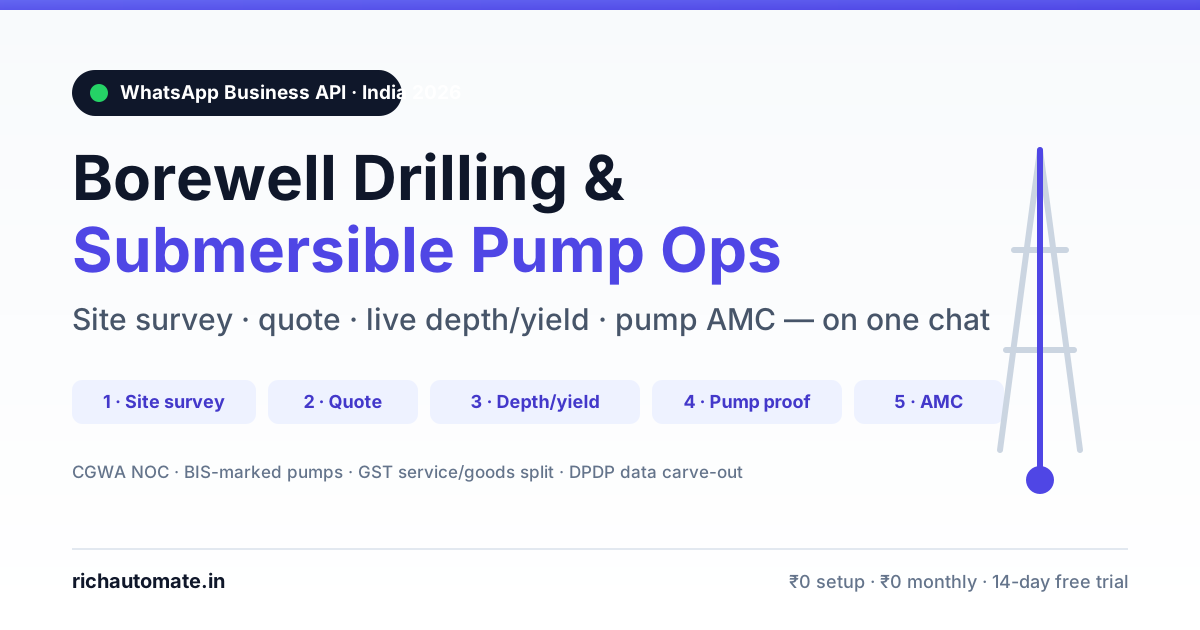
A borewell drilling and submersible pump company in India runs its whole field operation on the official WhatsApp Business API: a customer enquires and books a site survey in one chat, gets a drilling-plus-pump quote with clear CGWA-permit guidance, receives live depth-and-yield updates as the rig goes down, approves the pump commissioning with geotagged photo proof and a warranty card, and is later pulled back with an annual maintenance contract (AMC) for pump servicing, desilting and motor checks — plus a re-bore or deepening upsell when the water table drops. That single lifecycle turns a phone-and-referral business, where the rig's calendar and every AMC renewal live in someone's head, into a tracked, recurring-revenue engine on the one app every property owner already opens. Figures here are directional; verify current market data, CGWA and state groundwater rules, BIS pump standards, GST treatment and DPDP specifics with the relevant authorities.
Why borewell drilling and submersible pumps are a natural WhatsApp business
India's groundwater-extraction and pump-installation market is large and structurally growing — directionally a multi-thousand-crore field-service opportunity as water security tightens across agriculture, housing, industry and tier-2/tier-3 towns where the water table keeps falling and re-bores multiply (verify current sizing with an industry source before quoting it). A borewell business is really three businesses stitched together: a drilling-rig operation booked days ahead, a pump-and-motor supply-and-install job, and a long AMC tail on every pump sold. The money leaks in two places — slow enquiry response, because a farmer whose bore ran dry messages three rig owners at once and books whoever answers first, and one-and-done installs that never convert to an AMC, so the pump that fails in three years goes to a competitor. WhatsApp fixes both, because it is the channel the customer actually opens and because a structured thread carries the quote, the live drilling update, the commissioning proof and the service reminder that a phone call cannot. The same recurring-service discipline that our WhatsApp playbook for RO water-purifier service and AMC brings to a single appliance scales cleanly to a rig-and-pump fleet — only the site survey and the yield data widen the workflow.
The 5-stage borewell & pump lifecycle on WhatsApp
Map every stage of the job to a WhatsApp touchpoint and the field funnel stops leaking:
- 1. Enquiry + site-survey / feasibility booking: a Click-to-WhatsApp ad, a QR sticker on the rig, or a "Book a site survey" link opens a WhatsApp Flow that captures location pin, plot type, purpose (agri / domestic / industrial), existing bore history and target depth — a qualified, geo-routable lead and a scheduled feasibility visit instead of a vague "I need a borewell" call.
- 2. Quote + CGWA / permit-doc guidance thread: after the survey the customer gets a line-item quote — drilling per running foot by strata, casing pipe, and the submersible pump-and-motor package — plus a plain-language checklist of the CGWA No-Objection-Certificate and state groundwater permissions their location needs. This document thread is where a compliant borewell business separates itself from the informal rig down the road.
- 3. Drilling schedule + live depth / yield-update push: the customer self-books a drilling window, then receives live updates as the rig goes down — depth reached, strata logged, and the water-yield reading at commissioning. The yield figure is the single most important number in the whole job, and delivering it in writing to the customer's chat builds the trust that wins the pump order and the referral.
- 4. Pump installation + commissioning photo-proof + warranty: on pump-set installation the technician attaches geotagged photos of the installed submersible pump, motor and control panel, and the customer receives a digital warranty card plus a GST invoice — proof the BIS-marked pump was fitted and is covered.
- 5. AMC + re-bore / deepening upsell: after commissioning, nudge an annual maintenance contract covering pump servicing, borewell desilting/flushing and motor and control-panel checks, then fire utility reminders for each service-due date. When yield drops with the water table, the same thread offers a re-bore or deepening quote. This is the recurring-revenue engine: AMC plus deepening turn a one-time drilling job into an annuity.
The pump leg overlaps directly with solar-powered irrigation, whose subsidy and sizing workflow we map in the WhatsApp playbook for PM-KUSUM solar pump subsidies, while borewell water that feeds treatment or bottling follows the RO and water-treatment-plant AMC playbook and the packaged-drinking-water plant playbook downstream.
The regulatory spine: what shapes your quotes and survey flow
A borewell and groundwater business sits at the intersection of water, safety and tax law. Build these into your templates and quote flow from day one — treat them as the reason to get the workflow right, not as a blocker (and verify the current position with the relevant authority):
- CGWA NOC for groundwater extraction: the Central Ground Water Authority regulates groundwater abstraction, and many uses — especially industrial, infrastructure and bulk extraction — need a No-Objection-Certificate, with notified/over-exploited ("dark") blocks under tighter control. Guide the customer to the right NOC through the WhatsApp document thread; verify the current CGWA guidelines and which categories and areas require prior permission.
- State groundwater rules vary by state: several states run their own groundwater authorities and borewell registration, spacing and permit rules on top of the central framework — verify the exact requirement for the customer's state and district rather than assuming one national rule.
- Mandatory borewell-safety / capping norms: Supreme Court directions and state rules require registration of drilling agencies and safe capping of abandoned and functional bores to prevent child-fall tragedies. Log the cap and fencing in your commissioning photo-proof; verify the current safety guidelines applicable to your operation.
- BIS certification on submersible pumps & motors: submersible pump-sets and motors carry BIS/IS standards; quote and fit BIS-marked equipment and record the model on the warranty card. Verify the applicable IS standards and any mandatory-certification scope.
- State electricity board for pump power connection: an agricultural or domestic pump needs a sanctioned power connection or load from the state DISCOM, and the paperwork often runs in parallel with drilling. Fold the connection checklist into the same guidance thread; verify the current DISCOM process for the customer's category.
- GST — drilling service vs pump goods: a borewell invoice typically mixes a service component (drilling, installation labour) and goods (casing pipe, the submersible pump-set), which can carry different GST treatment. Show the split clearly on the invoice and get your exact classification and rates confirmed by a qualified tax professional.
- Local-body permissions: municipal or panchayat permissions and road-cutting or access approvals may apply to the drilling site — verify local requirements before scheduling the rig.
Handling customer and site data the DPDP way
Survey and drilling flows pull in exactly the data the Digital Personal Data Protection Act, 2023 treats as personal — plot address, phone, and precise borewell location coordinates. A few disciplines keep a borewell operator on the right side (verify the current DPDP Rules and their commencement as they roll out through 2026):
Book a WhatsApp booking demo
See how brands run bookings, reminders, and re-engagement on WhatsApp — DPDP-compliant, India-hosted. Book a 15-minute demo.
Worth knowing the scale of the risk, and the DPDP penalty calculator estimates it from your own numbers.
- Site-address & location-data minimisation: collect only what the survey and drilling need — pin, plot type, purpose and target depth — not a permanent lake of every property's coordinates, and take clear opt-in before any marketing broadcast. A borewell's geotag is sensitive location data; store it against the job, not in a shared contact list.
- Technician-side access limits: a rig operator or pump technician should see only the job in hand — customer name, site and scope — not the full customer database. Use an API stack with role-based access, not a shared WhatsApp group where every field agent sees every customer's location.
- Consent for AMC re-contact: AMC-renewal and deepening reminders to a past customer need a lawful basis and easy opt-out; keep utility service-due reminders separate from marketing offers, and honour data-principal access and erasure requests.
The automation tech stack
Three building blocks on the official API run the whole lifecycle:
- WhatsApp Flows for survey booking & quote: a Flow captures the structured site-survey request (location, plot type, purpose, bore history, target depth) in-chat, and a second Flow presents the line-item drilling-and-pump quote for one-tap acceptance — no app install, no web redirect.
- Utility templates for depth/yield & AMC reminders: survey confirmations, live depth and yield updates, commissioning cards, AMC service-due and deepening reminders are transactional and sit in the cheaper utility category. Keep pump-upsell and new-offer broadcasts in the marketing category, which needs prior opt-in.
- Two-way status + geotag proof: "rig scheduled", "drilling started", "yield logged" and "pump commissioned" statuses flow back to the customer thread with geotagged photos, so the property owner is never left wondering where the job stands.
The same job-card, live-status and AMC-reminder pattern powers any distributed rig-and-technician operation — see how a dispersed crew is tracked in our WhatsApp playbook for field-force operations and attendance.
What a WhatsApp setup costs a borewell & pump business on RichAutomate
RichAutomate runs on the official Meta WhatsApp Business API with ₹0 platform fee, ₹0 setup and ₹0 monthly — you pay only for messages. Two models:
- Client Pay — ₹0.10 per message plus Meta's conversation charges billed to you directly at cost by Meta.
- SaaS Pay — ₹1.50 marketing / ₹0.50 utility per message, all-inclusive on one INR GST invoice, tiering down toward ₹0.50 at volume.
Because most field traffic — survey confirmations, depth and yield updates, commissioning cards and AMC service reminders — is utility, the running cost stays low even for an operator running several rigs and a large pump-AMC base. Going live on the official API needs a verified business, and in India GST is effectively required to move a WhatsApp Business Account to live status, so treat it as necessary, not optional. See the full WhatsApp Business API pricing breakdown for the per-conversation maths. A 14-day free trial with 100 free credits lets a borewell business pilot a site-survey Flow and an AMC-reminder campaign before committing. Pricing shown is RichAutomate's own; verify any competitor's current rates directly, and no platform should promise a ban-proof account for unsolicited or bulk sends.
Run your borewell & pump business on WhatsApp
From site-survey booking and CGWA-permit guidance, to live depth-and-yield drilling updates, to geotagged pump-commissioning proof with warranty and GST invoice, to AMC servicing, desilting and re-bore reminders — RichAutomate runs it all on the official Meta WhatsApp Business API at ₹0 setup, ₹0 monthly, ₹0 platform fee. Client Pay is ₹0.10/message plus Meta's rates billed direct at cost; SaaS Pay is ₹1.50 marketing / ₹0.50 utility all-inclusive. Start with a 14-day free trial and 100 free credits, or book a 30-minute walkthrough. This is general information; verify current CGWA, state groundwater, borewell-safety, BIS, GST and DPDP specifics with the relevant authorities.
Start your 14-day free trial → · Book a 30-min walkthrough · WhatsApp us on 91 81603 11319
Related: WhatsApp for water-tanker suppliers in India 2026 — booking capture, dispatch ETA, delivery proof and refill reminders on one thread.
Related: WhatsApp for scaffolding & formwork rental in India 2026 — enquiry capture, itemised dispatch, on-rent reconciliation and loss-damage billing on one thread.