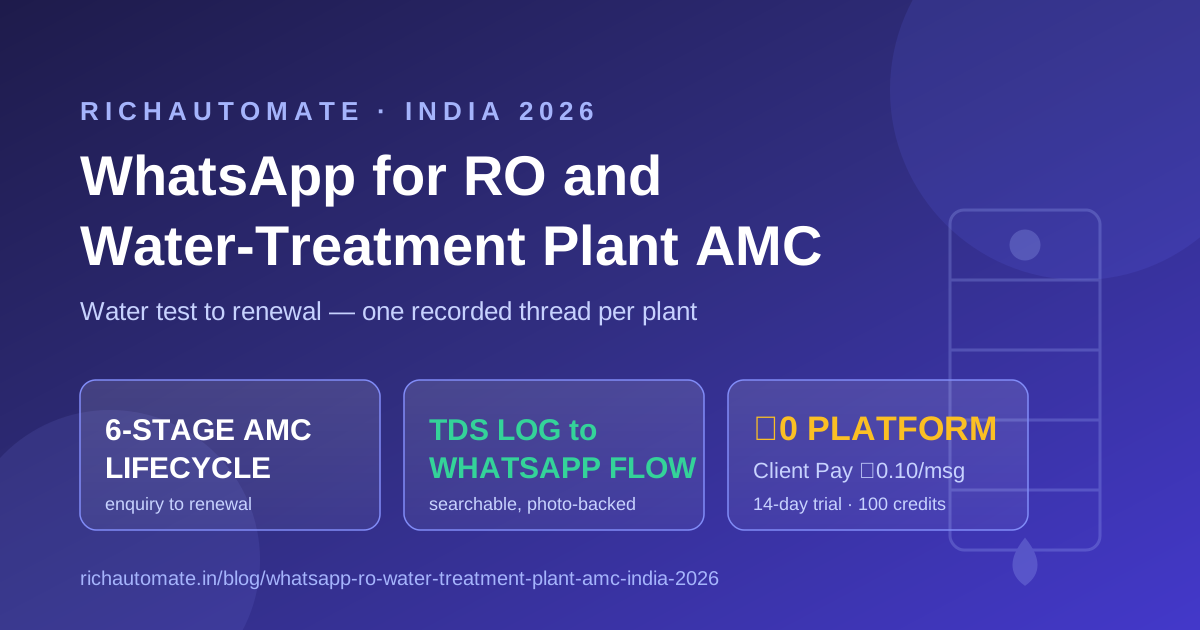
An industrial RO or water-treatment-plant company does not really sell a machine. It sells the promise that water keeps flowing at the right quality, every shift, for years — a promise that starts at the bore, whose drilling and pump lifecycle we map in our borewell drilling & submersible pump lifecycle playbook — — and that promise is kept by service, not by the sale. A commercial RO skid, a sewage-treatment plant for an apartment complex, an effluent-treatment plant for a factory, or a packaged-drinking-water unit all share one economic truth: the equipment is a one-time invoice, but the membranes, cartridges, dosing chemicals, sanitization cycles, TDS logs and breakdown call-outs are a recurring annuity that runs for the plant's entire life. The firms that win in 2026 are not the ones with the cheapest skid; they are the ones whose annual-maintenance-contract (AMC) book renews, whose service tickets close inside SLA, and whose compliance evidence is ready the day an inspector or a client's facility manager asks for it. This is the deep-research playbook for running that whole supply-plus-AMC lifecycle over WhatsApp Business — for the RO and WTP integrator, the STP/ETP operator, the packaged-water-unit owner and the field-service team who keep the water clean. It covers the recurring-service economics, the full six-stage enquiry-to-renewal lifecycle, AMC-reminder automation, breakdown-SLA ticketing, the compliance-evidence trail, TDS and flow-log capture, why generic CRMs fail field-service water businesses, and how to get started. Every regulator and threshold below is hedged — CPCB and State Pollution Control Board consents, CGWA groundwater NOC, BIS IS 10500 and the RO-system standard, FSSAI for packaged drinking water, Legal Metrology, GST treatment and the Factories Act all move — so treat each as “verify current rules as of 2026,” treat every cohort figure as illustrative, and treat none of this as legal, regulatory or engineering advice.
Why the service, not the skid, is the business. The capital cost of a water-treatment plant is paid once; the cost of keeping it compliant and running is paid forever. A reverse-osmosis membrane fouls and is replaced on a cycle; sediment and carbon cartridges are swapped on a usage curve; an STP or ETP needs dosing, desludging and periodic third-party testing to hold its consent-to-operate; a packaged-drinking-water line needs batch testing and sanitization to keep its licence. Every one of those is a scheduled, recurring, billable event — and every one is also a moment the relationship can quietly lapse if nobody reminds the client. The firm that treats commissioning as the end of the job loses both the plant's uptime and a predictable AMC annuity. A WhatsApp Business workflow that books the water test, narrates commissioning with photo-proof, fires membrane and sanitization reminders, captures TDS and flow logs, runs breakdown tickets to SLA, and renews the AMC with the compliance pack attached turns a one-time equipment sale into a managed, multi-year service relationship. Verify the operative CPCB, State PCB, CGWA, BIS and FSSAI positions and Meta's policy as of 2026.
The recurring-service economics of RO and water-treatment plants
Start with the money, because it explains every design choice that follows. In a water-treatment business the equipment margin is thin and competed away on every tender; the durable margin is in the AMC, the consumables and the call-outs. A plant that is sold and forgotten generates one invoice. The same plant under a live AMC generates membrane and cartridge replacements, dosing-chemical supply, sanitization visits, periodic testing, and breakdown labour — year after year — and it keeps the client locked to your service team rather than the cheaper local technician who appears the moment your follow-up goes silent. The leak in this business is not pricing; it is forgotten service: an AMC that lapses because the renewal reminder never went out, a membrane left in past its life because nobody flagged the TDS creep, a consent-to-operate test missed because the date sat in a spreadsheet nobody opened. WhatsApp's role is to make every recurring, billable, compliance-critical event visible and timed, so the annuity is collected rather than leaked. This is directional — model your own service economics — but the shape holds across commercial RO, STP/ETP and packaged-water operations.
If you are unsure where you stand, the WhatsApp compliance self-audit covers the checks in order.
The six-stage enquiry-to-renewal lifecycle
Before any automation, internalise the lifecycle, because every WhatsApp message in this playbook is timed against a stage. A water-treatment relationship moves through a predictable arc from first enquiry to the annual renewal that starts the next cycle, and each stage has its own follow-up load. This is directional and varies by plant type, client and contract — verify your own service pathway.
| Stage | What happens | What the firm must coordinate over WhatsApp |
|---|---|---|
| 1. Enquiry + free water test / TDS report | A prospect asks about a plant or an upgrade | Capture site, source water, intended use; book the free water-test / TDS-report visit; set expectations |
| 2. Plant sizing + proposal | Test results drive a sizing and a quote | Send the plant-sizing logic and the proposal PDF; answer questions; record what was agreed |
| 3. Installation + commissioning | The plant is installed and commissioned | Narrate the schedule; send commissioning photo-proof and the handover pack; book the first service |
| 4. AMC service reminders | Membranes, cartridges, dosing, sanitization, logs | Timed reminders per consumable life; TDS and flow-log capture; service-visit confirmations |
| 5. Breakdown + SLA ticket | Something fails between scheduled visits | Log the ticket, dispatch a technician, run the parts thread, keep the client updated to SLA |
| 6. Annual renewal + compliance pack | The AMC year closes | Renew with the compliance-evidence pack attached; ask for the referral |
The single operational truth that falls out of this table: the firm's uptime and its AMC annuity are both made or lost at the handoffs between stages, not inside any one of them. A perfectly sized plant means nothing if the first service is never booked; a flawless commissioning means nothing if the membrane reminder never fires and the client switches when output quality drops. WhatsApp's job is to make every handoff — especially the easy-to-forget service reminder and the annual renewal — visible, timed and recorded. It does not replace the field engineer's hands or the chemist's judgement, which are exactly what cannot be automated. Treat every timing above as directional and verify it against your own protocol.
AMC-reminder automation: collecting the annuity instead of leaking it
The heart of the business is stage four, and it is the stage manual operators leak the most. Each consumable and each compliance event has its own cadence, and a reminder fired at the right time is the difference between a renewed contract and a lapsed one. Map the recurring events to their automation and the case makes itself.
| AMC service event | WhatsApp automation | Why it wins |
|---|---|---|
| RO membrane replacement | Usage- or TDS-aware reminder before output quality drops | Catches creeping TDS before the client notices bad water and blames you |
| Sediment / carbon cartridge swap | Scheduled nudge per cartridge life | Keeps the plant within spec; books the visit instead of waiting for a complaint |
| Sanitization / CIP cycle | Calendar reminder + a logged completion confirmation | Holds the hygiene cycle that a packaged-water or institutional plant depends on |
| Dosing-chemical resupply | Low-stock reminder tied to the consumption rate | Prevents a dosing gap that can breach an effluent norm |
| Periodic third-party test | Reminder ahead of the consent / licence test window | Keeps the consent-to-operate or licence evidence current, not scrambled-for |
| AMC renewal | Renewal nudge with the year's compliance pack attached | Renews the annuity with the value already demonstrated in-thread |
The asymmetry is the argument: these reminders are largely utility-category conversations — the cheapest tier — and they directly move the numbers that decide a water-treatment firm's year, namely renewed AMCs, consumables sold on time, and plants kept inside spec. One recovered AMC renewal pays for years of messaging, and the messaging bill is a rounding error against the value of a single multi-year service contract. For the consent-category economics behind this, the WhatsApp WABA pricing and cost-optimisation guide covers how to keep service messaging in the cheaper utility lane.
Breakdown-SLA ticketing over WhatsApp
Between scheduled visits, plants fail — a pump trips, a membrane chokes, an STP blower stops — and for an institutional or industrial client a water outage is not an inconvenience, it is a halted canteen, a hostel without water, or an effluent line that risks a norm breach within hours. The firm that closes these tickets fast, visibly and to a stated SLA keeps the contract; the one that takes a day to even acknowledge the call loses it at renewal. WhatsApp turns the breakdown into a tracked thread rather than a panicked phone tag. The client raises the fault in the thread they already use; the ticket is logged with a reference; a technician is dispatched with a visible window; the parts conversation — what is needed, what it costs, when it arrives — runs in the same thread; and the resolution is confirmed and recorded. Nothing is lost to a missed call or a forgotten promise, and the whole exchange becomes a written SLA record the firm can stand behind at renewal. The discipline is to keep the technician's diagnosis and the actual repair where they belong — with the qualified field engineer — and let WhatsApp do only the logging, dispatch coordination, parts thread and status updates that the client experiences as responsiveness.
The SLA principle, in one line. A breakdown is won or lost in the first hour, and the first hour is communication, not engineering. Use WhatsApp to acknowledge the fault instantly with a ticket reference, give a dispatch window, run the parts thread transparently, and confirm resolution in writing — so the client always knows where their ticket stands. Keep the diagnosis and repair with the field engineer; let WhatsApp carry the responsiveness the client actually judges you on. A logged, in-SLA breakdown thread is also exactly the evidence that wins the renewal conversation, because it proves — in the client's own chat history — that you showed up. Verify any client-contracted SLA terms and your own service capacity before committing to a response window.
The compliance-evidence trail: CPCB, CGWA, BIS and FSSAI
This is the carve-out that separates a water-treatment business from a generic equipment seller, and it is where a casual operator gets caught out. A water plant sits inside a web of regulation that a retail playbook never touches, and the AMC is partly a promise to keep that evidence current. The WhatsApp layer cannot make a compliance claim or substitute for the actual lab test or consent — but it is the perfect place to schedule the evidence, deliver the certificate, and keep the trail recorded so it is ready the day a Pollution Control Board officer, a CGWA query, or a client's facility manager asks. Map the plant type to the regulatory touchpoints and the value of a recorded trail is obvious.
Get a 1-minute BSP audit on WhatsApp
Drop your WhatsApp number — we line-item your current invoice against Meta India rates in under 60 seconds. India-hosted, DPDP-compliant.
| Plant type | Typical service cadence (illustrative) | Compliance touchpoint to keep evidenced (verify 2026) |
|---|---|---|
| Commercial / industrial RO skid | Membrane, cartridge and sanitization cycles per usage | Output water quality against the relevant drinking-water spec (BIS IS 10500); the RO-system standard where it applies |
| STP (sewage treatment) | Dosing, desludging, periodic sampling | State PCB / CPCB consent-to-operate; treated-effluent parameters within consented norms |
| ETP (effluent treatment) | Dosing, sludge handling, parameter logging | State PCB / CPCB effluent consent; Factories Act obligations on an industrial site |
| Groundwater-fed plant | As per source and treatment train | CGWA NOC for groundwater extraction where required |
| Packaged-drinking-water unit | Batch testing, line sanitization | FSSAI licence + batch evidence; BIS spec; Legal Metrology on the packaged bottle; label declarations |
The principle every careful firm internalises: WhatsApp narrates and stores the compliance trail; it never performs the regulated act. The lab test is a lab test, the consent is a consent, the licence is a licence — those happen in the regulated world and are recorded in your formal compliance files. But the reminder that a test is due, the delivery of the certificate PDF to the client, and the searchable in-thread record that the sanitization happened on the day it was due are exactly the unglamorous follow-up work that keeps a plant's evidence current and a client's auditor satisfied — and none of it carries a regulatory claim, so it sits comfortably inside the rules. Note too the GST nuance: an AMC that bundles service labour with equipment or spares can carry different treatment for the service versus the goods component, so keep your invoicing clean and verify the current GST position. Verify every regulator threshold and any IS-standard applicability as of 2026; this is operational guidance, not regulatory or engineering advice.
The data carve-out: B2B does not mean DPDP-free. A water-treatment AMC is mostly a business-to-business relationship, but the WhatsApp threads still hold personal data — the site contact's name and number, and sometimes water-quality and lab data tied to an identifiable site. Under India's Digital Personal Data Protection framework that data deserves the familiar discipline: capture consent to message about service, use the contact only for this plant's service and renewal (purpose limitation), hold only what the AMC genuinely needs, scope who on the team can see it, and separate clinical-grade retention of compliance records from messaging-consent withdrawal and opt-out. And one bright line on claims: an RO plant's output is described by its specification — the parameters it is designed to achieve against a standard — never by a health or medical claim about what the water cures or prevents. “Treated to meet the drinking-water spec” is a specification statement; any “removes X% impurities so it cures Y” framing is a health claim to avoid. Verify the operative DPDP provisions and advertising-claim rules as of 2026; this is operational guidance, not legal advice.
TDS and flow-log capture via WhatsApp Flows
One stage of this lifecycle is uniquely suited to WhatsApp and uniquely painful on paper: the routine capture of TDS readings, flow rates, dosing levels and service-completion notes. Today most field teams scribble these in a paper logbook that lives at the site, is illegible by the time it reaches the office, gets lost, and is impossible to search when a client or an inspector asks for a year's history. A short WhatsApp Flows form changes that — the technician opens the form on the same phone they already carry, taps in the readings and the visit notes, attaches a photo of the meter or the membrane, and the structured log lands in your system the moment the visit ends, tied to the plant and the date.
| Dimension | Paper logbook at site | WhatsApp Flow TDS/flow capture |
|---|---|---|
| Where the data lives | A book at the plant — one copy, easily lost | Structured, in your system, the moment the visit ends |
| Legibility + completeness | Handwritten, often partial | Form-validated fields the technician must fill |
| Searchability for a year's history | Near impossible — manual flip-through | Instant — pull the plant's log on demand |
| Photo evidence of meter / membrane | Rare — needs a separate camera and filing | Attached in the same flow, tied to the log |
| Ready for a client or inspector | Scramble to reconstruct | Exportable trail, already current |
The shift is from a logbook nobody can find to a searchable, photo-backed service history per plant. That history is not just tidy — it is the asset that wins renewals and survives audits, because it proves in structured data that every membrane, sanitization and test happened when it should have. Keep the engineering judgement on what the readings mean with your chemist or engineer; let the Flow only make the capture effortless and the record permanent.
Why generic CRMs fail field-service water businesses
Most water-treatment firms have tried to bolt their service operation onto a generic sales CRM or a spreadsheet, and it fails for structural reasons. A sales CRM is built around a deal that closes once; a water-treatment business is built around a plant that is serviced forever, on consumable-specific cadences, with compliance dates and breakdown SLAs that a deal-pipeline tool has no concept of. The result is that the renewal date sits in a field nobody automates, the membrane cadence lives in an engineer's head, the breakdown runs over a phone call that leaves no record, and the compliance certificate is emailed once and lost. This comparison is directional — verify your own fit — but the gap is consistent.
| Need | Owned WhatsApp service workflow | Generic sales CRM / spreadsheet |
|---|---|---|
| Consumable-specific service reminders | Native — timed per membrane, cartridge, sanitization | Manual — a date field someone must watch |
| Reaches the client where they answer | Yes — the app they open all day | Email/portal the client rarely opens |
| Breakdown SLA with a written trail | Logged ticket + dispatch + parts thread | A phone call with no record |
| TDS / flow-log capture from the field | Flows form, structured, photo-backed | Paper, or nothing |
| Compliance-evidence trail per plant | Certificates delivered + recorded in-thread | Emailed once, then lost |
| AMC renewal reliability | Auto-nudge with the compliance pack | Depends on someone remembering |
The conclusion most firms reach: WhatsApp is the best field-service and AMC layer for a water-treatment business — not a replacement for the engineering, the lab or the formal compliance file, but the one channel where clients already are and where every reminder, ticket, log and certificate can be timed, written and recalled. The spreadsheet keeps the dates nobody reads; the sales CRM was never built for a plant that is serviced for a decade; WhatsApp does the part that decides whether the AMC renews. For organising the client relationships and renewals behind all this, the best WhatsApp CRM for India guide is a useful companion, and operators who run the same recurring-AMC pattern on other equipment will recognise it in the WhatsApp for elevator and lift AMC and DG-genset rental and AMC playbooks. Firms that also run packaged-drinking-water distribution should read the dedicated packaged-drinking-water plant playbook for the jar-route lifecycle, which is a different business from the plant-AMC one described here.
The automation stack that runs it — and getting started
The reassuring news for a water-treatment firm is that none of this needs new hardware or a developer — it maps onto a standard WhatsApp Business API automation stack, with the engineering and the compliance file untouched. Enquiry and free-water-test booking run through a short Flows form (site, source water, use case) instead of a long call. The proposal PDF, commissioning photo-proof and handover pack are sent as document deliveries in-thread. AMC service reminders — membrane, cartridge, sanitization, dosing, periodic test — are scheduled, consumable-aware nudges. Breakdowns run as logged tickets with technician dispatch and a parts thread in a team inbox with scoped access. TDS and flow logs are captured by a Flows form the technician fills on site. The annual renewal is an auto-nudge with the compliance pack attached. A chatbot FAQ handles predictable questions — process, rough timelines, what a free water test involves — and a fast human handoff takes over the instant anything technical or contractual arises. The field engineer's hands, the lab and the formal compliance records stay exactly where they are; WhatsApp is the communication, follow-up, ticketing and evidence-delivery layer on top. The discipline is to keep the bot scoped to logistics and never let it make an engineering or a compliance claim.
Keep the water flowing — and the AMC renewing
A water-treatment firm's reputation is not won by the skid it installs — it is won by the fact that the membrane is changed before the TDS creeps, the sanitization happens on the day it is due, the breakdown is acknowledged inside the hour, and the compliance pack is ready the moment the client's auditor asks. That is a field-service and follow-up problem, and recurring, time-critical service across a whole plant base is exactly what a spreadsheet and a sales CRM cannot hold. From the first enquiry and a free-water-test booking, through plant sizing and the proposal PDF, commissioning with photo-proof, the consumable-aware AMC reminders, breakdown tickets run to SLA with a written trail, TDS and flow logs captured by a Flows form, to the annual renewal with the compliance pack attached — WhatsApp can be the one structured, recorded thread that runs the whole lifecycle, while your engineering, your lab and your formal compliance file stay the source of truth and the regulatory boundary, and you describe your plant by its specification, never by a health claim. On illustrative numbers that means fewer lapsed AMCs, more consumables sold on time, more breakdowns closed in SLA, and more renewals won with the evidence already in the client's chat history. RichAutomate's pricing stays flat through all of it: ₹0 platform fee, ₹0 setup, ₹0 monthly — Client Pay at ₹0.10 per message with Meta's conversation charges billed direct by Meta, or SaaS Pay at ₹1.20 marketing / ₹0.30 utility all-in, and service reminders, tickets, logs and renewals are utility conversations, the cheaper category. Start the 14-day free trial with 100 credits, WhatsApp us at 917434901027, or book a 30-minute walkthrough at https://calendly.com/inrichdaddy/30min. (All cohort, renewal and retention figures here are illustrative — model your own — and CPCB / State PCB consents, CGWA NOC, BIS IS 10500 and the RO-system standard, FSSAI, Legal Metrology, GST treatment and the Factories Act all change; verify the current position as of 2026. This is operational guidance, not legal, regulatory or engineering advice.)
Start your 14-day free trial → · See full pricing · Read the elevator-AMC playbook
Related: WhatsApp for water-tanker suppliers in India 2026 — booking capture, dispatch ETA, delivery proof and refill reminders on one thread.
Related: WhatsApp for ETP & STP plant AMC operators in India (2026) — shift parameter logs, OCEMS excursion alerts, service reports and SPCB consent-to-operate reminders in one thread.