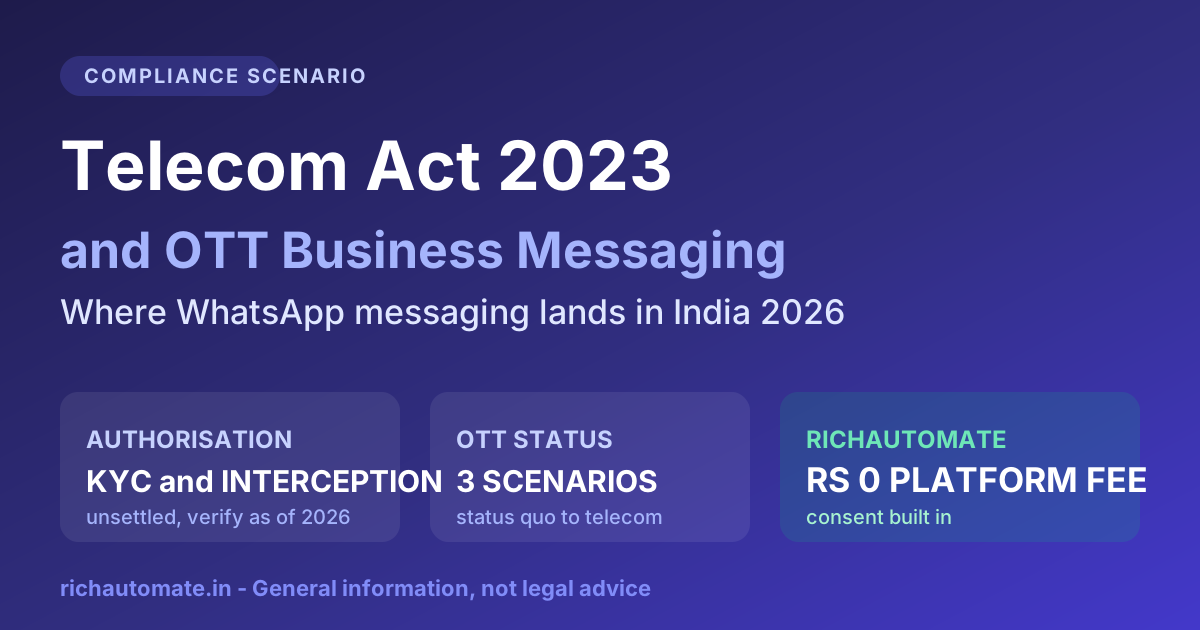
One question quietly hangs over every business that sends WhatsApp messages in India: as the Telecommunications Act, 2023 is rolled out through 2026 via its delegated rules — and as TRAI's long-running consultation on "OTT" communication services plays out — does business messaging over WhatsApp start to acquire telecom-style obligations such as authorisation, know-your-customer (KYC) and lawful-interception readiness? The honest answer in 2026 is: it is unsettled, and anyone who tells you otherwise is guessing. This piece is a scenario map, not a prediction. It lays out where the law could land, what each landing would mean for senders, and the no-regrets moves you can make now that pay off under every scenario. Every regulatory, Meta and legal specific below is evolving and must be verified against current official sources as of 2026 — do not treat any rule, clause, date or category here as settled fact. This is general information, not legal advice.
What the Telecom Act 2023 actually is — and what is still open
The Telecommunications Act, 2023 replaced the colonial-era telegraph and wireless statutes and created a new framework for "telecommunication" in India. At a high level it deals with authorisation to provide telecom services and operate networks, spectrum, lawful interception and message powers of the government, user protection against unsolicited commercial communication, and rule-making powers delegated to the executive and to the regulator. The critical word for our purposes is "telecommunication" and how broadly its definitions are read in practice. The Act is a frame; the substance that decides whether an over-the-top (OTT) messaging surface like WhatsApp Business is swept in lives in the delegated rules, notifications and any authorisation framework issued under it — much of which is still being shaped or interpreted as of 2026. So the right mental model is not "the law says X"; it is "the statute opens several doors, and which one opens for OTT business messaging is the thing to watch." Verify the current status of the Act's commencement, its rules and any relevant notifications as of 2026 before acting on any specific.
The core question: is WhatsApp business messaging a "telecom service"?
The unresolved question is whether sending business notifications, OTPs and conversations through an internet messaging app counts as providing a "telecommunication service" that needs authorisation, or whether it remains an application riding on top of the licensed access network (your ISP and the mobile operators) and is governed by data-protection and consumer rules instead. Telecom operators have long argued for "same service, same rules" — that OTT communication apps compete with SMS and calls and should carry comparable obligations. OTT platforms and many users argue these are internet applications already covered by IT and data-protection law, and that layering telecom authorisation on top would be duplicative and chilling. TRAI's consultations have explored exactly this boundary. Where it settles — broad sweep, narrow carve-in, or status quo — is the fork that everything else in this article hangs on. As of 2026 this is genuinely open; verify the latest TRAI recommendations and any government decision before relying on a position.
Why this is not the DLT/TCCCPR question. Do not confuse this with the commercial-communication rules. The TRAI TCCCPR framework and DLT registration govern how commercial messages are sent over operator channels — template/header/consent registration, scrubbing, complaint handling — and is covered in our TRAI TCCCPR and DLT guide for WhatsApp. This article is about a different, prior question: under the Telecom Act 2023, is the WhatsApp messaging service itself classified as telecom — bringing authorisation, KYC and interception duties — regardless of the commercial-comms rules that already apply. One is "rules for the message"; the other is "status of the channel." Track them separately.
Rather than writing from scratch, pull a close match out of the WhatsApp template library and edit it.
Three scenarios for how OTT business messaging could land
Rather than predict, plan against a small set of plausible end-states. The table sketches three; reality may be a blend, and the probabilities are deliberately omitted because they are unknowable as of 2026. Treat this as a planning device, not a forecast.
| Scenario | What it would mean | Likely impact on a business sender |
|---|---|---|
| A. Status quo / app-layer | OTT messaging stays outside telecom authorisation; governed mainly by IT and DPDP data-protection rules plus existing platform policy | Lowest change — keep doing consent, opt-out and data-protection hygiene; obligations sit with you as a data fiduciary, not as a telecom provider |
| B. Light-touch carve-in | Some OTT communication obligations introduced — e.g. enhanced traceability, abuse-handling, or limited KYC of high-volume senders — without full telecom-licence weight | Moderate — expect stronger sender-identity, record-keeping and complaint-response expectations; mostly handled by your BSP and platform, but you own the consent and identity trail |
| C. Broad telecom classification | OTT communication treated closer to a telecom service, pulling in authorisation, KYC and lawful-interception-style obligations on platforms/intermediaries | Highest — heavier duties land primarily on Meta and your BSP/platform, but downstream you may face stricter sender verification, message-purpose declarations and data-handling terms |
Note who carries the weight in each case: the heaviest new obligations in Scenario C fall on the platform and intermediary layer (Meta and Business Solution Providers), not directly on an individual business sending order updates. But the second-order effects — tighter onboarding, identity checks and contractual terms — flow down to you. Plan for the flow-down, not the headline. All three scenarios and their contents are illustrative and must be re-checked against the actual rules as of 2026.
The telecom-style obligations worth watching
If any carve-in materialises, three families of obligation are the ones to watch because they are the hallmarks of telecom regulation. None of these is confirmed for OTT business messaging as of 2026 — this is a watchlist, not a compliance checklist.
| Obligation family | What it could require (if it applies) | Who would mostly carry it |
|---|---|---|
| Authorisation / registration | The messaging service or certain senders may need to be authorised or registered under a framework defined by the rules | Platform / intermediary layer; possibly high-volume sender categories |
| Sender KYC / identity | Stronger verification of who is sending business messages and for what purpose, beyond today's WABA onboarding | BSP and platform, flowing down to the business at onboarding |
| Lawful interception readiness | Defined processes for lawful access to communications on government order, within the limits set by law | Platform / network layer — generally not the individual business sender |
The practical takeaway: most of this, if it ever lands, is a platform-and-BSP problem you procure your way around by choosing a compliant provider — not a coding project for your own team. Your job is to keep your own house in order (consent, identity, purpose, data handling) so you slot cleanly into whatever onboarding bar your platform raises. Verify which, if any, of these obligations apply to OTT business messaging as of 2026; do not assume any of them are in force.
Get the DPDP WhatsApp checklist
A founder-led WhatsApp reply with the DPDP consent + audit-log checklist for WhatsApp Business messaging. India-hosted. No spam.
The carve-out tension: lawful interception vs DPDP confidentiality
The most interesting unresolved tension is between two things the same state is building at once. On one side, telecom law has long contemplated lawful interception — defined, authorised government access to communications under specified conditions and safeguards. On the other side, the Digital Personal Data Protection Act, 2023 (DPDP) builds an expectation of confidentiality, purpose limitation and data minimisation for personal data, and end-to-end encryption is central to how messaging platforms protect user content. These pull in different directions, and how the rules reconcile them — what is accessible, under what authorisation, with what safeguards, and what platforms must technically enable — is one of the genuinely hard, genuinely open questions as of 2026. For a business sender, the point is not to resolve this debate; it is to recognise that your obligation lives squarely on the DPDP side: you are a data fiduciary responsible for lawful, minimal, purpose-bound processing of the customer data you push through WhatsApp, whatever the platform-level interception framework turns out to be. Keep your consent and retention discipline tight and you are insulated from most of the volatility above. See our DPDP compliance checklist for WhatsApp business for the operational mechanics. This is general information, not legal advice; verify the interplay of telecom and DPDP rules as of 2026.
The insulation principle: you cannot control whether India classifies OTT messaging as telecom, what authorisation looks like, or how interception and encryption are reconciled — those are platform-and-government questions. You can control your own consent records, sender identity, message-purpose discipline and data retention. Every one of those is required under DPDP and consumer rules today, pays off under all three scenarios, and is exactly what a stricter onboarding bar would ask you to prove. Spend your energy there. The regulatory weather will change; a clean consent-and-data trail keeps you dry in every forecast.
No-regrets moves for senders right now
Here is the value of a scenario map: it lets you act before the rules settle, on the moves that help no matter how things land. Each of these is justified by today's DPDP, consumer and platform-policy expectations, so none is wasted effort even under the status-quo Scenario A.
| No-regrets move | Why it pays off under every scenario |
|---|---|
| Keep auditable opt-in consent per contact, with timestamp and source | Required by DPDP and consumer rules now; exactly what any KYC/identity carve-in would demand |
| Honour opt-out instantly and keep the suppression record | Already expected; protects you from unsolicited-communication penalties under any regime |
| Send only genuine, purpose-matched messages (utility/auth vs marketing) | Aligns with platform policy and any future purpose-declaration requirement |
| Verify your business identity cleanly at WABA onboarding and keep it current | If sender-KYC tightens, you are already verifiable; reduces account-review friction |
| Minimise and time-bound the personal data you push through chat | Core DPDP duty; shrinks your exposure whatever the interception framework becomes |
| Choose a BSP/platform that tracks regulatory change and updates terms | Most platform-layer obligations get solved by your provider, not your code |
If you are choosing or re-evaluating a provider with this uncertainty in mind, our guide on how to evaluate a WhatsApp BSP in procurement includes the regulatory-readiness and contractual questions worth asking. The provider you pick is your main shock-absorber against whichever scenario unfolds.
What to watch through 2026
Signals worth tracking, all to be verified against primary sources as they appear: the commencement status and phased notification of the Telecom Act 2023's provisions; any delegated rules or notifications touching OTT, authorisation, KYC or interception; TRAI's final recommendations on regulating OTT communication services and the government's response; any classification decision that names or excludes internet messaging apps; and Meta's own platform-policy and onboarding changes for India, which often move ahead of formal rules. The pattern to expect is incremental and phased, not a single big-bang reclassification — which is good news, because it means a sender with clean consent-and-data hygiene gets time to adapt at each step. Do not act on rumour or draft text as if final; wait for notified rules and verify as of 2026.
Where this leaves a business sender
Strip away the uncertainty and the practical position is calm. The heaviest potential obligations — authorisation, interception readiness, platform-level KYC — sit with Meta and your BSP, not with the shop sending delivery updates or the clinic sending appointment reminders. Your responsibilities are the ones you already owe under DPDP and consumer law: real consent, instant opt-out, honest purpose, verified identity, minimal and time-bound data. Do those well and you are positioned for Scenario A, B or C without rework. The businesses that will scramble are the ones sending unconsented bulk messages with sloppy identity and no data discipline — and they are exposed under today's rules already, never mind tomorrow's. Treat the Telecom Act 2023 question as a reason to tighten the fundamentals you should have tightened anyway, on a platform whose provider is paid to absorb the regulatory shocks for you.
This article is general information, not legal or compliance advice. The Telecommunications Act, 2023, its delegated rules and notifications, the classification of OTT communication services, any authorisation, KYC or lawful-interception obligations, and the interplay with the DPDP Act 2023 are all evolving and unsettled as of 2026. No rule, clause, category, date or penalty is asserted here as final, and any market or cohort framing is illustrative and directional. Verify every specific against current official sources — the Department of Telecommunications, TRAI, MeitY and notified rules — and consult qualified advisors before relying on any point here.
Send WhatsApp with consent and compliance built in
RichAutomate runs on the official Meta WhatsApp Business API with a no-code flow builder, per-contact consent and opt-out tracking, verified WABA onboarding, message-purpose templates and a shared team inbox — so whichever way the Telecom Act 2023 and OTT rules land, your consent trail, sender identity and data discipline are already in order. ₹0 platform fee, ₹0 setup, ₹0 monthly — pay per message only: Client Pay ₹0.10/msg with Meta's conversation charges billed to you directly by Meta at their rate with no markup, or SaaS Pay ₹1.50 marketing / ₹0.50 utility-auth. 14-day free trial with 100 credits. See full pricing, WhatsApp us at 918160311319, or book a 30-minute walkthrough at https://richautomate.in/book/demo.
Related reading: EU AI Act for WhatsApp Bots: India Exporters 2026 walks through the same WhatsApp setup for a neighbouring use case.