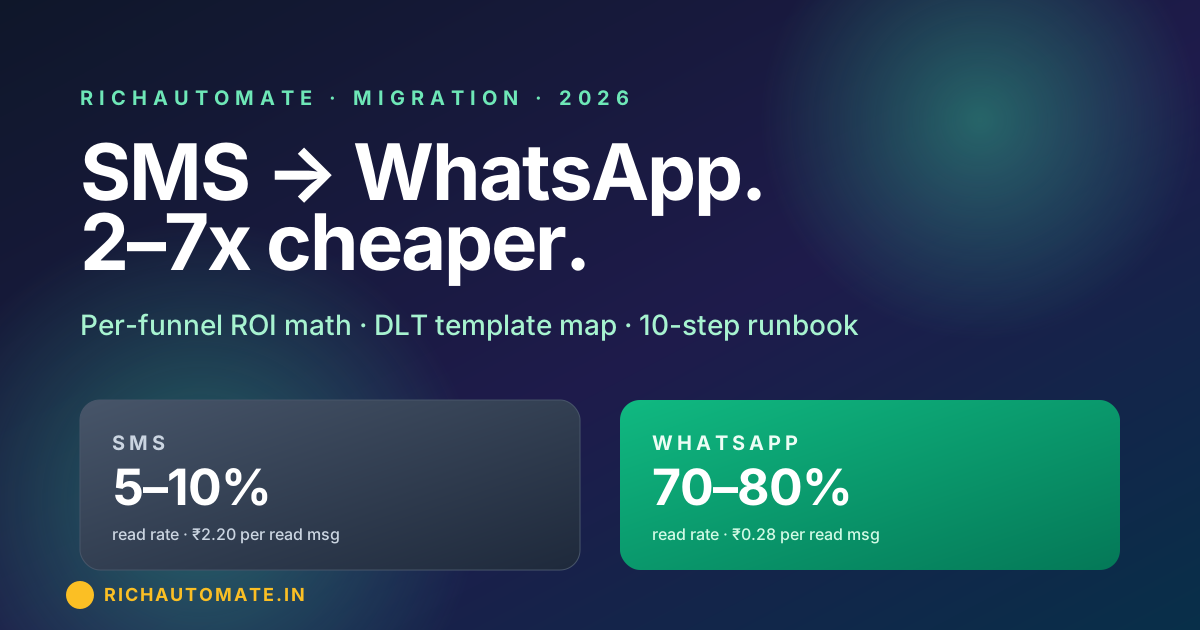
Indian brands sending bulk SMS in 2026 are quietly bleeding revenue. SMS open rates collapsed below 8% post-DLT enforcement, transactional delivery has fallen apart on BSNL routes, and per-message costs sit between ₹0.18 and ₹0.45. WhatsApp templates over the same audience deliver at 95–98%, get read at 70–80%, and cost ₹0.115 to ₹0.96 depending on category — usually less per read message than SMS per sent message. This guide is the 2026 SMS-to-WhatsApp migration playbook — exact per-funnel ROI math, the four message types where SMS still wins, the DLT/template equivalence map, and the ten-step migration runbook that keeps your number unblocked through the cutover.
Why SMS Engagement Collapsed in India 2024–2026
| Factor | Impact on SMS | Year |
|---|---|---|
| TRAI DLT enforcement (full) | Sender-ID and template scrubbing reject 8–14% of legitimate SMS | 2023 |
| Operator-side spam filtering tightened | Promotional SMS read rate falls to ~5–8% | 2024 |
| RCS rollout on Jio + Airtel | Subscribers shift attention; legacy SMS feels obsolete | 2024–2025 |
| WhatsApp 600M+ Indian DAU | WhatsApp becomes default messaging surface | 2025 |
| Smartphone OS spam-block defaults | SMS auto-folder/silenced for unknown sender IDs | 2025–2026 |
| Meta India rate optimisation | Marketing template rate ₹0.86, utility ₹0.115 — cheaper per read than SMS per send | 2026 |
Per-Funnel ROI Math: Three Real D2C Funnels
Funnel 1 — Order confirmation (transactional / utility)
10,000 daily orders, single confirmation message.
| Channel | Per-msg cost | Daily cost | Read rate | Cost per read |
|---|---|---|---|---|
| SMS (utility, DLT-registered) | ₹0.22 | ₹2,200 | 10% | ₹2.20 |
| WhatsApp utility template | ₹0.215 (Client Pay) / ₹0.30 (SaaS Pay) | ₹2,150 / ₹3,000 | 78% | ₹0.28 / ₹0.38 |
WhatsApp Client Pay is ~7.8x cheaper per read. Annual saving on a 10k/day funnel: ~₹7 lakh.
Funnel 2 — Marketing campaign (offer/promo)
50,000-contact send, 4 sends/month.
| Channel | Per-msg cost | Send cost | CTR | Cost per click |
|---|---|---|---|---|
| SMS (promotional, DLT) | ₹0.42 | ₹21,000 | 0.6% | ₹70 |
| WhatsApp marketing template | ₹0.96 (Client Pay) | ₹48,150 | 4.5% | ₹21.40 |
WhatsApp marketing costs ~2.3x more per send but delivers 7.5x more clicks. Cost per click drops by 70%. Conversion rates compound the gap further — WhatsApp clicks land in a richer experience and convert 1.3–2x better than SMS clicks.
Funnel 3 — OTP / authentication
5,000 daily logins.
| Channel | Per-msg cost | Daily cost | Delivery rate | Drop-off cost |
|---|---|---|---|---|
| SMS OTP (transactional) | ₹0.18 | ₹900 | 91% | ~9% retry/abandon |
| WhatsApp authentication template | ₹0.215 (Client Pay) | ₹1,075 | 99.4% | ~0.6% |
WhatsApp OTP costs ~₹175 more daily but the 8.4% reduction in failed-OTP retries saves more than that in lost conversions on signups, KYC, and high-AOV transactions. Net positive at any conversion value above ~₹100.
Where SMS Still Wins (Don't Migrate Everything)
- Customers without WhatsApp. ~10% of Indian feature-phone users + senior demographics. Keep SMS as fallback for opt-in bounce.
- Pure-data carrier failures. Rural Bihar / parts of Northeast where data connectivity drops; SMS routes via voice channel still deliver.
- One-shot voice OTP confirmation. Bank flows where regulator mandates dual-channel — SMS + voice — keep SMS.
- Sub-3-second OTP delivery SLA. SMS typically delivers in 2–4s; WhatsApp authentication template adds 1–2s due to encryption handshake. For 2-second SLA scenarios (high-frequency-trading login), SMS still wins on tail latency.
For everything else — order updates, shipping tracking, marketing campaigns, abandoned-cart recovery, support broadcasts, refund notifications — WhatsApp wins on cost-per-read, conversion, brand experience, and customer trust.
Get a 1-minute BSP audit on WhatsApp
Drop your WhatsApp number — we line-item your current invoice against Meta India rates in under 60 seconds. India-hosted, DPDP-compliant.
DLT-to-WhatsApp-Template Equivalence Map
| SMS DLT category | WhatsApp template category | Notes |
|---|---|---|
| Transactional | Utility | Direct equivalent — order confirmations, OTP follow-ups, shipping updates |
| Service Implicit (post-purchase) | Service window or Utility template | Service window opens 24h after customer-initiated message; Utility template if outside window |
| Service Explicit (account alerts) | Utility | Submit as Utility with explicit account-context content |
| Promotional | Marketing | India 2026 marketing rate ₹0.86 base; gets approved with clear opt-in audit trail |
| Authentication / OTP | Authentication | Submit with auth-template format: code variable + expiry. Approval tightly enforced — must include "Do not share" disclaimer |
The Ten-Step Migration Runbook
- Audit your SMS sender IDs and DLT templates. Pull the last 90 days of SMS logs. Categorise by template type (transactional / service / promotional / OTP) and message count.
- Map each DLT template to a WhatsApp template equivalent. Use the equivalence table above. Aim to consolidate — a single WhatsApp template often covers what required 3 SMS variants in DLT.
- Submit 5–7 highest-volume templates to Meta first. Don't submit all at once; Meta scrutiny is harsher under high-volume new submissions.
- Wait for approval (24–48h typical). Track approval rate; if you see >15% rejection, consult your BSP for content tweaks before re-submitting.
- Run a 14-day shadow campaign. Send the WhatsApp version to 10% of audience while continuing SMS to 100%. Track delivery, read, click, and conversion rates side-by-side.
- Validate cost-per-conversion in your CRM. Confirm the math holds for your actual audience. Most brands see 2–4x lift in conversion-attributed revenue from the WhatsApp arm.
- Set up the SMS-fallback rule. Brand logic: send WhatsApp first; if no read receipt within 4 hours, send SMS. Captures the 10% who don't have WhatsApp without doubling cost.
- Migrate transactional first, marketing second. Transactional templates get faster Meta approval and lower scrutiny. Build quality rating with utility before pushing marketing volume.
- Throttle the cutover. Don't drop SMS to 0% on day 1. Ramp WhatsApp share over 30 days: 25% week 1, 50% week 2, 75% week 3, 100% week 4 with SMS fallback.
- Decommission unused DLT registrations. Once stable, remove obsolete DLT sender IDs and templates to reduce platform fees from your SMS aggregator.
Five Anti-Patterns That Wreck the Migration
- Migrating without an opt-in audit. Customers who never opted in to WhatsApp will report your sends. Run a re-permission campaign first if your CRM consent state is unclear.
- Submitting marketing templates before utility ones. Meta's quality rating starts NEUTRAL on a fresh WABA. Marketing volume on a NEUTRAL WABA gets throttled to ~250 sends/day. Build to GREEN with utility first.
- Same-day full cutover with no SMS fallback. Even at 99.4% WhatsApp delivery, the 0.6% missed messages on a 100k-customer base = 600 customers without their order confirmation. Cascade to support tickets.
- Sending the same SMS copy as a WhatsApp template body. SMS copy is bare and short (160 char). WhatsApp customers expect richer, branded, multi-line copy with media headers. Direct port underperforms.
- Forgetting to update your customer-data lifecycle. SMS opt-out keyword is "STOP". WhatsApp opt-out is a button or "Stop promotions" reply. Customers who opted out of SMS may not be opted out of WhatsApp. Migrate consent state explicitly.
Rule of Thumb
If your brand is sending more than 100,000 SMS / month in India today, the migration math is unambiguous in WhatsApp's favour at the per-conversion level — usually 50–70% lower cost-per-converted-customer. The harder question is operational: opt-in re-permission, template approval pipeline, and SMS-fallback architecture. Brands that nail those see ROI within 60 days; brands that rush it get burned by quality-rating throttling and consent complaints.
The conversation window cost calculator shows how the 24-hour window changes your per-conversation spend.
Approximate Annual Savings by Volume Tier
| Monthly SMS volume (current) | WhatsApp migration estimated annual saving | Time to ROI |
|---|---|---|
| 50,000 SMS / month | ₹2.5L–₹4L | 3–4 months |
| 250,000 SMS / month | ₹14L–₹22L | 2 months |
| 1,000,000 SMS / month | ₹60L–₹95L | 4–6 weeks |
| 5,000,000 SMS / month (mid-large enterprise) | ₹3.2Cr–₹4.8Cr | 2–4 weeks |
Numbers assume mixed transactional + marketing portfolio at typical Indian D2C ratios (60% utility, 30% marketing, 10% authentication) and Client Pay billing on RichAutomate.
What Most Indian Brands Get Wrong in the First 90 Days
The first 90 days of WhatsApp adoption are where most ROI gets lost. Brands that come from SMS expect a similar fire-and-forget broadcast model and treat WhatsApp the same way. Three corrections:
- Quality rating matters more than send volume. A YELLOW rating throttles you below 1,000 marketing sends/day, regardless of plan tier. Keep block + report rates clean from day one.
- Opt-in is not just compliance — it is a quality signal. Customers who explicitly tap a Click-to-WhatsApp ad or fill out a form have implicit consent. Customers ported over from your SMS list do not. Re-permission campaigns lift quality rating fast.
- WhatsApp is conversational, not broadcast. A reply received within the 24-hour service window opens a free message channel that bypasses template costs entirely. Brands that engineer their flows to capture replies (quick-reply buttons, list pickers) cut their per-customer cost by another 30–50%.
Migrate from SMS to WhatsApp on RichAutomate.
Free SMS-to-WhatsApp template equivalence audit. Migration team rebuilds your DLT templates as Meta templates within 7 days. Dual-billing transparency on Client Pay so you see the per-message savings in real time. 14-day trial.
Related reading
- Migrate Your WhatsApp Business API Between BSPs Without Losing WABA (2026 India Guide)
- WhatsApp for Healthcare Clinics India 2026: Compliance Gates, Seven Clinical Workflows, and Real Per-Appointment ROI
- WhatsApp Cohort Retention India 2026: Six Lifecycle Messages, Real Day-90 Retention Lift, Per-Cohort Economics
- Maximizing WhatsApp ROI for Indian D2C Brands with RichAutomate (Special Report)
- Best WhatsApp CRM India 2026: ₹ Pricing Compared
Weighing RCS as an alternative? See our head-to-head on RCS Business Messaging vs WhatsApp Business API for India.