WhatsApp templates are not landing pages. You cannot iterate them in minutes — every variant needs a separate Meta approval (24–48h SLA), and Meta caps active templates at 250 per WABA. This forces brands into one of two failure modes: ship one variant and pray, or ship many and burn the template cap. The 2026 methodology is different — statistically rigorous A/B testing built around Meta's constraints, not against them. This guide gives you the variant-design pattern, the sample-size math for click-through rate lifts, the sequencing that protects WABA quality rating, and the ten anti-patterns that make most Indian D2C brands' "tests" worthless.
Why WhatsApp A/B Testing Is Different from Email
Three constraints reshape the entire methodology:
- Approval gating. Each variant is a separate template requiring Meta review. Submit Friday night, you cannot test Saturday morning.
- 250-template cap per WABA. Naive variant explosion (6 versions × 5 campaigns × 5 languages = 150 templates) kills your active-template headroom for normal operations.
- Quality rating fragility. Sending an underperforming variant to a large audience drops the WABA quality from GREEN to YELLOW within hours. One bad variant can throttle marketing volume for a week.
The Variant Design Matrix
Test one dimension at a time. Each test isolates exactly one variable. This is non-negotiable — multivariate tests at WhatsApp's approval cadence are infeasible.
| Dimension | What to vary | Typical lift if winner is found | Approval risk |
|---|---|---|---|
| Header media | Image vs video vs no media | 15–35% on CTR | Low — same body |
| First-line hook | Discount-led vs benefit-led vs urgency-led | 20–45% on CTR | Medium — body change |
| Offer specificity | "20% off" vs "₹400 off" vs "Buy 1 get 1" | 10–30% on CTR + AOV | Low |
| CTA button text | "Shop now" vs "Claim offer" vs "See deals" | 5–15% on CTR | Low |
| Send time-of-day | 10am vs 1pm vs 7pm vs 9pm | 10–25% on read rate | None — same template |
| Personalisation depth | {{1}} name only vs name + last purchase | 15–40% on CTR for repeat customers | Medium |
| Quick-reply count | 1 vs 3 quick-reply buttons | 5–20% on engagement | Low |
| Language | English vs Hindi vs regional | 30–55% on tier-2/3 audiences | High — separate approvals |
Sample-Size Math (the honest version)
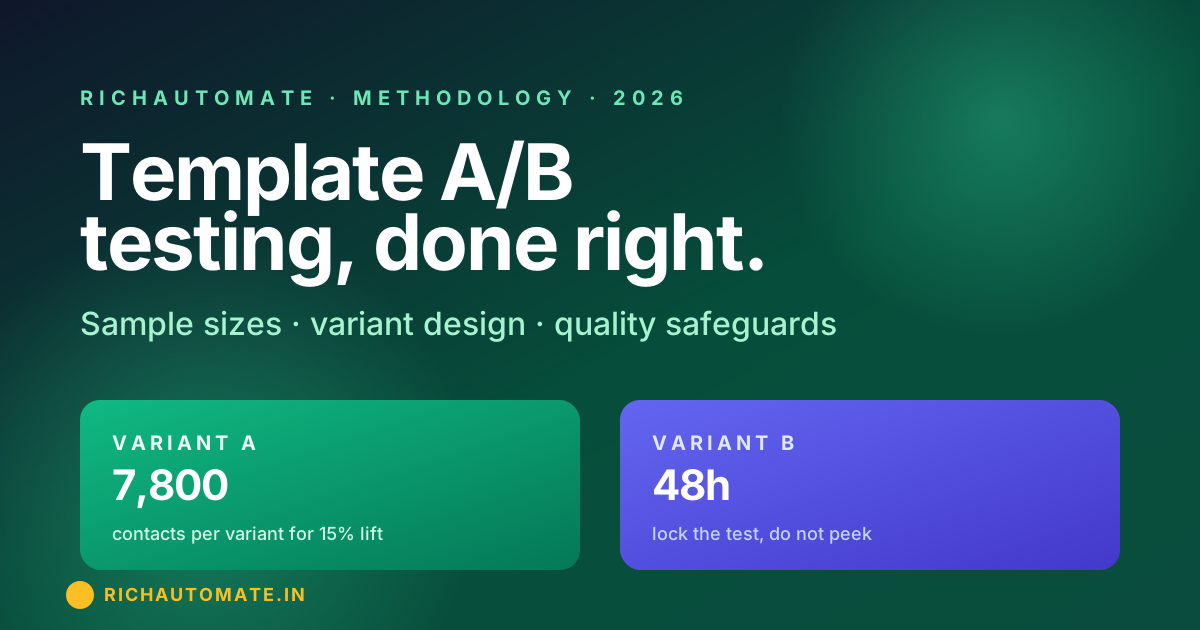
To detect a 15% relative lift in click-through rate from a 4% baseline at 95% confidence and 80% power, you need approximately 7,800 contacts per variant. Skip the math, skip the test — anything smaller is noise. Common Indian D2C numbers:
| Baseline CTR | Target lift | Sample / variant (95% conf, 80% power) |
|---|---|---|
| 4% | +10% relative (4% → 4.4%) | ~17,000 |
| 4% | +15% relative (4% → 4.6%) | ~7,800 |
| 4% | +25% relative (4% → 5%) | ~3,000 |
| 8% | +15% relative (8% → 9.2%) | ~3,800 |
| 8% | +25% relative (8% → 10%) | ~1,500 |
| 15% | +15% relative (15% → 17.25%) | ~1,800 |
Brands under 50,000 active opted-in contacts cannot rigorously test small lifts. Either accept that or test bigger creative differences (where lifts are 25%+ and sample requirements drop).
The Three-Phase Test Architecture
- Phase 1 — Submit both variants together. Same business day, same body language, both variants enter Meta approval queue in parallel. Approval typically returns within 24–48h for both.
- Phase 2 — Holdout 10% control split. Send variant A to 45% of test audience, variant B to 45%, hold 10% as no-send control to measure incremental lift (not just A vs B).
- Phase 3 — Roll out winner to remaining 80% of contacts after 48h. Wait at least 48h before declaring winner — late readers and weekend behaviour skew early signal.
Quality Rating Safeguards
Underperforming variants don't just lose the test — they degrade your WABA quality rating, which throttles marketing send volume for everyone. Three safeguards:
- Cap variant audiences at 5,000 contacts each in Phase 1. Even a disastrous variant won't drop quality from GREEN to YELLOW at this volume.
- Pre-screen audiences for high-engagement segments first. Test on contacts who replied or clicked in the last 30 days, not your full list. These cohorts are 3x more tolerant of marketing.
- Monitor block + report rates hourly during Phase 1. A block rate above 0.5% means kill the variant immediately, regardless of CTR.
The Statistical Significance Trap
Most D2C "winning" tests are statistically meaningless. Two patterns kill credibility:
Get a 1-minute BSP audit on WhatsApp
Drop your WhatsApp number — we line-item your current invoice against Meta India rates in under 60 seconds. India-hosted, DPDP-compliant.
- Peeking. Checking results every hour and stopping when the winner looks ahead. This inflates false-positive rate from 5% to 30%+. Lock the test duration upfront — typically 48h — and don't peek.
- Multiple comparisons. Running 10 tests simultaneously and celebrating any "winner" is the same as a 1-in-2 false-positive rate (Bonferroni correction). Pre-register which tests matter, ignore the rest.
How to Sequence Tests Across the Quarter
| Week | Test focus | Why |
|---|---|---|
| 1–2 | Hook A/B | Biggest lever; hook drives 60% of CTR variance |
| 3 | Send-time test (no template change) | Free signal; same template approved |
| 4–5 | Header media test | Build on winning hook |
| 6 | CTA button text test | Final tuning |
| 7–8 | Audience segmentation test | Same template, different segments |
| 9–10 | Personalisation depth test | Higher complexity, save for later |
| 11–12 | Language variant test | Highest approval cost, run last |
Operating Rule of Thumb
One test per dimension per quarter. Twelve tests per year, three to five winners per year, 60–90% cumulative CTR lift if the wins compound. Brands that "test constantly" usually run 30 inconclusive tests and end the year worse than where they started.
The Ten Anti-Patterns That Kill Tests
- Variant audiences too small. Under 1,500 per variant on any baseline below 8% CTR is noise.
- Multiple changes in one variant. Different hook + different CTA + different image = you cannot attribute the lift.
- Peeking and stopping early. Lock duration upfront.
- Comparing today's variant against last week's send. Day-of-week and seasonality dominate; you must test in parallel, not sequentially.
- Sending to the wrong segment. Testing on lapsed customers when winner will be deployed to active customers.
- Ignoring revenue lift, optimising CTR. A higher-CTR variant that drives lower-AOV traffic is a loss.
- No control / holdout group. "Variant A vs B" tells you which is better; the holdout tells you whether either is incremental over no send.
- Burning template cap on near-identical variants. If two variants differ only by a comma, the test is not worth a Meta approval slot.
- Not factoring approval rejection risk. Marketing-policy-borderline variants get rejected; have a backup variant ready.
- Forgetting language audiences. Hindi audiences respond to different hooks than English. A test winner in English may lose in Hindi.
Tools to Capture Results Cleanly
Three tracking layers, all free:
- WABA Insights API. Read rate + delivery rate per template, per send, per language. Pull daily into a sheet.
- Click tracker. Wrap CTA URLs in a tracker (Bitly with UTM, or your own short.io / yourbsp/r/{id}). Map clicks back to template name + variant.
- Server-side conversion tracking. When the link lands on your site, attribute the resulting purchase back to the WhatsApp send via UTM. Connect to GA4 + your CRM. Without this, you only see CTR — not revenue.
Run rigorous WhatsApp A/B tests on RichAutomate.
Variant scheduling that respects Meta's 250-cap. Holdout groups built into campaign sends. Quality-rating dashboards updated every 5 minutes during active tests. Dual-billing transparency so you see the per-variant spend, not just an invoice total.
Related reading
- WhatsApp Template Versioning + A/B/C/D Experimentation Framework India 2026: 4-Arm Orthogonal Design
- WhatsApp Cohort Retention India 2026: Six Lifecycle Messages, Real Day-90 Retention Lift, Per-Cohort Economics
- WhatsApp Churn Prediction ML + Intervention India 2026: 47% Save Rate, AUC 0.84, Real Cohort Numbers
- WhatsApp + GenAI / LLM Agent India 2026: 78% Resolution, ₹0.42 per Conversation, RAG Over Catalog
- Client Pay vs SaaS Pay: How RichAutomate's Dual WhatsApp Billing Saves Indian D2C ₹21 Lakh/Year