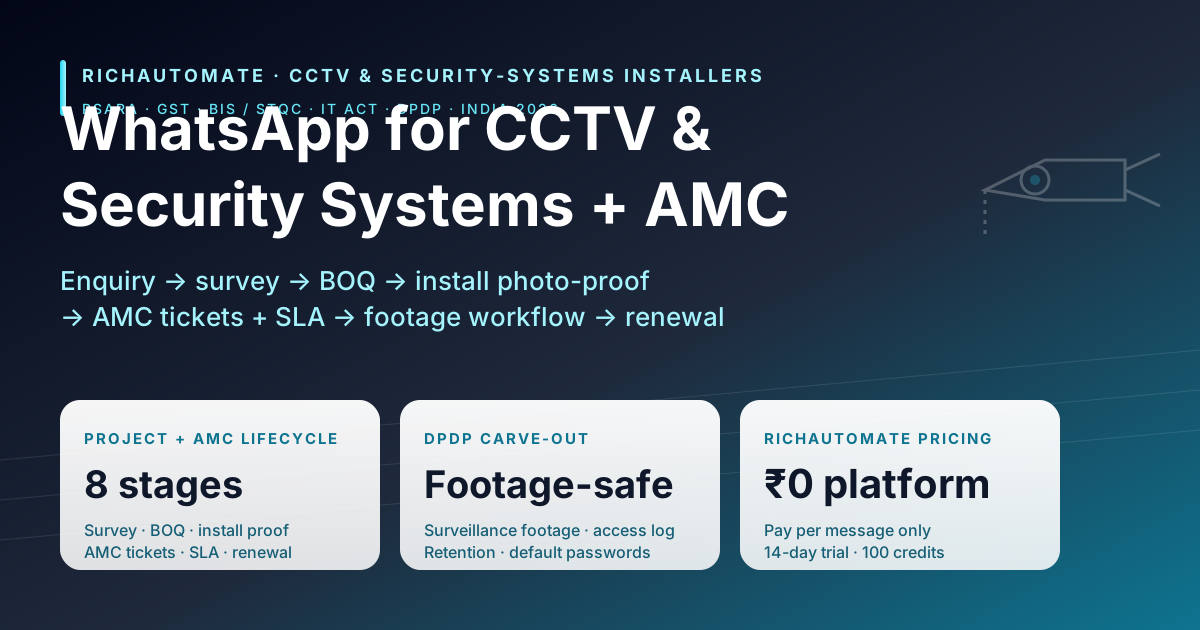
A CCTV and electronic-security-systems installer in India 2026 sells two products that look identical on the invoice and behave completely differently in the bank account: a one-time installation, and a recurring annual maintenance contract (AMC). The install pays the bills this quarter; the AMC — camera health checks, DVR/NVR firmware, storage rotation, alarm-panel servicing, lens cleaning and the dreaded "footage retrieval at 11pm because there was a theft" — is what compounds into a real, defensible business. Yet most security-systems firms in India run the entire thing on a personal phone: a chaos of site-survey photos, half-quoted BOQs, "sir camera not working" voice notes, AMC renewals that silently lapse, and footage requests that arrive with zero audit trail. The installers who actually scale in 2026 move the whole lifecycle onto the WhatsApp Business API — one auditable thread per site carrying the survey, the quote, the milestone payments, the installation photo-proof, the AMC ticket queue and the renewal nudges. This guide maps that lifecycle end-to-end, the standards-and-licensing stack you should reference (all hedged), and the sharp DPDP carve-out for surveillance footage, which is among the most sensitive personal data a small business will ever hold. Every regulatory and standards specific below is as of 2026 — verify current GST treatment, PSARA/state-licensing applicability, BIS/STQC norms, IT Act and DPDP rules before relying on it. General information, not legal advice.
The Standards, Licensing & Compliance Spine in Five Minutes (All Hedged)
Electronic security sits awkwardly between "I sell and fit cameras" and "I am handling surveillance data on behalf of clients" — and the rule stack reflects that. Do not quote, install or store footage without checking the current text of each:
- PSARA — only if you also supply guards. The Private Security Agencies (Regulation) Act 2005 (PSARA) and its state rules license agencies that supply security personnel. A pure electronic-security installer (cameras, alarms, access control) supplying only equipment and AMC generally does not need a PSARA licence — but if you bundle manned guarding or remote monitoring framed as a security-agency service, the boundary blurs. Verify your specific model against your state's PSARA controlling authority, and read the manpower side in our PSARA private-security playbook.
- GST: goods vs works-contract / composite supply. Whether you supply only the hardware (sale of goods) or supply-and-install a complete surveillance system on site (often a works contract or composite supply) changes the GST treatment, the rate and the HSN/SAC. Mark every quote "GST as applicable, verify current rate" and get your exact treatment from a qualified tax professional.
- BIS / STQC and import norms for CCTV hardware. CCTV cameras, recorders and surveillance equipment have been brought under tightening quality, certification and security-testing expectations (BIS standards, STQC/essential-requirements testing, and source/origin scrutiny for imported devices used in sensitive deployments). Reference the standard your hardware claims to meet and verify which certifications are currently mandatory vs voluntary for your SKUs and the deployment type.
- IT Act 2000 + DPDP for footage. CCTV footage is personal data and, in many contexts, sensitive — handling it engages the IT Act 2000 (and its rules on reasonable security practices) and the DPDP Act 2023. If you store, back up or retrieve client footage, you are processing personal data and likely acting as a data processor for your client. Verify your obligations and put a written data-processing understanding in place.
- Local CCTV-mandate and signage rules. Several states, municipal bodies and sector regulators mandate CCTV in specific premises (banks, jewellers, schools/daycare under NCPCR/POCSO norms, certain commercial establishments) with retention windows and visible-notice/signage requirements. When you install for such a client, the compliance burden is theirs — but the retention period and signage you configure should match it. Verify the current local mandate per client type.
- Consumer Protection Act 2019 + warranty/SLA. A security system is a durable good sold with explicit warranties and an AMC service-level commitment. Service-deficiency provisions apply, so the response time and resolution SLA you promise in chat are enforceable — a documented WhatsApp thread is your first line of defence.
- GeM / tender supply. If you sell to government or PSU buyers, supply often routes through GeM with its own catalogue, make-in-India and security-vetting conditions. Verify current GeM requirements for surveillance categories before bidding.
Treat all market sizing as directional — the operational truth for an installer is simpler: this is a high-trust, install-heavy, AMC-recurring, footage-sensitive business, which makes quote-to-advance conversion, on-time install rate, AMC renewal rate, ticket-resolution SLA and footage-request turnaround — not number of cameras shipped — the real competitive variables. Every one of those is a WhatsApp problem.
The customer LTV calculator turns repeat rate and margin into a per-customer number you can budget against.
Why Electronic Security Is a Near-Perfect WhatsApp Vertical
Few trades fit WhatsApp as cleanly as CCTV and alarms. The buyer is anxious about safety and wants instant responsiveness; the site survey is inherently photographic; the install needs photo-proof; the AMC is a recurring ticket-and-reminder machine; and footage requests are urgent, emotional and need an audit trail. Here is the contrast that makes the case:
| Operational reality | On a personal phone | On WhatsApp Business API |
|---|---|---|
| Enquiry capture | Missed call at midnight, lead gone | Click-to-WhatsApp Flow captures site type, camera count, pin-code instantly |
| Site survey | Camera positions on a paper sketch, lost | Slot-picker booking + structured survey form + zone photos in thread |
| Quote & BOQ | Verbal "around 40k", later disputed | Itemised BOQ PDF in thread + one-tap approve/revise with version log |
| Payments | UPI screenshots, mismatched amounts | One-tap UPI link per milestone + auto payment-confirmed template |
| Install proof | "It's all working" — no record | Per-camera photo + live-view test + signed-off handover in thread |
| AMC & tickets | "Camera 3 down" voice note, forgotten | One-tap fault report + SLA timer + technician dispatch + closure photo |
| Renewals & footage | AMC lapses silently; footage request chaos | Auto renewal nudge + logged, consent-checked footage-request workflow |
The 8-Stage Security-Systems Lifecycle on WhatsApp
A CCTV/alarm engagement is a project that becomes an annuity. The table maps each stage to the WhatsApp capability that drives it, plus the data and the compliance note that rides along.
| Stage | Installer activity | WhatsApp capability | Key data / documents | Compliance note |
|---|---|---|---|---|
| 1. Enquiry capture | Site type, camera/sensor count, indoor/outdoor, budget band | CTWA/QR entry + chatbot menu + intake Flow with DPDP consent | Pin-code, site type, camera count, timeline | Opt-in captured and logged at first contact |
| 2. Site-survey booking | Surveyor slot, camera placement, cabling route, power points | Slot-picker Flow + reminder + structured survey form + zone photos | Coverage zones, blind spots, lux/night needs, photos | Survey accuracy stays with the engineer, not the bot |
| 3. Quote + BOQ | Cameras, NVR/DVR, storage, cabling, alarm/access add-ons, labour | BOQ PDF in thread + line-item explainer + GST breakup | BOQ PDF, GST split, warranty terms, validity date | "GST as applicable, verify current rate"; warranty stated |
| 4. Approval + advance | Spec confirmation, storage-days choice, advance booking | One-tap approve/revise card + UPI advance link | Approved spec, advance receipt, milestone plan | Approval timestamped; UPI not screenshots |
| 5. Installation + proof | Mounting, cabling, recorder config, live-view test, training | Per-camera photo + live-view test + handover checklist | Camera-position photos, config sheet, sign-off | Secure default passwords; signage where required |
| 6. Handover + warranty | Warranty cert, app/login setup, retention configured | Warranty PDF + login guide + retention-policy confirmation | Warranty terms, retention window, login handover | Retention matches client's mandate; consent recorded |
| 7. AMC + ticketing | Health checks, fault repair, firmware, storage, footage retrieval | One-tap fault report + SLA timer + dispatch + closure photo | Ticket log, SLA timestamps, closure proof | Footage access logged + consent-checked; SLA honoured |
| 8. Renewal + up-sell | AMC renewal, camera additions, AI analytics, alarm upgrades | Auto renewal nudge + segmented up-sell broadcast | Renewal schedule, up-sell attribution | Marketing to opted-in contacts only; honour STOP instantly |
Stage 1-2: Enquiry Capture and the Site-Survey Flow
The most expensive leak in a security business is the unanswered safety enquiry. A homeowner who just had a break-in, or a shop owner who lost stock, is high-anxiety and high-intent — if your number rings out, the next installer's WhatsApp answers within the hour. Route every enquiry — the click-to-WhatsApp ad, the QR on your shop shutter, the Justdial/IndiaMART lead, the society-WhatsApp-group referral — into a structured intake. The chatbot asks the four things that qualify a security job: what kind of site (home, shop, office, factory, society), roughly how many cameras or what coverage, indoor/outdoor and night-vision needs, and the urgency. It explains your camera grades and typical price bands so unqualified leads self-select out, then it books a site-survey slot. A WhatsApp Flow then lets the surveyor capture, on site, the coverage zones, the blind spots, the cabling route, the power points and the zone photos directly into the thread — so the placement sketch can never be lost on the way back to the office. For the high-volume qualification and FAQ-deflection mechanics behind this, see our WhatsApp chatbot for business guide.
Get a 1-minute BSP audit on WhatsApp
Drop your WhatsApp number — we line-item your current invoice against Meta India rates in under 60 seconds. India-hosted, DPDP-compliant.
Stage 3-4: The BOQ, the Storage-Days Decision and the Approval Loop
A security quote is never one number — it is a bill of quantities (BOQ) that prices the cameras (by resolution, indoor/outdoor, IR range), the recorder (DVR/NVR channel count), the storage (the single biggest swing variable — how many days of footage at what resolution), the cabling, any alarm or access-control add-ons, and the supply-and-install labour, with a GST treatment that depends on classification. Delivered as a clean PDF inside the WhatsApp thread, with a line-item explainer and a stated validity date, the quote becomes a reference the customer can revisit instead of a forgotten email attachment. The approval loop matters because the storage-days choice (7 days vs 30 vs 90) and the camera grade drive both the price and, crucially, the client's compliance posture if they are in a CCTV-mandated category. A spec card with one-tap "approve" / "request change" buttons turns a week of phone-tag into a logged, timestamped decision, and every revision is a new version in the thread — so when the customer says "I never agreed to only 7 days," the version log settles it. Tie the contact record, spec, storage policy and AMC dates together with a proper WhatsApp CRM.
Stage 5-6: Installation Photo-Proof and Secure Handover
Installation is where trust is won or lost — and where the audit trail earns its keep. As each camera goes up, the engineer photographs it in position and runs a live-view test, posting both into the thread. The result is a per-camera photo-proof record that doubles as a dispute-killer and an AMC baseline. Handover then delivers the warranty certificate as a PDF, walks the customer through the mobile-app/login setup, and confirms the configured retention window. Two non-negotiables ride here: change every default password on cameras and recorders (an insecure surveillance device is a breach waiting to happen — and a reputational catastrophe for you), and configure the retention window to match the client's mandate (a bank, jeweller, school or daycare may have a legally specified minimum). The handover message that confirms "retention set to N days as per your requirement; default passwords changed; warranty PDF attached" is both good service and good evidence.
Stage 7: The AMC Engine — Tickets, SLAs and Footage Requests
The AMC is the business. On a personal phone it is a graveyard of "camera 3 not working" voice notes that get forgotten until renewal time, when the angry client refuses to renew. On the Business API it becomes a ticketing engine: the customer taps a one-tap fault report, picks a category (camera down, no recording, app not connecting, footage needed), and it auto-routes to your service desk with an in-thread SLA timer running. A technician is dispatched, the fix is logged, and the closure is confirmed with a photo. The same engine handles the most sensitive event in the whole lifecycle — the footage-request workflow. When a customer (or, with proper authority, a third party) needs footage after an incident, the request, the authorisation check, the access and the delivery should all be logged. Who asked, what was the lawful basis, what was shared, when — because footage is sensitive personal data and uncontrolled sharing is both a DPDP problem and a trust catastrophe. The AMC patterns here mirror other recurring-service trades; compare the playbooks for fire-safety equipment AMC and elevator/lift installation and AMC.
Stage 8: Renewal, Up-Sell and the Annuity Flywheel
Most installers treat the AMC like an afterthought and watch renewals lapse silently. The compounding firms automate it. A renewal nudge fires 60, 30 and 7 days before AMC expiry, with the renewal amount and a one-tap UPI link — turning a forgotten contract into a routine, low-friction payment. The up-sell layer is where the margin lives: a customer who bought four cameras two years ago is a warm prospect for adding more, upgrading to higher resolution, layering on motion-alarm or access-control, or adding AI analytics (line-crossing, intrusion, people-counting). A segmented up-sell broadcast — only to opted-in past customers, capped in frequency, opt-out honoured instantly — re-engages them at a fraction of new-customer CAC. Security is a referral-heavy trade (one society installs, the neighbours follow), so a one-tap "refer a building/shop" with attribution turns satisfied customers into your lowest-cost channel.
The Automation Tech Stack: Stage by Stage
Everything above assembles from five WhatsApp Business API primitives — Flows for structured intake (enquiry, on-site survey), approved templates for business-initiated messages (survey reminders, payment confirmations, install updates, AMC renewals), a chatbot for FAQ deflection and qualification, human handoff for judgement calls (custom-spec queries, footage authorisation, complaints), and broadcast segments for renewals and up-sell. Mapped to the lifecycle with the KPI each stage owns:
| Stage | Automation | KPI to watch |
|---|---|---|
| Enquiry → survey | CTWA entry + qualification chatbot + survey-booking Flow + reminder | Enquiry-to-survey rate; survey no-show % |
| Quote → approval | BOQ PDF + storage-days spec card with version log | Quote-to-approval turnaround; revision count |
| Advance → install | UPI advance link + per-camera photo-proof + handover checklist | Advance-backed conversion; on-time install % |
| AMC → tickets | One-tap fault report + SLA timer + dispatch + closure photo | Ticket-resolution SLA %; footage-request turnaround |
| Renewal | 60/30/7-day renewal nudge + one-tap UPI | AMC renewal rate; renewal-payment latency |
| Up-sell / referral | Segmented up-sell + referral broadcasts to opted-in base | Up-sell revenue; referral-sourced installs |
Security installers share the recurring-service, AMC-funded rhythm with the broader building-services world — read the facility-management and housekeeping playbook to see how the same ticketing-and-renewal primitives flex across an entire building's service stack.
The DPDP Carve-Out: Surveillance Footage Is the Most Sensitive Data You Hold
A CCTV installer who offers footage storage, backup or retrieval is processing some of the most sensitive personal data a small business can touch — and the DPDP Act 2023 (verify implementation status as of 2026), alongside the IT Act 2000, governs it.
- You are likely a data processor. When you store or retrieve footage on a client's behalf, the client is typically the data fiduciary and you are processing on their instructions. Put a written data-processing understanding in place defining purpose, security and retention — do not store footage on an informal, "we'll keep a backup" basis.
- Footage and survey photos are personal (often sensitive) data. Images that identify individuals, plus survey photos that reveal a premises' entry points and blind spots, demand purpose limitation, data-minimisation and strong access control. Never reuse a customer's footage or premises photos as marketing without separate written consent.
- Retention and signage. Configure retention to the client's lawful requirement, not "as long as the disk lasts." Where CCTV signage/notice is mandated for the premises type, ensure it is in place — the obligation is the client's, but you configure the system around it.
- Footage-access audit trail. Every footage retrieval should record who requested it, the lawful basis, what was shared and when. An uncontrolled WhatsApp forward of a client's footage is a breach and a reputational disaster — route requests through the logged workflow.
- Device security and breach readiness. Default passwords changed, firmware patched, recorders not needlessly exposed to the open internet. If a breach occurs, breach-notification expectations may apply — verify current CERT-In/DPDP obligations and have a plan.
- Dropped-enquiry deletion. Survey photos of premises you never won are pure liability — set a deletion schedule and honour it.
Where individuals captured in footage or named in records are identifiable natural persons, DPDP applies; verify your exact obligations with qualified data-privacy counsel as of 2026.
Cost Model: A Security-Systems Firm on RichAutomate
With RichAutomate (₹0 platform fee · ₹0 setup · ₹0 monthly), the cost of the WhatsApp Business API for a CCTV/alarm installer is purely the Meta conversation charges — and only for conversations actually sent. Consider a mid-size firm doing 30 new installs a month plus an AMC base of 400 sites, each install generating roughly 6-10 business-initiated conversations (survey, quote, advance, install updates, handover, warranty) and the AMC base generating tickets and renewal nudges:
- Install + AMC utility conversations (survey reminders, payment confirmations, install updates, ticket SLAs, renewal nudges): comfortably several hundred utility-tier conversations a month at this scale
- On Client Pay (₹0.10 per message, Meta conversation charges billed directly to you by Meta): the platform cost is a few hundred to low-four-figure rupees a month
- SaaS Pay is ₹1.20 per marketing message and ₹0.30 utility/authentication, all-inclusive — relevant when you run an up-sell or AMC-renewal broadcast to your opted-in base
- A 14-day free trial with 100 credits lets you pilot a full survey-to-handover-to-AMC Flow on a handful of live sites before paying anything
Set that against the value of a single saved AMC — one renewed annual contract is worth thousands of rupees of recurring revenue, so recovering even a few renewals that would otherwise have lapsed, or winning one lead that would have rung out at midnight, pays for a year of conversation charges. Model your own install volume, AMC base and message mix with the WABA cost calculator, and see the RichAutomate pricing page for volume rates — the platform fee stays ₹0 regardless of scale.
Anti-Patterns: How Security Firms Get This Wrong
- Running it on a personal number. No templates, no shared inbox, no audit trail, and one ban away from losing every customer thread and every AMC schedule. Use the Business API — and never promise a customer their number "won't get banned"; promise opt-in discipline instead.
- Leaving default passwords on installed devices. The fastest way to turn a security install into a security breach. Change every default, patch firmware, and confirm it in the handover thread.
- Storing footage informally. "We'll keep a backup" without a data-processing understanding, retention policy or access log is a DPDP and trust failure. Formalise it.
- Letting AMCs lapse silently. No renewal nudge means a forgotten contract and an angry, churned client. Automate 60/30/7-day nudges with one-tap UPI.
- Quoting GST as a flat fact. Goods-vs-works-contract classification is fact-specific. Hedge "GST as applicable, verify current rate" and get your treatment from a tax professional.
- Forwarding footage casually on WhatsApp. An uncontrolled footage forward is a sensitive-data breach. Route every request through the logged, authorisation-checked workflow — and honour opt-outs and frequency caps on every marketing send, because your number's quality rating is an operational asset.
This article is general information, not legal or tax advice. GST classification and rates, PSARA/state-licensing applicability, BIS/STQC and import norms, IT Act and DPDP obligations, local CCTV mandates and consumer-protection provisions all change — verify every specific against current government publications and qualified professional advice before acting.
Run your CCTV & security business on WhatsApp
RichAutomate gives CCTV, alarm and electronic-security installers a WhatsApp Business API platform — enquiry and survey Flows, BOQ and storage-spec approval cards, one-tap UPI milestone payments, per-camera install photo-proof, an AMC ticketing engine with SLA timers, a consent-checked footage-request workflow, and 60/30/7-day renewal nudges — at ₹0 platform fee, ₹0 setup, ₹0 monthly. Start with a 14-day free trial and 100 conversation credits, no card required.
Related: WhatsApp for building-automation & BMS installers in India (2026) — scope capture, point-list sign-off that kills re-cabling disputes, commissioning handover and AMC/energy-report reminders.