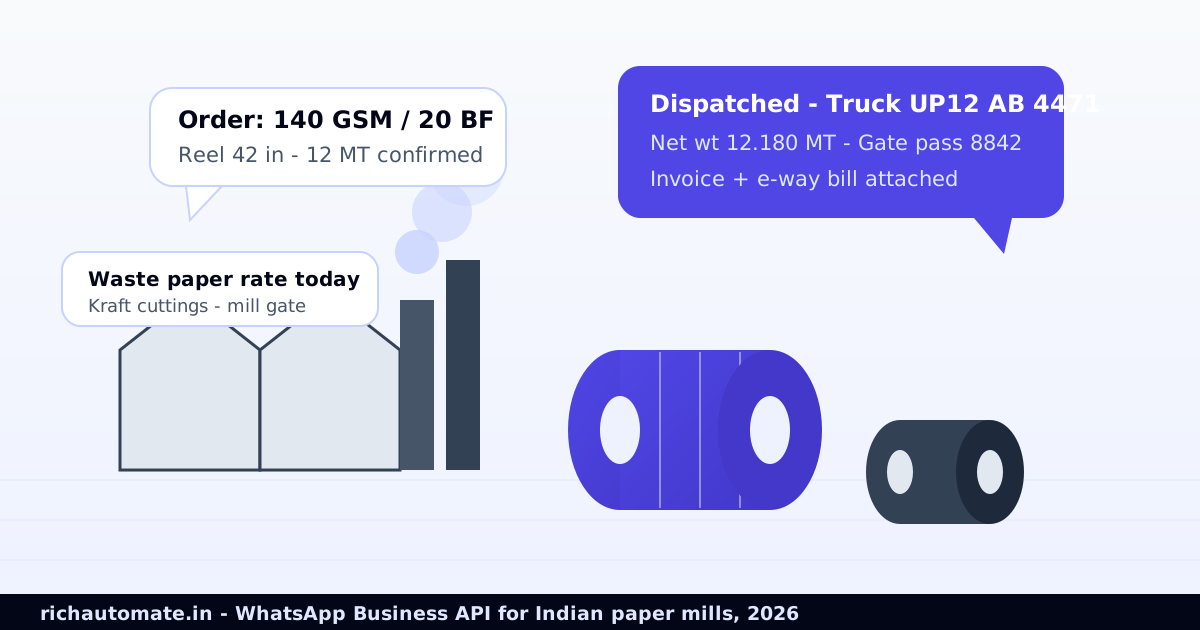
WhatsApp Business API lets an Indian kraft paper or recycled board mill run its whole order-to-dispatch conversation — reel booking, GSM and BF confirmation, weighbridge slips, e-way bill copies, and payment follow-ups — inside the one app the buyer, transporter and waste-paper supplier already open forty times a day. For a mill in Muzaffarnagar, Vapi, Kashipur or the packaging belt feeding Morbi, that replaces a tangle of personal numbers and voice calls with one verified business number, approved message templates, and a message log you can actually audit when a dispatch is disputed.
This guide is written for the people who run the mill, not for a marketing team: the dispatch in-charge chasing a truck at 2 a.m., the sales desk quoting 120 GSM 18 BF against a fluctuating waste-paper landed cost, and the accounts head who has to reconcile a 12% GST invoice against an e-way bill that expired in transit. Below is what the API actually does, what it costs in rupees, where Indian regulation touches the conversation, and a rollout you can finish inside one quarter.
Why the kraft and recycled board sector is a WhatsApp-first industry
India's paper and paperboard industry is dominated by volume by recycled-fibre mills rather than virgin wood-pulp mills. Industry bodies such as the Indian Paper Manufacturers Association (IPMA) and the Indian Agro & Recycled Paper Mills Association have consistently described recovered fibre as the largest single furnish for Indian capacity, with kraft paper and duplex or recycled board concentrated in dense industrial clusters — Muzaffarnagar and Bijnor in western Uttar Pradesh, Vapi and the Gujarat corridor, Kashipur and Rudrapur in Uttarakhand, Sivakasi and Erode in Tamil Nadu, and the Rajkot–Morbi belt that supplies corrugation to the ceramics trade.
Two structural facts make chat the default channel here. First, the buyer base is fragmented: a single kraft mill may serve two hundred corrugated box plants, most of them 5–40 employee units where the owner personally places every order. Second, the input side is even more fragmented — waste-paper aggregators, kabadi networks and importers who quote daily and confirm by voice note. Neither side is going to log into a portal. Both will reply to a WhatsApp message within minutes.
The gap is that most mills run all of this on a personal WhatsApp account sitting on the dispatch manager's phone. That gives you no multi-user inbox, no ownership of the number when the person resigns, no delivery receipts, no opt-in trail, and no safe way to send five hundred rate-revision notices without tripping personal-account limits. The Business API closes exactly that gap.
Where a mill's day actually breaks: chat use-cases mapped to the shop floor
Before choosing templates, map the conversation to the physical process. A kraft mill's message traffic clusters into six repeatable events.
| Mill event | Who is waiting | WhatsApp message type |
|---|---|---|
| Enquiry for a grade (e.g. 140 GSM / 20 BF) | Corrugated box plant owner | Inbound free-form, answered inside the 24-hour service window |
| Order confirmation with reel width, deckle and tonnage | Buyer and production planning | Utility template with variables |
| Weighbridge gross / tare / net capture | Transporter, gate, accounts | Utility template plus slip image or PDF |
| Invoice and e-way bill dispatch pack | Driver and consignee | Utility template with document attachment |
| Waste-paper buying rate circular | Aggregators and importers | Marketing template to an opted-in list |
| Payment and credit-day reminder | Accounts receivable | Utility template, scheduled |
The distinction between the last two rows is not cosmetic — it is what your per-message bill is made of. A rate circular is marketing; a payment reminder tied to an existing invoice is utility. Getting the category right on every template is the single biggest lever on cost, which we price out further down.
How much this costs depends on your reply timing, and the conversation window cost calculator models it.
Quoting GSM and BF over chat without creating disputes
Kraft paper in India is commonly specified against BIS IS 1397, the standard for kraft paper used for corrugated purposes, which defines grades by substance and by bursting factor. In trade practice an order is agreed in three numbers: GSM (grammage), BF (bursting factor), and reel width or deckle in inches or millimetres, with moisture and Cobb value added for the higher grades. A large share of post-dispatch arguments in this sector trace back to one of those numbers being spoken on a call and never written down.
Make the spec the template, not the conversation
A utility template with named variables forces the spec into a fixed, timestamped record. A practical order-confirmation body looks like this:
Order confirmed. Grade: {{grade}} · GSM: {{gsm}} · BF: {{bf}} · Reel width: {{width}} · Qty: {{qty}} MT · Rate: ₹{{rate}}/MT ex-mill · Expected dispatch: {{date}}. Reply CHANGE within 2 hours if any specification differs.
Because Meta requires templates to be approved before use, the wording stays identical across every salesperson, and because the API returns delivered and read receipts you can show the buyer received the spec before the reels were slit. For a mill, that evidentiary value is usually worth more than the automation itself.
Write the tolerance line into the same template
Add a standing line covering grammage tolerance, moisture range, and whether the rate is ex-mill or delivered. Ambiguity on ex-mill versus delivered is the second most common dispute after bursting factor, and it costs a full truckload of margin every time it lands badly.
GST, e-way bills and the dispatch documentation pack
Paper and paperboard, including kraft paper and recycled board, attract 12% GST under the current rate schedule for HSN Chapter 48, with some converted stationery items sitting at other rates. That means your dispatch pack is always a taxable-supply document set, and it always carries a movement-compliance layer.
Under the e-way bill rules an e-way bill is generally required where consignment value exceeds ₹50,000, subject to state-specific thresholds for intra-state movement — several states set their own intra-state limits, so a Muzaffarnagar mill and a Vapi mill are not working to identical rules. E-way bills also carry validity keyed to distance, which is why a truck held at a checkpost or parked overnight can strand a dispatch on a technicality. Sending the buyer and the driver the invoice PDF plus the e-way bill number the moment the vehicle leaves the gate is the cheapest insurance a mill can buy.
On the input side, the API charges themselves are a taxable service to you. Paying an Indian provider is a normal domestic invoice with input tax credit available; paying Meta directly in a foreign-currency arrangement brings reverse-charge considerations into play. The mechanics are worked through in GST on WhatsApp Business API charges, RCM and ITC — read it before your accounts head signs off on a plan.
One point to be blunt about: for a WhatsApp Business Account to go live in India, GST registration is effectively mandatory. Meta business verification wants documentation that matches the legal entity, and for a manufacturing company the GST certificate is the document that reconciles legal name, principal place of business and trade name against the number. Plan for it rather than hoping to work around it.
Weighbridge, gate pass and the truck-loading loop
Kraft is sold by the tonne, so the weighbridge is the commercial truth of the mill. A typical loop runs: vehicle in, tare weight, loading against the reel list, gross weight, net, gate pass, invoice, e-way bill, departure. Any of those steps stalling means a truck occupying a bay and a driver calling the dispatch desk every ten minutes.
Pushing each state change as a WhatsApp utility message to a small set of people — transporter, dispatch in-charge, the buyer's purchase contact — collapses the phone calls that normally surround it. Independent weighing stations already run this pattern, and the operational detail is worth borrowing from our piece on WhatsApp for weighbridge and dharam kanta operators, particularly the sections on sending slip images and heading off tampering disputes.
Get a 1-minute BSP audit on WhatsApp
Drop your WhatsApp number — we line-item your current invoice against Meta India rates in under 60 seconds. India-hosted, DPDP-compliant.
If your weighbridge software can fire a webhook, or even just write a row your ERP can poll, the message can be fully automatic. If it cannot, a supervisor tapping a canned quick reply from a shared inbox is still a step change over a call the buyer misses.
Waste-paper procurement: the highest-value inbound channel
India remains structurally dependent on imported recovered paper alongside domestic collection, because domestic recovery rates have historically lagged those of North America and Western Europe. Landed waste-paper cost is the largest swing factor in a recycled-fibre mill's margin, and it moves week to week.
Two chat workflows pay for themselves quickly here:
- Daily buying-rate broadcast to opted-in aggregators — one marketing template, one clean list, delivered before the local market opens. Suppliers reply with available tonnage and grade inside the free-form window, at no extra template cost.
- Inbound quality rejection notice with photographs of moisture, plastic contamination or prohibited material found in a bale, sent from the tipping floor while the vehicle is still on site. Photographic evidence delivered within minutes settles a deduction argument that otherwise runs for weeks.
Supplier lists rot fast in this trade — numbers change hands, traders exit, and messaging a dead list quietly drags your quality rating down. Run the discipline described in WhatsApp opt-in list hygiene and re-permissioning at least once a quarter.
EPR, PWM Rules and the laminated-board question
Plain kraft and recycled board are paper products. The moment a mill or its converting arm produces plastic-laminated, poly-coated or metallised board, the Plastic Waste Management Rules 2016 and their amendments — and the Extended Producer Responsibility framework built on them — come into scope. Producers, importers and brand owners register on the CPCB EPR portal for plastic packaging and file returns against category-wise obligations.
The compliance filing itself is not a chat problem, but the evidence collection is. Mills that laminate typically need declarations from converters and brand owners about the end use of the material. Collecting those over WhatsApp — a template asking for category confirmation, with a document sent back into the same thread — is far faster than an email chain nobody answers. Keep the messages factual and archive the files, because CPCB filings are audited on documents, not on intent.
Cross-sector note: the paperwork rhythm here is close to what natural-fibre packaging suppliers deal with. If you also handle sacking or laminated bags, the operational parallels in WhatsApp for jute mills and bag suppliers under the JPM Act map across almost one for one.
What it costs: real numbers, no invented tiers
RichAutomate prices WhatsApp Business API on usage only. There is ₹0 setup and a ₹0 monthly floor — a seasonal mill that dispatches nothing in a slow month pays nothing that month. There are two ways to pay.
| Model | Platform charge | Who pays Meta | Best for |
|---|---|---|---|
| Client Pay | ₹0.10 per message | You do — your own Meta billing, Meta charges you direct | High-dispatch mills with an accounts team happy to hold a Meta billing account |
| SaaS Pay | ₹1.20 per marketing message · ₹0.30 per utility or authentication message | We do — one consolidated Indian invoice | Mills that want a single rupee invoice with input tax credit and no foreign-currency card |
Both models start with a 14-day trial and 100 free credits, so you can run a full week of real dispatch notifications before committing anything. The full breakdown sits on the usage-only WhatsApp API pricing page.
Do the arithmetic against your own traffic rather than a case study. A mill dispatching 25 trucks a day and sending four utility messages per dispatch is at roughly 3,000 utility messages a month — on SaaS Pay that is about ₹900 of platform charge for the entire notification layer, before whatever your rate circulars add. Marketing volume is where bills grow, which is exactly why the category discipline below matters.
Templates, categories and the 24-hour window
Meta splits business-initiated messages into categories and treats free-form replies inside the 24-hour service window differently again. Getting this wrong is how mills end up paying marketing rates for what is really a dispatch alert.
| Message | Correct category | Why |
|---|---|---|
| Reels dispatched, LR number attached | Utility | Follows a confirmed transaction |
| Invoice overdue by 7 days | Utility | Account-specific, tied to an existing order |
| New 22 BF grade now available, book early | Marketing | Promotional offer sent to a list |
| Login OTP for your buyer portal | Authentication | One-time passcode |
A caution that a responsible provider should give and many will not: nobody can guarantee that a WhatsApp number will never be restricted. Meta enforces on user signals — blocks and report taps — and quality ratings fall when people receive messages they never asked for. Messaging a scraped list of corrugators you have never traded with is the fastest route to a low quality rating and reduced messaging limits, and no platform can promise otherwise. Send to people who gave you their number for this purpose, keep an opt-out path in every marketing template, and honour it the same day it arrives.
A 90-day rollout for a working mill
Days 1–15: get live
Pick one number, ideally a fresh company number rather than the dispatch manager's personal handset. Complete Meta business verification with the GST certificate, incorporation document and a matching address proof. Get four templates approved: order confirmation, dispatch notice, payment reminder, and one generic rate circular. Import only buyers you have actually invoiced in the last twelve months.
Days 16–45: automate the dispatch spine
Wire the weighbridge or ERP event to the dispatch template. Attach the invoice PDF and the e-way bill number to the same message so the driver and the consignee hold identical paperwork. Put two people in the shared inbox with one rule: any inbound specification question gets a reply within 30 minutes during mill hours.
Days 46–90: extend to procurement and receivables
Bring waste-paper suppliers onto the daily rate broadcast with a documented opt-in. Schedule the receivables reminder against your credit-day matrix. Then measure two numbers and nothing else: average hours from dispatch to buyer acknowledgement, and days sales outstanding. If neither moves in 90 days the workflow is wrong, not the channel.
Start with one dispatch line
You do not need a digital transformation programme to get value here. Take the single message your mill sends most often — the dispatch notice with the LR and the e-way bill — put it on an approved template, and count how many phone calls stop. Everything else in this article is an extension of that one habit.
Start your 14-day trial with 100 free credits →
RichAutomate is an Indian WhatsApp Business API platform at richautomate.in — usage-only pricing, ₹0 setup, ₹0 monthly floor.