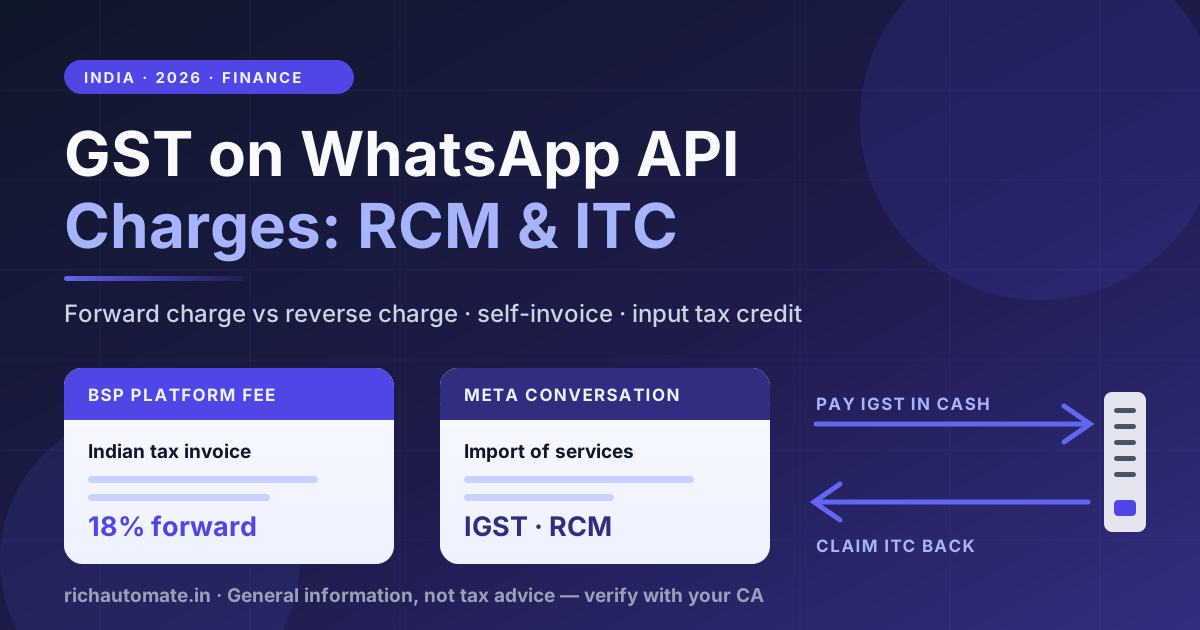
GST hits WhatsApp Business API spend in two layers, taxed differently: the platform fee from your Indian BSP carries 18% GST as an ordinary forward charge with input tax credit where the messaging is used for business, while Meta's conversation charges — invoiced from Meta Platforms Ireland — are an import of services on which you, the Indian recipient, self-assess IGST under the reverse charge mechanism (RCM), pay it in cash, and only then claim it back as ITC. Which layer lands on your books depends on your billing model: on Client Pay you face both, because Meta bills your account directly; on SaaS Pay you get one Indian tax invoice and never touch RCM.
Billing deadline: eligible India-based businesses must move every WABA to INR billing before Meta stops delivering non-INR messages on 1 Jan 2027. See our guide to the Meta INR billing migration for Indian WABAs.
Read this first. This is general business information for finance teams, not tax, legal or accounting advice, and must not be relied on for filing. Rates, reverse-charge notifications, TDS thresholds and ITC time limits change, and reasonable professionals take different positions on several questions below. Verify every specific with your CA against current CBIC, GST Council, Income-tax Department and RBI/FEMA guidance.
Why your WhatsApp bill has two tax identities
Most teams treat "WhatsApp spend" as one ledger line. It is not. The platform layer is what your Business Solution Provider charges for API access, templates, campaigns and inbox; if that BSP is an Indian registered person this is a domestic B2B supply — Indian tax invoice, GST charged forward, credit through the normal GSTR-2B route. The conversation layer is Meta's own charge for carrying the message. Where Meta Platforms Ireland bills that to an Indian business you have a supplier outside India, a recipient in India and a place of supply in India: the textbook import of services.
That second characterisation is where the money and the mistakes live. The RCM liability sits on you, not Meta, and never appears on any document labelled "GST" — nothing in your accounting software flags it. If you book Meta charges as a plain foreign expense with no GST entry, that is the gap. Still deciding whether you need a GSTIN? Start with our explainer on whether GST registration is required for WhatsApp Business API.
| Cost layer (directional — verify) | Who invoices you | GST mechanism | Who pays government |
|---|---|---|---|
| BSP platform / per-message platform fee | Indian BSP | Forward charge, commonly 18% — verify rate and SAC | The BSP; you claim ITC |
| Meta conversation charge on Client Pay | Meta Platforms Ireland | Import of services, IGST under reverse charge | You — self-invoice, pay cash, then claim ITC |
| Meta charges bundled into an Indian invoice (SaaS Pay) | Indian BSP only | Forward charge on the whole value | The BSP; no RCM for you |
| Card FX markup and bank charges | Your Indian bank | Forward charge on the fee | The bank; normal ITC |
Layer one: BSP platform fees are the easy half
With an Indian registered BSP this behaves like any software purchase — a tax invoice with both GSTINs, taxable value, SAC and tax split. Services are commonly taxed at 18%, though rate and classification must be confirmed for your supply. Credit follows section 16 of the CGST Act: invoice in hand, service received, tax paid to government, invoice reflected in GSTR-2B, and supplier paid within 180 days or you enter rule 37 reversal territory. ITC on business messaging is generally not blocked under section 17(5), but exempt or non-business supplies trigger proportionate reversal under 17(2) with rule 42 — your CA's computation. Watch the 16(4) outer limit; late-booked invoices lose credit permanently.
Layer two: Meta's charges and the RCM cash-flow gap
Where you pay Meta directly, reverse charge on the import is the standard position, discharged as IGST. Three procedural consequences follow:
- Self-invoice. Section 31(3)(f) requires a recipient liable under reverse charge to invoice himself. Meta issues no GST document. Without a self-invoice your ITC is exposed on audit — the most common finding here.
- Payment voucher. Section 31(3)(g) requires one at the time of payment. Most teams skip it; it costs nothing and closes an obvious audit question.
- Cash payment. Reverse-charge tax is discharged through the electronic cash ledger — you cannot set it off against ITC.
Timing matters more than amount. You remit to Meta in month one, self-invoice and pay IGST in cash with that month's GSTR-3B, then take credit in the same or a later return. With healthy output liability the effect is near-neutral across a cycle; for an exporter under LUT or anyone accumulating credit, that outflow is real working capital parked in the ledger. Directional rule of thumb: budget roughly 18% of monthly Meta spend as temporary cash lock-up in the first close after switching on Client Pay. Meta bills in foreign currency, so the RCM value uses the rate prescribed under section 15, not your card issuer's FX rate. Fix one documented conversion policy.
Client Pay vs SaaS Pay: the treatment genuinely differs
Here a billing-model choice becomes a tax-workflow choice. Under Client Pay, RichAutomate charges ₹0.10 per message on an Indian tax invoice and Meta bills conversation charges directly to your own Meta billing account. You are the importer: RCM, self-invoice, payment voucher, cash payment and the FEMA trail all sit with you. Under SaaS Pay, you pay an all-inclusive ₹1.50 per marketing message and ₹0.50 per utility message on one Indian tax invoice — domestic forward charge, no import, no self-invoice, no RCM.
Neither is universally better. Client Pay is cheaper in absolute cost because you pay Meta's rate without a margin, and suits teams already running foreign vendor payments. SaaS Pay costs more per message but collapses the compliance surface to a single invoice — often cheaper once you price your finance team's time and the audit risk. For the commercial mechanics see our breakdown of Client Pay vs SaaS Pay WhatsApp billing, and model your volumes on the pricing page. Both run on ₹0 platform fee, ₹0 setup and ₹0 monthly, with a 14-day free trial and 100 credits.
Worked monthly close: 1,00,000 messages, both models
Assume 1,00,000 messages a month — 60,000 marketing, 40,000 utility — with a blended Meta charge assumed at ₹0.52 per billable message. Illustrative only: Meta's India rate card differs by category and some utility messages inside an open service window may not be charged. Directional — verify against Meta's current rate card. GST assumed at 18%; the business assumed fully ITC-eligible with sufficient output liability.
If you message outside India, the WhatsApp pricing calculator by country has the per-country rates.
Get the DPDP WhatsApp checklist
A founder-led WhatsApp reply with the DPDP consent + audit-log checklist for WhatsApp Business messaging. India-hosted. No spam.
| Monthly close line (directional, illustrative) | Client Pay | SaaS Pay |
|---|---|---|
| Platform fee to RichAutomate (Indian invoice) | 1,00,000 × ₹0.10 = ₹10,000 | 60,000 × ₹1.50 + 40,000 × ₹0.50 = ₹1,10,000 |
| Meta conversation charge (billed by Meta Ireland) | 1,00,000 × ₹0.52 = ₹52,000 | Nil — inside the platform invoice |
| Total base spend | ₹62,000 | ₹1,10,000 |
| GST charged forward @18% | ₹1,800 | ₹19,800 |
| IGST payable under RCM @18% | ₹9,360 — cash only | Nil |
| Self-invoice 31(3)(f) + payment voucher 31(3)(g) | Required, on ₹52,000 | Not applicable |
| GSTR-3B table 3.1(d) reverse-charge inward supplies | ₹52,000 value, ₹9,360 IGST | Nil |
| ITC claimed — table 4(A)(3) plus 4(A)(5) | ₹9,360 + ₹1,800 = ₹11,160 | ₹19,800 in 4(A)(5) only |
| Gross cash out in the month | ₹73,160 | ₹1,29,800 |
| Net effective cost after full ITC | ₹62,000 | ₹1,10,000 |
| Cash locked in RCM until credit is used | ₹9,360 | ₹0 |
| Recurring compliance acts | Self-invoice, payment voucher, RCM cash payment, 2B note, FEMA trail | One invoice, one 2B match |
Read the last three rows together — that is the decision. Client Pay is roughly ₹48,000 a month cheaper in net cost here and locks up about ₹9,360 each cycle. SaaS Pay costs more but removes five recurring compliance acts. At 1,00,000 messages a month the cost saving usually wins; at 5,000 it often does not. Run the table on your own volumes and have your CA confirm the assumptions.
TDS: 194J, 194O or 195 — and why positions differ
Withholding is the messier half — genuinely contested, not settled. Competent advisors reach different conclusions on identical facts.
| Provision | Argument for applying it | Counter-argument |
|---|---|---|
| 194J — technical services, resident payee | BSP platform fees look like technical services; many deduct as the conservative default. Verify threshold and the 2% or 10% rate | A standardised SaaS subscription with no human intervention is arguably not "technical services", so no deduction arises |
| 194O — e-commerce operator withholding | Raised where a platform facilitates a supply by another person through its digital facility | A BSP selling its own service is generally not facilitating a third party's sale; the Meta pass-through is where views diverge |
| 195 — payment to a non-resident (Meta Ireland) | Applies if chargeable in India as royalty or FTS under section 9 or the India–Ireland treaty | Non-exclusive access to an automated platform, no copyright or know-how transferred, is often argued to be neither; absent a permanent establishment, business profits may not be taxable here |
Two points for your advisor. The equalisation levy that once caught many digital and online-advertising payments has been progressively withdrawn, pushing the analysis back to section 195, treaty characterisation and the Significant Economic Presence provisions in section 9(1)(i) — confirm the current status, because stale advice still circulates. Second, procedure survives characterisation: even where no tax is deductible, Form 15CA and, where applicable, 15CB are typically required for the outward remittance. Paying Meta on a corporate credit card does not remove the section 195 analysis or the GST reverse charge — a card is a payment rail, not a change in the nature of the transaction. Take a written view from your CA.
The document pack your CA will ask for
Assemble this monthly, not at audit. Agree the pack once, then repeat:
- Tax invoice from the Indian BSP — both GSTINs, taxable value, SAC, tax split. Reconcile to GSTR-2B.
- Self-invoice for the Meta charges under section 31(3)(f), on a distinct serial series, with the converted rupee value and IGST computed.
- Payment voucher under section 31(3)(g) at the time of payment.
- GSTR-3B placement — liability in 3.1(d), matching credit in 4(A)(3), domestic ITC in 4(A)(5). Do not net the two.
- A documented GSTR-2B exception note. RCM imports do not auto-populate there; its absence looks like an unexplained gap.
- Bank statement plus the FEMA trail with the purpose code your authorised dealer bank assigned — software, IT and advertising services carry different codes, so ask the bank rather than guessing. File the Form 15CA acknowledgement with the month.
- A one-page classification memo recording the SAC you adopted and why, your FX conversion policy and your TDS position per vendor.
If you are a practice rather than an end user, the same discipline is worth productising — see our guide to WhatsApp workflows for CA and tax firms.
Five mistakes that quietly cost you the credit
- Claiming RCM credit without a self-invoice. The tax gets paid, the credit gets taken, and the document anchoring both was never created.
- Waiting for the Meta charge to appear in GSTR-2B. It will not. Document the exception instead of reversing in a panic.
- Discharging RCM liability from the ITC balance. Reverse-charge tax is paid in cash; set-off from credit is a classic notice trigger.
- Treating a foreign-card payment as outside GST. The instrument is irrelevant to whether an import of services occurred.
- Booking everything under one convenient SAC. Platform access, advertising-type services and pure software may classify differently — choose deliberately, stay consistent.
A sixth: losing credit to the section 16(4) limit because the Meta charge sat in suspense for two quarters. Whoever owns the monthly close should own the self-invoice, not the marketing team. If your invoicing runs over WhatsApp too, our guide to GST invoice automation on WhatsApp covers the delivery side of the same cycle.
Disclaimer, restated: general business information only, not tax, legal or accounting advice. Every rate, section reference, threshold, return-table placement, TDS position, equalisation-levy status, FEMA purpose code and time limit above is directional and must be verified with your own chartered accountant against current CBIC, GST Council, Income-tax Department and RBI/FEMA guidance. Several positions — section 195 on Meta payments, 194J versus 194O, SAC classification — are genuinely contested. The worked example uses assumed rates and is not a quotation. RichAutomate is a messaging platform, not a tax advisor. No platform can promise immunity from blocking or guaranteed delivery for unsolicited or bulk sending.
Run WhatsApp on a billing model your CA is comfortable with
RichAutomate runs on the official Meta WhatsApp Business API with a no-code template, campaign and flow builder and a shared team inbox — and lets you pick the billing model your finance team prefers. Client Pay: ₹0.10 per message platform fee, with Meta's conversation charges billed directly to your own Meta billing account. SaaS Pay: ₹1.50 marketing and ₹0.50 utility on one Indian tax invoice — no import of services on your books. Both on ₹0 platform fee, ₹0 setup, ₹0 monthly, with a 14-day free trial and 100 free credits. See full pricing, WhatsApp us at 918160311319, or book a 30-minute walkthrough at https://richautomate.in/book/demo.