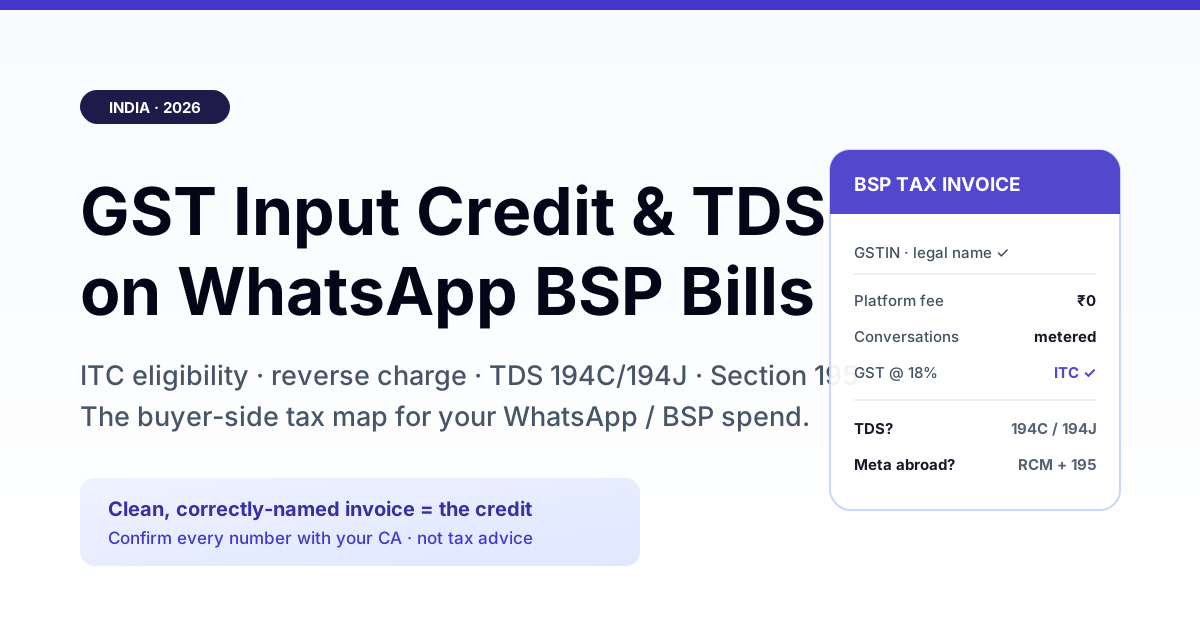
In most cases yes — a GST-registered Indian business can claim input tax credit on the GST charged on its WhatsApp Business API and BSP (Business Solution Provider) invoices, because those charges are a communication/software service used in the course of business, provided the invoice is valid, the supplier has filed it, and the spend is not blocked or personal. TDS is a separate question that turns on who you pay: a payment to an Indian BSP is a normal domestic vendor payment that may attract TDS under Section 194C or 194J, while any amount paid directly to Meta abroad raises reverse-charge GST and foreign-remittance withholding instead. This is general information, not tax advice — the rate, threshold and classification all move, so confirm your exact position with your CA against the rules current in 2026. Here is the buyer-side map of how WhatsApp/BSP spend is treated for GST and TDS in India.
Who this is for — and what it is not
This guide is for the business that pays for WhatsApp messaging — the D2C brand, clinic, agency or SME whose finance team sees a monthly BSP invoice and a Meta conversation charge and asks two things: "can I take the GST credit on this?" and "do I have to deduct TDS before I pay?" It is not about selling to GST firms, not about invoice-automation, and it is not the seller-side Section 194-O e-commerce TDS question (that is about TDS on your sales when a platform facilitates them). This is the opposite direction: the tax hygiene of your own WhatsApp/BSP cost. Everything below is hedged because Indian indirect and direct tax positions genuinely shift — treat it as a checklist to raise with your CA, not a ruling.
How WhatsApp/BSP charges reach your books
Understanding the tax treatment starts with seeing the three cost layers that can appear on a WhatsApp Business API stack, because they are not all invoiced by the same party and are not all taxed the same way:
| Cost layer | Who typically invoices you | Nature |
|---|---|---|
| Platform / software fee | Your BSP or SaaS platform (Indian entity, GST invoice) | Domestic supply of service |
| Per-conversation / per-message charge | Passed through by the BSP, or billed by Meta depending on the billing model | Domestic if re-billed by an Indian BSP; import of service if billed directly by Meta abroad |
| Add-ons (numbers, seats, integrations) | The BSP / platform | Domestic supply of service |
On a model where an Indian BSP or platform re-bills you everything in INR with its GSTIN — which is how RichAutomate and most Indian BSPs invoice — you receive a single domestic GST tax invoice, and the tax question is the ordinary one of input tax credit on a vendor service. Where a business is billed directly by Meta on a foreign invoice, a reverse-charge and foreign-remittance layer is added on top. Which model you are on decides most of what follows, so check your invoices before assuming.
GST input tax credit on WhatsApp/BSP spend
WhatsApp Business API and BSP charges are a service used for your business communication, so as a general rule the GST on a valid domestic BSP invoice is eligible input tax credit — it is not on the blocked-credit list the way, say, certain motor vehicles or personal expenses are. But eligibility under the CGST Act is conditional, and finance teams lose credit on avoidable failures rather than on the law:
The conditions that actually decide your credit
- A valid tax invoice in your legal name and GSTIN. Credit follows the invoice — a BSP invoice raised to a personal name or the wrong GSTIN is a credit you cannot take. Make sure your BSP has your correct legal entity name, GSTIN and place of business on file before the first invoice, not after.
- The supplier must actually report the invoice. Under the current GST framework, your credit is broadly tied to the invoice appearing in your auto-drafted statement (the GSTR-2B mechanism) because the supplier filed it. A BSP that does not file correctly can strand your credit — a reason to prefer a BSP that invoices cleanly and on time.
- Business purpose, not personal. The spend must be for business. A number used for genuine business messaging qualifies; personal use does not.
- Time limit. ITC must be claimed within the statutory window for the financial year — do not let BSP invoices sit unclaimed across year-end.
None of this is a ruling on your specific facts — blocked-credit interpretation and the invoice-matching rules are exactly the kind of thing that changes, so confirm the current 2026 position with your CA. For where these costs sit in your overall unit economics once the credit is accounted for, see the WhatsApp cost-optimization and unit-economics guide.
Get the DPDP WhatsApp checklist
A founder-led WhatsApp reply with the DPDP consent + audit-log checklist for WhatsApp Business messaging. India-hosted. No spam.
Reverse charge when Meta bills you directly from abroad
If your business is billed directly by Meta (a foreign supplier) rather than re-billed by an Indian BSP, the per-conversation charge can be an import of service. Import of service for business use generally attracts GST under reverse charge — meaning you, the recipient, self-account for the GST, pay it, and then (subject to the ordinary conditions) claim it back as input tax credit, so it is often revenue-neutral but it is a compliance step you must not skip. This is one of the quiet reasons many Indian businesses prefer an Indian BSP that re-bills in INR with a domestic GST invoice: it keeps the whole thing a simple domestic-vendor credit and removes the reverse-charge and foreign-remittance overhead. Whether reverse charge applies to your exact billing arrangement is a fact-specific call — verify it, do not assume it away.
TDS: do you deduct tax before paying your BSP?
TDS is income-tax withholding and is entirely separate from GST. It turns on who you are paying and under what section — and, importantly, whether you are even in the TDS net at all. Small proprietors and firms below the tax-audit threshold are generally not required to deduct TDS on such payments; businesses that are in the net need to look at the right section for a BSP/software service.
| You are paying… | Likely direct-tax treatment (verify) | Practical note |
|---|---|---|
| An Indian BSP for a platform/messaging service | Domestic TDS may apply — commonly examined under Section 194C (contract) or 194J (technical/professional/software), depending on the nature and how the service is characterised | The section and rate are a genuine judgement call for a software/communication service — your CA should fix the characterisation; get it in writing and be consistent |
| An Indian BSP, but you are below the tax-audit threshold | You may not be required to deduct at all | Do not deduct TDS you have no obligation to deduct — it creates its own mess |
| Meta directly, abroad | Foreign-remittance withholding (Section 195) and the equalisation-levy position both need checking; the equalisation levy on online advertising/services has itself been changing, so confirm the 2026 status | This is specialist territory — banks require Form 15CA/15CB style documentation on foreign remittances; involve your CA before the first payment |
The honest answer to "194C or 194J?" for a WhatsApp/BSP payment is that it depends on how the specific service is characterised and on positions that reasonable CAs can differ on — which is exactly why this is a "confirm with your CA" item and not something to copy from a blog. What matters operationally is that you decide the treatment once, apply it consistently, deduct and deposit on time if you are obliged to, and issue the TDS certificate so your vendor can claim credit.
e-invoicing and the paper trail
If your turnover is above the current e-invoicing threshold, your outward invoices need Invoice Reference Numbers — but on the buyer side of WhatsApp/BSP spend, your job is simpler: keep every BSP invoice, match it to your auto-drafted GST statement, and reconcile it to what you actually consumed. This is where running your messaging on a platform that gives you a clean, itemised, correctly-addressed invoice pays for itself at filing time — the same clean-trail argument as the cost guide and the hidden-costs breakdown make on the spend side. If your own clients are CA or tax firms, the workflow angle is covered separately in WhatsApp for CA/tax/GST firms.
A finance-team checklist for WhatsApp/BSP spend
- At onboarding: give the BSP your exact legal name, GSTIN and registered place of business. A wrong-name invoice is lost credit.
- Confirm your billing model: Indian BSP re-billing in INR (domestic ITC) vs direct Meta foreign invoice (reverse charge + Section 195). Most Indian businesses are cleaner on the former.
- Each month: match the BSP invoice to your GSTR-2B; chase any invoice the supplier failed to file.
- Fix your TDS position once with your CA — in the net or not; if in, 194C vs 194J — then apply it consistently, deposit on time, issue the certificate.
- For any direct foreign remittance to Meta: handle reverse-charge GST and Form 15CA/15CB before paying.
- Claim ITC within the year-end window; do not let credits expire.
What RichAutomate invoices look like
RichAutomate is an Indian platform on the official WhatsApp Business API (Meta Cloud API) with ₹0 platform fee, ₹0 setup and ₹0 monthly minimum — you pay per conversation on Meta's category rates (Client Pay at ₹0.10/message plus Meta's per-conversation rate, or SaaS Pay at ₹1.20/marketing and ₹0.30/utility conversation all-in). Because billing is a domestic INR invoice with GST, the ordinary input-credit route applies rather than the reverse-charge/foreign-remittance overhead of being billed abroad — subject, as always, to your own facts and your CA's view. Compare the two billing models in Client Pay vs SaaS Pay, and note that going live on the official API in India effectively requires GST for business verification anyway — so most businesses on the API are already in a position to claim the credit. Verify current Meta rates, which change periodically; a 14-day trial with 100 free credits and no card lets you generate a real invoice to hand your CA before committing.
Bottom line
GST input tax credit on WhatsApp/BSP spend is generally available to a GST-registered business — the credit is usually won or lost on the invoice being correctly addressed and actually filed, not on the law. TDS is a separate, who-do-you-pay question: a domestic BSP payment may attract 194C or 194J if you are in the TDS net, and any direct payment to Meta abroad brings reverse-charge GST and Section 195 into play. Keep clean, correctly-named invoices, prefer a domestic INR-billing BSP if you want the simplest treatment, fix your TDS characterisation once with your CA, and treat every number and section here as something to confirm against the 2026 rules — this is a map, not advice.