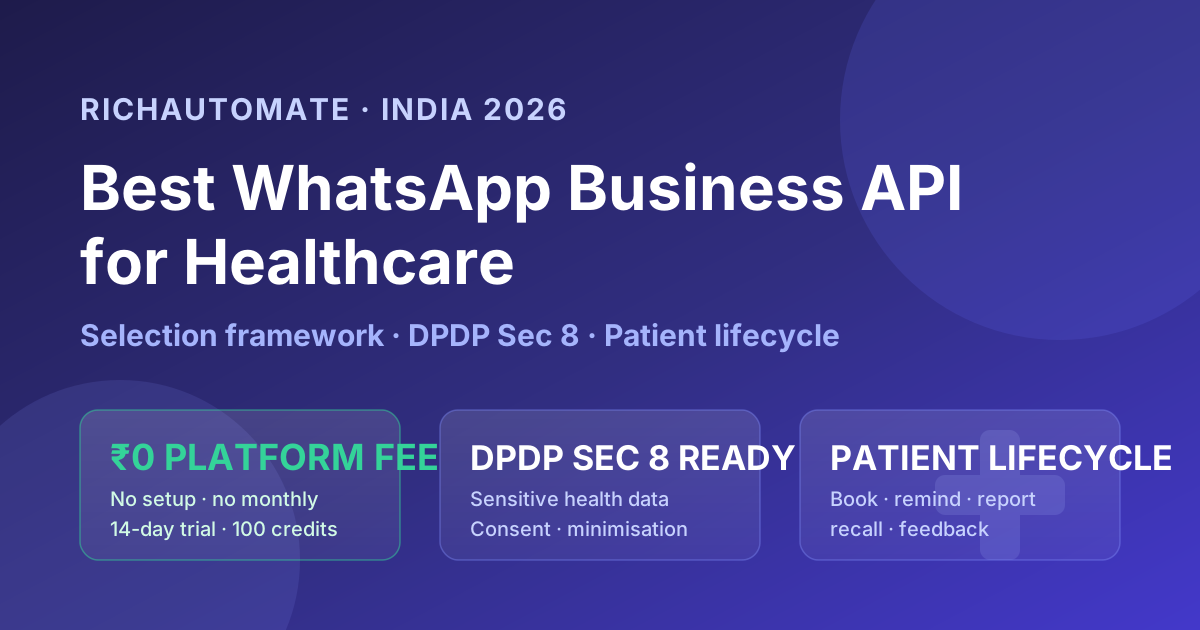
The short answer. There is no single “best” WhatsApp Business API for every healthcare provider in India — the best one for you is whichever lets you run the full patient-communication lifecycle (booking, reminders, report delivery, follow-up, feedback) without leaking sensitive health data, while keeping consent, purpose-limitation and retention defensible under the DPDP Act. So choose on a criteria framework, not a vendor leaderboard: official Meta Cloud API, healthcare-grade data handling, consent and opt-out tooling, exportable audit logs, data-minimised templates, and usage-only pricing. RichAutomate runs on the official WhatsApp Business API at ₹0 platform fee, ₹0 setup and ₹0 monthly, and below we show how to score it — and any rival — against those criteria. Treat every DPDP, ABDM and Meta specific as something to verify against the live 2026 position; all rupee and cohort figures are illustrative.
Picking a WhatsApp Business API for a clinic, diagnostic lab, hospital, IVF/fertility centre, pharma operation or polyclinic is not the same decision an e-commerce store makes. In retail the deciding question is “which one sends cart-recovery cheapest”; in healthcare the deciding question is “which one lets me message patients about appointments, reports and recalls without mishandling sensitive health data.” Under India’s Digital Personal Data Protection (DPDP) Act, information about a patient’s health is sensitive personal data, your facility is the Data Fiduciary, and the messaging channel you push a “report ready” alert through is now part of your data-handling posture. That flips the ranking: data handling, consent mechanics and audit trails sit above price and template throughput. This guide gives you a buyer’s framework instead of a fake ranking — a five-stage patient-communication lifecycle to plan against, a healthcare-grade selection-criteria matrix to score every shortlisted provider, a DPDP Section 8 treatment of consent, purpose-limitation and retention, an ABDM-adjacent readiness note (verify the current ABDM/NDHM rules as of 2026), illustrative cost math for a clinic or lab, an honest can-and-cannot section, and finally how RichAutomate measures against the criteria. This is general information, not legal or medical advice; verify every regulatory specific against the current 2026 position.
Why WhatsApp fits healthcare patient communication
Healthcare communication is mostly reminder-and-document work that runs on deadlines, and that is exactly the shape WhatsApp serves best. A patient relationship is a sequence of time-critical, personal touchpoints — your appointment is tomorrow, your report is ready, your prescription is due for renewal, your test prep starts tonight — and almost all of it is read within minutes on WhatsApp when email goes unopened and the front desk cannot make hundreds of calls a day. Critically, most of these messages are transactional: appointment confirmations, preparation instructions, report-ready doorbells and recall reminders sit in WhatsApp’s cheaper utility lane and are genuinely welcomed by patients rather than resented. The one rule that makes the whole channel safe is data minimisation — a “your report is ready, tap to view securely” message carries zero clinical content over the wire, with the actual result living behind authentication in your portal. Done that way, WhatsApp turns a high, repetitive communication load into a set of timed, opted-in, mostly utility-priced sequences. But this only works on the official WhatsApp Business API with proper consent and approved templates — never on a personal phone broadcasting to a saved-contacts list, which is both unscalable and a compliance risk.
If you would rather start from something proven, the WhatsApp template library has formats you can adapt.
The five-stage patient-communication lifecycle
Before you score any provider, map the whole patient journey, because the “best” platform is simply the one that handles every stage cleanly. The table below lays out the five stages most healthcare providers manage and the dominant WhatsApp job at each, with the message category each tends to fall in. Treat any clinical or regulatory reference as something to verify for 2026.
| Stage | Patient job | WhatsApp job | Message category |
|---|---|---|---|
| 1. Appointment booking | Find a slot, confirm, reschedule | Interactive booking + instant confirmation | Utility (some marketing for first enquiry) |
| 2. Reminders & preparation | Remember the visit, follow prep instructions (fasting, documents) | Timed reminder + prep-instruction template | Utility |
| 3. Report & result delivery | Know a report is ready, access it securely | “Report ready” doorbell — link to secure portal, no result in body | Utility |
| 4. Follow-up & recall | Return for review, renew a prescription, complete a care cycle | Recall sequence timed to the care/medication cycle | Utility (recall) + marketing (health-camp promo) |
| 5. Feedback & reviews | Share experience, rate the visit | Post-visit feedback request + review nudge | Utility (feedback) + marketing (review ask) |
The pattern across all five stages is the same: a handful of personal, deadline-bound touchpoints per patient that today live in spreadsheets, phone calls and front-desk memory, each mapping cleanly to a WhatsApp template or short automated sequence, and most falling in the cheaper utility category. A diagnostic lab leans heaviest on stages 2–4 (prep, report delivery, recall), as the diagnostic-labs and home-phlebotomy guide walks through; a clinic lives in stages 1–2, covered in the clinic appointments guide; and a fertility centre runs an unusually long, sensitive version of the whole cycle, detailed in the IVF/fertility patient-journey guide. The best WhatsApp API is whichever handles your heaviest stages without forcing clinical data into a message body.
What makes a WhatsApp API “healthcare-grade” — the selection-criteria matrix
Run every shortlisted provider through the matrix below. The middle column is why each line is sharper for healthcare than for retail; the right column is the concrete thing to ask the vendor before you sign. This is the framework that replaces a fake leaderboard — score each provider, including RichAutomate, against it.
| Criterion | Why it matters for healthcare | What to check / ask the vendor |
|---|---|---|
| Official Meta Cloud API | Unofficial/grey gateways risk number bans and have no compliance standing for health data | Confirm the official WhatsApp Business (Cloud) API, not a scraped or unofficial bridge |
| DPDP Section 8 readiness | Health data is sensitive personal data; you are the Data Fiduciary and must show reasonable security safeguards and purpose limitation (verify 2026) | Written data-processing terms, the BSP’s processor role, breach-notification commitment |
| Consent capture & opt-out | Reminders and recalls need a lawful basis; STOP must be honoured instantly on a channel carrying medical context | Is opt-in timestamped and logged? Is opt-out automatic, instant and auditable across all sequences? |
| Data minimisation in templates | A “report ready” alert must reveal nothing clinical in the message body | Can you template “your report is ready, view securely” without any test result inline? |
| Exportable audit trail | You must show who was messaged, when, with what consent — for grievance and DPDP accountability | Exportable message + consent logs, with a retention period you control |
| No PII resale / no model training | Patient numbers and context must not be resold, used to train models, or shared with un-named sub-processors | Named sub-processor list, data-handling location, “we do not sell or train on your data” in writing |
| ABDM-adjacent flexibility | If you participate in ABDM/NDHM, consent and linkage flows touch patient identity (verify current rules 2026) | Custom flows/webhooks you can wire to your appointment system, LIS, or ABDM consent steps |
| Usage-only economics | Reminder/report/recall volume is high and recurring; fixed platform fees compound fast at clinic scale | Platform fee, setup fee, per-message markup, and who Meta bills for usage |
The data-minimisation rule that de-risks everything. Never put a clinical result, diagnosis or test name in a WhatsApp message body. “Your test report is ready — tap to view in our secure portal” carries zero sensitive content over the wire and zero in the WhatsApp thread; the result lives behind authentication, and the WhatsApp message is just a doorbell. This single design choice removes most of the DPDP risk surface from patient messaging — and because it is a template-design decision rather than a vendor feature, you control it no matter which BSP you pick.
Get a 1-minute BSP audit on WhatsApp
Drop your WhatsApp number — we line-item your current invoice against Meta India rates in under 60 seconds. India-hosted, DPDP-compliant.
DPDP Section 8 — sensitive health-data duties, consent, purpose-limitation and retention
Healthcare is the vertical where the WhatsApp BSP choice is a compliance decision first, because under the DPDP Act health information is treated as sensitive personal data and your facility, as the Data Fiduciary, carries the duties that attach to handling it. The framework most relevant here — the obligations a Data Fiduciary owes when processing personal (and especially health) data — covers reasonable security safeguards, purpose limitation, consent and accountability; verify the operative Section 8 provisions and the current DPDP Rules as of 2026, because the detail evolves. In practice that translates into a short, checkable discipline for patient messaging. Consent: every patient you message must have given a clear, recorded, revocable opt-in to WhatsApp contact, captured at a real touchpoint (booking form, front desk, first message) with a timestamp, and a STOP reply must remove them from every active sequence immediately, not just the one they replied to. Purpose limitation: use the data only for the purpose the patient consented to — an opt-in for appointment reminders is not blanket permission for marketing health camps, which needs its own honestly categorised marketing template and consent. Data minimisation: collect only what the workflow genuinely needs and keep clinical detail out of the message body entirely. Retention: set and document a retention period for message and consent logs, restrict who inside the facility can access patient data, and be able to delete on a valid request. Accountability: keep exportable logs so you can demonstrate, for any patient, who was messaged, when, and under what consent. None of this is unique to WhatsApp — it is the same posture the broader WhatsApp for healthcare clinics playbook describes — but the channel makes it concrete. This is operational guidance, not legal advice; take professional counsel for your facility’s posture.
ABDM-adjacent readiness — what to verify for 2026
If your facility participates in the Ayushman Bharat Digital Mission (ABDM, the programme formerly framed around the National Digital Health Mission / NDHM) or handles ABHA-linked identities, then consent and linkage flows touch patient identity in ways that sit alongside — but separate from — your WhatsApp messaging. The honest framing is that no WhatsApp BSP is “ABDM-certified” in a way that makes you compliant; what a healthcare-grade platform can do is give you custom flows and webhooks you can wire to your own appointment system, lab information system, or ABDM consent steps, so the messaging layer cooperates with whatever ABDM integration you build. ABDM/NDHM and the associated health-data exchange specifications continue to evolve, so treat any provider’s “ABDM-ready” badge — including how RichAutomate is described — as “supports the flows you wire up,” not “compliant out of the box.” Verify the current ABDM/NDHM rules, the National Health Authority specifications, and any health-data-exchange requirements against their official 2026 position before relying on an integration path, and keep the WhatsApp consent layer aligned with whatever consent artefacts ABDM requires.
Illustrative cost math for a clinic or lab
The cost of running the whole patient lifecycle on WhatsApp is modest, because most messages are utility and the spend scales with patient volume rather than with a fixed monthly plan. Every figure below is illustrative — model your own facility. Take a mid-size clinic or lab handling, say, 4,000 patient interactions a month: appointment reminders and confirmations, report-ready doorbells, prep instructions, recall reminders, and a smaller slice of marketing for health camps and reviews. Suppose that breaks into roughly 3,300 utility conversations and 700 marketing conversations.
| Line item (illustrative) | Fee-bearing BSP | RichAutomate SaaS Pay | RichAutomate Client Pay |
|---|---|---|---|
| Fixed platform / monthly fee | ~₹3,599 (verify) | ₹0 | ₹0 |
| 3,300 utility conversations | Meta rate + markup × 3,300 (verify) | ~₹990 (3,300 × ₹0.30) | Meta direct + ~₹330 markup (3,300 × ₹0.10) |
| 700 marketing conversations | Meta rate + markup × 700 (verify) | ~₹840 (700 × ₹1.20) | Meta direct + ~₹70 markup (700 × ₹0.10) |
| Setup (one-time) | Sometimes charged (verify) | ₹0 | ₹0 |
| Indicative monthly total | Plan + messages + GST | ~₹1,830 + 18% GST, no platform fee | ~₹400 markup + Meta’s own charge |
The structural point for a fee-conscious clinic or lab is that a fixed monthly platform plan is dead weight — you pay it whether you message 4,000 patients or 40. Because most healthcare messaging falls in the cheaper utility/authentication lane, a ₹0-platform, usage-only model keeps the cost tracking your actual patient volume. RichAutomate charges ₹0 platform, ₹0 setup and ₹0 monthly. Run your real message mix through the WABA cost calculator, and verify Meta’s live conversation rates and the GST treatment as of 2026.
What WhatsApp software can — and cannot — do for a healthcare provider
It is worth being honest about the boundary, because over-claiming is exactly what a healthcare buyer should distrust. WhatsApp automation can book and confirm appointments, fire timed reminders and prep instructions, deliver a secure report doorbell, run recall sequences timed to a care cycle, collect post-visit feedback, capture and log consent, and hand off to a human for anything a bot should not answer — the communication and admin layer. It cannot make your facility DPDP-compliant on its own, diagnose or interpret a result, replace clinical judgement, or guarantee that your WhatsApp number will never be restricted. Compliance is a shared job: the BSP gives you a platform that does not leak plus tooling for consent, minimisation and logging, while you own consent capture, template design that keeps clinical data out of the body, retention policy, and your grievance process. Any provider that tells you their checkbox alone makes you compliant — or that promises “no ban” — is the one to walk away from; what actually keeps a number healthy is relevant, consented, well-spaced messaging and prompt opt-out handling. The right framing is that good software removes the front-desk drudgery — the chasing, reminding and report-paging — so your people can spend time on patients, which is the part no software can replace.
How RichAutomate measures against the criteria
Held against the healthcare-grade matrix above, RichAutomate runs on the official Meta WhatsApp Cloud API; provides timestamped opt-in and instant, auditable opt-out; lets you design data-minimised templates so a report alert is a doorbell, not a disclosure; gives exportable message and consent logs with a retention you control; and offers custom flows and webhooks you can wire to your appointment system, LIS or ABDM consent steps. On economics it removes the layers that punish recurring healthcare volume: ₹0 platform fee, ₹0 setup, ₹0 monthly, with Client Pay at a flat ₹0.10 per message on your own WhatsApp number (Meta’s conversation charge billed to you directly by Meta) or SaaS Pay at an all-in ₹1.20 marketing / ₹0.30 utility-auth. There is a 14-day free trial with 100 free credits, enough to pilot one workflow — appointment reminders or the report doorbell — and measure it before committing. The honest disclosure remains: this scores well against the criteria, but it does not make you compliant by itself; verify every DPDP, ABDM and Meta specific against the live 2026 position, get the data-processing terms in writing, and treat any “ABDM-ready” framing as “supports the flows you wire up.” For a structural view of how RichAutomate sits against a managed WhatsApp CRM, see the best WhatsApp CRM for India 2026 guide.
Healthcare use-cases that work on WhatsApp — all consent-gated. Appointment reminders with one-tap reschedule (cuts no-shows); preparation instructions before a test or procedure; report-ready alerts as a secure doorbell (no results in the body); cashless / pre-authorisation status updates so patients stop calling the desk; prescription-renewal and review-visit recalls timed to the care cycle; and post-visit feedback. Each one needs a logged opt-in and an instantly honoured opt-out. Done right these are utility-category messages patients welcome — done wrong they are a complaint and a quality-rating hit. Any uplift in show-rate or recall completion you have seen quoted is illustrative; measure your own.
Run your whole patient journey on a healthcare-grade WhatsApp API — ₹0 platform, ₹0 setup
From appointment booking and prep reminders to secure report doorbells, care-cycle recalls and post-visit feedback, RichAutomate runs an Indian clinic, lab, hospital, fertility centre or pharma operation’s entire patient-communication lifecycle on the official WhatsApp Business API — opted-in, data-minimised, mostly utility-priced, with exportable consent and audit logs. Pricing is flat: ₹0 platform fee, ₹0 setup, ₹0 monthly, with Client Pay at a flat ₹0.10 per message on your own WhatsApp number (Meta’s conversation charge billed to you directly by Meta) or SaaS Pay at an all-in ₹1.20 marketing / ₹0.30 utility-auth. Start the 14-day free trial with 100 free credits, build one workflow — the appointment reminder or the report doorbell — and measure the front-desk hours it saves before you commit. WhatsApp us at 917434901027 or book a 30-minute walkthrough at https://calendly.com/inrichdaddy/30min. (This is general information, not legal or medical advice. Every DPDP, ABDM/NDHM and Meta specific must be verified against the live 2026 position; all rupee and cohort figures are illustrative; no vendor can guarantee against a ban or make your facility compliant on its own.)
Start your 14-day free trial → · See full pricing · Run the WABA cost calculator