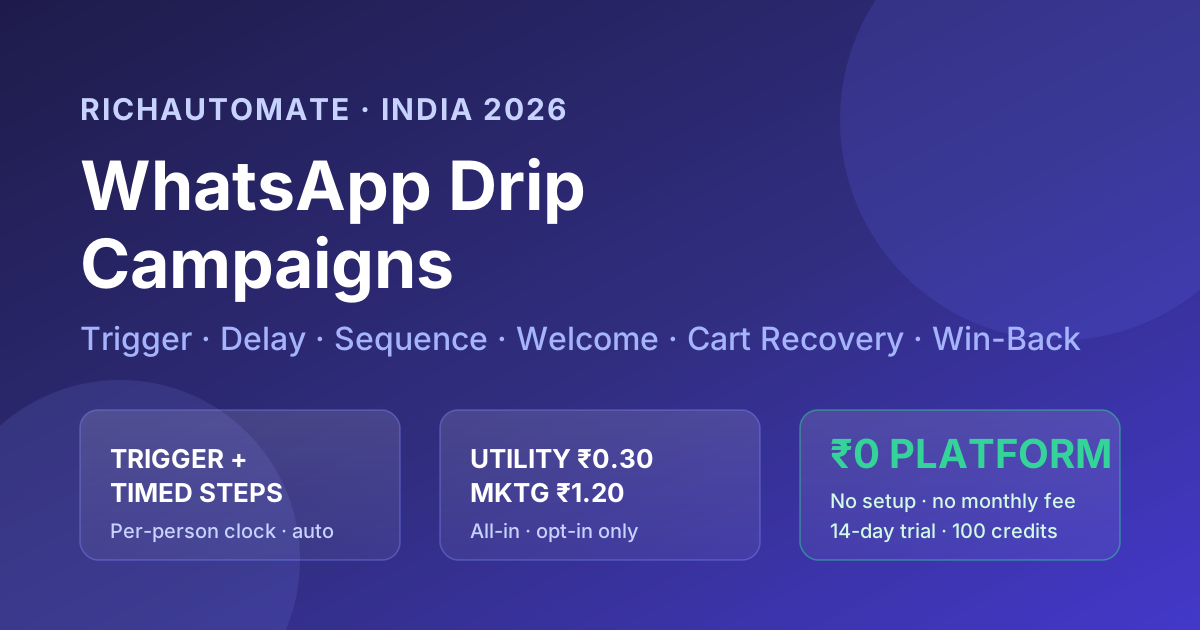
The short answer. A WhatsApp drip campaign is a pre-planned sequence of timed, automated WhatsApp messages triggered by a customer action — a sign-up, a purchase, an abandoned cart — rather than blasted to everyone at once. In India in 2026 it is built on the WhatsApp Business API using approved utility and marketing templates, runs on opt-in only, and on RichAutomate costs roughly ₹0.30 per utility and ₹1.20 per marketing conversation with no platform fee. Verify Meta's live conversation rates as of 2026.
If you have ever signed up for a service and received a welcome message on Day 0, a how-to nudge on Day 2, and a gentle “still interested?” on Day 5, you have been through a drip campaign — you just experienced it as helpful timing rather than a spray of ads. On WhatsApp, where messages land in the same inbox as a customer's family and friends, that sense of timing matters more than on any other channel. A drip campaign is the discipline of sending the right message at the right moment in a person's journey, automatically, instead of dumping one broadcast on your whole list and hoping. This is the 2026 playbook for building WhatsApp drip campaigns for the Indian market: what they are, how the trigger-and-delay machinery works on the WhatsApp Business API, where utility versus marketing templates fit, illustrative cost math, the opt-in and DPDP rules you cannot skip, and a 24–48 hour go-live. Every Meta-pricing and regulatory specific below should be verified against the live position as of 2026, and all rupee and cohort figures are illustrative.
What a WhatsApp drip campaign actually is
A WhatsApp drip campaign is an automated, pre-built sequence of messages released over time in response to a defined trigger, so each contact moves through the same thoughtful series on their own clock. The word “drip” is the point: instead of one big pour, messages arrive in measured steps — a welcome now, a tip in two days, an offer in a week — each spaced by a delay and often gated by a condition (“only send step 3 if they haven’t replied”). This is fundamentally different from a one-off broadcast, which fires the same message to everyone at the same moment regardless of where they are in their journey. A drip is contextual and individual; a broadcast is bulk and simultaneous. On WhatsApp the distinction is sharpened by the medium: because the channel is intimate and tightly governed by Meta, a well-timed sequence of genuinely useful messages performs far better, and stays far safer, than repeated bulk promotion. For the broader campaign picture, the 30 WhatsApp campaign ideas swipe file shows where drips fit among other formats.
Drip campaign vs broadcast vs chatbot — how they differ
These three terms get muddled constantly, so it is worth being precise, because they solve different problems and a mature WhatsApp programme uses all three. A broadcast is a single message to many people at once; a drip is a timed multi-step sequence per person; a chatbot is an interactive, branching conversation driven by what the contact replies. The table below lays out the practical difference.
| Dimension | Broadcast | Drip campaign | Chatbot / flow |
|---|---|---|---|
| Trigger | You press send | A customer action or date | A customer reply / menu tap |
| Timing | One moment, everyone at once | Spread over days, per person | Real-time, conversational |
| Personalisation | Same message to all | Same sequence, per-person clock | Branches on each answer |
| Best for | Announcements, one-off offers | Onboarding, nurture, recovery | Support, qualification, FAQs |
| Risk profile | Highest if untargeted | Lower — spaced and relevant | Lowest — user-initiated |
A drip sits in the middle: more personal than a broadcast, less interactive than a chatbot, and ideal for guiding someone through a predictable journey such as onboarding or cart recovery. For the chatbot end of the spectrum, the flows vs chatbot decode covers when interactivity beats a fixed sequence.
How the trigger-and-delay machinery works on the WhatsApp Business API
Under the hood, every WhatsApp drip is just three building blocks wired together: a trigger that enrols a contact, a series of message steps using approved templates, and delays or conditions between them. The trigger is the entry point — a new sign-up, a first purchase, a cart left for an hour, a date such as a renewal anniversary, or a tag applied in your CRM. Once enrolled, the contact starts at step one; after a defined wait (an hour, a day, three days) the next step fires, and so on, with optional branches that skip or change a step based on behaviour, for example “exit the sequence the moment they buy.” Each message that lands outside the 24-hour customer-service window must use a pre-approved template in the correct category — utility for service-related steps, marketing for promotional ones — while a reply from the contact opens a 24-hour window in which freeform messages are allowed. A good builder lets you assemble all of this visually without code; the underlying engine handles the waits, the window logic and the template selection. Getting the cadence engineering right at volume is its own discipline — the WhatsApp marketing automation playbook for D2C brands goes deeper on building and sequencing these journeys.
Utility vs marketing templates — the rule that controls your cost and your safety
The single most important technical fact about WhatsApp drips in 2026 is that Meta categorises template-initiated conversations, and the category decides both the price and the compliance posture of each step. Utility templates cover transactional, service-driven messages tied to a specific action or account — order confirmations, shipping updates, appointment reminders, payment receipts — and they are cheaper. Marketing templates cover anything promotional — offers, launches, re-engagement, upsells — and cost more. The implication for drip design is concrete: structure your sequence so that genuinely transactional steps are sent as utility templates and only the explicitly promotional steps carry the marketing category, because mislabelling a marketing message as utility risks rejection or worse. This is not a loophole to exploit; it is a design constraint that, followed honestly, keeps your sequences both cheaper and safer. Meta’s exact category definitions and rates evolve, so verify the current template categories and conversation pricing on Meta’s developer documentation at developers.facebook.com as of 2026.
Five WhatsApp drip campaigns worth building first
The fastest way to see value is to build the high-leverage sequences first, the ones that map onto journeys every Indian business already has. Each below is described by its trigger, a sketch of its steps, and the template mix it should use.
| Drip | Trigger | Step sketch (illustrative) | Template mix |
|---|---|---|---|
| Welcome / onboarding | New sign-up or first contact | Day 0 welcome → Day 2 how-to → Day 5 first-value nudge | Mostly utility |
| Abandoned cart recovery | Cart left > 1 hour | +1h reminder → +24h benefit nudge → +48h offer (opted-in) | Utility → marketing |
| Post-purchase | Order placed | Confirmation → shipping update → delivery → review request | Utility |
| Re-engagement / win-back | No activity for N days | “We miss you” → what’s new → incentive (opted-in) | Marketing |
| Renewal / repeat | Subscription or refill date nears | Reminder → easy-renew link → lapse follow-up | Utility → marketing |
Notice how the strongest drips lean on utility steps and reserve marketing templates for the moments that are genuinely promotional. The abandoned-cart sequence in particular is one of the highest-ROI drips a D2C brand can run, and several of the ideas in the swipe file above translate directly into multi-step drips rather than single sends.
Get a 1-minute BSP audit on WhatsApp
Drop your WhatsApp number — we line-item your current invoice against Meta India rates in under 60 seconds. India-hosted, DPDP-compliant.
Plug your own numbers into the WhatsApp ROI calculator to see the payback period at your volume.
The opt-in and DPDP discipline you cannot skip. A drip campaign is only as safe as the consent behind it, and in 2026 that means two things working together. First, Meta’s own rules: every contact in a sequence must have opted in to receive messages on WhatsApp, marketing templates must be honestly categorised, and you must honour opt-outs immediately — a “STOP” should remove someone from every active drip, not just the one they replied to. Second, the Digital Personal Data Protection framework: collect only the data the sequence genuinely needs, tell people why you are messaging them, make consent recorded and revocable, and set a retention period for the contact data driving your drips. Never buy lists, never enrol someone who did not opt in, and never promise “guaranteed no ban” — sending relevant, consented, well-spaced messages is what keeps a number healthy, not any vendor guarantee. The same minimisation and consent rigour in the DPDP compliance checklist applies directly to every drip you build. Verify the operative DPDP provisions and Meta’s messaging policy as of 2026.
What a WhatsApp drip campaign costs — illustrative math
Because most drip steps are transactional utility messages and only some are marketing, the cost of running drips is usually modest and scales with enrolment, not with a fixed monthly fee. Take an illustrative D2C brand enrolling 2,000 new contacts a month into a welcome drip (3 utility steps each), running an abandoned-cart drip that reaches 1,000 carts a month (2 utility + 1 marketing step), and a monthly re-engagement drip to 1,500 lapsed contacts (1 marketing step). That is roughly 8,000 utility conversations and 2,500 marketing conversations a month — every figure here is illustrative, so model your own enrolment.
| Line item (illustrative) | RichAutomate SaaS Pay | Fee-bearing provider (illustrative) |
|---|---|---|
| Platform / monthly fee | ₹0 | A fixed monthly platform fee (verify the vendor’s number, 2026) |
| ~8,000 utility conversations | ~₹2,400 (8,000 × ₹0.30 all-in) | Meta’s utility rate + markup × 8,000 (verify) |
| ~2,500 marketing conversations | ~₹3,000 (2,500 × ₹1.20 all-in) | Meta’s marketing rate + markup × 2,500 (verify) |
| Indicative monthly total | ~₹5,400, no platform fee | A similar message cost plus a fixed platform fee on top (verify) |
The figures are illustrative — model your own enrolment volumes and step counts — but the shape holds: most of the spend sits in the cheap utility tier, and a ₹0-platform model means a slow month costs proportionally less. RichAutomate’s pricing is flat: ₹0 platform fee, ₹0 setup, ₹0 monthly. On Client Pay (your own WhatsApp number, ₹0.10 per message, with Meta’s conversation charge billed to you directly by Meta) the cost tilts further toward usage-only. Run your real numbers through the WABA cost calculator and verify Meta’s live conversation rates and the GST position as of 2026.
Designing drips that perform — cadence, length and exit rules
A drip’s results come less from clever copy and more from disciplined timing and respect for the contact’s attention. Keep sequences short — three to five steps is usually plenty for onboarding or recovery, and a sequence that drags past a week of promotional nudges tends to earn opt-outs rather than sales. Space steps so they feel like helpful reminders, not pestering: an hour, then a day, then a few days, rather than message after message. Always build an exit rule so a contact leaves the sequence the moment they take the desired action — nothing erodes trust faster than a “complete your purchase” nudge sent after someone has already bought. Lead with utility and value before any offer, personalise with the contact’s name and context, and make the call to action a single clear next step. Above all, measure: track which step drives action and which step bleeds opt-outs, and prune accordingly.
Going live in 24–48 hours
Standing up your first WhatsApp drip is a quick, low-risk exercise that does not touch your storefront, ERP or CRM beyond a simple trigger connection. Pilot a single sequence on a small segment first so your existing messaging keeps running exactly as it does today.
| Step | What happens | Typical timing |
|---|---|---|
| 1. Start the trial | Begin the 14-day free trial with 100 credits; connect or onboard your WhatsApp Business number | Day 0 |
| 2. Get templates approved | Draft and submit the utility and marketing templates for your first drip’s steps | Day 0–1 |
| 3. Build the sequence | Wire the trigger, the steps, the delays and the exit rule in the visual builder | Day 1 |
| 4. Pilot on a segment | Run the drip on a small opted-in segment; confirm enrolment, timing, opt-out and exit-on-conversion all work; then roll out | Day 1–2 |
Because you pilot on a small segment first, there is no dark window and no risk to your live messaging — the rest of your programme keeps running until you are satisfied. To keep the contacts, tags and triggers behind your drips organised, a WhatsApp CRM is the natural companion. Verify your number-onboarding steps, template categories and Meta’s messaging policy with the provider as of 2026.
Build your first WhatsApp drip on the channel your customers already check
A WhatsApp drip campaign turns scattered, one-off messaging into a timed, automated sequence that meets each customer at the right moment in their journey — a welcome series that lands real value, an abandoned-cart recovery that politely earns the sale back, a post-purchase flow that drives reviews and repeat orders. The machinery is simple once you see it: a trigger enrols the contact, approved utility and marketing templates carry the steps, delays and conditions space them out, and an exit rule respects the customer the moment they act. Run it on opt-in only, categorise every template honestly, honour every opt-out across all sequences, and handle contact data with DPDP-grade minimisation and consent — and never promise “no ban,” because relevance and consent are what keep a number healthy. RichAutomate keeps the economics flat: ₹0 platform fee, ₹0 setup, ₹0 monthly, Client Pay at ₹0.10 per message with Meta’s conversation charge billed direct by Meta, or SaaS Pay at ₹1.20 marketing / ₹0.30 utility all-in. Start the 14-day free trial with 100 credits, pilot one sequence on a small segment first, WhatsApp us at 917434901027, or book a 30-minute walkthrough at https://calendly.com/inrichdaddy/30min. (Meta’s template categories and conversation rates, the DPDP provisions and the GST treatment all change; verify the current position as of 2026. All cohort and rupee figures are illustrative; model your own.)
Start your 14-day free trial → · See full pricing · Run the WABA cost calculator