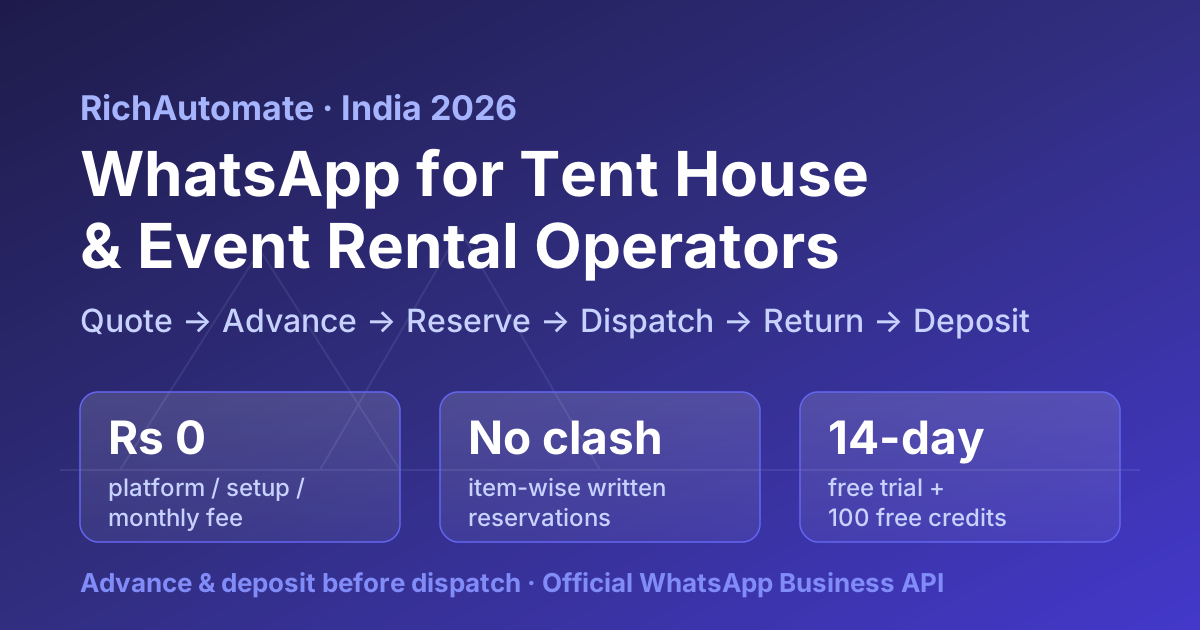
The short answer. A tent house or event-rental business lives and dies on three things: not double-booking inventory across overlapping wedding dates, collecting the advance and the security deposit before the truck rolls, and settling the deposit cleanly after teardown so you do not eat the cost of a torn shamiana or missing crockery. WhatsApp is where every customer already negotiates the quote, so it is the natural place to run that whole cycle — quote sharing, advance collection with a payment link, item-wise booking confirmation, dispatch and setup reminders, return checklists, and deposit settlement — on the official WhatsApp Business API. RichAutomate runs it at ₹0 platform fee, ₹0 setup and ₹0 monthly, so a seasonal business pays only for the messages it actually sends. Treat every Meta and tax specific as something to verify against the live 2026 position; all rupee and cohort figures are illustrative.
Run a tent house, mandap and decor rental, chair-and-table supply, crockery-and-catering-equipment, generator, lighting or sound-rental operation in India and your business is brutally physical: a finite stock of poles, fabric, furniture and equipment that has to be in two places it can never be at once during peak wedding season. Your margin is destroyed by exactly three failures — promising the same 500-chair set to two weddings on the same Saturday, sending inventory out before the advance lands, and losing the security deposit fight when items come back torn, stained or short. Almost every one of those failures traces back to communication that lives in a phone call, a paper register and a WhatsApp chat nobody can audit. This guide treats WhatsApp not as a marketing toy but as the operating system for a rental business: it maps the full rental cycle from enquiry to deposit settlement onto the channel customers already use, shows how to stop inventory clashes, how to collect advances and deposits before dispatch, how to share a per-item rate card without a hundred repeat calls, and how to survive the November–February peak when ten functions stack on one weekend. It uses the official WhatsApp Business API throughout — not a personal number broadcasting to saved contacts, which is unscalable and a compliance risk. This is general operational guidance; verify every Meta, payment and tax specific against the current 2026 position, and treat all figures as illustrative.
Why WhatsApp fits a tent house and rental operation
Rental is a deadline-and-deposit business, and that is exactly the shape WhatsApp serves best. Every booking is a chain of time-critical, money-bearing touchpoints — here is your quote, pay the advance to hold the date, your items are reserved, the truck reaches your venue at 7 AM, please confirm the return count, here is your deposit refund — and on WhatsApp each of those is read within minutes, where a phone call goes unanswered during a function and a paper slip gets lost in the chaos of a wedding lawn. Most of these messages are transactional: booking confirmations, payment reminders, dispatch alerts and return checklists sit in WhatsApp’s cheaper utility lane and are genuinely useful to a customer mid-event, not spam. The structural win is that a rental operation today runs on a register, a stack of advance slips and a memory of which set is going where; WhatsApp turns that into timed, logged, mostly utility-priced sequences with a payment link attached, so the advance and deposit are collected before the inventory leaves the godown. But it only works on the official WhatsApp Business API with approved templates and customers who have contacted you — not a personal phone blasting last season’s contact list.
The rental operating cycle, stage by stage
Before you automate anything, map the whole rental cycle, because the value of WhatsApp is that it handles every stage where money or inventory moves. The table below lays out the six stages a tent house or event-rental operator runs and the dominant WhatsApp job at each, with the message category each tends to fall in. Treat any tax or payment reference as something to verify for 2026.
| Stage | What happens | WhatsApp job | Message category |
|---|---|---|---|
| 1. Enquiry & quote | Customer asks rates for a date, items, venue | Share rate card + itemised quote instantly | Utility (some marketing for first enquiry) |
| 2. Booking & advance | Customer confirms; advance holds the date | Advance payment link + booking confirmation | Utility |
| 3. Inventory reservation | Items locked to that date so they cannot be re-sold | Item-wise reservation confirmation, clash check | Utility |
| 4. Dispatch & setup | Truck loaded, crew sent, structure raised at venue | Dispatch alert + setup-time + crew-contact share | Utility |
| 5. Teardown & return | Items dismantled, counted, loaded back | Return checklist + item-count confirmation | Utility |
| 6. Deposit & damage settlement | Stock inspected; deposit refunded or adjusted | Deposit settlement summary + refund/adjustment note | Utility |
The pattern across all six stages is the same: a handful of high-stakes, deadline-bound touchpoints per booking that today live in a register and a phone, each mapping cleanly to a WhatsApp template or short automated sequence, and most falling in the cheaper utility category. A pure tent-and-mandap operator leans heaviest on stages 1–4 (quote, advance, reservation, setup); a furniture-and-crockery supplier lives in stages 3, 5 and 6 (reservation, return count, damage settlement) where item counts and breakage drive the deposit fight. Where a customer is a wedding planner sub-contracting to you, your booking confirmations also become their proof of supply — the planner side of that relationship is covered in the WhatsApp for wedding planners and event management guide, and the venue side in the banquet hall and marriage venue guide. The best automation is whichever handles your heaviest stages without letting inventory or money slip.
The WhatsApp pricing calculator by country is the fastest check on what each destination market actually costs.
Stopping the inventory clash — the failure that costs you the most
The single most expensive mistake in rental is promising the same physical stock to two functions on the same day, and it almost always happens because the booking lives in someone’s head or a paper register while a second enquiry comes in over a phone call. WhatsApp does not magically give you a warehouse-management system, but it does give you a logged, timestamped record of exactly what was promised, to whom, and when — which is the foundation of clash prevention. The discipline is simple: every booking is confirmed with an item-wise reservation message (“reserved for 14 Nov: 500 chairs, 1 mandap 30x40, 8 round tables, sound set A”), so the commitment is in writing and searchable, and your team checks the reserved list before quoting a clashing date. Wire the WhatsApp flow to your inventory sheet or rental software through a webhook and the reservation can be checked against live availability before a quote even goes out. The point is not that the channel replaces stock-keeping — it is that it removes the verbal, un-auditable promise that causes the double-booking in the first place, and gives you a defensible record when a customer claims they booked something they did not. Treat any availability figure shown to a customer as needing a real stock check behind it.
The advance-before-dispatch rule that protects your cash. Never load the truck on a verbal promise. The booking-confirmation message carries the advance payment link, and inventory is only marked reserved when the advance lands — so a no-show customer cannot tie up your peak-season stock for free, and the deposit link goes out with the same flow before setup day. This single sequence — quote, advance link, reservation on payment, deposit link before dispatch — removes most of the cash-flow risk that sinks seasonal rental businesses, and because it is a workflow choice rather than a platform feature, you control it on any compliant BSP.
Collecting advances and security deposits over WhatsApp
Cash flow is the second business-killer, and it is where WhatsApp pays for itself fastest. A rental booking has two money events — the advance that holds the date and the security deposit that covers damage — and both should be collected before any inventory leaves your godown, not chased after the function when the customer has moved on. The mechanics are straightforward: your booking-confirmation template carries a payment link for the advance, the reservation is only locked when the payment is confirmed, and a second link for the security deposit goes out with the dispatch sequence before setup day. Reminders for a pending advance or deposit run as timed utility messages, so your team stops making awkward chase calls during the customer’s busiest week. After the event, the deposit-settlement message becomes the written record of what was refunded or adjusted for damage and shortage — which is exactly the documentation that ends the deposit dispute before it starts. Verify the live payment-gateway, settlement-timing and GST/tax treatment for rental services as of 2026, and keep the rate card and deposit terms explicit in the quote so there is no argument later. The structural win is that money is collected at the point of commitment, in writing, with a link — not chased in cash after the truck has already gone out.
Get a 1-minute BSP audit on WhatsApp
Drop your WhatsApp number — we line-item your current invoice against Meta India rates in under 60 seconds. India-hosted, DPDP-compliant.
Sharing the rate card and itemised quotes without a hundred repeat calls
Most of a tent house owner’s day disappears into repeating the same rates — what does a 30x40 mandap cost, how much per chair, is the generator included — over phone calls that lead nowhere. WhatsApp collapses that into a shareable, structured response. A rate-card document or a quick interactive menu (tent and mandap, furniture, crockery, lighting and sound, generator) lets a customer self-serve the basics before a human gets involved, and an itemised quote template turns a negotiation into a clear written estimate the customer can approve with one reply. The honest framing is that this filters time-wasters and speeds up serious buyers — the customer who is just price-checking gets their answer without occupying your phone, and the customer ready to book gets a quote and an advance link in the same thread. Pair it with a CRM view so every enquiry, quote and booking for a date is in one place rather than scattered across chats; the structural side of running customer relationships this way is covered in the best WhatsApp CRM for India 2026 guide. Keep marketing honestly categorised — a festival-season offer is a marketing template needing consent, while a quote in reply to an enquiry is utility.
Surviving the peak season — when ten functions stack on one weekend
A rental business does most of its year between roughly November and February, when wedding and festival dates cluster and a single Saturday can carry more bookings than a quiet month. That is exactly when manual coordination collapses: the register cannot keep up, the phone never stops, dispatches overlap, and a missed return count becomes a lost deposit. Automation earns its keep precisely here. Booking confirmations and reservation locks happen the moment an advance lands, with no manual entry; dispatch alerts fire on schedule for every truck without anyone remembering to call; return checklists go out automatically as each function ends so item counts are captured while the crew is still on site; and a customer chasing a quote at 11 PM gets the rate card instantly instead of waiting for morning. The illustrative effect is that the same team handles a multiple of the booking volume in peak weeks without dropping a dispatch or a deposit — the labour you would otherwise throw at phone calls and register entries goes into actual setup and service. Any throughput uplift you have seen quoted is illustrative; measure your own peak against your off-season baseline.
Illustrative cost math for a tent house or rental operator
The cost of running the whole rental cycle on WhatsApp is modest, because most messages are utility and the spend scales with booking volume rather than a fixed monthly plan — which matters enormously for a seasonal business that is busy four months and quiet eight. Every figure below is illustrative; model your own operation. Take a mid-size tent house handling, say, 220 bookings across a busy month at peak: quotes, advance and deposit links, reservation confirmations, dispatch alerts, return checklists and settlement notes, plus a smaller slice of festival-season marketing. Suppose that breaks into roughly 1,500 utility conversations and 300 marketing conversations.
| Line item (illustrative) | Fee-bearing BSP | RichAutomate SaaS Pay | RichAutomate Client Pay |
|---|---|---|---|
| Fixed platform / monthly fee | ~Rs 2,500–3,500/mo, paid even in off-season (verify) | Rs 0 | Rs 0 |
| 1,500 utility conversations | Meta rate + markup × 1,500 (verify) | ~Rs 450 (1,500 × Rs 0.30) | Meta direct + ~Rs 150 markup (1,500 × Rs 0.10) |
| 300 marketing conversations | Meta rate + markup × 300 (verify) | ~Rs 360 (300 × Rs 1.20) | Meta direct + ~Rs 30 markup (300 × Rs 0.10) |
| Setup (one-time) | Sometimes charged (verify) | Rs 0 | Rs 0 |
| Indicative monthly total | Plan + messages + GST (even when idle) | ~Rs 810 + 18% GST, no platform fee | ~Rs 180 markup + Meta’s own charge |
The structural point for a seasonal rental business is that a fixed monthly platform plan is dead weight in your eight quiet months — you pay it whether you do 220 bookings or two. Because most rental messaging falls in the cheaper utility/authentication lane, a ₹0-platform, usage-only model keeps the cost tracking your actual season. RichAutomate charges ₹0 platform, ₹0 setup and ₹0 monthly. Run your real message mix through the RichAutomate pricing page, and verify Meta’s live conversation rates and the GST treatment for rental services as of 2026.
What WhatsApp software can — and cannot — do for a rental business
It is worth being honest about the boundary, because over-claiming is what a seasoned rental owner will rightly distrust. WhatsApp automation can share rate cards and itemised quotes, collect advances and deposits with payment links before dispatch, confirm item-wise reservations in writing, fire dispatch and setup alerts, push return checklists and capture counts, send deposit-settlement summaries, run festival-season marketing to opted-in customers, and hand off to a human for negotiation — the communication, coordination and money-collection layer. It cannot physically stop you from over-committing stock if your inventory data is wrong, count returned items for you, settle a damage dispute on your behalf, or guarantee your WhatsApp number is never restricted. Clash prevention still needs an accurate stock list behind the messages; the channel makes promises auditable, it does not invent availability. The right framing is that good software removes the register-and-phone drudgery — the rate-repeating, the advance-chasing, the dispatch-calling, the deposit-arguing — so your people spend their time loading trucks and raising structures, which is the part no software can replace. And no provider can promise “no ban”: what keeps a number healthy is relevant, consented, well-spaced messaging and prompt opt-out handling.
How RichAutomate fits a tent house and event-rental operation
Held against the rental cycle above, RichAutomate runs on the official Meta WhatsApp Cloud API; lets you template the quote, advance link, reservation confirmation, dispatch alert, return checklist and deposit settlement as utility-category messages; carries payment links so the advance and deposit are collected before inventory leaves the godown; gives a CRM view so every enquiry and booking for a date sits in one place; and offers custom flows and webhooks you can wire to your inventory sheet or rental software for a real availability check before a quote goes out. On economics it removes the layers that punish a seasonal business: ₹0 platform fee, ₹0 setup, ₹0 monthly, with Client Pay at a flat ₹0.10 per message on your own WhatsApp number (Meta’s conversation charge billed to you directly by Meta) or SaaS Pay at an all-in ₹1.20 marketing / ₹0.30 utility-auth. There is a 14-day free trial with 100 free credits, enough to pilot one workflow — the advance-link booking confirmation or the return checklist — through one weekend of bookings before committing. The honest disclosure remains: the software handles communication and collection, not your physical stock-keeping; verify every Meta, payment-gateway and GST specific against the live 2026 position, and keep your rate card and deposit terms explicit so settlements stay clean.
Rental use-cases that work on WhatsApp — all to customers who contacted you. Instant rate-card share on enquiry; itemised quote with one-tap approval; advance payment link that locks the reservation only on payment; item-wise booking confirmation as a written, searchable record; security-deposit link before dispatch; dispatch and setup-time alert with crew contact; return checklist with item-count confirmation while the crew is still on site; deposit settlement summary that ends the damage dispute before it starts; and an off-season re-engagement or festival offer as an honestly categorised marketing template. Each marketing message needs a logged opt-in and an instantly honoured opt-out; quotes and confirmations in reply to an enquiry are utility. Any uplift in booking throughput or deposit-recovery you have seen quoted is illustrative; measure your own.
Related reading: DG generator rental: WhatsApp API comparison.
Estates and gated societies that run a garden also need scheduled upkeep — see our landscaping and garden-maintenance WhatsApp playbook.
Run your whole rental cycle on WhatsApp — ₹0 platform, ₹0 setup, pay only in season
From the first rate enquiry to the final deposit settlement, RichAutomate runs an Indian tent house, mandap and decor, furniture, crockery, lighting, generator or sound-rental operation’s entire booking cycle on the official WhatsApp Business API — quotes, advance and deposit links before dispatch, item-wise reservations, dispatch alerts, return checklists and settlement summaries, mostly utility-priced. Pricing is flat and seasonal-friendly: ₹0 platform fee, ₹0 setup, ₹0 monthly, so you pay nothing in your quiet months, with Client Pay at a flat ₹0.10 per message on your own WhatsApp number (Meta’s conversation charge billed to you directly by Meta) or SaaS Pay at an all-in ₹1.20 marketing / ₹0.30 utility-auth. Start the 14-day free trial with 100 free credits, build one workflow — the advance-link booking confirmation or the return checklist — and run it through one weekend of bookings before you commit. WhatsApp us at 918160311319 or book a 30-minute walkthrough at https://calendly.com/inrichdaddy/30min. (This is general operational guidance. Every Meta, payment-gateway and GST/tax specific must be verified against the live 2026 position; all rupee and cohort figures are illustrative; no vendor can guarantee against a ban or replace your physical stock-keeping.)
Start your 14-day free trial → · See full pricing · Read the WhatsApp CRM guide