All articles
Industry Guides

WhatsApp for Nutraceutical Contract Manufacturers 2026

Indian nutraceutical CMOs use WhatsApp API to lock formulation, COA and label-artwork sign-off in writing before a private-label batch ever runs.

RichAutomate Editorial
11 min read 0 views
WhatsApp for Nutraceutical Contract Manufacturers 2026

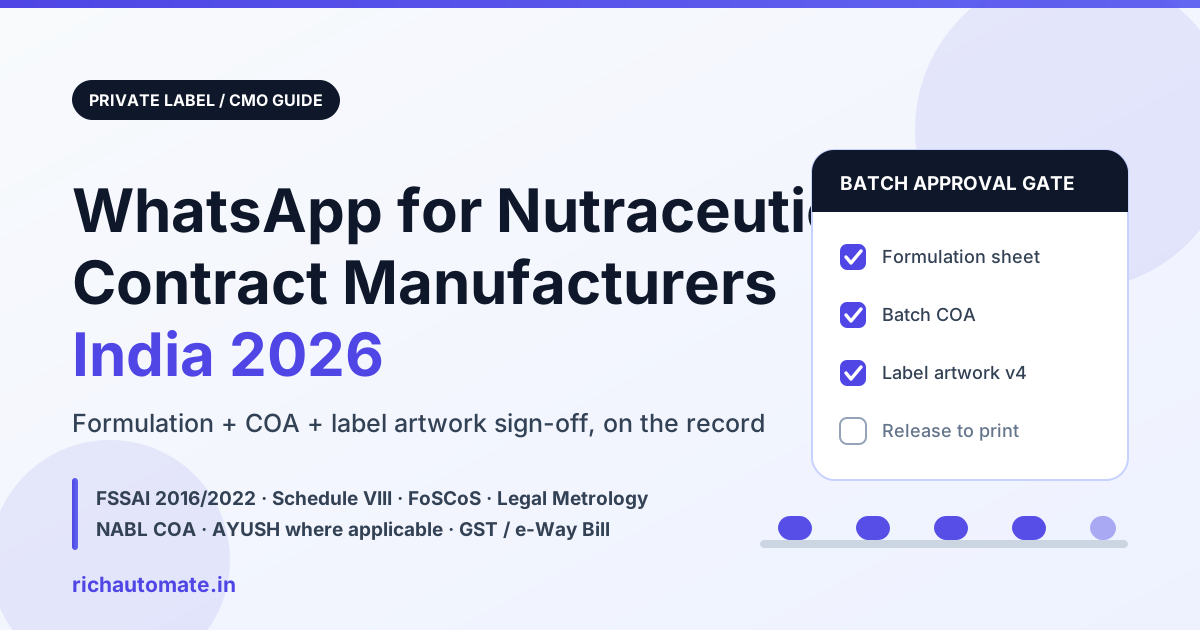
Nutraceutical and health-supplement contract manufacturers in India use the WhatsApp Business API to lock the one stage that decides whether a private-label batch is profitable or a write-off: getting the brand owner's timestamped, in-writing sign-off on the formulation sheet, the batch COA and the printed label artwork before the blender, encapsulation line or pouch printer starts. Around that approval gate the same number also runs RFQ and MOQ capture, quotations and sample dispatch, batch-status updates, e-Way-linked dispatch proof, stability and retest reminders, and repeat-batch reorder nudges — on the channel the brand's founder already answers.

This is a factory-side workflow, not a brand-side one. If you are the D2C label selling scoops and gummies to consumers, the playbook you want is WhatsApp for sports nutrition and supplement D2C brands. This guide is for the CMO — the unit in Baddi, Paonta Sahib, Roorkee, Ahmedabad, Hyderabad or Chennai that takes those brands' purchase orders and carries the manufacturing licence on which their claim is printed.

Why the approval gate is the only stage that really decides your margin

A private-label nutraceutical order has an irreversible point. Once 50,000 laminated pouches or 30,000 printed labels are gang-printed, and once a blend is charged into the blender, the money is spent. If the brand later says "we never approved boosts immunity on the front panel" or "we asked for 60 mg elemental iron, not 60 mg ferrous fumarate", you are in one of three places: eat the re-print, eat the rejected batch, or spend six months arguing over an email thread nobody can find.

The typical Indian CMO already knows this and already tries to solve it — a PDF artwork on email, a phone call, and a message from a salesperson's personal number saying "ok sir approved". None of that is a record you can lean on when the dispute is worth several lakh rupees. A WhatsApp Business API thread is different in one specific way: the artwork is delivered on the business number, the brand replies with an explicit approval, both are timestamped, and both sit in a database you own and can export. That is the entire product argument for a factory.

The compliance spine you carry on someone else's brand name

A contract manufacturer sits in an uncomfortable position. The licence, the plant and often the FSSAI number on the pack are yours, while the claim, the positioning and the marketing belong to the brand. Treat the areas below as what your approval thread should evidence — and verify the current position of each with your regulatory consultant or the relevant authority before relying on it, because India's nutraceutical rules have been amended repeatedly and further amendment is likely.

  • FSSAI Health Supplements, Nutraceuticals, Food for Special Dietary Use, Food for Special Medical Purpose and Functional Food Regulations, 2016 (as amended, including the 2022 amendment cycle) — the core framework separating a health supplement from a nutraceutical from an FSMP. Which bucket a product falls into changes the permissible ingredients, the permissible claim and the label. Verify the current position for each SKU.
  • Ingredient positive-lists and the Schedules — including Schedule VIII and the associated schedules covering vitamins, minerals, amino acids, plant and botanical ingredients and additives. An ingredient not on the applicable list, or above the permitted level, is a formulation-stage problem, not a dispatch-stage problem. Get the brand to sign the exact formulation sheet with quantities and sources.
  • FSSAI manufacturing licence and FoSCoS — your licence category, product endorsements and any Non-Specified Food approval route should actually cover what you are being asked to make. Manufacturing an unendorsed product for a client is your exposure, not theirs. Confirm current endorsement scope on FoSCoS.
  • Legal Metrology (Packaged Commodities) Rules — net quantity, MRP, manufacturer versus marketer declaration, country of origin, consumer-care details, month and year of manufacture, unit sale price. Legal Metrology defects are among the most common reasons printed packaging gets scrapped. Confirm current declaration requirements before every artwork release.
  • AYUSH licensing where the formulation is ayurvedic or borderline — a herbal or classical-formulation product may sit under AYUSH and Drugs and Cosmetics licensing rather than the FSSAI nutraceutical route. Borderline products are exactly where a CMO gets caught. Establish which regime applies, in writing, per SKU.
  • Testing, BIS standards and NABL-accredited lab COAs — assay, heavy metals, microbiology, pesticide residue and, where applicable, disintegration. The COA the brand signs is the COA you will defend later.
  • Claim and advertising rules, including the ASCI code — "supports immunity", "cures" and "clinically proven" are not interchangeable, and the advertiser carries obligations independent of the label. If a brand insists on a claim you believe is not supportable, get that instruction on the record before you print it.
  • GST, e-invoicing and e-Way Bill — job-work versus principal-to-principal sale changes the GST treatment, and e-invoicing and e-Way Bill thresholds have moved several times. Verify current thresholds and treatment with your CA rather than assuming last year's position still holds.

None of this is what your customer wants to discuss at 9pm on a Tuesday. All of it is what your thread has to prove eighteen months later.

What a wrong label or rejected batch actually costs

Treat the figures below as directional planning ranges drawn from typical Indian private-label order sizes, not as quoted rates. Your own printer, blend size, dosage form and city will move them materially — verify against your own last three jobs before using them in a business case.

FailureDirectional cost rangeWho usually ends up payingWhat a timestamped approval changes
Re-print of laminated pouches or labels (30k–50k units)₹1.5–6 lakhDisputed; often split, or absorbed by the CMO to keep the accountApproval names the exact artwork version and date — the dispute ends in one screenshot
Blended or compressed batch rejected on assay or spec mismatch₹2–10 lakh plus lost line timeCMO, unless the formulation sheet was signedSigned formulation sheet fixes the spec you were asked to hit
Legal Metrology declaration defect found after printingRe-print plus relabelling labour, plus possible regulatory exposureShared; the licence-holder carries the regulatory sidePre-print checklist sent and acknowledged in-thread before print release
Claim objection raised on a marketed packRework or recall cost — hard to boundBrand, if the instruction is documented; CMO if notThe brand's written instruction to print that claim is preserved
Dispatch disputed as short or damagedRoughly 1–3% of invoice, plus 30–60 days of payment delayCMO absorbs the working-capital hitPhoto POD and e-Way reference sit on the same thread

India's nutraceutical and health-supplement market is routinely sized in the low-to-mid single-digit billions of US dollars with double-digit growth, but published estimates vary widely by scope and methodology — treat any single number as directional and verify against the current source before quoting it to a client or a bank.

The six-stage WhatsApp lifecycle for a contract manufacturer

The lifecycle below is deliberately factory-shaped. It starts at RFQ, not at an ad click, and it ends at repeat batch, not at checkout.

Stage 1 — RFQ and MOQ/spec capture

Inbound brand enquiries arrive vague: "do you make gummies?" A WhatsApp Flow collects what you actually need in order to quote — dosage form (tablet, capsule, sachet, gummy, powder, liquid), target category, key actives and strengths, MOQ, packaging format, whether artwork already exists, whether the brand holds its own marketer licence, and target dispatch date. That form does the work three phone calls used to do, and it arrives as structured data instead of a voice note at 11pm.

Stage 2 — Costing, quotation and sample dispatch

The quote goes out as a document on the thread, with the sample courier docket following it. The discipline that matters here is versioning: quotation v1, v2 and v3 each as a separate dated document, so that "the price you gave us" has a specific, retrievable meaning three months later.

Stop overpaying on WhatsApp

Get a 1-minute BSP audit on WhatsApp

Drop your WhatsApp number — we line-item your current invoice against Meta India rates in under 60 seconds. India-hosted, DPDP-compliant.

DPDP-compliant · India-hosted · 1-min reply

Stage 3 — The approval gate: formulation, COA and label artwork

This is the stage the whole system exists for, and it gets its own section below.

Stage 4 — Production batch status, dispatch, e-Way and POD

Template messages fire at the transitions the brand actually cares about: batch charged, in-process QC cleared, packing started, ready for dispatch, dispatched with LR and e-Way reference, delivered with photo POD. A brand founder who can see batch progress stops phoning your production head daily, which is worth more than it sounds.

Stage 5 — Stability, retest and repeat-batch reorder

Scheduled utility messages at retest intervals, and a reorder nudge sized to the brand's likely stock cover. Supplement demand is repeat by nature; the CMO who nudges first usually gets the next purchase order.

Stage 6 — New-formulation and capacity broadcasts to the brand roster

An opted-in list of brand owners is a genuinely valuable asset — far more valuable per contact than a consumer list. A new dosage-form capability, a new certification, free capacity in a slow month, or a raw-material price window are all legitimate reasons to broadcast to that roster.

Inside the approval gate: what "approved" has to mean

A defensible approval has four properties. It is specific — it names the document version, not "the artwork". It is attributable — a named person at the brand, on a known number. It is timestamped. And it is retrievable — you can pull it up in seconds, two years later, without hunting through an ex-employee's personal phone.

In practice that means sending three artefacts as separate, individually named documents on the business thread — the formulation sheet with quantities and overages, the batch COA from the testing lab, and the print-ready label artwork PDF — and asking for an explicit, itemised reply against each. "Haan theek hai" on a call is not a record. "Approved: formulation FS-2026-0143 rev C, COA batch NC260714, artwork ART-0143-v4" is.

Two habits pay for themselves here. First, attach a short pre-print checklist to the artwork message covering the declarations most often missed — net quantity, MRP inclusive of taxes, marketer versus manufacturer declaration, FSSAI logo and licence number, consumer-care details, allergen information, vegetarian or non-vegetarian mark, and the exact wording of the claim — and state that the brand is responsible for confirming its own marketer details. Second, never accept approval from a number you cannot identify. If the brand's freelance designer sends revised artwork from a personal number, route it back through the registered contact before it goes to print.

The same discipline that protects a food unit's blend spec applies here — see how spice and masala manufacturers run batch and dispatch threads for a close cousin of this workflow inside a food-licence environment.

Manual approval loop versus a WhatsApp approval loop

StepEmail, phone and personal WhatsAppWhatsApp Business API thread
Artwork deliveryEmail attachment; lands in promotions, or gets compressed by a personal-app forwardDocument sent on the business number, delivery and read status visible
Getting a decisionChased by phone; verbal "go ahead"Explicit in-thread reply against a named version
Typical turnaround3–7 days, most of it chase timeOften same-day to 48 hours — the founder replies on the app they live in
Record ownershipSalesperson's personal phone; leaves when they leaveConversation history you control, scoped to your account and exportable
Audit retrievalHours of searching, frequently unsuccessfulSearch the contact, pull the dated approval
Handover when the account manager changesInstitutional memory walks out of the gateFull thread history is already there

If your commercial team already runs on a CRM, the approval event and its batch reference should land there too rather than living only in chat — the patterns in WhatsApp CRM integration for HubSpot, Zoho and Salesforce cover how that sync is normally wired.

Message types and who pays for each stage

Under current Meta conversation pricing, business-initiated template messages are categorised — marketing, utility, authentication — and a business reply inside the 24-hour customer service window behaves differently from a fresh template. Categories and rates change periodically; verify current Meta pricing before you model anything.

StageTypical message typeWho initiatesNotes
RFQ and spec captureService reply inside the window, plus a Flow formBrandCheapest stage — the brand opened the conversation
Quotation and sample dispatchUtility template plus documentCMOVersion every quote document
Approval gateUtility template plus three documents, then in-window repliesCMOThe revenue-protecting stage — do not economise here
Batch status and dispatchUtility templatesCMOTrigger from your ERP or MES status changes, not by hand
Stability, retest and reorderUtility template, scheduledCMOHighest-return automation in the whole list
New capability broadcastMarketing templateCMOOpted-in brand roster only

What this costs to run

RichAutomate is usage-only: ₹0 setup and ₹0 monthly platform fee. You either bring your own Meta billing — Client Pay, where our platform charge is ₹0.10 per message and Meta bills you directly — or use SaaS Pay at ₹1.20 per marketing message and ₹0.30 per utility message, all-inclusive. A contract manufacturer's mix is heavily utility-weighted (quotes, approvals, batch status, dispatch, retest), which is the cheaper side of that table. The trade-offs between the two models are laid out in Client Pay versus SaaS Pay WhatsApp billing.

For a unit running roughly 40 private-label orders a year at 25–40 messages per order across the six stages, annual messaging spend stays small relative to a single avoided re-print. That is the honest business case: this is insurance that also happens to shorten your approval cycle.

Getting it live without disrupting the plant

Start narrow. Take one workflow — the approval gate — and run it for your next five orders before touching anything else. You will need a WhatsApp Business Account on a number that is not already registered on the consumer WhatsApp app, Meta business verification (which in India in practice means your GST and business documents in order), and two or three approved utility templates. Only once the approval gate is habitual should you wire batch status into your ERP.

Two decisions to make early. First, who inside your unit owns the thread — usually the production planning or QA coordinator rather than the salesperson, because the approval is a quality record before it is a commercial one. Second, retention: your conversation history is now effectively part of your quality file, so agree how long you keep it and who can export it. Manufacturers handling regulated documentation flows on WhatsApp face the same question in other sectors — the approach in EPR documentation on WhatsApp for recyclers is a useful reference point.

None of this replaces your QA system, your regulatory consultant or your legal agreement with the brand owner. It closes the gap between them — the undocumented verbal "go ahead" that nearly every contract manufacturer in India has been burned by at least once.

Start with your next private-label order

Set the approval gate up first, on your existing number, and see whether your next artwork sign-off comes back in a day instead of a week. Create a free RichAutomate account and connect your WhatsApp Business number — usage-only pricing, ₹0 setup, ₹0 monthly, and no commitment beyond the messages you actually send. Everything else on richautomate.in can wait until the gate is working.

Ready to ship this?

Get the full migration playbook on WhatsApp

A founder-led 1-minute reply with the migration steps, template approval timeline, and a 14-day pilot offer. DPDP-compliant. India-hosted. No spam.

DPDP-compliant · India-hosted · 1-min reply
Tagged
whatsapp-business-apinutraceutical-manufacturingcontract-manufacturingprivate-labelfssai-complianceindia-2026supplement-industry
Written by
RichAutomate Editorial
Editorial team at RichAutomate. We build the WhatsApp Business automation platform Indian D2C brands, fintechs, and agencies use to ship campaigns and flows on the official Meta Cloud API.
FAQ

Frequently asked questions

Can a WhatsApp approval from a brand owner be used as a quality or dispute record?
A WhatsApp Business API thread gives you a timestamped, attributable exchange stored in your own account rather than on a salesperson’s personal phone, which is materially stronger than a verbal go-ahead. Whether it is sufficient on its own as a quality-system record or as contractual evidence depends on your QMS, your manufacturing agreement and legal advice — most contract manufacturers use it alongside, not instead of, a signed artwork and formulation approval in their quality file. Verify the current position with your regulatory consultant and legal advisor.
Which regulations govern private-label nutraceutical manufacturing in India?
The core framework is the FSSAI Health Supplements, Nutraceuticals, Food for Special Dietary Use, Food for Special Medical Purpose and Functional Food Regulations, 2016 as amended, together with the ingredient positive-lists and schedules (including Schedule VIII), your FSSAI manufacturing licence and endorsements on FoSCoS, Legal Metrology packaged-commodity declarations, applicable BIS standards and NABL-accredited lab testing, ASCI advertising and claim norms, and GST with e-invoicing and e-Way Bill where applicable. Ayurvedic or borderline formulations may fall under AYUSH and Drugs and Cosmetics licensing instead. These rules have been amended repeatedly — verify the current position for each SKU before relying on any of it.
What does a re-print of wrong label artwork typically cost an Indian CMO?
As a directional range for a 30,000–50,000 unit private-label order, re-printing laminated pouches or labels commonly lands somewhere between roughly ₹1.5 lakh and ₹6 lakh, before counting lost line time and the delayed dispatch. A rejected blended or compressed batch is usually larger again. These are planning ranges only — your printer, dosage form, blend size and city will move them significantly, so verify against your own recent jobs.
How is this different from a supplement D2C brand using WhatsApp?
A D2C supplement brand uses WhatsApp to sell to consumers — catalogue browsing, abandoned-cart recovery, COD confirmation, subscription refills. A contract manufacturer uses it business-to-business with a small roster of brand owners, and the highest-value stage is not a sale at all but the formulation, COA and label-artwork approval gate that has to close before production starts. The message volumes are far lower and heavily utility-weighted, and the value is loss prevention rather than conversion.
What does it cost to run WhatsApp for a contract manufacturing unit?
RichAutomate is usage-only with ₹0 setup and ₹0 monthly platform fee. On Client Pay you bring your own Meta billing and pay a ₹0.10 per message platform charge with Meta billing you directly; on SaaS Pay it is ₹1.20 per marketing message and ₹0.30 per utility message all-inclusive. A CMO’s traffic is mostly utility — quotations, approvals, batch status, dispatch and retest reminders — so a unit running around 40 private-label orders a year at 25–40 messages per order spends far less annually than the cost of one avoided re-print.
RichAutomate · WhatsApp BSP for India 2026

Ship WhatsApp campaigns + flows on a transparent, compliance-ready BSP.

₹0 platform fee. DPDP audit log included. Visual flow builder. Multi-tenant from day one.

Start free trial
Want this for your brand?

Get a free 24-hour BSP audit

Send us your last invoice. We line-item it against Meta's published rates and benchmark against three alternatives.

Limited Spots Available

Get a Free
Automation Audit

Stop leaving revenue on the table. Get a custom roadmap to automate your growth.

Secure & Confidential