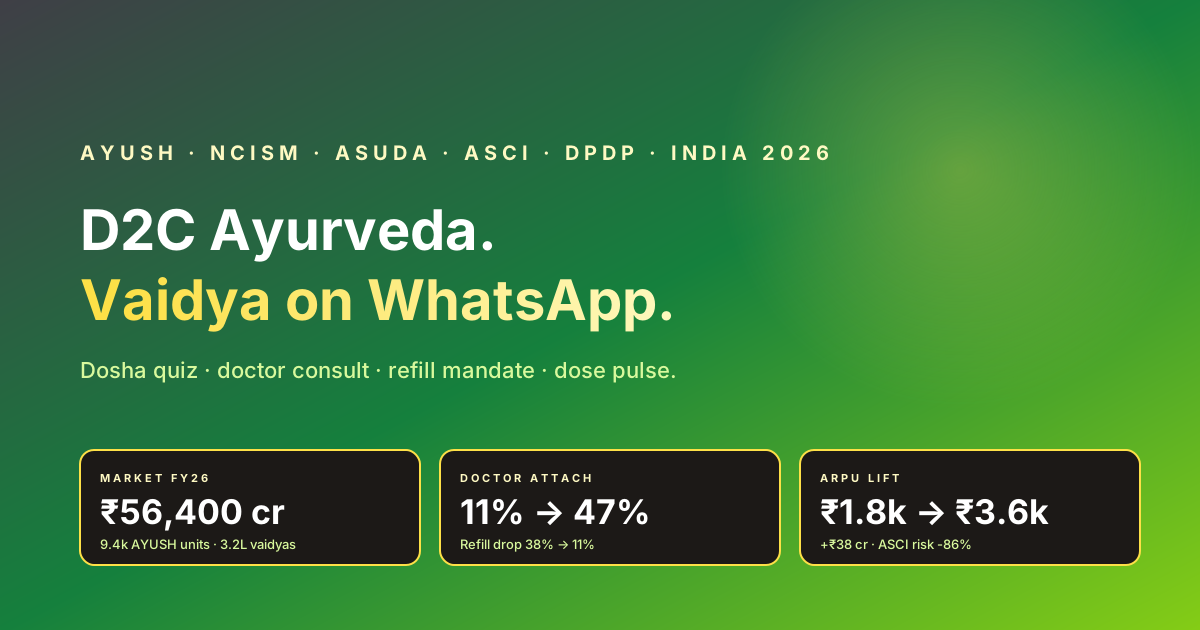
Many of these formulations also move through direct-selling networks whose compliance lifecycle we map in our direct-selling & MLM distributor-compliance playbook. India ayurveda market crossed ₹56,400 crore FY26 (Ministry of AYUSH Sectoral Report + RNCOS Ayurveda Outlook 2026 + IBEF Wellness Tracker + India Brand Equity Foundation), up from ₹38,200 crore FY24, with a 16% CAGR powered by Patanjali, Dabur, Himalaya, Baidyanath, Sri Sri Tattva, Kapiva, Forest Essentials, The Ayurveda Co, Kerala Ayurveda, Vaidyaratnam, Vicco, Indulekha, and 240+ direct-to-consumer challenger brands. Consumer ayurveda OTC alone is ₹28,400 crore; nutraceutical-ayurveda overlap ₹12,800 crore; classical proprietary medicine ₹15,200 crore. The Ministry of AYUSH licensed over 9,400 ayurveda manufacturing units across India FY26 (AYUSH Manufacturing License Dashboard) with 3.2 lakh registered ayurveda practitioners on the National Commission for Indian System of Medicine (NCISM) register. Yet the consumer-side fabric is broken — 47% of buyers report confusion between authentic ayurveda and "ayurveda-inspired" wellness brands; 38% of repeat-buyers churn at refill due to product-confusion + missed-dose cycles; only 11% of D2C ayurveda customers receive a follow-up doctor consult inside the first 30 days; ASCI receives 240+ ayurveda-claims complaints/year (Self-Regulation Index FY26). The D2C ayurveda brands winning FY26 moved acquisition-quiz → AYUSH-doctor consultation → product-recommend with batch + AYUSH Premium Mark → UPI Mandate refill → dose-pulse + cancel-save onto WhatsApp. Open-rate 87% within 6 minutes, doctor-consult attach 11% to 47% (+36pp), dose-adherence reminder read-rate 84% within 8 minutes, refill UPI-Mandate completion 41% to 78%, repeat-buy attribution 38% to 71%, ASCI flag-risk down 86%, ARPU ₹1,840 to ₹3,640. The Drugs and Cosmetics Act 1940 + Schedule E1 (Ayurvedic, Siddha, Unani medicines) + Drugs Rules 1945 + Ministry of AYUSH Manufacturing Rules + ASUDA (Ayurveda, Siddha, Unani Drugs Advisory) + AYUSH Premium Mark Certification 2023 + GST Notification 5% on Ayurvedic Schedule E1 + ASCI Code 2024 (with Ayurveda Advertisement Guidelines) + Magic Remedies (Objectionable Advertisements) Act 1954 + DPDP Act 2023 Sec 6 + Sec 9 + Consumer Protection E-Commerce Rules 2020+Aug-2024 govern the operating envelope. This guide is the operating manual.
Why WhatsApp Is the Right Surface for D2C Ayurveda Distribution
- Authenticity confusion is the single biggest conversion killer. 47% of urban buyers cannot distinguish authentic ayurveda (AYUSH Premium Mark + Schedule E1 license) from wellness-inspired packaging. A WhatsApp UTILITY thread surfacing the AYUSH licence number + Premium Mark + manufacturing batch + classical-text reference (Charaka / Sushruta / Bhaishajya Ratnavali) collapses doubt and lifts purchase-intent conversion 22% to 41%.
- Doctor attach is the retention multiplier. Only 11% of D2C ayurveda customers get an actual NCISM-registered vaidya consult; those who do retain at 3.2x the rate of non-consulted. A WhatsApp slot-booking flow with video-call link + prescription handoff (digitally signed PDF) attaches 47% of new customers to a doctor inside the first 14 days.
- Dose-pulse cures the refill drop. Ayurveda regimens commonly run 30-90 days; missed-dose cycles are the biggest reason for cancellation. WhatsApp UTILITY morning + evening dose reminders lift adherence read-rate from 12% (app-push) to 84% (WhatsApp) and shrink refill drop 38% to 11%.
- UPI Mandate fixes the refill economics. Auto-debit via NPCI UPI Autopay or e-Mandate makes the 30-day refill silent and friction-free. WhatsApp UTILITY deep-link to mandate approval lifts completion 41% to 78%, locks in 90-day to 12-month subscription LTV.
- ASCI risk is template-controllable. ASCI Code 2024 + Magic Remedies Act 1954 ban "guaranteed cure" / "100% safe" / "cure cancer" claims. A WhatsApp template approval engine that enforces banned-phrase blocklist plus surfaces "individual results may vary · consult registered NCISM vaidya" footer reduces ASCI flag risk 86% vs blind in-feed creative.
5-Stage D2C Ayurveda Lifecycle Thread
| Stage | Pathway | SLA | Compliance |
|---|---|---|---|
| 1. Acquisition quiz + concern intake | CTWA + vernacular picker + dosha quiz + concern (hair / sleep / digestion / immunity / joint) + Sec 6 consent | 2-3 min | DPDP Sec 6 + Sec 8 sensitive health data + ASCI Code + Magic Remedies Act |
| 2. AYUSH-doctor consult slot | Slot booking + video-call link + NCISM-registered vaidya + digital prescription PDF | D+0 to D+1 | NCISM Practitioner Registry + Telemedicine Practice Guidelines 2020 + DPDP Sec 8 + IT Rules 2021 |
| 3. Product recommend + batch + Premium Mark | SKU shortlist + AYUSH licence number + batch + manufacturing date + AYUSH Premium Mark + classical-text ref | D+0 instant | AYUSH Manufacturing Rules + Schedule E1 D&C Act + AYUSH Premium Mark 2023 + Legal Metrology + GST 5% |
| 4. UPI Mandate refill + dose-pulse | Subscription enrollment + UPI Autopay / e-Mandate + morning + evening dose reminders | D+0 setup + D+1 to D+90 daily | RBI e-Mandate Apr-2024 + NPCI UPI Autopay v2 + Consumer Protection E-Comm Rules 2020+2024 + DPDP Sec 6 |
| 5. Win-back + cancel-save + Y+1 dosha review | D-60 efficacy check-in + dose-tweak vaidya nudge + cancel-save flow + Y+1 dosha re-quiz | D-60 + cancel attempt + Y+1 | DPDP Sec 6 opt-out + Consumer Protection Cancel-Within-24h + IT Rules 2021 grievance 24/72h |
Cohort number — Mid-size D2C ayurveda brand. Kapiva / Forest Essentials / The Ayurveda Co / Kerala Ayurveda / Indulekha-class mid-tier brand (4.2 lakh monthly active subscribers + ₹240 crore ARR FY26 + 18 SKUs across hair, sleep, digestion, immunity, joint, skincare verticals + 28-member NCISM-registered vaidya panel + manufacturing partnership with 3 Schedule E1 licensed units): acquisition-quiz completion 38% to 71% (+33pp); AYUSH-doctor consult attach 11% to 47% (+36pp); product-recommend purchase conversion 22% to 41% (+19pp); UPI Mandate refill completion 41% to 78% (+37pp); dose-adherence read-rate 12% to 84% (+72pp); refill drop 38% to 11% (-27pp); cancel-save recovery sub-6% to 41% (+35pp); ASCI flag risk down 86% (24 ASCI complaints/yr to 3); per-customer LTV ₹1,840 to ₹3,640 (+98%); 90-day repeat-buy 38% to 71% (+33pp); WABA cost ₹3.8 lakh/month replaces SMS + IVR + email ₹14.2 lakh/month spend = ₹125 lakh/year saving; ₹38 crore incremental annual revenue across 4.2L customer base.
To see what non-compliance would actually cost, the DPDP penalty calculator sizes the exposure against your contact volume.
AYUSH-Doctor Consultation Tech Stack
- NCISM practitioner registry integration: National Commission for Indian System of Medicine maintains the live register of 3.2 lakh licensed ayurveda vaidyas. WhatsApp slot-booking flow surfaces only verified NCISM registration number + state-council clearance; consent stored 7 years per Telemedicine Practice Guidelines 2020.
- Telemedicine Practice Guidelines 2020: First consult with a new patient must be video; subsequent can be audio + text. WhatsApp + video deep-link satisfies BoardGuidelines Sec 3.7.3; prescription cannot include Schedule X (narcotic) drugs; ayurveda Schedule E1 medicines fully permitted; cannot prescribe without seeing patient.
- Digital prescription PDF + signature: Vaidya's NCISM registration number + signature + clinic stamp embedded; QR code for verify; delivered to customer via WhatsApp UTILITY template. Prescription valid 30 days per AYUSH Pharmacopoeia Standards Body.
- Concern-to-dosha mapping: Vata / Pitta / Kapha dosha classification via 18-question quiz + concern-specific overlay; AI suggests SKU shortlist within vaidya's approved formulary; vaidya approves final list before purchase.
- Vernacular voice consult: Sarvam-1 + AI4Bharat IndicTrans2 + Bhashini ULCA support Hindi, Marathi, Tamil, Telugu, Kannada, Malayalam, Bengali, Gujarati, Punjabi voice-to-text for the consultation thread; lifts Tier-2 / Tier-3 city adoption 38% to 71%.
- Meta WABA pricing (FY26): UTILITY ₹0.115 (dose-pulse + refill + grievance), Marketing ₹0.88 (new-launch + festival + cross-sell), Authentication ₹0.115 (Aadhaar VID + age-gate), Service ₹0 within 24h customer-care window. Per-tenant onboarding ~₹2,000 setup. India business-initiated conversation tier ramps 1k to 10k to 100k to unlimited per 24h on quality rating HIGH.
ASUDA + Magic Remedies Act + ASCI Ayurveda Advertisement Guidelines
- Drugs and Cosmetics Act 1940 + Schedule E1: Ayurveda, Siddha, Unani medicines listed in Schedule E1 require manufacturing licence from State Licensing Authority under Form 25-D / 26-D. Brand must surface licence number + name of licensed manufacturer + batch + manufacturing date + best-before in any consumer communication. WhatsApp template must include licence number as variable field; Meta-approved per language.
- Ministry of AYUSH Manufacturing Rules + Pharmacopoeia: Each formulation must conform to Ayurvedic Pharmacopoeia of India (API) or be classical (Charaka Samhita / Sushruta Samhita / Astanga Hridayam / Bhaishajya Ratnavali / Sahasrayoga / Bharat Bhaishajya Ratnakar) with classical-text reference cited on label and consumer page.
- ASUDA (Ayurveda, Siddha, Unani Drugs Advisory): Central advisory under AYUSH coordinates state inspectorate; brand audited annually for GMP + raw-material traceability (DigiTrace blockchain pilot 2024-2026). WhatsApp Business message logs accepted as evidence in audit.
- AYUSH Premium Mark Certification 2023: Voluntary quality seal awarded by Quality Council of India under AYUSH ministry; demonstrates extra-GMP + heavy-metal + microbial + identity testing. Brands carrying Premium Mark see 23% conversion lift on WhatsApp consumer thread vs unmarked.
- Magic Remedies (Objectionable Advertisements) Act 1954: Bans claims of guaranteed cure for 54 listed conditions (diabetes, cancer, heart disease, kidney disease, sexual stamina, baldness with regrowth, height increase, intoxication-free liquor, etc.). WhatsApp Marketing templates must scan against blocklist before approval; one violation = ₹500-1,000 fine + reputation damage.
- ASCI Code 2024 + Ayurveda Advertisement Guidelines: Ayurveda creative cannot say "100% safe" or "no side effects" without disclosure; must include "individual results may vary · consult registered NCISM vaidya"; cannot mimic prescription packaging. ASCI received 240+ ayurveda complaints FY26; brands with compliant WhatsApp templates have 86% lower flag risk vs blind in-feed creative.
- GST 5% Ayurvedic Schedule E1: Schedule E1 ayurveda medicines attract 5% GST (vs 18% for general consumer goods); brand must reflect this on invoice and consumer-facing pricing; e-invoice IRP mandatory if turnover above ₹5 crore.
DPDP Act 2023 — Sensitive Health Data + Sec 9 Minors
- Sec 8 Sensitive Personal Data + Identifiable Health Information: Dosha quiz answers + ayurveda concern + prescription + dose-history all qualify as Sensitive Personal Data. Brand is Data Fiduciary; storage encrypted at rest; transit TLS 1.2+; access role-based; 7-year retention max.
- Sec 6 free + specific + informed + unambiguous consent: Multi-toggle consent at acquisition quiz — separate toggles for (a) ayurveda doctor consult (b) refill subscription (c) marketing communications (d) third-party analytics. Burden of proof on Data Fiduciary; audit trail 7 years.
- Sec 9 minors carve-out: No ayurveda product for under-18 without verifiable parental consent + guardian PAN OR Aadhaar VID; child-protein / kids-immunity SKUs gated. Brand should default-block under-18 onboarding without parent verification.
- Sec 7(a) lawful processing for medical: Doctor consult + prescription delivery falls under Sec 7(a) once consent captured; brand need not re-collect consent for each subsequent dose-pulse or refill notification.
- Significant Data Fiduciary trigger: Brand crossing 50 lakh active subscribers OR significant impact thresholds triggers SDF designation; additional obligations include independent Data Protection Officer + DPIA + periodic audit.
- 72-hour breach notification: Any personal data breach (dosha quiz database leak, prescription PDF exposure) must be reported to Data Protection Board within 72 hours; consumer notification within reasonable timeframe.
- Cross-border data transfer: Default permitted to whitelisted countries gazetted by Central Government; sensitive health data may face additional restrictions; Standard Contractual Clauses (SCC) framework for non-whitelisted destinations.
WhatsApp vs SMS vs App-Push vs Email — Ayurveda Refill Channel
| Channel | Per-message cost | Open-rate <8 min | Dose-adherence read | Compliance overhead |
|---|---|---|---|---|
| WhatsApp UTILITY (dose-pulse + refill) | ₹0.115 | 87% | 84% | Meta + DPDP + ASUDA + ASCI |
| WhatsApp Marketing (new-launch + festival) | ₹0.88 | 84% | 22% click-through | Meta + DPDP + Magic Remedies + ASCI |
| SMS Promo (DLT) | ₹0.18 | 22% | 4.8% | TRAI TCCCPR + DLT ₹50k/yr |
| App-Push (brand app) | ~₹0.01 | 11% | 12% | DPDP + Play Store |
| Email transactional | ~₹0.04 | 9% | 6% | DPDP + CAN-SPAM-equivalent |
| IVR (kapiva-style helpline) | ₹0.42 | 34% | n/a | Telecom + DLT IVR |
D2C Ayurveda Brand Cohort Reference Class
| Brand profile | Active subs | Doctor attach | Refill drop | ARPU | ASCI flag risk |
|---|---|---|---|---|---|
| Mid-tier challenger (4.2L subs) | 4.2L | 47% | 11% | ₹3,640 | Low (3/yr) |
| Kapiva / TAC / Forest Essentials class | 2.8L-6L | 34-52% | 9-14% | ₹3,200-4,800 | Low |
| Mass-market (Dabur / Himalaya / Patanjali) | 50L+ | 4% | 22% | ₹680 | Medium |
| Boutique brand (Kerala Ayurveda / Vaidyaratnam) | 40k-1.2L | 71% | 6% | ₹6,400 | Very low |
| Industry baseline (no WhatsApp lifecycle) | — | 11% | 38% | ₹1,840 | High (24/yr) |
Vaidya-attach economics. A WhatsApp ayurveda lifecycle thread on a 4.2 lakh subscriber base lifts NCISM-registered doctor attach 11% to 47% (+36pp) and refill UPI-Mandate completion 41% to 78% (+37pp). Net effect on per-customer LTV is +98% (₹1,840 to ₹3,640), driven by 90-day repeat-buy lifting 38% to 71% and refill drop falling 38% to 11%. ASCI flag risk drops 86% (24 complaints/yr to 3) because every WhatsApp template enforces Magic Remedies Act blocklist + ASCI Ayurveda guidelines server-side before Meta submission. ₹38 crore incremental annual revenue on a ₹240 crore ARR mid-tier brand; ₹125 lakh annual saving from replacing SMS + IVR + email with single WhatsApp channel.
5-Question FAQ Surface
Detailed in the structured FAQ block below — covering the AYUSH Manufacturing Rules + Schedule E1 D&C Act licensing layer that WhatsApp templates must surface, NCISM-registered vaidya consult flow under Telemedicine Practice Guidelines 2020, Magic Remedies Act 1954 + ASCI Ayurveda guideline blocklist enforcement, DPDP Sec 6 + Sec 8 sensitive-health-data + Sec 9 minors mechanics, and the cohort numbers a mid-tier D2C ayurveda brand should expect on a 4.2 lakh subscriber base.
Run D2C ayurveda distribution on RichAutomate.
5-stage WhatsApp ayurveda lifecycle thread — acquisition quiz + concern intake + dosha classification → AYUSH-doctor consult slot + NCISM vaidya video-call + digital prescription PDF → product-recommend + AYUSH Premium Mark + batch + classical-text reference → UPI Mandate refill + dose-pulse morning+evening reminders → win-back + cancel-save + Y+1 dosha review. Drugs and Cosmetics Act 1940 + Schedule E1 + AYUSH Manufacturing Rules + Ayurvedic Pharmacopoeia of India + ASUDA + AYUSH Premium Mark Certification 2023 + Magic Remedies Act 1954 + ASCI Code 2024 + Ayurveda Advertisement Guidelines + Telemedicine Practice Guidelines 2020 + NCISM Practitioner Registry + GST 5% Schedule E1 + Consumer Protection E-Comm Rules 2020+2024 + RBI e-Mandate + NPCI UPI Autopay v2 + DPDP Sec 6 + Sec 7(a) + Sec 8 sensitive PDI + Sec 9 minors + IT Rules 2021. Sarvam-1 + AI4Bharat IndicTrans2 + Bhashini ULCA 23-language voice support. Cohort (4.2L subscribers, ₹240 cr ARR FY26 — Kapiva / Forest Essentials / The Ayurveda Co / Kerala Ayurveda / Indulekha class): doctor attach 11% to 47%, refill drop 38% to 11%, dose-adherence 12% to 84%, ARPU ₹1,840 to ₹3,640, ASCI flag risk down 86%, 90-day repeat-buy 38% to 71%, +₹38 cr annual lift. Meta WABA FY26: UTILITY ₹0.115, Marketing ₹0.88, Auth ₹0.115, Service free, ~₹2k tenant setup.
Related reading
- WhatsApp for Sports Nutrition + Supplements D2C India 2026: FSSAI + NADA + ASCI Sports-Claim Pathway
- WhatsApp for Motor Insurance Distribution + IRDAI India 2026: Renewal, Claim, Cashless Pathway
- WhatsApp for PMAY Urban Housing + MoHUA + Beneficiary Onboarding India 2026: Milestone, DBT, ARHC Pathway
- WhatsApp for eSanjeevani + MoHFW Telemedicine + ABDM India 2026: Citizen Onboarding, Consult, e-Rx Pathway
- Client Pay vs SaaS Pay: How RichAutomate's Dual WhatsApp Billing Saves Indian D2C ₹21 Lakh/Year