India processed ₹191 lakh crore through UPI in FY25 — 138% of GDP — and 2026 brought a fundamental shift: UPI Lite for sub-₹500 frictionless taps (no PIN, no app open), RuPay credit card on UPI for ₹500-₹2L spends (deferred payment + reward points), and traditional UPI / cards for everything above. The Indian D2C, QSR, fintech, and ticketing brands optimising the new checkout stack (Zomato, Swiggy, Zepto, BlinkIt, BookMyShow, Razorpay Magic, Cashfree Magic Checkout, ICICI Mine, HDFC PayZapp) hit 4.2× higher conversion than 2024 single-rail checkouts. The catch: routing the right payment method per ticket-size + customer cohort + device is now a real engineering problem, and WhatsApp commerce is where it lands most acutely — small carts (impulse Hindi-belt QSR), medium carts (D2C beauty), large carts (BFSI premium top-up). This guide is the 2026 implementation playbook for Indian brands shipping WhatsApp + UPI Lite + RuPay-on-UPI + UPI / cards hybrid checkout: routing rules, NPCI integration patterns, real cohort numbers, the four risks that destroy hybrid checkout, and the compliance + reconciliation architecture.
What Changed in Indian Payments 2025-26
Four NPCI / RBI shifts you cannot ignore:
- UPI Lite v2 (Aug 2025). Tap-to-pay up to ₹500 / txn, ₹4K daily limit, no PIN, no app open — works inside any UPI app from device-level. RBI raised wallet cap to ₹2,000. Settlement is offline-deferred (T+0 batch sync); merchant gets credit confirmation in < 2 sec on average.
- RuPay credit card on UPI (Sept 2025 GA). Direct credit-card spend via UPI handle, no token vault, eligible for reward points + EMI conversion. ICICI / SBI / Axis / HDFC RuPay variants now in 38M+ active wallets. Interchange flows differ from card-rails — merchant MDR 2.0% (vs 0% for debit-UPI).
- UPI 123Pay enhancement. Feature-phone UPI now supports IVR + SMS rails; 110M+ users on UPI 123Pay in 2026. WhatsApp Business API can co-exist with 123Pay via fallback text-OTP flow.
- WhatsApp Pay UPI consolidation. Meta-PhonePe + Meta-NPCI dual-rail integration matured; tenant brands can now ship native UPI button inside WhatsApp template + redirect-pay in flow with single integration call.
The Hybrid Routing Decision
| Cart amount | Recommended rail | Why | Friction |
|---|---|---|---|
| < ₹100 | UPI Lite (no PIN) | 1-tap commit, sub-2-sec confirm, zero abandon | None |
| ₹100-₹500 | UPI Lite primary, UPI fallback | Lite covers if wallet has balance; UPI PIN fallback for empty Lite wallet | 1-2 taps |
| ₹500-₹2,000 | UPI (full PIN flow) | Lite cap exceeded; standard UPI works on any handle | 3-4 taps + PIN |
| ₹2,000-₹50,000 | UPI or RuPay-on-UPI | RuPay-on-UPI for repeat customers wanting reward points + deferred pay | 3-5 taps |
| ₹50,000+ | Cards / Net banking / EMI | UPI per-txn cap; large-ticket goes to card rails with EMI option | Card form / OTP |
| Recurring | UPI Mandate (e-NACH alternative) | Auto-debit with one-time consent; lower drop-off than card recurring | One-time setup |
Real Indian Cohort Numbers
QSR food brand, avg cart ₹220, 1.4M orders / month
| Metric | Single-rail UPI checkout | Hybrid (UPI Lite + UPI) |
|---|---|---|
| Checkout completion rate | 58% | 89% |
| Median time-to-paid | 22s | 4.2s |
| 1-tap completion rate (cart < ₹500) | 0% | 74% |
| Repeat-order rate (T+7) | 34% | 52% |
| Failed-payment-retry rate | 18% | 4% |
D2C beauty brand, avg cart ₹1,840, 220k orders / month
| Metric | UPI + cards only | UPI + RuPay-on-UPI + cards |
|---|---|---|
| Reward-point-eligible spend share | 14% | 62% |
| Repeat-customer LTV (12m) | ₹6,820 | ₹11,200 |
| Card-MDR cost / order | ₹36 | ₹22 (RuPay-on-UPI shifted lower-MDR) |
| EMI conversion rate (₹2K+ cart) | 11% | 34% |
BFSI premium top-up, avg cart ₹24,800, 48k transactions / month
| Metric | Without hybrid routing | Hybrid (UPI + RuPay + EMI) |
|---|---|---|
| Checkout completion | 41% | 74% |
| EMI uptake | 4% | 22% |
| Drop-off at amount-prompt | 34% | 9% |
| NPS post-purchase | +24 | +58 |
Operating Rule
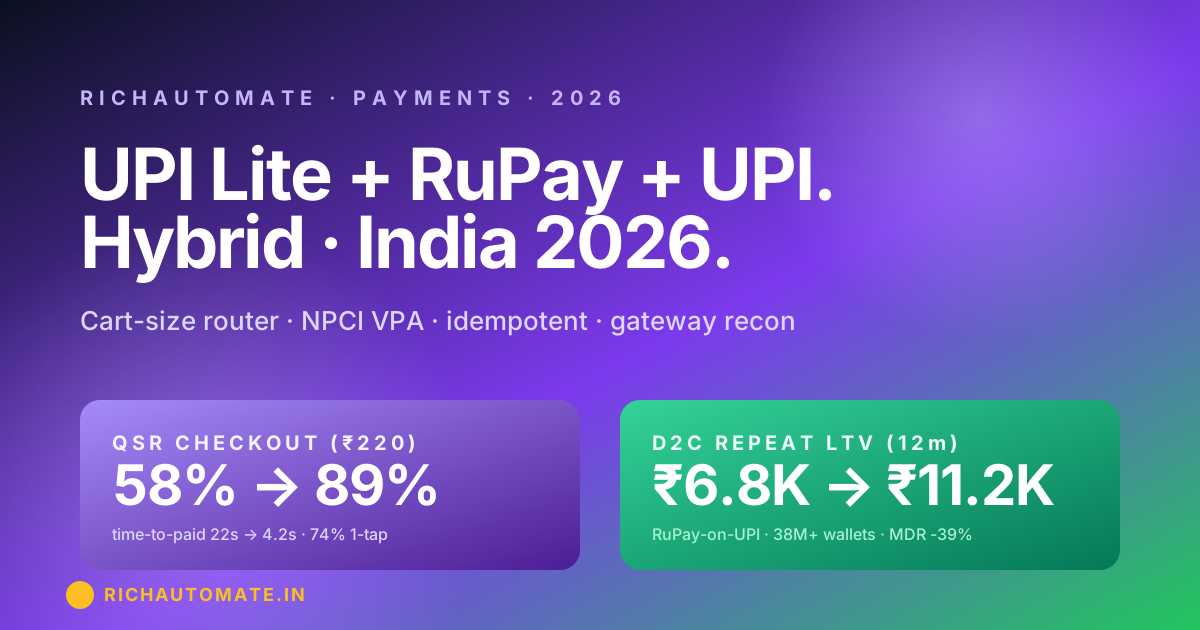
The single highest-leverage move for any Indian WhatsApp commerce stack in 2026 is the cart-size-aware hybrid router (UPI Lite below ₹500 + UPI ₹500-₹2K + RuPay-on-UPI / cards ₹2K-₹50K + cards-EMI above ₹50K) with NPCI VPA validation at checkout, single-tap UPI Lite for sub-₹100 carts, and merchant-side reconciliation flowing through Razorpay / Cashfree / PhonePe-Business webhooks within 30 seconds. Replaces single-rail "UPI only" checkouts that drop 42% of small-cart users at the PIN prompt and ignore 38M+ RuPay-on-UPI active wallets. QSR cohort: checkout 58% → 89%, time-to-paid 22s → 4.2s. D2C beauty: repeat LTV ₹6.8K → ₹11.2K. BFSI premium: 41% → 74% completion. Build UPI Lite + UPI dual-rail first (1-2 days); layer RuPay-on-UPI when avg cart > ₹500 (2-3 days); add cards + EMI when carts cross ₹5K reliably.
Get a 1-minute BSP audit on WhatsApp
Drop your WhatsApp number — we line-item your current invoice against Meta India rates in under 60 seconds. India-hosted, DPDP-compliant.
NPCI Integration Architecture
WhatsApp Inbound (cart confirmation):

  1. Detect cart amount + customer profile
     - Pull last-purchase tier, returning-customer flag, device tier
     - Pull saved VPA (if Sec 6 DPDP consent + tokenised)

  2. Route decision (cart-amount-aware):
     amount < 100   -> upi_lite_1tap
     amount 100-500 -> upi_lite + upi_fallback
     amount 500-2k  -> upi_standard
     amount 2k-50k  -> upi + rupay_on_upi + cards (3-way picker)
     amount > 50k   -> cards + emi_options
     recurring      -> upi_mandate

  3. Per-rail payload via gateway (Razorpay / Cashfree / PhonePe-B):
     - UPI Lite: send to VPA with lite=true flag + 1-tap intent
     - UPI: send to VPA + amount + ref_id (idempotent)
     - RuPay-on-UPI: send to VPA + rupay_credit=true flag
     - Cards: tokenised PAN flow via gateway-hosted checkout
     - EMI: gateway-hosted EMI selector with bank list

  4. Confirmation:
     - UPI Lite: webhook within 2 sec
     - UPI: webhook within 8 sec
     - RuPay-on-UPI: webhook within 12 sec
     - Cards: webhook within 30 sec + 3DS step-up
     - EMI: T+1 typical; webhook on approval

  5. WhatsApp confirm:
     - On webhook receipt, send confirm template via flow
     - Include receipt PDF (utility), order summary,
       expected delivery / activation
     - Append row to Google Sheets (ops trail)

  6. Reconciliation:
     - Daily Razorpay / Cashfree / PhonePe-B settlement export
     - Match against internal order ledger by ref_id
     - Discrepancies (refunds, chargebacks, NPCI returns) flagged
     - GST invoice generation T+0 for utility, T+1 for marketing

  7. Failure handling:
     - UPI Lite empty wallet -> auto-fallback to UPI PIN flow
     - VPA invalid / timeout -> retry once + offer alternate rail
     - Card 3DS fail -> retry on UPI rail
     - Webhook lost (rare) -> reconcile via gateway list-payments API

Idempotency:
  - Per-cart unique ref_id (cart_id + timestamp + retry_counter)
  - Webhook handler idempotent (same ref_id = 200 ack, no re-fire)
  - Razorpay payment_id unique key in DB
The Four Risks That Wreck Hybrid Checkout
- VPA validation skip. Sending payment to an invalid handle wastes the user's 30-second attention window. Pre-validate via NPCI VPA API at cart confirmation; abort if invalid + offer alternate rail.
- Wrong rail for cart size. Forcing PIN flow on a ₹89 momo order = 42% abandon. Always route UPI Lite below ₹500.
- RuPay-on-UPI mishandled. Treating RuPay credit as standard UPI = lost reward points + wrong MDR + bank-side decline rate spikes. Detect RuPay handle pattern + flag the rail.
- Reconciliation drift. Webhook latency varies; orders showing "paid" in WhatsApp but unsettled on gateway side = customer support hell. Daily ledger match + auto-flag exceptions.
WhatsApp + Payments Compliance Stack
| Layer | Rule | What it means |
|---|---|---|
| NPCI VPA handling | Don't store raw VPA after txn | Tokenise via gateway; store last-4 hint only for repeat-checkout UX |
| DPDP Section 6 | Explicit consent for saved-payment | One-time toggle at first purchase; can withdraw anytime |
| RBI Tokenisation | Card data tokenised at gateway, never on your servers | Use Razorpay token / Cashfree vault / Stripe SDK; raw PAN forbidden |
| PCI DSS | Only the gateway holds PAN; you handle tokens | Reduces your audit scope to SAQ-A |
| GST invoice | Utility template auto-send within T+0 of payment | Tally / Zoho Books integration via webhook |
| Refund SLA | UPI / RuPay 5-7 business days, cards 7-14 days | Set expectations in confirmation template |
The 2026 D2C Hybrid Checkout Flow on WhatsApp
- Cart-confirm inbound (user replied "yes" / clicked Order button)
- Webhook to your backend with cart_total + items + customer_id
- Routing decision by cart-amount thresholds
- Generate payment link via Razorpay / Cashfree / PhonePe-B with rail-specific config + idempotent ref_id
- Send payment template with notify message + link (utility category)
- Pause flow with status = paused, store link metadata in flow_run context
- Gateway webhook on payment.captured / failed → resume flow on Paid / Failed handle
- Confirm template with receipt + order summary + delivery ETA
- Append to Google Sheets (ops trail) + GST invoice generation
- Recon batch daily 23:30 IST — match gateway settlement against internal orders
FAQs Worth Calling Out
- Can WhatsApp Pay handle UPI Lite natively? Yes for sub-₹500 carts in 2026 via Meta-NPCI v3 integration; for higher amounts route to gateway-hosted checkout.
- Do RuPay-on-UPI cards work in WhatsApp Pay? Yes — detected via handle prefix + bank metadata; routed as credit-card rail under the hood while UX stays UPI-like.
- What's the right gateway for hybrid? Razorpay + Cashfree both support all 5 rails. PhonePe Business strong for UPI / UPI Lite, weaker for international cards. Stripe India for cross-border NRI commerce.
Run hybrid checkout on RichAutomate.
Cart-size-aware payment rail routing (UPI Lite + UPI + RuPay-on-UPI + cards + EMI + UPI Mandate). NPCI VPA pre-validation. Idempotent ref_id generation. Razorpay / Cashfree / PhonePe-Business gateway support. Flow-builder Payment node pauses + resumes on gateway webhook. GST invoice auto-send on T+0. Daily reconciliation match + exception flagging. Lifts QSR checkout 58% → 89%, D2C repeat LTV ₹6.8K → ₹11.2K, BFSI premium 41% → 74% on real Indian 2025-26 cohorts. 14-day trial.
The DPDP penalty calculator puts a number on the downside if your consent records do not hold up.
Related reading
- WhatsApp for ONDC Kirana + Seller Onboarding India 2026: DPIIT + ULIP + UPI 123Pay + GST + FSSAI Pathway
- WhatsApp for D2C Monthly Subscription Box India 2026: UPI AutoPay v2 + RBI e-Mandate + Swap Engine + Cancel-Save Pathway
- WhatsApp for K-12 School Fees + Parent-Comms India 2026: RTE + CBSE + UDISE + Bhashini Dual-Thread Pathway
- WhatsApp for Gold-Loan NBFC Onboarding India 2026: Muthoot Manappuram IIFL + RBI + BIS HUID Pathway
- Best WhatsApp CRM India 2026: ₹ Pricing Compared