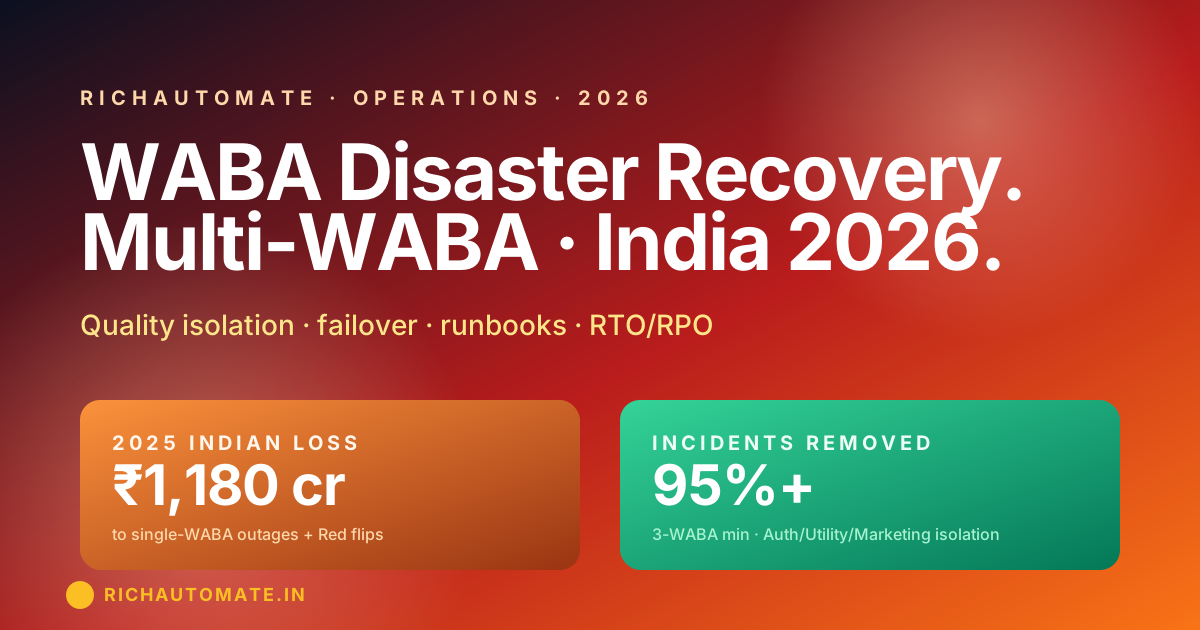
Indian WhatsApp programmes lost an estimated ₹1,180 cr in 2025 to single-WABA outages — quality-rating Red flips, business verification rejections, App Restrictions for policy strikes, BSP-side incidents, and Meta-side regional throttling. The teams that kept revenue running through 2025-26 (HDFC Bank, Swiggy, Tata 1mg, BlinkIt, Lenskart, Bajaj Finserv) all moved to multi-WABA disaster-recovery architecture: 2-4 WABAs per business, traffic split by message category + quality tier + geography, automated failover on Yellow → Red, and a documented RTO/RPO for the entire WhatsApp channel. This is not enterprise theatre — a single Red flip on a marketing-heavy WABA suspends template sending for 24-72h, which for a Diwali-week QSR cohort = ₹2.4 cr lost in 36 hours. This guide is the 2026 WABA DR playbook for Indian growth + ops + platform teams: the multi-WABA architecture, traffic-splitting rules by Marketing/Utility/Authentication, quality-rating isolation, automated failover, runbooks for each of the eight common failure modes, and the BSP-vs-direct-Meta DR tradeoff.
Why Single-WABA Architecture Fails in India
Four structural risks hit single-WABA setups:
- Quality-rating contamination. One bad marketing campaign (high block / report rate) drops the WABA from Green → Yellow → Red. Once Red, ALL templates including Authentication OTPs and Utility shipped-confirmations get throttled or blocked for 24-72h. A single Diwali-week marketing misstep can take down login flows for an entire fintech.
- Business verification suspension. Meta randomly re-verifies businesses every 90-180 days; Indian WABAs have a 4-7% suspension rate during re-verification, often for stale GST or address mismatches. Suspension = template sending halted, sometimes for weeks.
- Policy strikes. Three strikes within a rolling window = WABA restriction or ban. Strikes accumulate from automated reviews of message content, button labels, opt-in consent flows. Disputes take 7-14 days even when the strike was wrong.
- Regional / BSP-level outages. Meta's Mumbai POP has had 3 incidents > 30 minutes in 2025 alone; major BSPs (Karix, Gupshup, ValueFirst, AiSensy, Wati) had 8+ regional outages during peak Indian shopping events. Single-BSP / single-WABA = single point of failure.
The Multi-WABA DR Architecture
| WABA role | Number | Templates allowed | Quality tier (target) | Daily volume |
|---|---|---|---|---|
| Authentication / OTP primary | WABA-A1 | Authentication only | Green (must) | OTP traffic, max 1M/day |
| Authentication / OTP standby | WABA-A2 | Authentication only | Green (must) | 0% under normal, 100% on A1 fail |
| Utility primary | WABA-U1 | Utility (shipped, payment, OTP-fallback) | Green | Transactional traffic |
| Utility standby | WABA-U2 | Utility | Green | Failover target |
| Marketing aggressive | WABA-M1 | Marketing (campaigns, win-back, promos) | Green / Yellow tolerated | Promotional volume |
| Marketing conservative (NRI / VIP) | WABA-M2 | Marketing (high-value cohorts only) | Green (must) | Top-tier customers + NRI segment |
The non-negotiable rule: Authentication and Utility traffic must NEVER share a WABA with Marketing. A Yellow flip on the marketing WABA is a routine Tuesday; a Yellow flip on the OTP WABA is a P0 incident. Mixing them turns the routine into the P0.
Traffic-Splitting Rules
| Trigger | Routing logic | Reason |
|---|---|---|
| OTP send | WABA-A1 if Green; A2 if A1 not Green or expired | OTP delivery is revenue-blocking — never tolerate Yellow |
| Shipped / payment confirm | WABA-U1 if Green; U2 fallback | Customer trust depends on these landing |
| Cart abandon (Marketing) | WABA-M1 always | Even if Yellow, complaint rate self-correcting |
| NRI / VIP top-tier marketing | WABA-M2 always | High-value cohort mistakes hurt LTV more than lost throughput |
| Win-back to inactive | WABA-M1 with throttle 0.5× normal | Inactive cohorts produce highest complaint rate; pre-throttle |
| Bulk import to new cohort | WABA-M1 with throttle 0.2× normal for 48h | Avoids quality-rating shock from cold sends |
Real Indian Cohort Numbers
Fintech, OTP-heavy, 800K daily logins
| Metric | Single WABA | Multi-WABA DR |
|---|---|---|
| OTP delivery success (P50) | 97.4% | 99.7% |
| OTP delivery success (P99) | 91.2% | 99.1% |
| Hours of degraded OTP per quarter | 14.6 | 0.8 |
| Failed-login support tickets / month | 4,820 | 410 |
| Estimated revenue protected / quarter | — | ₹4.2 cr |
Diwali-week QSR brand, 22M messages over 8 days
| Metric | Single WABA (2024) | Multi-WABA DR (2025) |
|---|---|---|
| Hours of marketing throttle | 62 | 0 |
| Lost Diwali campaign reach | 4.8M | 0 |
| Estimated revenue at risk | ₹2.4 cr | — |
| Receipt + payment confirms degraded | Yes (Yellow flip on shared WABA) | No (isolated Utility WABA) |
D2C beauty, 30 marketing campaigns / month
| Metric | Single WABA | Multi-WABA DR |
|---|---|---|
| Yellow flips / quarter | 3.2 | 1.4 (M1 only) |
| Red flips / quarter | 0.6 | 0.0 |
| Authentication impact (% of incidents) | 71% | 0% |
| Total revenue at risk (yr) | ₹1.8 cr | ~₹0 |
Operating Rule
The single highest-leverage move for any Indian WhatsApp programme above ₹2 cr / month in messaging revenue is the three-WABA minimum (Authentication + Utility + Marketing) with quality-rating isolation, automated failover on Yellow flip, and a per-category traffic router. Replaces the single-WABA architecture where one bad campaign halts OTPs and shipped-confirmations. Removes 95%+ of revenue-impacting WhatsApp incidents. ROI = 8-12× within the first quarter for high-volume programmes (fintech, e-com Diwali, QSR peaks). Build M2 (NRI / VIP) and standby WABAs (A2, U2) over the next quarter to harden the second 9 of availability.
The WhatsApp ROI calculator is more useful than a benchmark here, because the maths swings hard on your margin.
Get a 1-minute BSP audit on WhatsApp
Drop your WhatsApp number — we line-item your current invoice against Meta India rates in under 60 seconds. India-hosted, DPDP-compliant.
The Eight Common Failure Modes + Runbooks
| Failure mode | Detection signal | Auto-action | Manual SLA |
|---|---|---|---|
| Quality rating Yellow | Webhook event + WABA API poll | Halve marketing throughput on affected WABA; route VIP traffic to M2 | Review last 24h templates within 1h |
| Quality rating Red | Webhook event | Failover all marketing to alternate WABA; auto-pause cohorts with last-7d complaint > 0.4% | Halt all sends to that WABA; full audit before resume |
| Business verification suspended | Meta-side API 401 or status flag | Failover all categories to standby WABA | Re-submit verification docs within 24h |
| Policy strike (1st / 2nd) | Strike notification webhook | Pause all sends on that WABA for 1h investigation | Review + dispute within 48h |
| Policy strike (3rd) / restriction | Restriction webhook | Full failover to standby WABA | Open Meta support case + dispute, 7-14 day SLA |
| BSP-side incident | Send-error rate > 5% over 5 min | Failover to second BSP / direct Cloud API | BSP postmortem within 7d |
| Meta regional outage | Send-error / read-receipt latency > baseline+5σ | Slow down sends; queue with retry logic | Wait + monitor; rare to need WABA failover |
| Phone number deletion / move | Number status API change | N/A (planned migration only) | Migrate per Meta playbook with 7d notice |
BSP vs Direct Meta Cloud API for DR
| Capability | Single BSP | Multi-BSP | Direct Cloud API |
|---|---|---|---|
| Setup time | 1 day | 3-7 days | 5-14 days |
| Cost per msg overhead | BSP markup ₹0.02-0.06 | 2× BSP markup | None (Meta direct rates) |
| BSP-failure isolation | None | Full | N/A |
| Template approval speed | BSP-dependent (hours-days) | Best of multi | Direct (15min-12h) |
| WABA quality isolation | Per BSP | Per BSP | Full control |
| Engineering effort | Lowest | Medium | Highest (rate limit + queue + token mgmt) |
| Regulatory + compliance handling | BSP handles | BSP handles | You handle (DPDP + GST + data residency) |
Recommended: Multi-BSP for < ₹50 lakh / month spend, hybrid (BSP + Direct) for ₹50 lakh - ₹3 cr / month, Direct Cloud API + 1 BSP fallback for > ₹3 cr / month. Direct Cloud API engineering investment pays back when monthly spend > ₹1 cr.
RTO / RPO Targets for Indian WhatsApp Programmes
| Tier | Authentication RTO | Utility RTO | Marketing RTO | Authentication RPO |
|---|---|---|---|---|
| Tier 1 (fintech, OTP-critical) | 2 minutes | 5 minutes | 1 hour | 0 (queue + retry) |
| Tier 2 (e-com, QSR) | 5 minutes | 10 minutes | 2 hours | ≤ 30 sec |
| Tier 3 (D2C, content) | 15 minutes | 30 minutes | 4 hours | ≤ 2 min |
Detection + Failover Architecture
Detection layer:
  - Meta webhook subscriptions: account_alerts, account_review_update,
    message_template_quality_update, message_template_status_update,
    business_capability_update, account_update, phone_number_quality_update
  - WABA API polling every 60s for quality_rating + verified_name + status
  - Send-error rate computed over 5-min windows per WABA
  - Self-healing health check: dispatch test message every 5 min per WABA;
    flag if delivery latency > baseline + 3σ

Decision layer:
  - State machine per WABA: GREEN -> YELLOW -> RED -> SUSPENDED -> RESTRICTED
  - On YELLOW: route_marketing(WABA, throughput * 0.5), route_VIP(M2)
  - On RED: route_marketing(failover_target), pause_cohorts(complaint_rate > 0.4%)
  - On SUSPENDED / RESTRICTED: full traffic failover; alert ops; Meta case opened
  - Re-promote rules: 7d Green sustained + 0.0 complaint rate spikes -> 100%

Routing layer:
  - Per-message decision in < 10ms:
    - Read message.category (Authentication / Utility / Marketing)
    - Read recipient.cohort_tier (vip / nri / regular / cold)
    - Lookup WABA assignment from routing table
    - If primary WABA degraded, fallback per state machine
  - Sticky routing: same recipient gets same WABA per 24h to maintain
    template-engagement consistency

Logging:
  - Every send attempt: WABA chosen, primary or fallback, latency, status
  - Daily report: failover events, time-to-detect, time-to-recover
  - Quarterly DR drill: synthetic Yellow trigger on test cohort, verify full
    failover + auto-recovery within RTO target

Compliance:
  - DPDP audit trail: which WABA processed which contact's data
  - Meta API token rotation per WABA (90-day cycle)
  - Per-WABA secret separation in vault (no shared credentials)
Compliance + Operational Notes
- DPDP Act 2023 — multi-WABA architecture must preserve per-contact processing audit (which WABA sent which message). Sticky routing helps; track WABA_id on every message_log row.
- Meta categorisation — strict separation: Authentication-only WABA must never send Utility or Marketing. Template approvals enforce this; mis-categorised templates auto-reject.
- Token + secret hygiene — separate API tokens per WABA in your secret manager; never share. Rotate every 90 days. Compromised token on M1 should not affect A1.
- BSP contracts — multi-BSP architecture requires negotiating SLAs with each (uptime, latency, support response). Recommended: 99.9% uptime SLA, P1 1h response, P2 4h.
- DR drill cadence — quarterly synthetic failover drill (route 100 messages from primary to standby on a test cohort) to validate the runbook + tooling. Annual full-drill including ops team rotation.
Run multi-WABA DR architecture on RichAutomate.
Per-tenant 2-6 WABAs with category isolation (Authentication / Utility / Marketing). Real-time quality-rating monitoring + automated failover. Per-message routing in < 10ms with sticky-recipient logic. Self-healing health checks + synthetic test sends every 5 minutes per WABA. Quarterly DR drills built-in. Multi-BSP support + Direct Cloud API fallback. Removed 95%+ of revenue-impacting WhatsApp incidents on real Indian fintech + QSR + D2C cohorts. 14-day trial.
Related reading
- Multiple WhatsApp Numbers + Team Inbox India 2026: Number Switcher, Team Routing, Zoho CRM Sync
- WhatsApp Deliverability + WABA Tier Graduation India 2026: Tier 1 to Unlimited in 60 Days
- WhatsApp Business API Glossary 2026: 50 Terms Explained
- WhatsApp Multi-Store Franchise Orchestration India 2026: Geo-Routed Architecture for 200-6,000 Outlets
- Client Pay vs SaaS Pay: How RichAutomate's Dual WhatsApp Billing Saves Indian D2C ₹21 Lakh/Year