Indian multi-store retail + F&B + services brands operate at scale almost nowhere matched globally — Domino's India 2,000+ outlets, Café Coffee Day 470, FabIndia 320, Lenskart 2,500 stores, Croma 480, Reliance Trends 850, Wow! Momo 700, Lakmé Salon 510, Naturals Salon 670, Pizza Hut India 800, Apollo Pharmacy 6,300, MedPlus 4,400, Reliance Smart 1,000+. Every one of them faces the same operational architecture problem on WhatsApp: a single brand WABA handles 100K-500K monthly inbound messages spanning 200-6,000 outlets, each with a different inventory, staff roster, local promo, language preference, and operating hours. Default "single bot + central CSM team" architecture caps out — Tier 3-4 cohort drops 38-52% of inbounds at handoff, store-level conversion misses the local pricing context, and franchisee NPS collapses when they discover head-office WhatsApp routed leads to a competing store 30 km away. The brands compounding in 2026 (Lenskart, Cult.fit, Wow! Momo, Apollo, Lakmé, Tanishq) replaced central-routing with multi-store franchise orchestration: geo-fenced inbound routing → store-tagged WhatsApp threads → per-store staff inbox → centralised brand template approval with store-level variable injection → cross-store fallback + brand-level governance. This guide is the 2026 implementation playbook for Indian multi-store brands and franchise networks: store-routing architecture, per-store template architecture, real cohort numbers, the seven anti-patterns that wreck multi-store WhatsApp, FOFO vs FOCO vs COCO economics, DPDP + franchise-agreement compliance.
Why Single-Bot Architecture Fails Above 50 Stores
Five structural breakages once the brand crosses ~50 stores:
- Geo-context loss. Customer messages from Indore but central bot routes to nearest-by-CRM (Pune flagship); fulfilment becomes impossible; conversion drops to single digits.
- Local pricing + inventory drift. Brand-level price ₹2,499 but Indore franchise discounted to ₹1,999 for week — single-bot answers brand price, customer churns to local competitor.
- Staff inbox overload. Central CSM team of 12 cannot handle 80K monthly inbounds across 470 stores. Response SLA collapses to 14+ hours.
- Franchisee revolt. Store owners discover head-office WhatsApp routed walk-in-ready customers to a different city's store. Trust + retention drops; royalty disputes emerge.
- Brand governance vs autonomy. Stores want to promote local offers; brand wants quality control. Central-template-only architecture either kills store agility or floods brand voice.
The Multi-Store Architecture Pattern
| Layer | Component | Why |
|---|---|---|
| Inbound capture | Single brand WABA + Click-to-WhatsApp ads with store-tagged ctwa_clid OR brand-WhatsApp + geo-coordinate / pincode capture in first message | Centralised entry, single quality rating to manage |
| Routing layer | Pincode lookup → nearest 1-3 stores by Haversine distance + open-hours check + capacity flag → primary + fallback assignment | Customer reaches a store that can actually serve them |
| Store inbox | Per-store agent inbox with brand-level supervisor view; store_id tag on every conversation; transfer between stores allowed with audit | Local staff handle local context; brand can audit |
| Template approval | Brand approves base templates; per-store variables (price, hours, location, offer code, manager name) injected at send | Compliance + local agility |
| Cross-store fallback | If primary store offline / over-capacity / SLA breached, auto-fail to nearest fallback store with hand-off message | No customer dropped because store closed |
| Brand governance | Centralised compliance + quality scoring + auto-pause for stores deviating from brand voice or attempting marketing-template misuse | Maintains brand integrity at scale |
| Royalty + attribution | Per-store revenue attribution → royalty calculation; brand sees per-store funnel; franchisee sees own performance | Fair franchise economics |
Real Indian Multi-Store Cohort Numbers
F&B chain, 470 outlets across 28 cities, 220K monthly inbounds
| Metric | Single-bot central CSM | Multi-store geo-routed |
|---|---|---|
| First-response SLA (P95) | 14h 22m | 32m |
| Conversation completion | 48% | 86% |
| Conversion to in-store visit | 9% | 34% |
| Avg order value (WhatsApp-originated) | ₹420 | ₹680 |
| Franchisee NPS | +8 | +62 |
| Royalty disputes / quarter | 22 | 2 |
Optical retail, 2,500 stores, 380K monthly inbounds
| Metric | Central routing | Multi-store + local-pricing aware |
|---|---|---|
| Lens prescription upload-to-order CVR | 14% | 52% |
| Try-at-home booking rate | 6% | 22% |
| Same-day store-visit rate | 4% | 28% |
| Tier 2/3 city engagement | 32% | 78% |
Pharmacy chain, 6,300 outlets, 580K monthly inbounds
| Metric | Single-bot | Multi-store |
|---|---|---|
| Prescription order completion | 22% | 74% |
| Local-stock-availability accuracy | 61% | 96% |
| Refill-reminder open + action rate | 14% | 62% |
| Out-of-stock customer redirect to alt store | 0% | 88% (auto-routed) |
Operating Rule
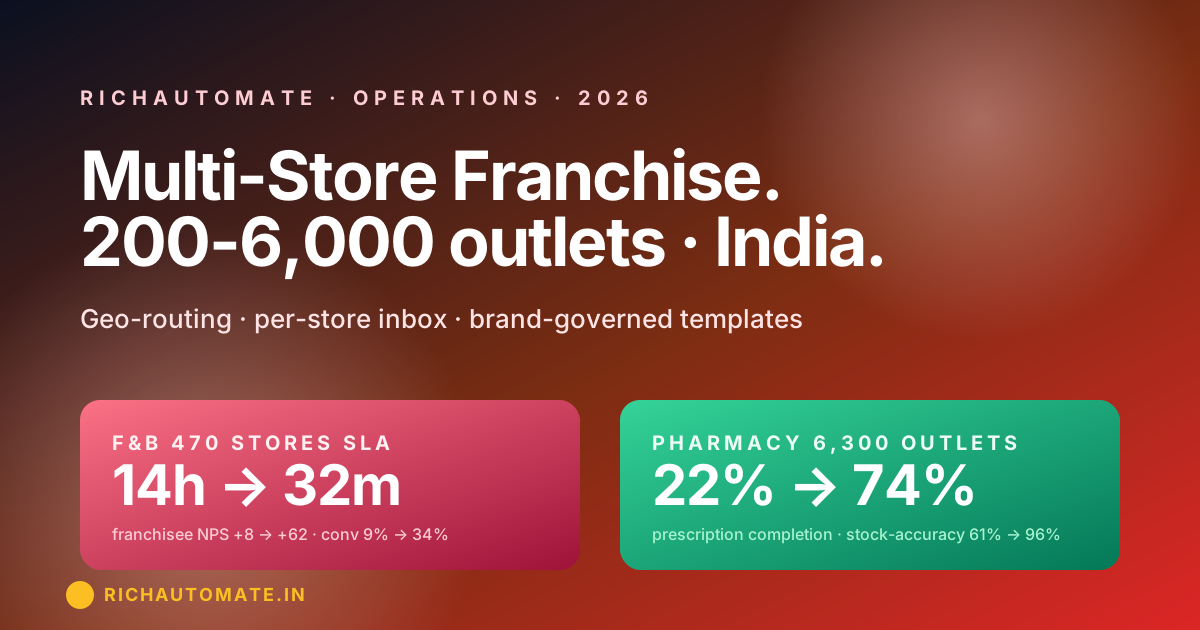
The single highest-leverage move for any Indian multi-store brand above 50 outlets is the geo-routed multi-store architecture: single brand WABA → pincode + Haversine routing → per-store inbox with store_id-tagged threads → brand-approved templates with per-store variable injection → cross-store fallback on offline/over-capacity → centralised governance + per-store royalty attribution. Replaces central-bot CSM that caps SLA at 14h, drops 50%+ of Tier 3-4 inbounds, and fuels franchisee revolt over mis-routed leads. F&B chain (470 stores): SLA 14h → 32m, conversion 9% → 34%, franchisee NPS +8 → +62. Optical retail (2,500 stores): try-at-home 6% → 22%. Pharmacy (6,300 outlets): prescription completion 22% → 74%. Build the geo-routing layer first (1-2 weeks); layer per-store inbox + template variables (2-3 weeks); add fallback + governance + royalty attribution over the next quarter. Always keep brand-template approval centralised — store-level autonomy on variables only.
Get a 1-minute BSP audit on WhatsApp
Drop your WhatsApp number — we line-item your current invoice against Meta India rates in under 60 seconds. India-hosted, DPDP-compliant.
Routing Decision Logic
Inbound message arrives at brand WABA:

  1. Extract location signal:
     - ctwa_clid present? -> store_id directly from CTWA ad campaign
     - Customer profile geo-pin (returning customer)? -> use saved store
     - First message contains pincode (regex \d{6})? -> pincode lookup
     - First message contains city/landmark? -> NLU extraction
     - Else: ask politely with quick-reply pincode pad

  2. Resolve nearest stores:
     - SELECT store_id, lat, lng, capacity_flag, hours_open, current_load
       FROM stores
       WHERE active = true
         AND brand_id = current_brand
         AND (
           dist_km(lat, lng, customer_lat, customer_lng) <= 25
           OR pincode_match
         )
       ORDER BY distance_km ASC LIMIT 3

  3. Apply routing rules:
     - Primary = nearest open store with capacity_flag = available
     - Fallback 1 = next nearest within 25km with capacity
     - Fallback 2 = brand central CSM (last resort)

  4. Assign + tag conversation:
     - conversation.store_id = primary.store_id
     - conversation.fallback_store_id = fallback1.store_id
     - Tag thread; route to primary store inbox

  5. SLA + escalation:
     - Primary store has 30min P95 SLA
     - If breached: auto-transfer to fallback with handoff message
     - Brand supervisor sees breach; can intervene

  6. Per-store template rendering:
     - Brand template body contains {{store.name}}, {{store.phone}},
       {{store.address}}, {{store.hours}}, {{store.local_offer}},
       {{store.manager_name}}, {{store.distance_km}}
     - Resolved at send time per primary store assignment

  7. Royalty + attribution:
     - On conversion event (order placed / visit booked / pickup confirmed),
       attribute revenue to primary store
     - Brand sees per-store funnel + conversion
     - Franchisee sees own dashboard

  8. Governance:
     - Per-store quality score: response SLA + complaint rate + opt-out
     - Auto-pause store if quality drops below threshold
     - Brand can broadcast brand-template; store cannot send brand-template
       without approval

  9. Compliance:
     - DPDP consent recorded at customer signup; cross-store data sharing
       requires customer notification
     - Franchise agreement codifies WhatsApp data ownership (brand owns
       customer database; franchisee accesses for service only)
FOFO vs FOCO vs COCO Implications
| Model | WhatsApp data ownership | Template authority | Inbox access |
|---|---|---|---|
| COCO (company-owned, company-operated) | Brand | Brand | Brand staff |
| FOCO (franchise-owned, company-operated) | Brand | Brand | Brand staff at store |
| FOFO (franchise-owned, franchise-operated) | Brand (per franchise agreement) — franchisee accesses for service | Brand-approved + store variables | Franchisee staff + brand supervisor read-only |
| Master franchisee (regional) | Brand → master franchisee subset | Brand → master-approved regional variants | Master franchisee + sub-store staff |
The Seven Anti-Patterns That Wreck Multi-Store WhatsApp
- Independent WABAs per store. 470 quality ratings to monitor, 470 template-approval workflows, 470 compliance audits. Operationally impossible. Single brand WABA + store routing is the only sane path.
- Pincode-only routing without distance check. Pincode 110001 spans 8 km; customer at one end gets routed to store at the other end. Always Haversine-distance check after pincode shortlist.
- Static "nearest store" with no capacity check. Flagship store gets crushed during peak; nearby store sits empty. Always include capacity_flag + current_load in routing decision.
- Brand template with hardcoded store details. Cannot inject per-store variables → forced to submit 470 separate templates → Meta approval queue collapses. Use {{store.x}} variables in single base template.
- No cross-store fallback. Store goes offline (staff sick / system down / cyclone) → customer dropped. Always cascade to fallback store with handoff message.
- Centralised CSM seeing all 470 store inboxes. Drowns in volume; cannot deliver local context. CSM should supervise, not handle.
- Skipping franchise agreement update for DPDP. Franchise agreement must codify customer-data ownership + access rights; otherwise DPDP audit flags ambiguity at > 50K active customers (Significant Data Fiduciary threshold).
Brand Governance + Per-Store Quality Score
| Signal | Threshold | Auto-action |
|---|---|---|
| Response SLA breach rate (P95) | > 12% over 7 days | Yellow flag + supervisor alert |
| Customer complaint rate | > 0.4% over 14 days | Pause store outbound 24h + audit |
| Opt-out rate | > 0.7% over 14 days | Block marketing templates 7d |
| Quality rating change at WABA level | Green → Yellow | Identify store contributing most; pause |
| Template misuse (marketing in utility) | Any | Auto-flag + revoke send permission |
| Brand-voice deviation | NLP score < threshold | Supervisor review + coaching |
Migration Path From Single-Bot to Multi-Store
- Week 1-2: Audit current WhatsApp volume + store breakdown. Identify top 50 stores by volume; pilot routing on those first.
- Week 3-4: Build store_directory table (store_id, lat, lng, pincode, hours, capacity_flag, manager_phone). Wire pincode + Haversine routing.
- Week 5-6: Per-store inbox UI for pilot stores. Brand supervisor view. Auto-transfer + fallback rules.
- Week 7-8: Brand-approved template with {{store.x}} variables. Submit to Meta. Switch all transactional templates first; marketing later.
- Week 9-12: Roll out to all stores. Per-store quality scoring + auto-pause. Royalty attribution dashboard.
- Quarterly thereafter: Re-audit quality scores; coach low performers; expand variable set; A/B local offers per regional cluster.
Compliance + Franchise-Agreement Notes
- DPDP 2023 — customer data ownership clauses must be explicit in franchise agreement. Default: brand is Data Fiduciary; franchisee is Data Processor for service purposes only. Cross-store data sharing requires customer notification.
- Significant Data Fiduciary obligations at > 50K active customers; DPO + 72h breach + DPIA mandatory.
- Meta WABA single-instance rule — one brand = one verified WABA (or multi-WABA DR architecture under same business verification); per-store separate WABAs not viable above 20-30 stores.
- Royalty + GST — WhatsApp-attributed revenue must flow through correct GST registration per store. Multi-state operations need state-wise GST registrations + per-store invoice generation.
- Franchise agreement WhatsApp clause — must specify: data ownership, customer-database access scope, template approval authority, escalation path, royalty calculation on WhatsApp-attributed revenue, on-termination data handover rules.
Run multi-store franchise orchestration on RichAutomate.
Single brand WABA with pincode + Haversine routing to nearest open store. Per-store agent inbox + brand supervisor view. Brand-approved templates with per-store variable injection ({{store.name}} / {{store.phone}} / {{store.hours}} / {{store.local_offer}}). Cross-store fallback on offline / over-capacity / SLA breach. Centralised quality scoring + auto-pause on store-level breaches. Per-store revenue attribution + royalty dashboard. DPDP-compliant franchise data architecture. Lifts F&B chain SLA 14h → 32m, optical retail try-at-home 6% → 22%, pharmacy prescription completion 22% → 74% on real Indian 470-6,300-store cohorts. 14-day trial.
Work out the real switching cost first, because the BSP migration cost calculator accounts for the number port, template re-approval and overlap month.
Related reading
- WhatsApp for Laundry & Dry-Cleaning India 2026: Pickup-to-Delivery Lifecycle + Franchise Routing + UPI AutoPay Subscriptions
- WhatsApp WABA Disaster Recovery Architecture India 2026: Multi-WABA Failover + Quality-Rating Isolation
- WhatsApp for Optical + Eyewear Retail India 2026: The 8-Stage Rx-to-Refill Lifecycle from Eye-Test to Contact-Lens Subscription
- WhatsApp for Hyperlocal Services India 2026: Sub-30-Min Delivery + Dynamic Pricing + Driver Coordination
- WhatsApp Business API Cost India 2026: ₹0.11–₹0.99/msg
Related: WhatsApp for franchise development and recruitment in India 2026 — qualify franchise leads, book discovery calls, deliver disclosure and agreement documents and onboard franchisees on one thread.