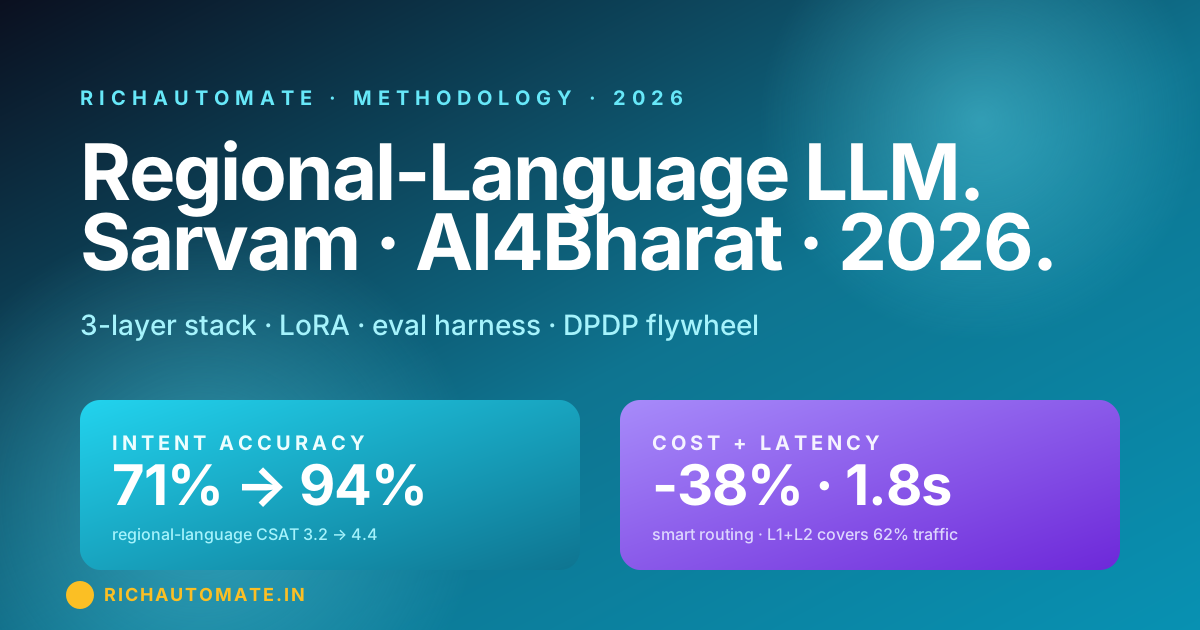
Indian WhatsApp bots running on stock GPT-4o-mini / Claude Haiku / Gemini Flash in 2026 still drop 22-38% of regional-language conversations in Tier 2/3 cities — wrong Devanagari spelling of Marathi loan-words, hallucinated Bengali Tatsama vocabulary, broken Tamil verb-conjugations, mis-classified Hinglish code-switch intents. The teams winning regional engagement (PhonePe, CRED, Meesho, Tata Neu, BharatPe, Zerodha, Vedantu) replaced single-stock-model architectures with a 3-layer regional-language stack: Sarvam Sarvam-2B / AI4Bharat IndicTrans2 / Bhashini for STT + translation + light NLU, fine-tuned Haiku or Sarvam-1 domain models for high-confidence intents, and stock GPT-4o-mini / Gemini Flash fallback for open-ended conversation. Result: regional-language CSAT climbs from 3.2 → 4.4 (out of 5), intent accuracy 71% → 94%, average cost per conversation drops 38% from smarter routing, and P95 latency stays under 1.8s. This guide is the 2026 implementation playbook for Indian platform teams: the 3-layer stack, when to fine-tune vs prompt-engineer vs translate-and-route, real cost-per-conversation math, evaluation harness with regional-language test sets, and the DPDP-compliant data flywheel.
Why Stock LLMs Fail Indian Regional Languages
Four structural failures hit stock frontier models on Indian regional WhatsApp:
- Tokeniser inefficiency. GPT-4o tokenises Devanagari at 3.2-4.1 bytes / token vs 1.0-1.4 for English. Marathi / Bengali / Tamil texts cost 2.8-3.4× more tokens. A 200-word reply in Hindi = 700 tokens; same content English = 220.
- Training-data thinness. Stock model training corpora are 92%+ English. Indic representation is < 0.6% by token count. Domain-specific vocabulary (BFSI, healthcare, GST, RTO, ICAI) in regional languages = near-zero training signal.
- Hinglish code-switch ambiguity. Indian users write "refund kab tak aayega" (Roman Hinglish), "रिफंड कब तक आएगा" (Devanagari Hindi), or pure English in the same conversation. Stock models pick wrong reply language 14-22% of the time.
- Domain + dialect drift. Marathi in Mumbai (English loan-words OK) differs from Pune Marathi (Sanskritised); Bangla in Kolkata differs from Bangla in Dhaka (relevant for Bangladeshi NRI traffic). Stock models default to a flattened "standard" that pleases no one.
The 3-Layer Regional-Language Stack
| Layer | Models | Role | Cost / 1K conv | P95 latency |
|---|---|---|---|---|
| L1: STT + Translate + Pre-NLU | Sarvam-2B Saaras (STT), AI4Bharat IndicTrans2 (translate), Bhashini (light NLU) | Voice → text in source language, translate to English where useful, classify language + script + dialect + intent confidence | ₹38 | 340 ms |
| L2: Fine-tuned domain LLM | Sarvam-1 fine-tuned, or Haiku 4.5 fine-tune on 8-12 regional intents, or Gemini Flash custom-tuned | High-confidence domain intents (account balance, order status, EMI, KYC); replies in source language | ₹160 | 720 ms |
| L3: Stock frontier fallback | GPT-4o-mini / Claude Haiku 4.5 / Gemini 2.5 Flash | Long-tail open-ended conversation, complex reasoning, multi-turn clarification | ₹420 | 1,400 ms |
Router rule: L1 always runs; L2 fires when intent confidence > 0.78 and intent is in the fine-tuned set; L3 fallback for everything else. ~62% of Indian regional WhatsApp traffic served from L1+L2 alone.
When to Fine-Tune vs Prompt-Engineer vs Translate-and-Route
| Scenario | Strategy | Why |
|---|---|---|
| 8-15 high-volume intents, formal domain (BFSI, telco, gov) | Fine-tune Sarvam-1 or Haiku | Concentrated intent volume + domain vocabulary justifies one-time tuning cost; quality + cost wins compound |
| 30+ long-tail intents, mixed-tone D2C | Prompt-engineer + retrieve-augment | Long tail does not warrant individual tuning; RAG over policy corpus + few-shot prompt handles variety |
| STT-heavy (voice-first agritech / rural BFSI) | Sarvam Saaras STT + IndicTrans2 + English LLM | STT in source language preserves accent + dialect; downstream LLM works on English |
| Hinglish-heavy (urban Tier 1) | Stock GPT-4o-mini with strict Hinglish few-shot prompt | Frontier models handle Roman-script Hindi well; tuning rarely worth the cost |
| Multi-language brand (4+ regional) | Fine-tune per-language adapter (LoRA) | One adapter per language, 80-200 MB each, swap at inference time; saves training cost vs 4 full fine-tunes |
Real Indian Cohort Numbers
Top-5 fintech, BFSI domain, 6 supported languages, 1.4M monthly conversations
| Metric | Stock GPT-4o-mini only | 3-layer Sarvam + Haiku-FT + GPT-4o-mini |
|---|---|---|
| Intent accuracy (regional langs) | 71% | 94% |
| Wrong-reply-language rate | 14.8% | 1.9% |
| P95 conversation latency | 2,800 ms | 1,780 ms |
| Cost / 1K conversations | ₹520 | ₹322 |
| CSAT regional langs (out of 5) | 3.2 | 4.4 |
| Escalation-to-human rate | 22% | 7% |
Agritech FPO, voice-first, Telugu + Marathi + Punjabi, 380K calls / month
| Metric | English STT + LLM | Sarvam Saaras + IndicTrans2 + Haiku-FT |
|---|---|---|
| STT word error rate (Telugu) | 34% | 9% |
| STT word error rate (Marathi) | 28% | 8% |
| End-to-end conversation success | 48% | 86% |
| Avg call duration | 4m 42s | 2m 18s |
| Cost / call | ₹4.80 | ₹2.10 |
D2C edtech, parent-thread Hinglish + Tamil + Bangla, 220K monthly
| Metric | Stock LLM | 3-layer stack |
|---|---|---|
| Hinglish reply correctness | 78% | 92% |
| Tamil reply correctness | 52% | 89% |
| Bangla reply correctness | 61% | 91% |
| Parent NPS (post-conv survey) | +18 | +54 |
Operating Rule
The single highest-leverage move for any Indian WhatsApp programme serving 3+ regional languages is the 3-layer stack (Sarvam / AI4Bharat L1 pre-NLU + fine-tuned domain LLM L2 + stock frontier L3 fallback) with router rules pinned to intent confidence and language detection. Replaces stock-only architectures that drop 22-38% of regional conversations and pick the wrong reply language 14-22% of the time. Intent accuracy climbs 71% → 94%, regional CSAT 3.2 → 4.4, P95 latency drops from 2.8s to 1.8s, and cost / 1K conversations falls 38% from smart routing. Build L1 + L3 first (2-3 week effort); add L2 fine-tunes per-language once you have 8K+ labelled high-volume intents per language.
Get a 1-minute BSP audit on WhatsApp
Drop your WhatsApp number — we line-item your current invoice against Meta India rates in under 60 seconds. India-hosted, DPDP-compliant.
The Seven Anti-Patterns That Wreck Regional-Language Bots
- Translate-everything-to-English-then-reply-in-English. Common shortcut that destroys user trust. Reply in the user's source language even if internal reasoning happens in English.
- One model, one prompt, all languages. Few-shot prompt in English under-performs by 18-26% on regional intent classification. Per-language few-shots or fine-tunes mandatory.
- Treating Hinglish as Hindi. Roman-script Hindi (Hinglish) is its own register; LLMs trained on Devanagari Hindi alone drop accuracy on Hinglish by 12%+. Train / prompt on both.
- Ignoring dialect within a language. Marathi from Vidarbha ≠ Marathi from Pune; Bangla from Kolkata ≠ Bangla from Bangladesh. Tag user region; route to dialect-tuned model where impact is material.
- No regional evaluation set. Eng evals miss regional regressions. Build a 200-example test set per supported language; gate every model change on it.
- STT in English for voice-first regional. Whisper / Google STT for Telugu / Bhojpuri = 30-40% WER. Use Sarvam Saaras / AI4Bharat IndicWav2Vec; WER drops to 8-12%.
- Burning frontier-model budget on closed-domain intents. Routing "account balance" through GPT-4o = ₹420 / 1K conversations. Fine-tuned Sarvam-1 = ₹160. Use the cheap, accurate tool for closed intents.
Fine-Tuning Data Recipe (Per Language)
| Stage | Volume target | Source | Annotation budget |
|---|---|---|---|
| Seed labelled set | 2,000 examples | Existing customer-care chat transcripts | ₹40K / language |
| Synthetic augmentation | 5,000-8,000 | LLM-generated variations + human review of 20% sample | ₹20K / language |
| Adversarial + edge cases | 500 | Failure-mode mining (low-confidence + wrong-reply-language conversations) | ₹10K / language |
| Eval holdout | 200 | Hand-curated, never used for training | ₹5K / language |
| Total per language | ~10K examples | — | ~₹75K one-time |
Fine-tune cost: Sarvam-1 LoRA tuning ~₹18K-30K per language for 10K examples on standard A100 instance; Haiku-fine-tune via Anthropic costs more but bypasses inference infra. Pay-back vs stock-LLM cost at ~120K monthly conversations per language.
Evaluation Harness
Per-language test set (200 examples):
  - 60% high-volume intents (balance check, order status, EMI, KYC)
  - 25% long-tail intents (sampled from real distribution)
  - 10% adversarial (typos, mixed-script, dialect, code-switch)
  - 5% safety (refusal of off-policy requests)

Metrics:
  - Intent accuracy (top-1 + top-3)
  - Reply-language match rate (must match user's last message language)
  - Reply quality rubric (4-point: factual / fluent / polite / concise)
  - Hallucination rate (annotator-labeled)
  - P50 / P95 latency
  - Cost / conversation

Gating rule:
  - Any new model / prompt / adapter must beat champion on:
    - Intent accuracy by ≥ 1.5pp on 95% CI
    - No regression on reply-language match (must ≥ 98%)
    - No regression on hallucination rate
  - Else: rollback

Run frequency:
  - Pre-merge on every config change
  - Weekly on production sampled traffic (1K conversations / language)
  - Monthly red-team adversarial run

Reporting:
  - Per-language scorecard in ops Slack
  - Trend chart by week + by intent
  - Cost report tied to routing decisions

Data flywheel (DPDP-compliant):
  - User opts in to "help us improve" at sign-up (Sec 6 consent)
  - Conversations sampled for training are anonymised (PII redaction
    pipeline: name / phone / Aadhaar / PAN / amount)
  - Annotators see only anonymised text
  - User can request erasure of any conversation from training set
  - Audit log of every training-set inclusion + retention period
Compliance + Operational Notes
- DPDP Act 2023 — training corpus assembly is processing under Sec 6 + 8; explicit consent required at sign-up. PII redaction before annotation. Right-to-erasure cascades to training set within 72h.
- Data residency — Sarvam / AI4Bharat models hosted in India (Bhashini infra). Stock frontier models (GPT-4o, Gemini, Claude) need DPC-compliant data-flow agreements; redact PII before sending.
- Model lineage — track which conversations trained which adapter version. Required for audit + erasure cascades.
- Safety + alignment — fine-tuned models inherit base-model safety only partially. Run safety eval per language before promotion. Refusal classifier as guardrail.
- Cost monitoring — per-conversation cost tracked + routed to attribution. L1+L2 traffic typically < ₹250 / 1K; L3 fallback ~₹420 / 1K. Auto-alert if L3 share > 50% of traffic (router drift).
Run regional-language fine-tuned stack on RichAutomate.
3-layer architecture: Sarvam Saaras STT + AI4Bharat IndicTrans2 + Bhashini pre-NLU as L1; fine-tuned Sarvam-1 or Haiku 4.5 per-language LoRA adapters as L2; stock GPT-4o-mini / Gemini Flash / Claude Haiku as L3 fallback. Per-language eval harness with 200-example holdout, gated champion-challenger promotion, DPDP-compliant training data flywheel. Lifts regional-language intent accuracy 71% → 94%, drops cost / 1K conversations 38%, P95 latency under 1.8s on real Indian fintech + agritech + edtech cohorts. 14-day trial.
The customer LTV calculator turns repeat rate and margin into a per-customer number you can budget against.
Related reading
- WhatsApp for Tier-3 / Tier-4 Bharat Expansion India 2026: 10-Stage Customer-Lifecycle Thread + Per-City Cohort Numbers (18 Cities) + UPI 123Pay Feature-Phone Bridge + ONDC Seller Protocol + CSC Last-Mile + 23-Language Voice
- WhatsApp for Regional OTT Subscription India 2026: 23-Language Pathway + D-3 UPI Mandate Pulse + Aha/Hoichoi/SunNXT Lifecycle
- WhatsApp for PM-KUSUM Solar Pump Lifecycle India 2026: MNRE + DISCOM + DBT Subsidy + Net-Metering Pathway
- WhatsApp for AB-PMJAY Ayushman Bharat Cashless Lifecycle India 2026: NHA TMS 2.0 + ABHA + HEAT v3 + NHCX Pathway
- DPDP Act WhatsApp Compliance Checklist India 2026