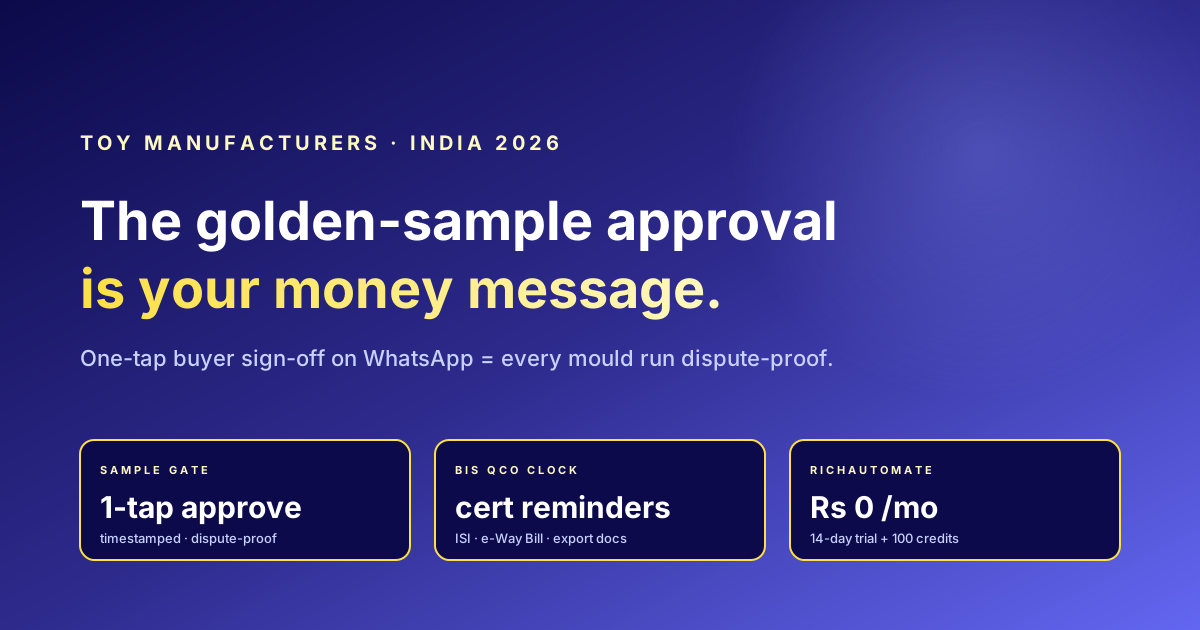
If you run a toy factory in India in 2026, the single most expensive message you send is the golden-sample approval — the photo of the physical first-off sample the buyer must sign off before you commit a mould run. Get a one-tap timestamped "approved" on WhatsApp and the batch is dispute-proof; rely on a verbal "haan, chalao" and a wrong colour, missing age-grade label, or off-spec joint means the whole run is scrapped at your cost. WhatsApp automation gives an Indian toy manufacturer exactly that: a documented sample-approval gate, BIS Toys QCO certificate-renewal reminders, e-Way Bill dispatch confirmations, and export-document collection — without adding headcount. This page maps the full order-to-dispatch lifecycle and where each automated message earns its keep. If you sell finished toys rather than make them, the buyer-side playbook is our WhatsApp for toy brands & retailers guide; if your line is plastic components, see injection-moulding & plastic processors.
Why 2026 Is Different for Indian Toy Makers
Two forces reshaped the trade. First, the Toys (Quality Control) Order made BIS/ISI marking mandatory for domestic sale and manufacture — every toy model must carry certification against Indian safety standards (IS 9873 series and IS 15644 for electric toys), verified by sample testing. Second, import curbs plus DPIIT's toy-cluster and PLI-style push turned dozens of small workshops into export-capable units overnight, chasing buyers in the Gulf, Africa, and Europe. Both changes mean a toy factory now lives or dies on documented approvals: a BIS licence tied to a specific model and sample, a buyer sign-off on that exact sample, and a paper trail on every dispatch. WhatsApp is where those approvals actually happen day to day — the buyer opens it in seconds when an email sits unread for a day.
None of this makes the phone-and-email way illegal; it makes it slow and dispute-prone. The margin leak in this trade is not the machine — it is the re-run caused by an approval nobody can prove was given. Every automated message below exists to close one such gap.
The Regulatory Spine (All Hedged — Verify Current Rules)
A toy manufacturer's compliance surface in 2026 is wider than most MSME owners expect. The playbook here treats WhatsApp strictly as a reminder and record layer — it never certifies compliance, never files anything, and never makes a safety claim on your behalf:
- BIS Toys (Quality Control) Order + ISI marking — mandatory certification per model against IS 9873 (mechanical/physical/flammability/chemical) and IS 15644 (electric toys). Licences and sample-test reports have renewal clocks worth reminding against. Verify current QCO scope and exemptions with BIS.
- Legal Metrology (Packaged Commodities) — declared MRP, net contents, manufacturer identity, and the mandatory age-grade and safety-warning labelling on the pack. A label error is a common rejection reason at the buyer's incoming-inspection.
- GST, e-invoicing, and e-Way Bill — for B2B dispatches above the threshold; the e-Way Bill number is the dispatch record buyers ask for.
- Plastic Waste Management Rules / EPR — for plastic-toy producers, extended-producer-responsibility obligations on packaging and material (hedged — scope varies by volume).
- DGFT / export documentation — IEC, country-of-destination safety marks (e.g. EN71/CE for the EU, ASTM for the US), and shipping docs where you export.
- DPDP Act 2023 — buyer contacts, order history, and any shared designs are personal/commercial data to be minimised and protected.
Treat every figure and rule as "verify current" — QCO scope, standards references, and thresholds change. The point is that each of these creates a dated event — a licence renewal, a label check, a dispatch record — and dated events are exactly what an automated reminder is good at.
The Money Message: The Sample-Approval Gate
In toy manufacturing the irreversible step is tooling and the first production run. Once a mould runs, a wrong Pantone shade, a mislabelled age grade, a sharp edge that fails the safety spec, or a missing ISI mark means the run is scrap — paid for by you, not the buyer, if you can't prove the buyer approved that exact sample. The fix is procedural, and WhatsApp makes it frictionless: photograph the physical golden sample (front, back, label, and the ISI/warning panel), send it in the buyer's thread with the model code and spec sheet, and require a one-tap "Approve" reply. That reply is timestamped, in the buyer's own chat, and impossible to later deny.
Get a 1-minute BSP audit on WhatsApp
Drop your WhatsApp number — we line-item your current invoice against Meta India rates in under 60 seconds. India-hosted, DPDP-compliant.
This one gate is the difference between a re-run absorbed at your cost and a re-run billed to the buyer who signed off. It is the same lever that works for glass processors and packaging makers — irreversibility makes the written approval genuinely expensive — but in toys it is compounded by the BIS angle: the approved sample is also the reference for the certified model, so keeping the approval and the ISI evidence in one thread doubles as a compliance record.
The Six-Stage Order-to-Dispatch Lifecycle
Here is where each automated message sits and what it protects:
- Enquiry & quotation. A structured intake Flow captures model, quantity, material, target age grade, and destination market, then returns an MOQ and quote — no more quotes lost in a WhatsApp scroll.
- Sample & artwork approval (the money message). Golden-sample photo + spec sheet + one-tap approval, versioned so the last-approved sample is always the reference. Scope change mid-run triggers a fresh re-approval.
- Production-status pushes. Moulding started, painting done, assembly, packing — short milestone pings keep the buyer warm and cut the "where is my order?" calls that eat your line supervisor's day.
- Dispatch with e-Way Bill + docs. Dispatch confirmation carries the e-Way Bill number, invoice, and (for exports) the packing list and safety-mark evidence, collected via a document Flow.
- Delivery & incoming-inspection. Proof-of-delivery and a prompt to confirm the buyer's incoming QC passed — surfacing a label or spec dispute in hours, not after the payment stalls.
- Reorder & certificate clock. Seasonal reorder nudges (Diwali/Rakhi/back-to-school peaks) plus an opt-in reminder when a BIS licence or test report approaches renewal, so a lapsed certificate never quietly blocks a dispatch.
The Carve-Outs (What the Bot Must Never Do)
Automation in a regulated manufacturing trade is defined as much by its limits as its features. In this playbook the bot never certifies BIS/ISI compliance or implies a toy is "safe" or "certified" on its own say-so; never starts a mould run before the sample approval is logged; never generates or interprets an e-Way Bill or GST document as advice; never shares one buyer's designs, samples, or pricing with another — buyer artwork and tooling designs are client IP under DPDP; and never markets to a contact who has not opted in. Certification, safety judgment, and statutory filing stay with your BIS-licensed process and your accountant; WhatsApp only carries the reminder and the record.
What It Costs on RichAutomate
RichAutomate ships the WhatsApp Business API connection and the software — shared inbox, visual Flow builder for the sample-approval and document flows, broadcasts for reorder campaigns, and template management — as one platform on the official Meta Cloud API v24, with ₹0 platform fee, ₹0 setup, and no monthly minimum. You pay only for usage on one of two transparent models:
- Client Pay — ₹0.10 per message. RichAutomate routes; Meta bills your own Meta Business Manager directly at wholesale, zero markup on Meta cost.
- SaaS Pay — all-inclusive. ₹1.20 per marketing conversation and ₹0.30 per utility/authentication conversation, Meta cost included, one GST invoice.
For a mid-size unit running 150–300 buyer conversations a month, that is a few hundred rupees against the cost of a single scrapped mould run — the math is not close. A 14-day free trial with 100 free credits lets you test the sample-approval Flow against your own buyers before paying; model your real conversation mix on the RichAutomate pricing page. One honest caveat that applies to every provider: WhatsApp messaging is governed by Meta's quality and policy rules — no BSP can promise "no ban", and opt-in discipline on broadcasts is how you stay in good standing. Going live on the official API in India also effectively requires GST for business verification — treat GST as required, not optional.
The Bottom Line
A toy factory's worst days are re-run days — a mould committed against an approval nobody can prove. Put the golden-sample sign-off, the BIS certificate clock, and the e-Way Bill dispatch record on WhatsApp, and you turn the trade's biggest margin leak into a timestamped, dispute-proof paper trail — while your buyers reply in seconds. Start with the 14-day free trial, build the sample-approval Flow once, and let it protect every run after that. If your line also makes leather goods for export, the leather-goods exporters playbook covers the same export-doc discipline for a neighbouring trade.
Related reading: WhatsApp for Uniform & Workwear Manufacturers 2026 walks through the same WhatsApp setup for a neighbouring use case.